
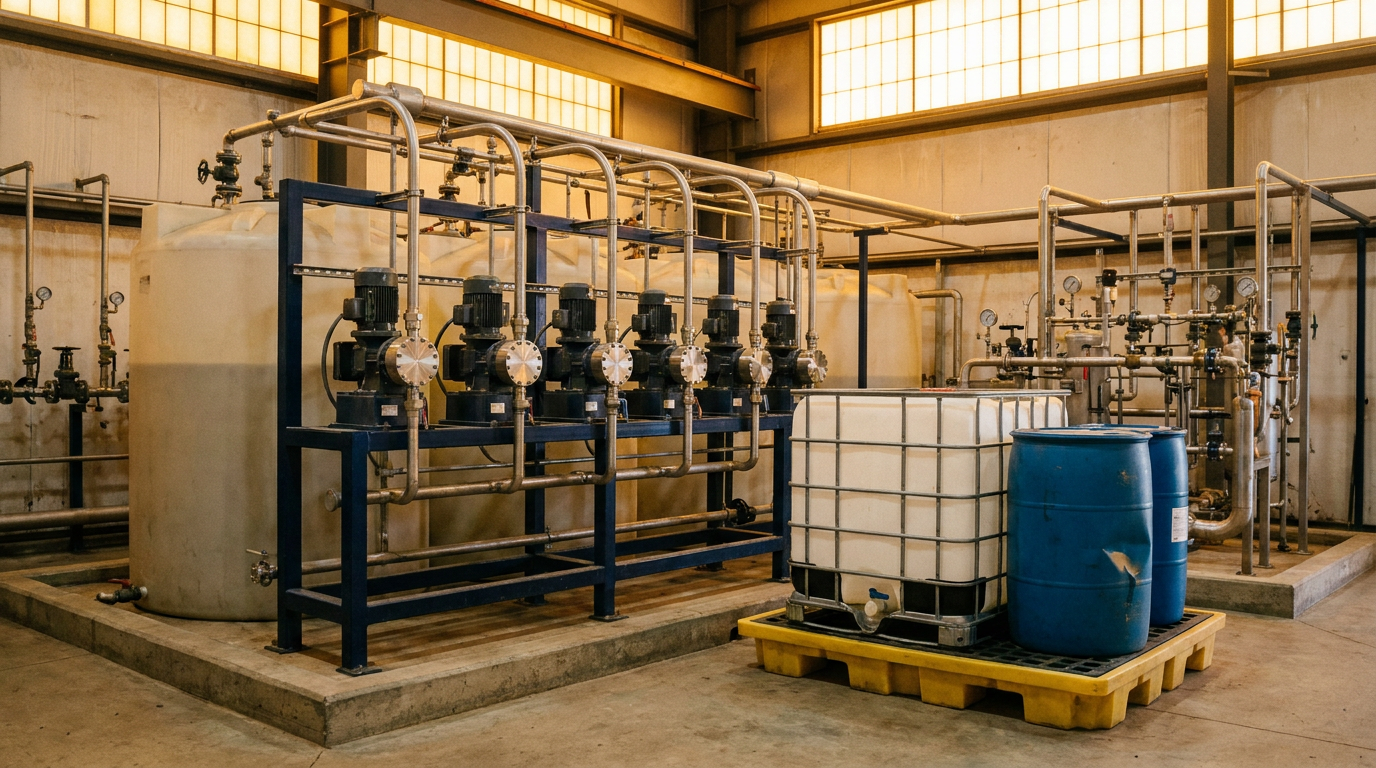
A plant does not buy “water treatment chemicals.” It buys a coagulant by the tanker, a polymer by the drum, a phosphonate by the tote, a biocide on a registered label, an acid and a base to hold pH, an antifoam, carbon, and a sulfite for the outfall. Eight families, eight specs, one purchasing desk. This page is written for that desk.
The short version: a water treatment chemicals supplier has to cover the whole program, hold each family to a grade the plant can verify on a Certificate of Analysis, ship in the format the feed system was built for, and put an SDS, TDS, and lot CoA on every delivery.
What does a water treatment chemicals supplier actually provide?
Four things.
Coverage of the program. A clarifier, a cooling tower, a boiler, and an outfall each need different chemistry, and a plant sourcing from six suppliers reconciles six CoA formats. We cover all eight families; the industrial water treatment hub maps the problems they solve.
A grade you can hold the lot to. “Alum” can mean liquid or dry, and the aluminum content differs. “Polyacrylamide” can be anionic, cationic, or nonionic, at a charge density and molecular weight that decide whether the floc settles. Published values are typical; the Certificate of Analysis for the lot governs. A supplier that cannot send a representative CoA before the PO is not ready to supply.
The right container. Coagulants and pH chemicals move in bulk or totes because they are tonnage items. Polymers, phosphonates, and biocides move in drums and totes because they dose in parts per million. Drums on a tonnage item cost you freight; bulk on a ppm item costs you shelf life.
Documentation. Safety Data Sheet (SDS), Technical Data Sheet (TDS), and lot CoA on every shipment, plus transport classification for anything hazardous. Drinking water plants add the additive certification their state primacy agency requires, commonly NSF/ANSI/CAN 60.
Recommendation: build the RFQ around the stage table, not a product list. It forces the grade and packaging questions to the front.
How to choose by treatment stage
| Treatment stage | Chemical family | Typical products | What to specify |
|---|---|---|---|
| Coagulation / clarification | Inorganic and organic coagulants | Aluminum sulfate, ferric sulfate, polyaluminum chloride, polyamine | Liquid or dry; metal content (Al2O3 or Fe basis); basicity for PAC; charge for polyamine |
| Flocculation / sludge dewatering | Polyacrylamide flocculants | Anionic, cationic, nonionic PAM (powder or emulsion) | Charge type and density; molecular weight class; powder vs emulsion; make-down capability on site |
| Scale control (cooling, boiler, RO) | Phosphonate antiscalants | HEDP, ATMP, PBTC and blends | Active phosphonate content; acid vs sodium-salt form; scaling species (carbonate, sulfate, silica) |
| Microbial control / disinfection | Oxidizing and non-oxidizing biocides | Chlorine dioxide, sodium hypochlorite, glutaraldehyde, CMIT/MIT | Registered use on the label (FIFRA); active content; drinking water vs cooling vs wastewater context |
| pH and alkalinity | Acids and bases | Sulfuric acid 93%, caustic soda beads or solution | Concentration; solid vs solution; compatibility with feed equipment |
| Foam control | Silicone antifoam emulsions | about 10% active silicone emulsions (higher-active by quote) | Active percent; dosing point; regulatory context where required |
| Adsorption / taste-odor / organics | Activated carbon | Granular (GAC) or powdered carbon | Base material; mesh size; adsorption indices on the CoA |
| Dechlorination | Sulfite reducing agents | Sodium metabisulfite, sodium bisulfite | Solid vs solution; assay; dosing basis against measured residual |
The column buyers skip is the last one. Every quote we cannot price in one pass is missing something from it.
The chemical families, by what they do
Coagulants: the tonnage item
Coagulants neutralize the charge on suspended solids so they can be gathered into floc. Three inorganic salts cover most plants, and the choice is a real trade-off. Aluminum sulfate (alum, CAS 10043-01-3) is the traditional municipal coagulant and the lowest cost per ton, but it consumes alkalinity and produces a voluminous hydroxide sludge. Ferric sulfate (CAS 10028-22-5) works over a wider pH range and is favored where phosphorus removal or sulfide control comes with the job.
Polyaluminum chloride (PAC, CAS 1327-41-9) is pre-hydrolyzed, so it consumes less alkalinity and typically leaves less sludge, at a higher price per ton that a jar test has to justify. Organic coagulants such as polyamine are cationic polymers used alone or alongside an inorganic salt to cut metal-salt dose and sludge. Mechanism and jar-test procedure are in coagulants vs flocculants.
Specify: liquid or dry, the metal-oxide or iron basis, and basicity for PAC. Recommendation: jar-test alum against PAC on your own raw water before switching; the sludge saving is site-specific.
Flocculants: polyacrylamide
Flocculants bridge neutralized particles into floc large enough to settle, float, or dewater. Nearly all of them are polyacrylamide (PAM, CAS 9003-05-8), sold as anionic, cationic, or nonionic grades in powder or emulsion form. Anionic PAM is the clarifier and mineral-slurry workhorse. Cationic polyacrylamide is what a wastewater plant buys for belt-press and centrifuge sludge conditioning, because biological sludge carries a negative surface charge.
The grade decision is charge type first, then charge density and molecular weight, and the wrong charge produces a wet cake and a polymer bill that keeps climbing. The full grade logic is on the polyacrylamide supplier page; the dewatering version is in PAM for sludge dewatering.
Specify: charge type and density, molecular weight class, powder or emulsion, and make-down capability. Recommendation: bench-screen two candidate grades before committing to a container load.
Antiscalants: phosphonates
Scale control in cooling towers, boilers, and reverse osmosis is phosphonate chemistry at parts-per-million doses. HEDP (CAS 2809-21-4, C2H8O7P2, PubChem CID 3305) is the general-purpose calcium carbonate inhibitor and the highest-volume phosphonate we move into this vertical; ATMP and PBTC cover the sulfate and high-stress cooling cases.
The phosphonate selection guide walks the choice; cooling tower and boiler water treatment show where each sits in a program.
Specify: active phosphonate content, acid or sodium-salt form, and the scaling species you are fighting. Recommendation: if phosphorus discharge limits apply at your outfall, say so in the RFQ; it changes which product we quote.
Biocides and oxidizers
Microbial control splits into oxidizing and non-oxidizing chemistry. Chlorine dioxide (ClO2, CAS 10049-04-4, MW 67.45, PubChem CID 24870) is a selective oxidant that does not form the chlorinated byproducts free chlorine does, which is why it is specified for biofilm control and drinking water disinfection. Its trade-off is the chlorite it leaves behind.
Under the National Primary Drinking Water Regulations, chlorine dioxide carries a maximum residual disinfectant level of 0.8 mg/L, chlorine and chloramines 4.0 mg/L, and chlorite a maximum contaminant level of 1.0 mg/L. Sodium hypochlorite (CAS 7681-52-9) is the lowest-cost oxidant and the default where the byproduct rules can be met.
Non-oxidizing biocides handle cooling loops and industrial systems where an oxidant would attack the inhibitor package: glutaraldehyde (CAS 111-30-8) and isothiazolinone (CMIT/MIT) are the two we are asked for most.
One rule governs all of them. A biocide sold for microbial control in the United States is a pesticide, and EPA requires every pesticide sold or distributed in the country to be registered under FIFRA. Registration is product-specific and use-specific: the label states the permitted use, and the buyer confirms that product and label match the job.
Specify: the system, active content, and the registered use you need on the label. Recommendation: for drinking water, ask for certification documents before the sample, not after.
pH adjusters: acid and base
Every program needs a pH lever. Sulfuric acid 93% (CAS 7664-93-9) is the standard acid for alkalinity reduction and neutralization because it is the lowest-cost proton per ton and ships in bulk.
On the base side, caustic soda beads (sodium hydroxide, CAS 1310-73-2) suit plants that store a solid and make down on site; solution grades suit plants with tank storage and a metering pump in place. The choice is a storage question more than a chemistry one.
Specify: concentration, solid or solution, and your storage and feed materials. Recommendation: confirm material compatibility before the first bulk delivery.
Defoamers and antifoams
Aeration basins, digesters, DAF units, and cooling tower basins foam, and the fix is a silicone antifoam emulsion (polydimethylsiloxane emulsion, CAS 63148-62-9) supplied at 10 to 50% active silicone. Higher active content means fewer drums and less water shipped; lower active content is easier to meter at low dose.
Specify: active percent, dosing point, and any regulatory context. Recommendation: trial the lowest active grade that holds the basin; move up only if the dose becomes hard to control.
Activated carbon
Activated carbon (CAS 7440-44-0) removes taste-and-odor compounds, dissolved organics, and residual oxidant by adsorption. Granular carbon (GAC) fills filter beds; powdered carbon is dosed ahead of clarification for seasonal events. It is a bulk-bag item, and the specification is the adsorption indices on the CoA, not the price per ton.
Specify: granular or powdered, base material, mesh size, and adsorption indices. Recommendation: buy against the index the filter was designed to, and reject lots that miss it.
Dechlorination
A permitted outfall usually has to remove the chlorine residual before discharge, and the standard reagent is a sulfite: sodium metabisulfite (SMBS, CAS 7681-57-4) as a solid, or sodium bisulfite solution for liquid feed. The same chemistry protects reverse osmosis membranes from oxidant damage upstream.
Specify: solid or solution, assay, and the residual you are dosing against. Recommendation: a plant already feeding bisulfite for RO protection can often standardize on one sulfite for both duties.
Bulk supply, grades and quality control
RawSource is a virtual distributor.
| Family | Usual packaging | On the Certificate of Analysis |
|---|---|---|
| Inorganic coagulants (alum, ferric, PAC) | Bulk tanker, totes/IBCs; dry grades in bags and super sacks | Metal content (Al2O3 or Fe basis), basicity (PAC), specific gravity, insolubles |
| Polyacrylamide flocculants | Bags and super sacks (powder); drums and totes (emulsion) | Charge type, ionic content, molecular weight class, moisture, residual monomer |
| Phosphonate antiscalants | Drums, totes/IBCs | Active content, phosphorous acid, pH, density, chloride |
| Biocides and oxidizers | Drums, totes/IBCs; ClO2 by precursor or generator feed | Active content, pH, density; registration and label documentation |
| Sulfuric acid, caustic soda | Bulk tanker, totes/IBCs; caustic beads in bags | Assay, iron, chloride, color |
| Silicone antifoam emulsions | Drums, totes/IBCs | Active silicone content, pH, viscosity, density |
| Activated carbon | Super sacks, bags | Iodine number and other adsorption indices, moisture, ash, mesh distribution |
| Sodium metabisulfite / bisulfite | Bags (solid), drums and totes (solution) | Assay as SO2 or Na2S2O5, iron, pH |
Typical values — Certificate of Analysis governs. Every value we publish is typical; the CoA for the lot you buy is the specification, and we send a representative CoA with the quote so the plant lab can compare it before the PO is cut. Each shipment carries the SDS, TDS, and lot CoA, plus DOT classification and packaging for hazardous families such as acids, caustic, and oxidizers.
Recommendation: send the plant’s CoA acceptance criteria per family with the RFQ. It removes a round-trip from every quote.
How to request a quote
Five items price a request in one pass:
1. Application and system. Municipal drinking water, municipal wastewater, industrial cooling, boiler, RO pretreatment, process water, or a formulated product you blend and resell. 2. Flow or dose basis. Monthly consumption per family, or plant flow with a target dose, so we quote the right container and cadence. 3. Grade. The CoA parameters that matter to you, per the table above, and any certification the plant or the state requires. 4. Packaging. Bulk, totes/IBCs, drums, bags, or super sacks, matched to your storage and feed system. 5. Delivery point and timing. Plant address, receiving constraints, and whether this is a one-time fill or a standing reorder.
Send those to the RawSource sourcing desk, or read the procurement guide for municipal and industrial systems first if you are building a program from scratch. Wastewater plants should also read wastewater treatment chemicals by stage.
Methodology and sources
This page was built from the eight chemical families that municipal and industrial plants reorder on the RawSource catalog, cross-checked against the live product page for each family on 2026-08-30. Chemical identities come from our master chemical data and PubChem. Drinking water limits are quoted from EPA’s National Primary Drinking Water Regulations, and the registration requirement from EPA’s FIFRA page.
Where a number could not be tied to a named authority, such as typical dose rates, it was left out. Producer names are omitted by policy. Nothing here claims that any RawSource product carries a specific certification or registration; those are documents a buyer requests and verifies.
Frequently asked questions
What is the difference between a water treatment chemicals supplier, distributor, and manufacturer? A manufacturer produces one or a few families. A distributor buys from several manufacturers and resells. A supplier is the commercial term for either.
Which chemicals are used in municipal drinking water treatment? A coagulant (alum, ferric sulfate, or polyaluminum chloride), a polymer aid, a disinfectant (sodium hypochlorite or chlorine dioxide), pH and alkalinity chemicals (sulfuric acid, caustic, lime, or soda ash), activated carbon for taste and odor, and a phosphonate or phosphate for corrosion and scale. Each is subject to the additive certification the state requires and to EPA’s disinfectant limits.
Which chemicals does an industrial wastewater plant buy? Coagulant and cationic polyacrylamide for clarification and sludge dewatering, acid and caustic for neutralization, an antifoam for the aeration basin, and a sulfite for dechlorination before the outfall. The permit sets the program; the stage table sets the spec.
What does “EPA compliant” mean for water treatment chemicals? Two different things. Biocides are pesticides and must be EPA-registered under FIFRA for the specific use on the label. Drinking water additives fall under EPA’s drinking water regulations and the additive certification a state primacy agency requires, commonly NSF/ANSI/CAN 60. Neither is a blanket property of “the chemical”; both are documents for a specific product and use that the buyer verifies.
What is the minimum order for bulk water treatment chemicals? It depends on the family. Coagulants and acids price best at tanker or container-load quantities; polymers, phosphonates, biocides, and antifoams are drum and tote items quoted at pallet quantities. Tell us your monthly consumption and we quote the container and cadence that fit.
What documentation comes with each shipment? A Safety Data Sheet, a Technical Data Sheet, and the lot Certificate of Analysis, plus DOT classification for hazardous families. For drinking water and biocide products, certification and registration documents are supplied for the specific product on request; the buyer confirms they match the intended use.
Editorial note. This page is general procurement and technical reference for industrial, municipal, and professional buyers and is not treatment, engineering, or regulatory advice. Chemical identities, regulatory limits, and registration requirements are sourced facts (PubChem, EPA) to verify through your own SDS, permit, state primacy agency, and qualified professionals. Products are for industrial and professional use only. Typical values are not a guaranteed specification; the Certificate of Analysis governs the material you buy. Nothing here states that any RawSource product carries a specific certification or registration. Always consult the current Safety Data Sheet before handling. RawSource makes no warranty, express or implied, and assumes no liability for use of this information.
Search 1,300+ industrial chemicals by name or CAS, or send us your spec — we quote by the drum, tote, or container.
Browse the Chemical Index → Request a Quote