
What is chlorine dioxide and what is it used for?
Chlorine dioxide (CAS 10049-04-4) is a selective, high-strength oxidizer and biocide. It is used mainly for ECF (elemental-chlorine-free) bleaching of kraft pulp, plus water-treatment oxidation and disinfection, taste- and odor-control, CIP and food-contact surface sanitation, and textile, flour and oil bleaching.
CHLORINE DIOXIDE- ▸ ECF pulp bleaching: Selective delignification of kraft pulp (dominant use)
- ▸ Water treatment: Oxidation, disinfection, and taste/odor control with low byproduct formation
- ▸ Sanitation: CIP, equipment, and food-contact surface disinfection
- ▸ Bleaching: Textile, flour, and fat/oil color removal
A grade-specific Safety Data Sheet (SDS) — with the complete hazard classification, handling precautions, and transport information — is supplied with every shipment and available on request. Confirm all safety and regulatory details against the SDS for your specific grade.
Request SDS →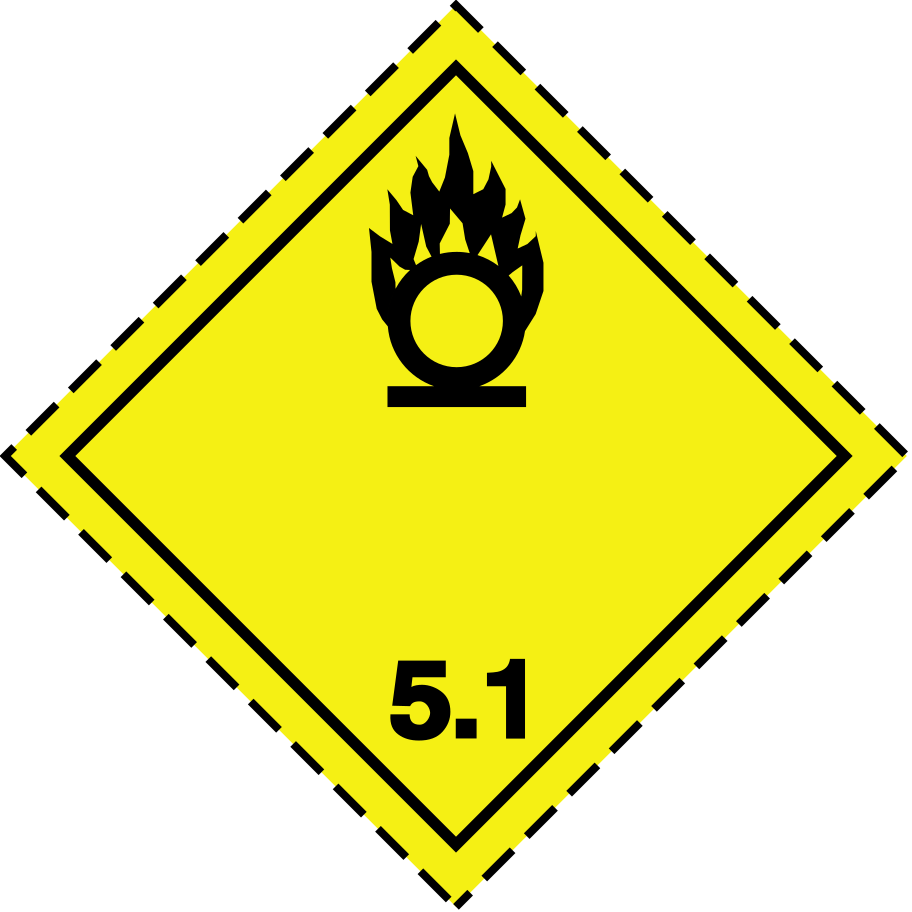
Transport classification per the UN Model Regulations / 49 CFR 172.101 Hazardous Materials Table. Confirm against the grade-specific SDS (Section 14) before shipping.
Chlorine dioxide (ClO2, CAS 10049-04-4) is a selective oxidizing agent valued where conventional chlorine chemistry creates more problems than it solves. It reacts as a dissolved gas through single-electron transfer rather than substitution, so it oxidizes target compounds (lignin, sulfides, iron and manganese, taste-and-odor organics, microorganisms) without chlorinating them. That distinction is the reason industry pays a premium for it: ClO2 bleaches and disinfects while generating far lower levels of chlorinated organic byproducts than elemental chlorine or hypochlorite. The catch is that it is unstable and cannot be shipped as a finished product at use concentration, which shapes how it is supplied and how you should plan a bulk program around it.
Typical Properties
Typical reference values, not a specification; the Certificate of Analysis (CoA) for the lot governs.
| Property | Typical Value |
|---|---|
| Chemical Name | Chlorine dioxide |
| CAS Number | 10049-04-4 |
| Molecular Formula | ClO2 |
| Molecular Weight | ~67.45 g/mol |
| Appearance | Yellow-green to reddish gas; handled as a dilute aqueous solution or generated on-site from precursors |
| Solubility | Soluble in water |
| Reactivity | Strong oxidizer — keep from combustibles/reducers; refer to the current SDS |
| Handling / storage | Per the current SDS and applicable regulations |
Regulatory & registration requirements
- TSCA (US):
- REACH (EU):
- EC number: 233-162-8
Source: EPA TSCA Inventory (July 2025 release) · ECHA CHEM — retrieved 2026-07-12
Applications by sector
ECF pulp bleaching (the dominant use)
The largest single market for chlorine dioxide is elemental-chlorine-free (ECF) bleaching of chemical wood pulp, where it delignifies and brightens kraft pulp in the later bleaching stages. Its high oxidation potential drives electron transfer at lignin’s electron-rich phenolic sites, cleaving chromophores and ether bonds while largely sparing the cellulose backbone. That selectivity protects the pulp viscosity, yield, and fiber strength that elemental chlorine degrades. The industry shift to ECF through the 1990s was driven by exactly this: replacing Cl2 with ClO2 sharply cut dioxin and furan formation and lowered adsorbable organic halogen (AOX) in mill effluent. ECF is not zero-AOX, so mills still balance ClO2 charge against effluent targets, but it remains the benchmark bleaching chemistry for high-brightness kraft.
Municipal and industrial water treatment
In drinking-water and process-water treatment, chlorine dioxide is used as a primary oxidant and disinfectant. It oxidizes iron and manganese for removal, destroys taste-and-odor compounds such as geosmin and MIB, and controls biofilm in cooling and process loops. Its defining water-treatment advantage is that it does not react with bromide or natural organic matter to form trihalomethanes the way free chlorine does, so it is often selected where regulated disinfection-byproduct limits are tight. It works across a wider pH band than hypochlorite and holds a residual, though its own byproduct — chlorite — is itself regulated, so dose control matters.
Hard-surface and equipment sanitation, food-contact
Chlorine dioxide is widely used for clean-in-place (CIP) sanitation, equipment and tank disinfection, and antimicrobial rinses in food and beverage processing. Because it works at low concentrations, leaves minimal residue, and is effective against biofilm, it suits process-water and food-contact surface applications where a clean rinse profile matters. Specific food-contact and antimicrobial uses are governed by EPA registration and FDA regulation — confirm the approved use, concentration, and contact conditions for your application.
Textile, flour, and fat/oil bleaching
Beyond pulp, ClO2 bleaches textiles, flour, and fats and oils, again exploiting selective oxidation of color bodies without the heavy chlorination of substitutive bleaches. These are smaller-volume uses than pulp or water, but they draw on the same chemistry: oxidize the chromophore, leave the substrate intact.
Forms and supply reality
Chlorine dioxide is thermally and photochemically unstable and explosive as a gas above roughly 10% by volume in air, so it is almost never transported or stored as concentrated finished product. In practice it reaches the point of use one of two ways. The dominant approach is on-site generation, where a generator combines precursors (most commonly sodium chlorite with an acid or with chlorine/hypochlorite) to produce a dilute ClO2 solution on demand at the application. The second route is the stabilized ClO2 solution: a dilute aqueous product, often chlorite-buffered, that releases active chlorine dioxide when activated, used where a packaged liquid is more practical than a generator.
So a bulk “chlorine dioxide” program is usually, in reality, a program for its precursor and generation chemistry. For most industrial buyers the bulk commodity is sodium chlorite (the chlorite feedstock) or a stabilized ClO2 solution, matched to an on-site generation system. RawSource sources around that reality rather than overstating shelf-stable supply of the gas itself.
Handling and safety
Chlorine dioxide is a strong oxidizer and is toxic by inhalation. The gas can decompose or explode violently at concentrations above roughly 10% v/v in air, reacts vigorously with organic materials and reducing agents, and causes severe skin and eye damage; thermal decomposition releases chlorine and corrosive vapors. Sodium chlorite precursor carries its own oxidizer hazard, particularly if a spill is allowed to dry on combustible material. These properties are what drive the on-site, low-concentration generation model and the engineering controls around it. Specific hazard statements, exposure limits, concentration limits, and transport classification are governed by the Safety Data Sheet and applicable regulations for the exact form supplied. Consult the current SDS before handling, storage, or transport.
Bulk supply from RawSource
RawSource sources chlorine dioxide chemistry in bulk for industrial buyers: stabilized ClO2 solutions and sodium chlorite precursor, in drums, totes, IBCs, and larger volumes against demand. Because the right form depends on your generation method, target concentration, application, and regulatory context, we quote on request rather than list fixed pricing or stock. Send your target concentration, form, volume, and application and we will return available options, lead time, and current pricing.
Reviewed and updated July 2026 by the RawSource technical team.
Chlorine dioxide is a selective oxidizing biocide (ClO2, CAS 10049-04-4), generated on site or supplied as stabilized solution, used in ECF pulp bleaching, industrial water treatment, and food-plant sanitation.
Solutions Using This Product
Process-solution guides on this site that specify this chemistry:
- Microbiological Control in Cooling Water Systems (Water Treatment)
Frequently Asked Questions
What is another name for chlorine dioxide?
Chlorine dioxide is the standard name for the compound with formula ClO2 and CAS 10049-04-4. It appears in older literature as chlorine(IV) oxide or chlorine peroxide. RawSource supplies it under its standard chemical identity, typically as a stabilized ClO2 solution or via its sodium chlorite precursor for on-site generation.
What is chlorine dioxide used for in industry?
Its dominant industrial use is as the selective oxidant in elemental-chlorine-free (ECF) bleaching of wood pulp. It is also used in municipal and industrial water treatment for disinfection, iron and manganese removal, and taste-and-odor control; in equipment, hard-surface, and food-contact sanitation; and in bleaching textiles, flour, fats, and oils.
Why use chlorine dioxide instead of chlorine?
Chlorine dioxide oxidizes by electron transfer rather than substitution, so it bleaches and disinfects without chlorinating the substrate. Compared with elemental chlorine, it forms far lower levels of chlorinated organic byproducts — including dioxins, furans, and trihalomethanes — and is more selective for lignin in pulp bleaching, protecting cellulose strength. That selectivity and cleaner byproduct profile are why it is chosen where conventional chlorine chemistry creates problems.
Why is chlorine dioxide generated on site instead of shipped?
Chlorine dioxide is unstable and explosive as a concentrated gas, so it is not transported or stored at use strength as a finished product. It is generated on demand at the point of use — most commonly from a sodium chlorite precursor reacted with acid or chlorine — or supplied as a dilute stabilized solution. For bulk programs this means the commodity purchased is usually the precursor chemistry or a stabilized solution matched to a generation system.
How does RawSource supply bulk chlorine dioxide, and what does it cost?
RawSource sources chlorine dioxide chemistry in bulk — stabilized ClO2 solutions and sodium chlorite precursor — in drums, totes, IBCs, and larger volumes. Because form, concentration, packaging, and regulatory fit vary by application, we quote industrial quantities directly rather than listing a fixed price. Send your target concentration, form, volume, and application, and we will return available options, lead time, and current pricing.
What are the disadvantages of chlorine dioxide?
The main disadvantages are logistical and regulatory. Chlorine dioxide gas is explosive above 10 percent concentration in air, so it cannot ship at use strength; plants buy precursors and generate it on site, which adds equipment cost. Its residual decays faster than chlorine or chloramine residuals, and it reduces predominantly to chlorite, a regulated byproduct capped at 1.0 mg/L in US drinking water (40 CFR 141.64). Dose control and residual monitoring are therefore mandatory line items.
What are the dangers of chlorine dioxide?
In industrial settings the dangers are inhalation exposure and oxidizer reactivity. OSHA caps workplace exposure at 0.1 ppm (0.3 mg/m³) as an 8-hour average, and NIOSH lists 5 ppm as immediately dangerous to life or health. The gas is explosive at concentrations above 10 percent in air and reacts vigorously with organic materials and reducing agents. Plants manage these hazards by generating dilute solution on site, monitoring air, and following the SDS for the form supplied.
What is stabilized chlorine dioxide?
Stabilized chlorine dioxide is a dilute aqueous product, typically chlorite-buffered, that releases active ClO2 when activated, usually with an acid. It is the packaged alternative to on-site generation: buyers who cannot justify a generator dose the stabilized solution at points of use. For bulk programs it competes with sodium chlorite precursor plus a generator, and the right choice depends on dose rate, duty cycle, and the regulatory status of the application.
How does chlorine dioxide remove odors?
It oxidizes the odor compound instead of masking it. Chlorine dioxide functions as an oxidant by single-electron transfer, and in water systems it is applied for taste-and-odor control and to oxidize dissolved iron and manganese. An EPA issue paper lists taste-and-odor control among the main reasons an estimated 700 to 900 US water systems apply it. The same oxidation chemistry drives odor control in industrial process water and food-plant sanitation loops, where masking fragrances are unacceptable.
What is the REACH and TSCA regulatory status of Chlorine Dioxide?
Chlorine Dioxide (CAS 10049-04-4) is subject to U.S. TSCA Inventory requirements; supplying it into the EU requires valid REACH registration ((EC) No 1907/2006). RawSource cannot verify a third-party supplier's registrations — buyers should require documented TSCA and REACH compliance for their jurisdiction and volume (EC 233-162-8).
What is the molecular formula of Chlorine Dioxide?
The molecular formula of Chlorine Dioxide is ClO2.
What is the molecular weight of Chlorine Dioxide?
The molecular weight of Chlorine Dioxide is 67.45 g/mol (PubChem).
What is the CAS number of Chlorine Dioxide?
The CAS number of Chlorine Dioxide is 10049-04-4.