
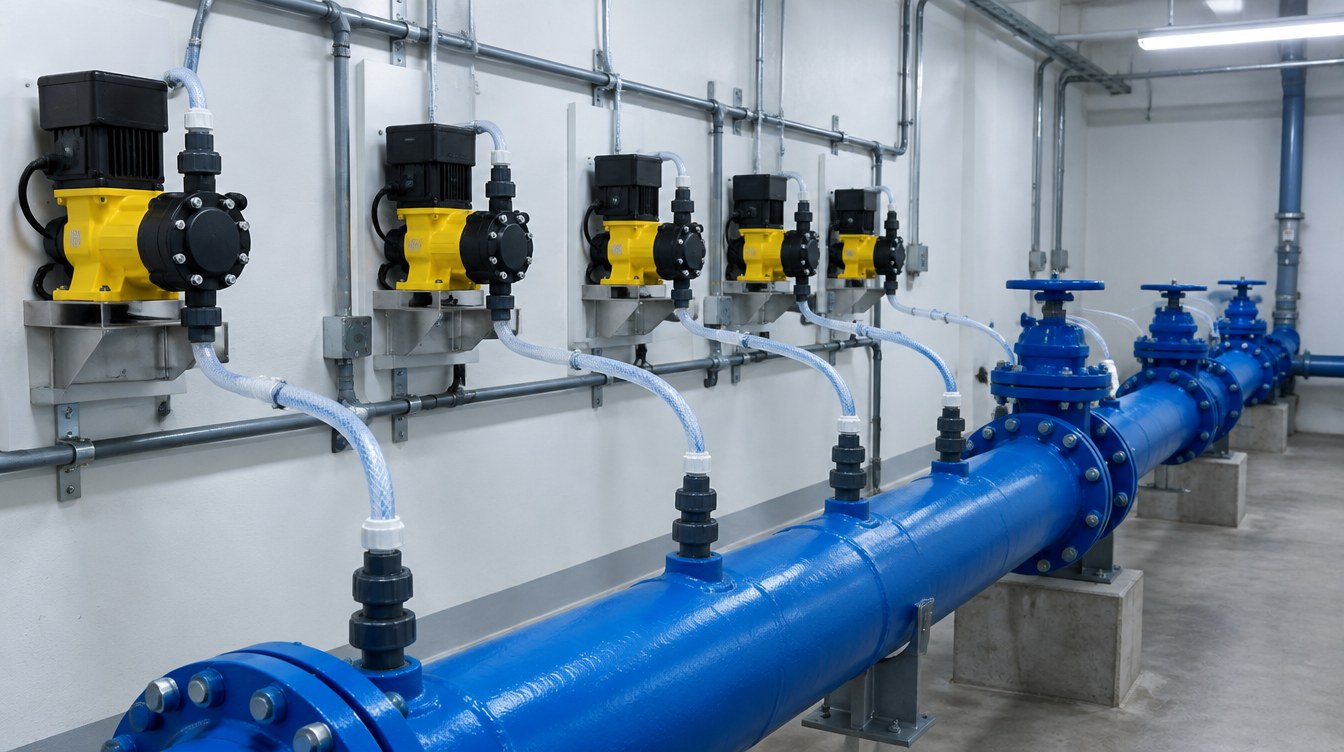
The quote for your chlorine dioxide system lists assay, strength and price. One number your plant answers for is not on it: chlorite, the by-product, has its own US limit of 1.0 mg/L under 40 CFR 141.64 (eCFR, up to date as of 2026-10-07). The pattern runs through drinking water treatment chemicals. Alum and aluminum chlorohydrate are watched for the aluminum they leave, polyacrylamide for its monomer, a fluoridation acid for fluoride. Industrial cooling-water and wastewater treatment chemicals are bought against a lab or jar test instead.
Water treatment chemicals are the coagulants, flocculants, disinfectants, pH and corrosion-control chemicals, scale and copper inhibitors and sludge polymers that a plant doses to treat drinking water, protect an industrial cooling loop or clean wastewater before discharge. Which one you buy, and the number it is judged on, depends on that job.
So what chemicals are used in water treatment? Sorted by job, coagulants destabilize particles so they settle: aluminum sulfate, ferric chloride, polyaluminum chloride, aluminum chlorohydrate (ACH) and polyDADMAC. Disinfectants include sodium hypochlorite, chlorine, chloramines, chlorine dioxide and ozone. Fluoridation adds a fluoride source. Corrosion control uses caustic soda, lime, soda ash, phosphoric acid and silicate; sodium hexametaphosphate is bought mainly to sequester iron and manganese. Industrial cooling water takes phosphonate inhibitors such as phosphonobutane tricarboxylic acid, plus azoles for copper. Wastewater takes metal salts, polymers and sodium bisulfite for dechlorination.
Water treatment chemicals by job, and the number each is bought against
US rules: eCFR title 40, up to date as of 2026-10-07. Study figures are scoped below.
| Job | Chemistries compared | Bought against (rule or test) |
|---|---|---|
| Coagulation, drinking water | aluminum sulfate, ferric chloride, polyaluminum chloride, aluminum chlorohydrate | Jar-tested turbidity, then residual metal: aluminum 0.05 to 0.2 mg/L, iron 0.3 mg/L, secondary goals (40 CFR 143.3) |
| Polymer flocculant aid | polyacrylamide | 0.05% acrylamide dosed at 1 ppm, or equivalent (40 CFR 141.111) |
| Disinfection residual | chlorine or sodium hypochlorite; chloramines; chlorine dioxide | MRDL 4.0 mg/L as Cl2; 4.0 mg/L as Cl2; 0.8 mg/L as ClO2 (40 CFR 141.65) |
| Disinfection by-products | chlorine dioxide; ozone; chlorine | Chlorite 1.0 mg/L; bromate 0.010 mg/L; TTHM 0.080 mg/L, HAA5 0.060 mg/L (40 CFR 141.64) |
| Fluoridation | fluorosilicic acid, sodium fluorosilicate, sodium fluoride | Fluoride 4.0 mg/L, community water systems (40 CFR 141.62); 2.0 mg/L secondary goal (40 CFR 143.3) |
| Corrosion control | caustic soda, lime, soda ash, phosphoric acid, silicate | If State-designated: pH at least 7.0; where orthophosphate is used, tap orthophosphate at least 0.5 or 1.0 mg/L as PO4 (40 CFR 141.82(f)) |
| Cooling-water scale | PBTC, HEDP | Calcium tolerance, ppm of actives per 1000 ppm calcium as CaCO3: PBTC 185, HEDP 8 (2005 lab study, 54 °C, pH 9.00) |
| Phosphorus removal, wastewater | ferric chloride, aluminum sulfate, ferrous sulfate | Dose for 90% total phosphorus removal: 30.01 mg/l ferric chloride, 41.05 mg/l aluminum sulfate (2024 jar study) |
| Sludge dewatering | polymer flocculants and coagulants | Roughly 5 to 15 g of chemical per kg total solids input, combined (2023 review) |
Every drinking-water number in that column is about something the chemical leaves in the water: a residual, a by-product, aluminum, monomer, fluoride, orthophosphate at the tap. None names the delivered product, though the polyacrylamide rule reaches it by capping residual monomer times dose. In the EU, Article 12 of Directive (EU) 2020/2184 (OJ L 435, 23.12.2020) also has the purity of treatment chemicals assessed against European standards.
Write the specification the same way. Ask for residual acrylamide on every polyacrylamide certificate of analysis (CoA), the chlorite a chlorine dioxide system forms, and the aluminum a coagulant leaves as well as the turbidity it reaches.
Drinking water coagulants: jar-test the dose, specify the residual
The article on flocculation in water treatment covers the jar test and mixing; here is what a buyer compares. EPA’s Enhanced Coagulation and Enhanced Precipitative Softening Guidance Manual (EPA 815-R-99-012, May 1999) explains that aluminum and iron salts, such as aluminum sulfate and ferric chloride, work as primary coagulants because they are trivalent.
Doses differ on the same water. In a 2021 jar study on Malaysian river and plant waters (Int. J. Environ. Res. Public Health 18(17):9164), water at 130.3 NTU and pH 6.80 needed 20 mg/L of aluminum sulfate (alum) to reach 5 NTU. Polyaluminum chloride needed 10 mg/L, and aluminum chlorohydrate (ACH) did it at 5 mg/L. Convert each dose to one basis, product or aluminum delivered, before the comparison goes into a quote.
40 CFR 143.3 (eCFR, up to date as of 2026-10-07) lists secondary levels of 0.05 to 0.2 mg/L for aluminum and 0.3 mg/L for iron, goals that States may set higher or lower. Directive (EU) 2020/2184 (OJ L 435, 23.12.2020) lists aluminum at 200 μg/l, an indicator for monitoring.
Polymer aids are capped through their monomer. 40 CFR 141.111 (eCFR, 2026-10-07) limits polyacrylamide dose times monomer to 0.05% acrylamide dosed at 1 ppm, or equivalent. Read as arithmetic, a lower monomer figure on the CoA leaves more dose headroom.
Which number binds a disinfectant, the residual or the by-product?
40 CFR 141.65 (eCFR, up to date as of 2026-10-07) sets maximum residual disinfectant levels (MRDLs) for community and non-transient non-community water systems of 4.0 mg/L for chlorine and for chloramines, both as Cl2, and 0.8 mg/L for chlorine dioxide, as ClO2; the chlorine dioxide MRDL also binds transient non-community Subpart H systems that use it. Put the basis in the contract: a residual on another basis is a different number.
The by-product limits in 40 CFR 141.64 (eCFR, 2026-10-07) are chlorite at 1.0 mg/L, bromate at 0.010 mg/L, total trihalomethanes (TTHM) at 0.080 mg/L and five haloacetic acids (HAA5) at 0.060 mg/L, the last two as running annual averages. The same section lists best available technologies that are process choices: ozone control for bromate, lower disinfectant demand and levels for chlorite, and enhanced coagulation or softening, or granular activated carbon, for TTHM and HAA5. The coagulant order is a by-product decision too.
Under 40 CFR 141.135 (eCFR, 2026-10-07), Subpart H systems using conventional filtration must remove TOC by enhanced coagulation or softening unless an alternative criterion applies: for the Step 1 band of source-water TOC more than 2.0 and up to 4.0 mg/L, 35.0, 25.0 or 15.0 percent as alkalinity rises through 0 to 60, more than 60 to 120 and more than 120 mg/L as CaCO3, measured from source water to combined filter effluent.
Directive (EU) 2020/2184 (OJ L 435, 23.12.2020) sets parametric values of 10 μg/l for bromate, 100 μg/l for total trihalomethanes and 60 μg/l for five haloacetic acids. Under the same Directive, chlorate and chlorite are each 0.25 mg/l, or 0.70 mg/l where a disinfection method that generates them, in particular chlorine dioxide, is used. Its Article 25 gave Member States until 12 January 2026 to comply on chlorate, chlorite and haloacetic acids.
The Directive’s notes have chlorate, chlorite and haloacetic acids measured only where the disinfection method can generate them, and ask Member States to strive for lower trihalomethane and chlorate values where possible without compromising disinfection.
A reading, not the text, for EU buyers of sodium hypochlorite: if your hypochlorite contributes chlorate, chlorate is a fair line on the certificate. Article 9(3)(d) of the Directive asks that by-product contamination be kept as low as possible without compromising disinfection, and contamination from treatment chemicals as low as possible; Article 12, covered below, adds a purity assessment for the chemicals themselves.
Fluoridation: the rule names the ion, not the product
Fluoridation chemicals (fluorosilicic acid, sodium fluorosilicate, sodium fluoride) are bought as an acid or salt and regulated as fluoride. Under 40 CFR 141.62 (eCFR, up to date as of 2026-10-07), the fluoride maximum contaminant level of 4.0 mg/L applies only to community water systems. 40 CFR 143.3 (eCFR, 2026-10-07) adds a secondary level of 2.0 mg/L, a goal that States may set higher or lower.
Directive (EU) 2020/2184 (OJ L 435, 23.12.2020) sets fluoride at 1.5 mg/l, and its Article 12 has the purity of treatment chemicals assessed against relevant European standards for specific treatment chemicals. In the EU, ask which standard the lot was assessed against.
Corrosion control: what 40 CFR 141.82 has a system evaluate
Under 40 CFR 141.82(c)(1) (eCFR, up to date as of 2026-10-07; text as published at 89 FR 86631, Oct. 30, 2024), a system without corrosion control treatment that must study it evaluates alkalinity and pH adjustment, an orthophosphate- or silicate-based inhibitor, and orthophosphate residuals of 1 mg/L and 3 mg/L as PO4. Confirm which compliance date applies to your system.
Once a State designates optimal parameters, 40 CFR 141.82(f) sets floors, unless the State finds them infeasible or unnecessary: a distribution-system pH of at least 7.0 and, where orthophosphate is used, tap orthophosphate of at least 0.5 mg/L as PO4, or 1.0 mg/L where treatment existed before.
EPA’s corrosion control technical recommendations (EPA 816-B-16-003, March 2016) bind no one but give working targets. For orthophosphate, the reference point is 0.33 to 1.0 mg/L as P, or 1.0 to 3.0 mg/L as PO4, at the tap at pH 7.2 to 7.8, and it is not a minimum. For pH adjustment: 8.8 to 10 for lead, as low as 7.8 for copper alone.
Watch the basis. The 2016 guidance notes that 3 mg/L as PO4 is roughly 1 mg/L as P. Orthophosphate comes as phosphoric acid, commonly 36 to 85 percent, as sodium or potassium salts, or as zinc orthophosphate. Price it per kilogram of PO4 delivered, not per kilogram of product.
Your coagulant can raise this bill. The 2016 guidance says higher orthophosphate doses, 1.0 to 1.2 mg/L as P or 3 to 3.5 mg/L PO4 and higher, may be needed where alum coagulation carries aluminum over, among other cases.
pH chemicals differ in what each milligram buys. Exhibit 3.1 of the 2016 guidance lists the alkalinity each mg/L of chemical adds: 1.25 mg/L as CaCO3 for caustic soda, 1.35 for hydrated lime, 0.94 for soda ash and 0.60 for sodium bicarbonate. Compare quotes per unit of alkalinity delivered, after assay, not per ton.
Sequestrants are a separate purchase. The 2016 guidance says polyphosphates, sodium hexametaphosphate among them, mainly sequester iron and manganese, may raise lead and copper measured at the tap, and are generally not effective alone for lead and copper control. Swapping orthophosphate for sodium hexametaphosphate changes the corrosion program, not just the line item.
Industrial water treatment chemicals for cooling: choose the phosphonate on calcium and chlorine, then on price
In a recirculating cooling tower, the scale inhibitor is bought against the water it has to survive. A 2005 laboratory study (Bioinorganic Chemistry and Applications 3(3-4):135) compared phosphonobutane tricarboxylic acid (PBTC) with hydroxyethylidene diphosphonic acid (HEDP) and amino-tris-methylene phosphonate.
The first test is calcium. At 54 °C and pH 9.00, PBTC stayed soluble up to 185 ppm of actives per 1000 ppm of calcium (as CaCO3) before a calcium-inhibitor salt began to precipitate. The aminomethylene phosphonate managed 12 ppm and HEDP 8 ppm. The authors note that this calcium tolerance usually falls as pH rises and matters most at high cycles of concentration.
The second test is the oxidizing biocide, such as sodium hypochlorite. The authors state that HEDP and the aminomethylene phosphonates are open to oxidation by halogen biocides, and that the orthophosphate formed can cause calcium phosphate scale. PBTC showed no appreciable decomposition with either halogen at 5 ppm (as Cl2 or Br2), a dose the authors put on the high side for cooling water, after 1 h at 25 °C and pH 8.3.
So the order is calcium tolerance at your cycles and pH, then stability against your biocide, then price per kilogram of actives. An HEDP quote that wins on price still carries a tolerance of 8 ppm, against 185 ppm for phosphonobutane tricarboxylic acid in that test. Even PBTC has limits. In water modelling runaway cycles (pH 9.0, 43 °C), 15, 30 and 60 ppm of actives inhibited calcium carbonate formation by about 35 %, 40 % and 44 %. Doubling the dose from 30 ppm bought four percentage points.
Copper needs its own inhibitor, an azole such as benzotriazole (BTA), and its study numbers come from closed fire sprinkler copper tubes, not cooling water. In that 2023 study (Heliyon 9(12):e23104), efficiency at 200 ppm fell from 90 % in synthetic tap water at pH 7.1 to 48 % in a simulated pit at pH 0.25. Injected after pits formed, it could not stop corrosion inside them; the study’s lesson is to protect copper before pits form.
Wastewater treatment chemicals: phosphorus removal and dewatering are bought by dose
A 2024 jar study (Scientific Reports 14:4918) used effluent from a pilot-scale bio-filter that the authors take to represent biologically treated urban sewage, at 0.519 mg/l total phosphorus. For 90% total phosphorus removal, the optimal doses were 30.01 mg/l of ferric chloride, 25.43 mg/l of ferrous sulfate and 41.05 mg/l of aluminum sulfate; a ferrous sulfate and aluminum sulfate composite needed 18.25 mg/l.
The salts were analytical grade, dosed in mg/l as reported, so convert a commercial liquid coagulant through its assay before these figures go into a quote.
Sludge conditioning is priced the same way. A 2023 review of 55 sewage-sludge dewatering datasets from 2003 to 2021 (Waste Management & Research 41:1081) gives a rough 5 to 15 g of chemical agent per kg of total solids (TS) input. That counts flocculants and coagulants together, use appears higher after anaerobic digestion, and the authors call the data scarce. Ask for trial results in grams per kg TS, so a low price that needs a high dose shows up as the higher cost.
Other water treatment chemicals and their jobs
Glutaraldehyde is a non-oxidizing biocide, silicone antifoams control foam in wastewater, and sodium bisulfite removes residual chlorine before discharge. In drinking water, 40 CFR 141.64 names granular activated carbon among the best available technologies for TTHM and HAA5.
Methodology: rules are from the eCFR (title 40, up to date as of 2026-10-07) and Directive (EU) 2020/2184 (OJ L 435, 23.12.2020), guidance from EPA 815-R-99-012 (May 1999) and EPA 816-B-16-003 (March 2016), and dose figures from open-access studies scoped to their test. Identities are from PubChem (aluminum sulfate, ferric chloride, sodium hypochlorite, chlorine dioxide, HEDP, PBTC, benzotriazole). For handling and hazards, check the current safety data sheet (SDS) for the grade and lot.
Frequently asked questions
What chemicals are used in water treatment and water purification?
Is there a US limit on the polymers used in drinking water treatment?
How do you compare industrial water treatment chemicals from different suppliers?
What chemicals are used in wastewater treatment?
What is the difference between a coagulant and a flocculant?
Sources & methodology
Figures are RawSource sourcing data unless attributed to a named source. Regulatory citations are current as of publication. Chemical identities verified by CAS number against the RawSource catalog.
Search 1,300+ industrial chemicals by name or CAS, or send us your spec — we quote by the drum, tote, or container.
Browse the Chemical Index → Request a Quote