
If every silicone antifoam shares CAS 63148-62-9, which grade do you actually need?
One is a silicone-in-water emulsion built on a 1,000 cSt base oil. Another is a neat silicone compound at 60,000 cSt. The third is a food-grade simethicone emulsion with an FDA letter on file. All three suppliers are technically correct. The CAS number matches. Only one of these drums will work in your aeration basin, and the other two could shut it down.
CAS 63148-62-9 is a Chemical Abstracts Service registry entry for the linear polydimethylsiloxane polymer family. Silicone oil grades listed under the related CAS 9006-65-9 on rawsource.com span 5, 10, 50, 100, 350, 1,000, 10,000, 12,500, 60,000, 100,000, and 500,000 cSt; antifoam and silicone fluid products listed under CAS 63148-62-9 include formulations such as the 60,000 cSt fluid. The CAS number covers neat fluids and dilute emulsions, food-contact and industrial-only products. It tells you the backbone chemistry.
It tells you nothing about whether the drum you receive will collapse foam in an activated-sludge basin or poison the biomass trying.
Regulatory status: three agencies, three orthogonal gates
The CAS registry groups all linear PDMS under one number regardless of chain length or formulation. FDA, NSF, and EPA each impose constraints that CAS does not encode. Those constraints operate independently of one another.
TSCA. CAS 63148-62-9 appears on the EPA TSCA Inventory as polydimethylsiloxane (generic). As of November 2026, no Significant New Use Rule (SNUR) applies specifically to CAS 63148-62-9 for linear PDMS polymer. Note that cyclic siloxane byproducts (D4, D5) present as residuals in PDMS products may be subject to separate regulatory actions. Confirm current TSCA status with counsel before relying on this summary.
REACH. Under EC Regulation No. 1907/2006, PDMS is registered broadly. No Annex XVII restriction or SVHC designation currently applies to unmodified PDMS.
FDA. Here the gates narrow. 21 CFR 173.340 permits dimethylpolysiloxane as a defoaming agent in food processing, capped at 10 ppm in the finished food. A technical-grade wastewater antifoam will not carry this clearance. If you are sourcing for a fermenter producing a food ingredient, the CoA must reference 173.340 compliance and the purity requirements that clearance demands.
NSF/ANSI 60. If treated effluent feeds a potable water reuse loop, the antifoam must be NSF/ANSI 60 listed as a drinking water treatment chemical. This is a product-specific listing, not a blanket CAS approval. Confirm the listing covers the exact product, not just the manufacturer’s portfolio.
EPA emissions monitoring. For refinery and chemical plant applications, 40 CFR Parts 60 and 63 govern emissions from stationary sources. The principle applies broadly: monitoring acceptance criteria define what the regulator measures, not which CAS number the additive carries. If your antifoam volatilizes in a coker drum and shows up in a stack test, the problem is the grade’s thermal stability, not its registry number.
What separates a wastewater antifoam from a food-grade or refinery grade?
The table below shows how one CAS number maps to products that differ by orders of magnitude in viscosity, and by entirely different regulatory clearances. Viscosity grades are those named on rawsource.com product pages.
| Parameter | Wastewater Aeration | Food / Fermentation | Delayed Coker / Refinery |
|---|---|---|---|
| Typical base-fluid viscosity grade | 1,000 – 12,500 cSt | 350 – 1,000 cSt | 60,000+ cSt |
| Emulsion type | Silicone-in-water (oil-in-water) | Silicone-in-water or neat simethicone | Neat or high-temperature emulsion |
| Required approval / listing | NSF/ANSI 60 if potable reuse | FDA 21 CFR 173.340 (10 ppm max in food) | Refinery vendor qualification; no food-grade needed |
| Downstream sensitivity | Activated sludge biomass | Residual cyclics (D4/D5) in product | Catalyst bed fouling |
Every row in that table is invisible on a CoA that lists only CAS 63148-62-9.
Why this chemistry works in an aeration basin
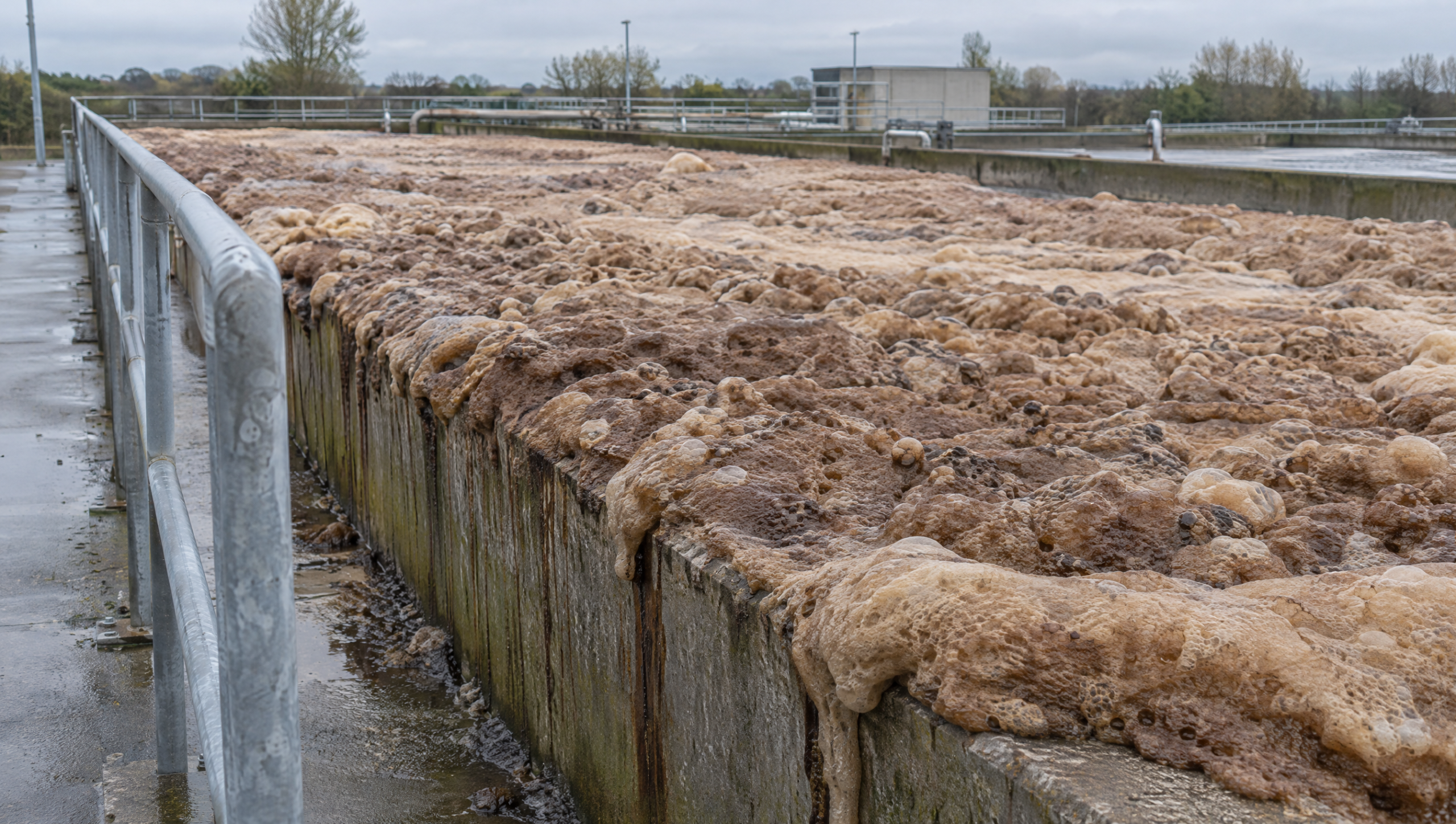
Foam in an activated-sludge aeration basin is stabilized by biosurfactants, filamentous bacteria (Nocardia, Microthrix), and fine suspended solids. The foam is persistent because the stabilizing agents regenerate continuously.
PDMS antifoams work by a spreading-entry mechanism: silicone droplets spread across the foam lamella, thinning it until the film ruptures. The silicone-in-water emulsion format matters because it disperses across the basin surface without requiring mechanical mixing beyond what the aeration diffusers already provide. A neat fluid, by contrast, sits as an undispersed lens on the surface and can coat activated-sludge floc, reducing oxygen transfer efficiency rather than solving the foam problem.
The base-fluid viscosity determines how quickly the silicone spreads and how persistent the knockdown is. Lower viscosity grades (the 1,000 cSt range) spread faster but re-dosing frequency increases. Higher viscosity grades (10,000 – 12,500 cSt, per rawsource.com product grades) give longer persistence but slower initial knockdown. The right grade depends on your basin’s hydraulic retention time and surface loading rate. There is no universal answer; the effective dose is set by trial against your specific foam profile.
The genuine trade-off: silicone antifoam is more persistent than many organic defoamers, but it is also harder to biodegrade. In systems where the final effluent must meet strict total organic silicon limits, or where downstream membrane bioreactor (MBR) units are sensitive to silicone fouling, the advantage of persistence becomes a liability. The choice between silicone and organic antifoam is not settled by chemistry alone. It is settled by what sits downstream of the dosing point.
What should you verify before qualifying a new antifoam source?
Match the spec, not the CAS. Before requesting quotes, define at minimum these five parameters: (1) base-fluid viscosity measured per ASTM D445, (2) active silicone content as a weight percentage, (3) emulsion type (oil-in-water, water-in-oil, or neat), (4) the specific regulatory listing required (FDA 21 CFR 173.340, NSF/ANSI 60, or neither), and (5) the maximum operating temperature for your process.
Check the CoA against your filing. Some manufacturers register PDMS under CAS 9006-65-9 (trimethylsiloxy-terminated) rather than 63148-62-9. The backbone chemistry is the same. If the CoA states one and your import documentation the other, the lot gets flagged. Confirm CAS alignment before the first shipment.
Compare consecutive lots. Request CoAs from at least three consecutive production lots. If viscosity drifts outside the tolerance band stated on the initial qualification sample, flag the supplier before committing volume.
Confirm the listing, not the claim. For NSF/ANSI 60, the listing is product-specific and searchable in the NSF database. A supplier claiming “NSF-60 compliant” without a searchable listing number has not met the bar. For FDA 21 CFR 173.340, the supplier should provide documentation demonstrating compliance with the 10 ppm limit in the food matrix, not just a statement that the base fluid is food-grade.
Import duty. Silicones in primary forms (HTS 3910.00) carry a general MFN rate of 3% ad valorem before Chapter 99 additions (USITC, as of November 2026). Formulated emulsions may classify under HTS 3824.99 at a different duty rate. The classification turns on whether customs views the product as a silicone in primary form or a prepared antifoam preparation. Confirm with your broker using the actual formulation data, not the CAS number.
| Buyer Question | Spec Parameter It Resolves | Why CAS Alone Fails |
|---|---|---|
| What viscosity base fluid does my process need? | Base-fluid viscosity (cSt per ASTM D445) | CAS 63148-62-9 spans grades from 5 to 500,000 cSt |
| Does the antifoam need to disperse in water on its own? | Emulsion type (O/W, W/O, or neat) | CAS does not indicate formulation format |
| Will the treated stream contact food or potable water? | FDA 21 CFR 173.340 or NSF/ANSI 60 listing | CAS carries no regulatory-approval data |
| What is the maximum process temperature? | Thermal stability ceiling | Different viscosity grades and formulation formats have different thermal limits |
| Is there a membrane or catalyst downstream? | Residual silicone tolerance / fouling risk | CAS does not encode downstream compatibility |
Request pricing and specification
Request current pricing, lot availability, and a full specification sheet for silicone antifoam for wastewater by providing your required viscosity grade, active percentage, emulsion type, and any regulatory listing needed. A quote built on those five parameters is a quote you can qualify against. A quote built on a CAS number is a conversation that has not started yet.
Related on RawSource
- Silicone Antifoam for Wastewater: product page for the wastewater-grade silicone antifoam discussed throughout this article
- Silicone Antifoam: Chemical Name and Registry Guidance: companion post on PDMS naming conventions and CAS cross-references
- Silicone Oil Antifoam and Silicone Fluids: explains how neat silicone fluids differ from formulated antifoam emulsions
- Cyclopentasiloxane vs. Dimethicone: covers the cyclic versus linear silicone distinction relevant to downstream residual concerns
Frequently asked questions
Why do some CoAs list CAS 9006-65-9 instead of 63148-62-9 for the same PDMS base fluid?
Does a silicone antifoam formulated for wastewater harm activated sludge biomass?
Is silicone antifoam subject to US import duty?
Sources & methodology
Figures are RawSource sourcing data unless attributed to a named source. Regulatory citations are current as of publication. Chemical identities verified by CAS number against the RawSource catalog.
Search 1,300+ industrial chemicals by name or CAS, or send us your spec — we quote by the drum, tote, or container.
Browse the Chemical Index → Request a Quote