
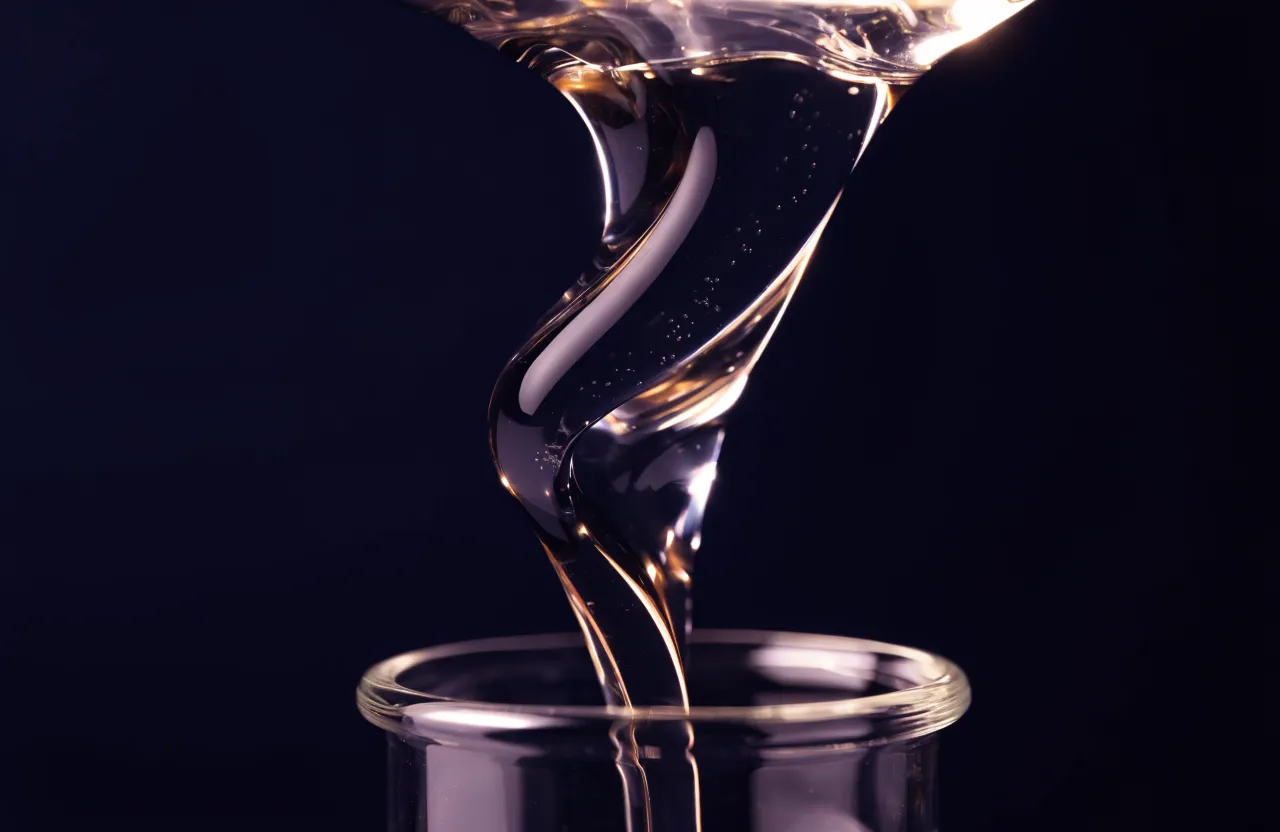
You go to spec a silicone fluid for a release coating, an antifoam, or a vibration damper, and the first question back from the supplier is the one that decides everything: what viscosity? Polydimethylsiloxane ships as anything from a 0.65 cSt liquid that flashes off like a solvent to a 1,000,000 cSt gum you can barely pour, and all of it is the same polymer. Pick the wrong grade and the fluid migrates off the part, wipes away, drags, or never wets the surface in the first place.
The short version: Polydimethylsiloxane (PDMS) is the workhorse silicone, a polymer built from a repeating [-Si(CH₃)₂-O-] unit: an inorganic silicon-oxygen (siloxane) backbone carrying two methyl groups on every silicon atom. That backbone explains its behavior. The Si-O-Si linkage is long, wide-angled, and almost free to rotate, so the chains are exceptionally flexible (glass transition near -120 °C), they present a low-energy methyl surface (surface tension around 20-21 mN/m), they repel water, they conduct almost no electricity, and they hold up thermally to roughly 200 °C in air before they start to oxidize. The one variable you actually buy on is viscosity, set by chain length, running from volatile fluids through 350 and 1,000 cSt oils up to high-viscosity gums. Dimethicone is the same polymer under its cosmetic (INCI) name. Match the grade to the job, because viscosity drives behavior more than any other single property.
What polydimethylsiloxane actually is
PDMS is a linear organosilicon polymer: a chain of repeating dimethylsiloxane units, where each silicon atom is bonded to two backbone oxygens and two methyl (–CH₃) groups, with the chain ends usually capped by trimethylsiloxy groups. It is registered under CAS 9016-00-6 and listed on PubChem under the names dimethicone, dimethylpolysiloxane, and PDMS. Commercially it is made by hydrolyzing and polymerizing dimethyldichlorosilane.
The thing to hold onto is that one chemistry covers a huge range of physical forms. How many repeat units sit in the chain (the degree of polymerization) sets the molecular weight, and molecular weight sets viscosity. Short chains give you a thin, water-like fluid; long chains give you a thick oil; the longest chains plus light crosslinking give you a gum or an elastomer. So when you specify “silicone oil,” you have named the polymer but not the product. Always specify the viscosity grade alongside the name, because that is what determines how the material behaves on your line.
Why the backbone gives PDMS its properties
Almost every useful property of PDMS traces back to two structural facts: the siloxane bond and the methyl groups hanging off it.
The Si-O bond is longer than a carbon-carbon bond, the Si-O-Si angle opens up to roughly 150°, and rotation around the bond meets almost no resistance. The chain is therefore one of the most flexible in polymer chemistry. That flexibility shows up as a glass transition temperature near -120 °C, so the fluid stays mobile and the elastomer stays rubbery across a wide span of cold and heat where an organic polymer would stiffen or crack.
The methyl groups point outward and shield the backbone. They are non-polar and low in surface energy, which gives PDMS its low surface tension (around 20-21 mN/m), well below water and most oils. Low surface tension is why the fluid spreads and wets readily, why it lubricates and releases, and why it breaks foam. The methyl shell also makes the surface hydrophobic, so the fluid sheds water and works as a water-repellent treatment.
The backbone is partly inorganic and the Si-O bond is strong, which is the source of two more properties buyers lean on. PDMS is thermally and oxidatively stable, typically usable to about 180-200 °C in air for extended service. It is also chemically inert toward many acids, bases, and polar solvents, and it carries almost no electrical charge, which makes it a useful dielectric and heat-transfer fluid.
Here is the honest trade-off that the marketing usually skips: that 200 °C figure is a ceiling, not a guarantee. Above roughly 200 °C in air, the methyl groups begin to oxidize and crosslink, the viscosity climbs, and the fluid can eventually gel. The exact limit depends on the grade, the atmosphere, and the exposure time, and phenyl-modified silicones are made specifically to push the range higher. Qualify the fluid at your real service temperature rather than trusting a single catalog number.
Viscosity grades: one polymer, many behaviors
Viscosity is the spec that matters. It is reported in centistokes (cSt) at 25 °C and spans more than six orders of magnitude, from thinner than water to a near-solid. The table below maps the common bands to what they are good for and to the RawSource grade that sits in each.
| Viscosity (cSt at 25 °C) | Character | Typical use | RawSource example |
|---|---|---|---|
| ~0.65–5 | Volatile, thinner than or near water; evaporates cleanly | Fast-flash carrier and solvent, low-residue release, water-repellent surface treatment | hexamethyldisiloxane (HMDSO, 0.65 cSt) |
| ~10–100 | Light, spreads easily, leaves a thin film | Wetting agents, light-duty lubrication, low-residue release, formulation carrier | light silicone oil grades |
| ~350 | Medium-light, balanced spread and film | General lubrication and release, antifoam base, personal-care formulation | silicone oil 350 cSt |
| ~1,000 | Medium body, good film build and lubricity | General lubricants, damping and hydraulic fluids, dielectric coolant, polishes | silicone oil 1,000 cSt |
| ~5,000–60,000 | Heavy, slow-flowing | Damping fluids, grease bases, heavy release, thick coatings | high-viscosity PDMS fluid |
| ~100,000–1,000,000+ | Gum-like, barely pourable to near-solid | Sealant, adhesive, and elastomer feedstock; viscosity-building additive | silicone gums |
The pattern is consistent: lower viscosity buys you volatility, easier spreading, and a thinner residual film; higher viscosity buys you film thickness, drag, cushioning, and persistence. There is no grade that does both, which is the whole reason the family exists as a ladder rather than a single product.
What is PDMS used for?
Across coatings, lubricants, electronics, process plants, and personal care, the same polymer shows up in a handful of recurring roles. This is the core of “polydimethylsiloxane uses,” and most of them are direct consequences of the properties above.
- Carrier and lubricant fluids. Neat PDMS fluid lubricates plastic-on-plastic and rubber surfaces, carries other actives, and damps motion. Its low surface tension and shear stability keep performance steady across a wide temperature range.
- Antifoam active. PDMS is the active ingredient in most silicone defoamers. Compounded with hydrophobic silica it becomes simethicone, and dispersed in water it becomes a silicone antifoam emulsion for aqueous systems. The low surface tension lets silicone droplets spread across the foam film while the silica particles bridge and rupture it. We cover the full picture in how defoamers work.
- Release agents. Because the methyl surface is low-energy and inert, cured resins, rubbers, and adhesives do not bond to it, so PDMS releases molded parts cleanly.
- Emulsions. Emulsifying PDMS in water makes it easy to dose into water-based processes such as textile finishing, release sprays, and the antifoam emulsions above.
- Dielectric and heat-transfer fluids. The combination of electrical insulation and thermal stability lets a single fluid both insulate and carry heat in transformers, coolers, and lab baths.
- Personal-care formulation (dimethicone). Under the INCI name dimethicone, PDMS is a formulation ingredient valued for slip, spreadability, and a dry, non-greasy after-feel. That is a description of its physical role in a formula, not a health or efficacy claim.
A caution worth stating because it bites coatings formulators: silicone is a double-edged tool at a surface. The same low surface tension that breaks foam can cause craters and fisheyes in a paint film if a silicone defoamer is over-dosed or poorly chosen. We walk through that failure mode and how to dose around it in our guide to defoamers in water-based coatings.
PDMS vs dimethicone: what is the difference?
There is essentially no chemical difference; the difference is the naming convention. PDMS is the materials-science and industrial name for the polymer. Dimethicone is the INCI name used on cosmetic and personal-care ingredient labels for the fully methylated PDMS homopolymer that is end-capped with trimethylsiloxy groups. The same molecule shares CAS 9016-00-6 under both names, and you will also see it called dimethylpolysiloxane.
The nuance is in the end-groups. “Dimethicone” specifically means the trimethylsiloxy-terminated homopolymer; change the end-group and the INCI name changes with it. Hydroxyl-terminated PDMS, for example, is named dimethiconol, not dimethicone. For purchasing, the practical rule is simple: treat dimethicone as PDMS, but spec the grade by viscosity and end-group, not by the trade or INCI name alone, since two materials can share a name and behave differently.
What viscosity grade do you need?
The selection question is almost always a viscosity question. Work backward from the behavior you need:
- Needs to evaporate and leave no residue? Go volatile, at the 0.65–5 cSt end. Hexamethyldisiloxane is the canonical low end, useful as a fast-flash carrier and a low-residue release fluid.
- Needs light lubrication or release with a thin film? A 100–1,000 cSt fluid covers most general cases; 350 cSt and 1,000 cSt are the common workhorses.
- Needs damping, heavy lubrication, or a thicker film? Move up to 5,000–60,000 cSt.
- Needs to feed an elastomer, sealant, or adhesive? You are in gum territory, 100,000 cSt and up.
- Running a water-based process? Use an emulsion or a self-emulsifying grade rather than a neat fluid, so it disperses instead of floating.
- Fighting foam? Use a compounded PDMS-plus-silica antifoam or an emulsion, dosed low (often parts per million), and watch for surface defects if you over-add.
The reliable move is to bracket: pick two grades on either side of your best guess, request samples, and test both on your own system at your real temperature and substrate. The Certificate of Analysis (CoA) governs the lot you ultimately buy.
Buying polydimethylsiloxane and silicone fluids
Tell us your target viscosity, your end use, and whether the system is water- or solvent-based, and request a sample to qualify the grade on your own process.
Frequently asked questions
What is PDMS used for?
PDMS is used as a silicone oil and lubricant, as the active ingredient in antifoams and defoamers, as a mold-release agent, as a dielectric and heat-transfer fluid, in water-based emulsions for textile and process use, and, under the INCI name dimethicone, as a formulation ingredient in personal care. Most of these roles follow from its low surface tension, flexibility, water repellency, and thermal and chemical stability.
What is the difference between PDMS and dimethicone?
They are the same polymer. PDMS (polydimethylsiloxane) is the industrial and materials-science name; dimethicone is the INCI name used on cosmetic ingredient labels for the fully methylated, trimethylsiloxy-terminated PDMS homopolymer. Both share CAS 9016-00-6. Change the end-group and the INCI name changes too: hydroxyl-terminated PDMS is dimethiconol, not dimethicone.
Is PDMS the same as silicone oil?
Silicone oil almost always means PDMS in fluid form. PDMS is the specific polymer; “silicone oil” is the everyday term for its liquid grades. Other silicone fluids exist (phenyl-modified, amino-functional, and so on), so when precision matters, specify polydimethylsiloxane and the viscosity grade rather than “silicone oil” alone.
What viscosity of silicone oil do I need?
Work backward from the behavior. Use a volatile grade (0.65–5 cSt, such as hexamethyldisiloxane) when you need it to evaporate cleanly; 100–1,000 cSt for general lubrication and release; 5,000–60,000 cSt for damping and heavier films; and gum grades (100,000 cSt and up) for elastomer and sealant feedstock. Bracket your best guess with two grades and test both on your own system.
What viscosity range does PDMS come in?
Roughly 0.65 cSt at the volatile low end (thinner than water) to over 1,000,000 cSt for gum grades, with 350 cSt and 1,000 cSt being common general-purpose fluids. Chain length sets viscosity, so the same chemistry covers volatile liquids, oils, and near-solid gums.
Does PDMS evaporate?
Only the lowest-viscosity, low-molecular-weight grades do. Hexamethyldisiloxane (about 0.65 cSt) and similar volatile siloxanes evaporate quickly and leave little residue, which is why they are used as fast-flash carriers and low-residue release fluids. Standard 350 and 1,000 cSt oils are effectively non-volatile at ambient conditions.
Editorial note. This article is general technical guidance for coatings, lubricant, electronics, and industrial formulation professionals. PDMS performance depends on the specific viscosity grade, end-group, formulation, dose, substrate, and service temperature, and must be validated on your own system; the Certificate of Analysis governs the grade you buy. Review the current Safety Data Sheet (SDS) and use appropriate handling practices before use. Products are sold for industrial and professional use only. Nothing here is a medical, health, cosmetic-benefit, or safety claim. RawSource makes no warranty, express or implied, and assumes no liability for use of this information.
Search 1,300+ industrial chemicals by name or CAS, or send us your spec — we quote by the drum, tote, or container.
Browse the Chemical Index → Request a Quote