
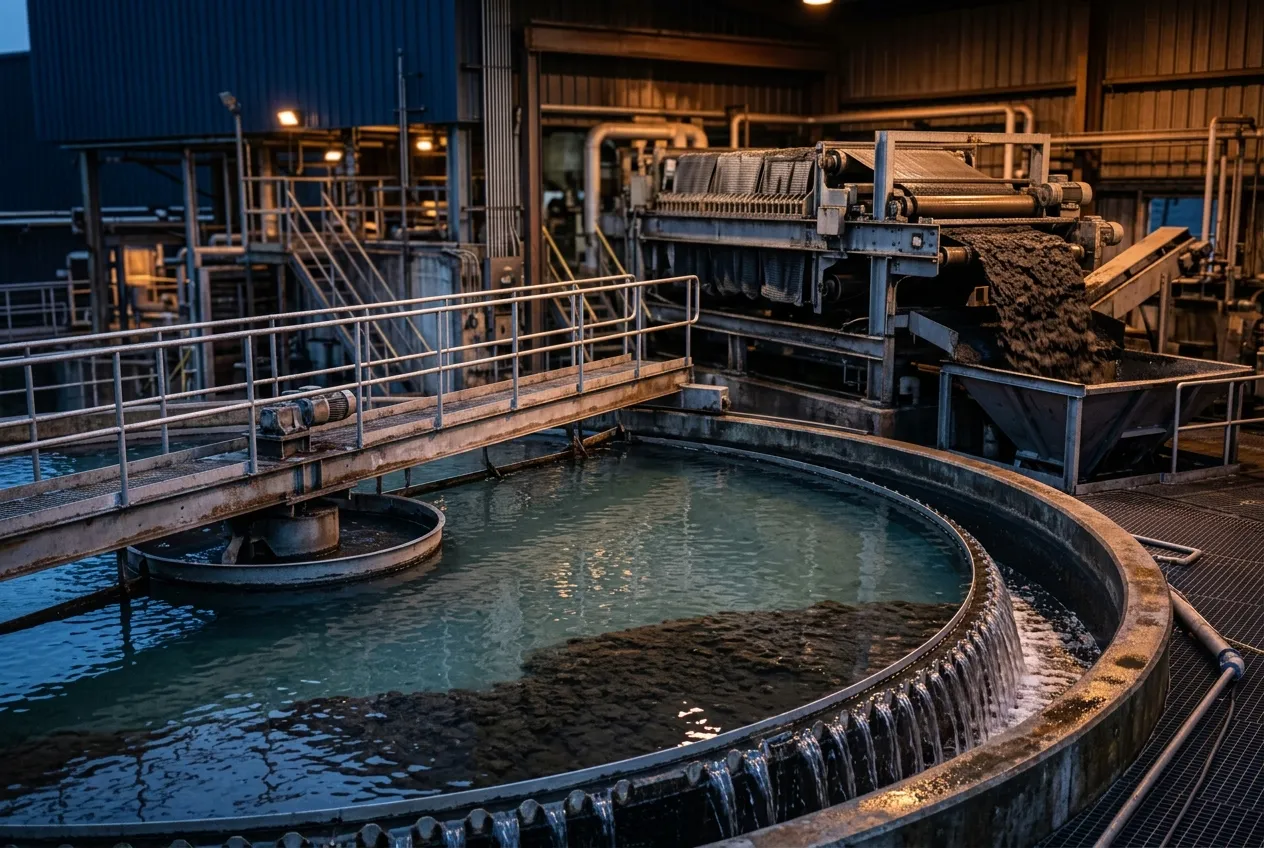
Two problems put a wastewater operator on the phone to a chemical supplier. The dewatered sludge cake comes off the belt press or centrifuge too wet, so disposal weight and cost are high and the cake will not stack or burn. Or the clarifier overflow and final effluent are cloudy, the total suspended solids are creeping over the discharge permit, and an exceedance is coming. Polyacrylamide is the polymer that fixes both, as long as the charge type matches the solids.
The short version: for dewatering an organic or biological sludge, use cationic polyacrylamide; it neutralizes the negatively-charged organics and bridges them into a firm floc that releases water on a belt press, centrifuge, or screw press, dosed roughly by the kilogram per ton of dry solids. For clarifying water with mineral or inorganic solids, use anionic polyacrylamide, often after a coagulant, to settle turbidity and drop suspended solids. Getting the charge right, and dissolving the polymer properly, is most of the battle.
Why the cake is too wet (and how PAM fixes it)
A wet cake means the solids are not releasing their water, usually because the sludge is poorly conditioned. Cationic polyacrylamide (CAS 9003-05-8, PubChem) conditions it: its positive charge neutralizes the negatively-charged organic particles so they stop repelling, and its long, high-molecular-weight chain bridges them into a large, strong floc. A well-conditioned floc traps less water and shears less in the machine, so the press or centrifuge squeezes out a drier, firmer cake. The charge-type logic is in anionic vs cationic vs nonionic polyacrylamide.
Dose is set by the dry solids in the sludge, not the volume, and typically runs in the range of tens to a few hundred grams of polymer per ton of dry solids. Underdose and the cake stays wet; overdose and you waste polymer and can blind the belt.
Why the effluent is cloudy (and how PAM fixes it)
High turbidity and rising suspended solids mean fine particles are not settling. For mineral and inorganic solids, the usual fix is a coagulant (an inorganic salt such as alum or a ferric or aluminum chloride) to neutralize charge and form pinflocs, followed by an anionic polyacrylamide to bridge those pinflocs into large, fast-settling flocs. The coagulant destabilizes; the polymer builds the settleable floc. The result is a clearer overflow and lower effluent suspended solids, pulling the discharge back under permit.
Belt press, centrifuge, and clarifier
The same polymer chemistry serves different equipment:
- Belt filter press: the conditioned floc forms, drains, then is pressed; the polymer must build a floc that drains fast and does not blind the belt.
- Centrifuge / decanter: needs a shear-resistant floc that holds together under high g-force; molecular weight and dose matter.
- Clarifier / DAF: the floc must be large and either settle fast (clarifier) or float cleanly (dissolved air flotation).
The grade and dose are tuned to the machine and the sludge, which is why operators jar-test and trial on the actual unit.
Dissolve it right, or none of this works
A common reason polyacrylamide “does not work” is poor make-down: the powder clumps into fish-eyes and never fully dissolves, so most of the polymer never acts. Dry polyacrylamide must be wetted evenly, aged, and diluted to a working strength before it is dosed. The make-down and dosing detail is in polyacrylamide grades and make-down.
Buying polyacrylamide for water and wastewater
See the Polyacrylamide Flocculant product page. Tell us your sludge or stream, the equipment, and your discharge target, and request samples to jar-test and trial on your own process. For potable-water treatment, ask for an NSF/ANSI 60-certified grade.
Frequently asked questions
Which polyacrylamide is best for sludge dewatering?
Cationic polyacrylamide, because municipal and organic sludge solids are negatively charged and the positive polymer neutralizes and bridges them into a firm, water-releasing floc. Dose by the dry solids in the sludge and confirm by trial.
Why is my sludge cake still wet after the belt press?
Usually poor conditioning: the wrong charge type, the wrong dose, or polymer that did not fully dissolve. Match cationic polymer to organic sludge, dose to the dry solids, and check that the polymer is properly made down before it reaches the sludge.
How do I lower TSS in my effluent with polyacrylamide?
For mineral solids, dose a coagulant (alum or a ferric or aluminum chloride) first to form pinflocs, then an anionic polyacrylamide to bridge them into large, fast-settling flocs. That drops turbidity and suspended solids in the clarified water.
How much polyacrylamide do I dose for sludge?
Dose is based on dry solids, not volume, typically tens to a few hundred grams of polymer per ton of dry solids depending on the sludge and machine. Optimize by trial; overdosing wastes polymer and can blind a belt.
Can I use polyacrylamide in drinking-water treatment?
Yes, with an NSF/ANSI 60-certified grade used within its dose limits, because the residual acrylamide monomer is regulated for potable use. Confirm certification and limits for your jurisdiction.
Editorial note. This article is general technical guidance for water-treatment and industrial professionals. Charge-type, dose, and equipment guidance is general and must be validated by jar testing and on-unit trials; the Certificate of Analysis governs the grade you buy. Polyacrylamide polymer has low toxicity per its SDS and is not classified as hazardous for transport, but residual acrylamide monomer is regulated for potable use, where an NSF/ANSI 60-certified grade within its limits is required. Spilled product is extremely slippery when wet. Always consult the current Safety Data Sheet (SDS) before handling. RawSource makes no warranty, express or implied, and assumes no liability for use of this information.
Search 1,300+ industrial chemicals by name or CAS, or send us your spec — we quote by the drum, tote, or container.
Browse the Chemical Index → Request a Quote