
A common call to a polymer supplier starts with “your polyacrylamide does not work.” Most of the time the polymer is fine and the make-down is wrong: the powder clumped into rubbery fish-eyes, the gel balls never dissolved, and three-quarters of the polymer washed through unused. Polyacrylamide is unusually sensitive to how it is wetted and dissolved, and getting that right, on the correct grade, is the difference between a polymer that flocculates and one that does nothing.
The short version: a polyacrylamide grade is defined by two numbers, molecular weight (which sets bridging and floc size) and charge degree (which sets neutralization), plus its charge type (anionic, cationic, nonionic) and its form (dry powder/granule or liquid emulsion). To use it, you must make it down: wet the powder evenly so it does not clump, dissolve it on a dilute, well-mixed solution, age it so the chains fully hydrate, and then dose it. Skip a step and you get fish-eyes and poor performance.
Reading a polyacrylamide grade
Polyacrylamide (CAS 9003-05-8, PubChem) is specified by a small set of properties:
| Property | What it controls |
|---|---|
| Charge type | Anionic, cationic, or nonionic, matched to the solids (see the selection guide) |
| Molecular weight | Bridging power and floc size; very high MW for solid-liquid separation |
| Charge degree (%) | Strength of charge neutralization; tuned to the stream |
| Form | Dry powder/granule (concentrated, long shelf life) or liquid emulsion (faster make-down) |
| Particle size and dissolving time | How fast and cleanly the powder goes into solution |
Which charge type to pick is covered in anionic vs cationic vs nonionic polyacrylamide.
Why it won’t dissolve: the fish-eye problem
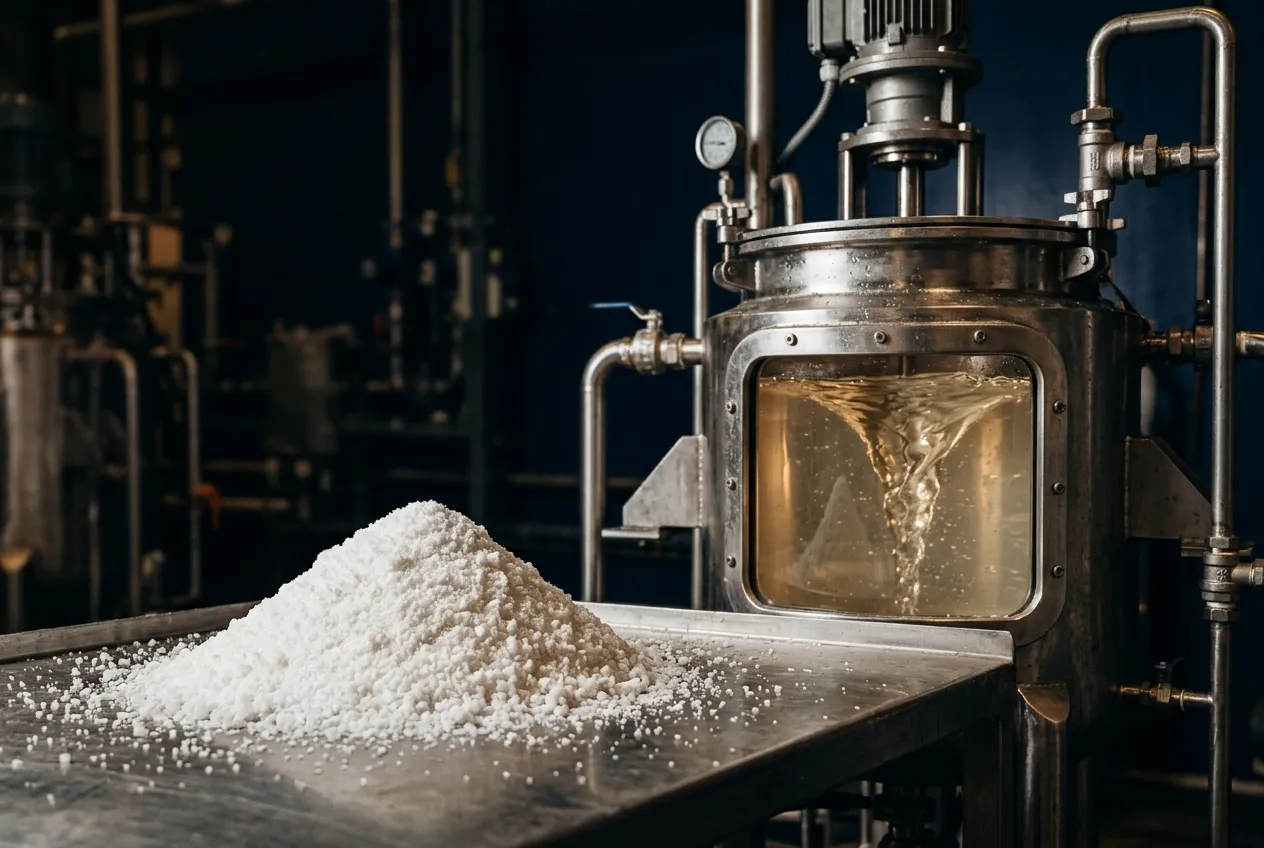
Dry polyacrylamide is so hydrophilic that when a clump of powder hits water, the outside instantly gels into a skin that seals the dry core inside. That is a fish-eye: a gel ball that will not dissolve and that plugs lines and screens. The cause is poor wetting, adding the powder too fast or into poorly mixed water, so particles touch before they separate. The fix is to disperse the powder evenly into well-agitated water, never dump it.
Making it down right
A correct make-down follows four steps:
1. Wet evenly. Feed the powder slowly into a vortex of clean, agitated water (an eductor or wetting cone helps) so each particle disperses before it gels. 2. Dissolve dilute. Make down to a dilute stock, commonly around 0.1 to 0.5%, with gentle mixing; too-strong solutions are too viscous to dissolve and dose well. 3. Age. Let the solution mix and stand so the polymer chains fully hydrate and uncoil, often 30 to 60 minutes; an under-aged solution under-performs. 4. Dilute and dose. Often dilute the aged stock again in-line to a low feed concentration and inject it into the stream with enough mixing to distribute it, but not so much shear that it tears the chains.
Over-shearing at any stage, a too-fast pump or a tight valve, breaks the high-molecular-weight chains and kills performance. The dosing detail for dewatering is in polyacrylamide for sludge dewatering.
Storage, handling, and materials
Dry polyacrylamide stores well, on the order of two years, kept dry and cool. It has low toxicity per its SDS and is not classified as hazardous for transport, though the residual acrylamide monomer is the regulated component for potable use. Two practical cautions: it is extremely slippery when wet, so spills must be cleaned up immediately around walkways and pumps, and it can be mildly corrosive to aluminum and galvanized surfaces, so stainless steel, fiberglass, polyethylene, and epoxy-coated equipment are preferred for make-down and storage.
Buying polyacrylamide by grade
See the Polyacrylamide Flocculant product page. Tell us your application, stream, and make-down setup, and request samples to optimize grade and dose on your own system. For potable use, ask for an NSF/ANSI 60-certified grade.
Frequently asked questions
Why won’t my polyacrylamide dissolve (fish-eyes)?
Poor wetting. When powder is added too fast or into poorly mixed water, the outside gels and seals the dry core into a fish-eye that never dissolves. Disperse the powder slowly into a vortex of well-agitated water, then dissolve dilute and age.
How do you make down polyacrylamide?
Wet the powder evenly into agitated water, dissolve to a dilute stock (around 0.1 to 0.5%), age it 30 to 60 minutes so the chains fully hydrate, then dilute in-line and dose with gentle mixing. Avoid over-shearing, which breaks the polymer chains.
What is the difference between high and low molecular weight polyacrylamide?
Molecular weight sets bridging. High-molecular-weight grades build larger, stronger, faster-settling flocs and are used for solid-liquid separation; lower-molecular-weight grades are used where strong bridging is not needed. Charge degree is a separate property controlling neutralization.
Powder or emulsion polyacrylamide, which is better?
Dry powder is more concentrated and has a longer shelf life but needs careful make-down; liquid emulsion makes down faster and is easier to meter but is less concentrated and shorter-lived. Choose by your make-down capability and logistics.
How long does polyacrylamide last in storage?
Dry polyacrylamide typically keeps about two years stored cool and dry in sealed packaging. Made-down solution is used promptly. Confirm shelf life on the product documentation.
Editorial note. This article is general technical guidance for water-treatment and industrial professionals. Make-down, grade, and dosing guidance is general and must be validated on your own equipment and stream; the Certificate of Analysis governs the grade you buy. Polyacrylamide polymer has low toxicity per its SDS and is not classified as hazardous for transport; residual acrylamide monomer is a regulated concern for potable use (use an NSF/ANSI 60-certified grade within its limits). Spilled product is extremely slippery when wet, and aluminum and galvanized surfaces should be avoided. Always consult the current Safety Data Sheet (SDS) before handling. RawSource makes no warranty, express or implied, and assumes no liability for use of this information.
Search 1,300+ industrial chemicals by name or CAS, or send us your spec — we quote by the drum, tote, or container.
Browse the Chemical Index → Request a Quote