
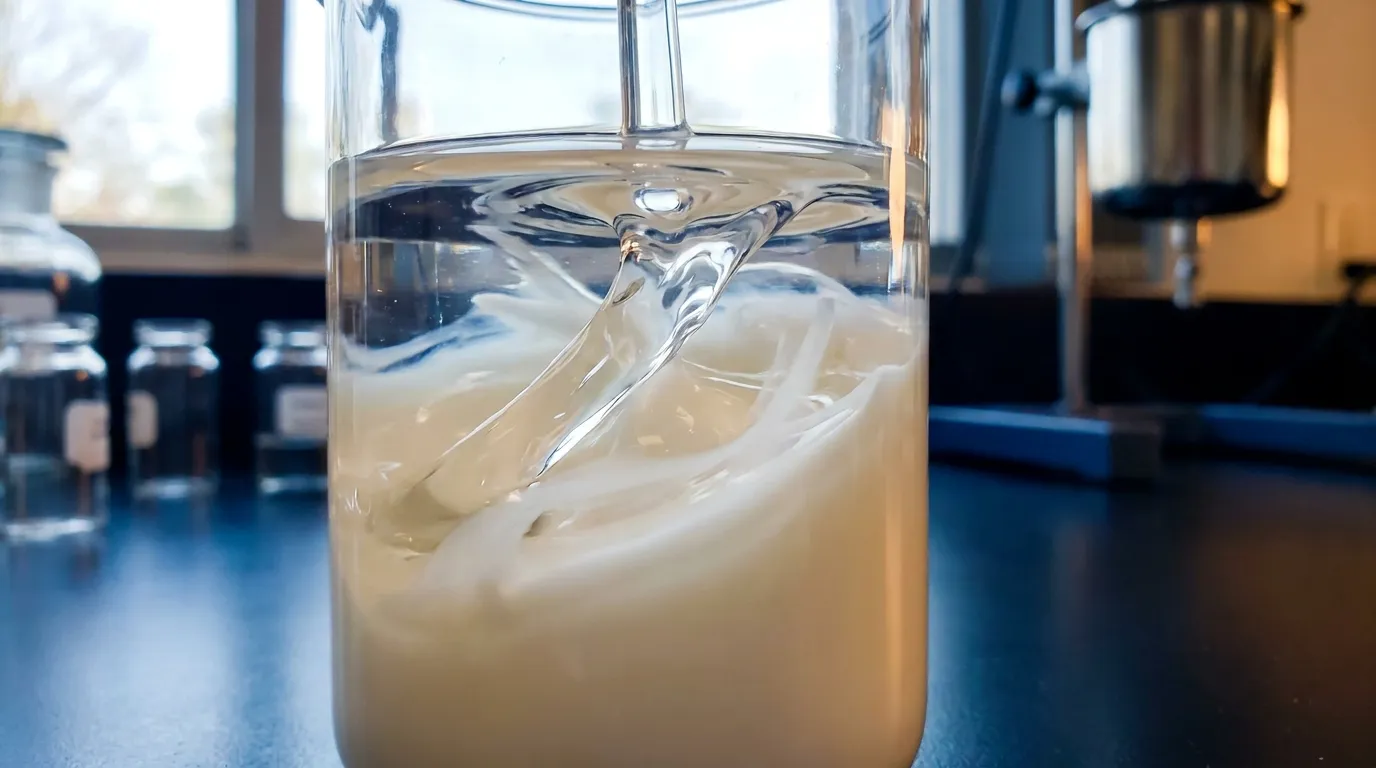
You ordered dimethicone for a leave-in conditioner that has to rinse clean in hard water. The drums arrive, the lab drops the silicone into the water phase, and it beads on the surface and refuses to go in. The CoA is correct. The label reads dimethicone, the assay checks out, the supplier did nothing wrong.
The formula needed PEG-12 dimethicone, and the two are not interchangeable. Many procurement systems file every silicone with “dimethicone” in the name under one line item, which is how a water-insoluble oil ends up substituted for a water-dispersible surfactant. The fix starts with knowing exactly what the PEG in front of the name does to the chemistry.
What is PEG-12 dimethicone?
PEG-12 dimethicone (INCI: PEG-12 DIMETHICONE, CAS 68937-54-2) is a polyethylene-glycol-modified silicone: a polydimethylsiloxane (PDMS) backbone with grafted PEG side chains. RawSource catalogs it in the Silicone Fluids and Oils family and treats it functionally as an emulsifier and dispersant. It is a polymer, not a single molecule, so it carries no fixed molecular weight and no single melting or boiling point. CosIng, the European Commission cosmetic ingredient database, lists it for hair conditioning and skin conditioning, which is the role most personal care formulators buy it for.
What does the PEG change?
Plain dimethicone is a chain of repeating dimethylsiloxane units. That backbone is hydrophobic, so the material behaves as a silicone oil: it spreads and lubricates while staying out of the water phase. PEG-12 dimethicone takes that same backbone and attaches polyoxyethylene chains to it. Under the INCI naming convention, the number is the average count of ethylene oxide units on the molecule, so “12” signals roughly twelve EO units per chain.
Those PEG chains are hydrophilic. Putting a water-loving section on an oil-loving backbone produces an amphiphile, which is the definition of a surfactant. The practical result is the property that matters at the bench: PEG-12 dimethicone disperses into water instead of separating out of it. That single change is why it can emulsify a silicone phase, stabilize an oil-in-water cream, and condition without leaving the heavy occlusive film that pure dimethicone leaves behind.
| Property | PEG-12 dimethicone | Plain dimethicone |
|---|---|---|
| CAS | 68937-54-2 | 9006-65-9 |
| Structure | PDMS backbone with grafted PEG chains | Linear PDMS, no PEG |
| Water behavior | Water-dispersible, self-emulsifying | Water-insoluble silicone oil |
| Primary function | Silicone surfactant, emulsifier, conditioner | Emollient, occlusive, skin protectant |
| Physical form | Liquid; MW varies by grade | Liquid (PubChem CID 24764) |
| FDA OTC monograph | Not a monographed active | Skin protectant active, 1 to 30% (21 CFR 347.10(g)) |
| Listed function | Hair and skin conditioning (CosIng) | Skin conditioning, emollient |
The comparison shows the trade-off plainly. You gain water compatibility, and you give up the high, persistent occlusivity that makes plain dimethicone a slip and barrier agent. A formula that needs a long-lasting silicone film on skin or hair is not improved by switching to the PEG grade, and a water-thin rinse-clean system is not served by the oil. Buy to the behavior you need, not to the shared family name.
The mechanism behind the surfactant behavior is the balance between the two halves of the molecule. The siloxane backbone is oil-loving, the PEG chains are water-loving, and the ratio between them sets how the material partitions between phases. A higher PEG content pushes the balance toward water and favors oil-in-water systems, which is the direction most personal care emulsions run. This is the same hydrophilic-lipophilic logic that governs any nonionic surfactant, applied to a silicone instead of a fatty chain. You do not need to calculate a value to use it, but you do need to read the grade’s stated solubility and cloud point, because those numbers are how the balance shows up in practice.
Why do personal care formulas use PEG-12 dimethicone?
The buyer question behind this material is direct: why reach for a PEGylated silicone when plain dimethicone is cheaper and well understood? The answer is that personal care formulas often need silicone performance inside a water-based system, and the oil cannot deliver that on its own.
Three jobs explain most of the demand. As a conditioning agent, it deposits silicone slip onto hair and skin while staying water-compatible, so a rinse-off conditioner carries silicone benefit without a greasy after-feel. As a silicone emulsifier, it lets a formulator build an oil-in-water cream where part of the oil phase is itself a silicone, holding a phase that ordinary surfactants struggle to stabilize. As a wetting and dispersing aid, the amphiphilic structure helps spread actives and pigments evenly across an aqueous base.
The hard-water case from the opening is the clearest example. A leave-in that has to rinse clean in municipal hard water needs its silicone to disperse, not bead. The PEG chains give the molecule enough water affinity to stay in the system through the rinse, which is the property a plain silicone oil cannot provide at any dose. CosIng lists the hair-conditioning and skin-conditioning functions explicitly, and the emulsifier role follows from the surfactant structure.
What do the grades look like, and what does “PEG-12” tell you?
Because the product is a polymer, the supplied material is defined by its synthesis, not by a purity percentage the way a small molecule is. Two lots both labeled PEG-12 dimethicone can differ in silicone chain length and in how the PEG is distributed, and those differences move the cloud point, the viscosity, and the feel on skin. The catalog record carries no fixed physical-property set for this reason, and the honest note on the line is that properties vary by grade. Treat the supplier Technical Data Sheet (TDS) as the spec of record, not a generic value found online.
The “12” in the name is the most useful single number a buyer gets up front. A higher PEG number means more ethylene oxide and more water affinity; a lower number leans back toward the oil. PEG-12 sits in the water-dispersible range that suits most rinse-out and leave-on personal care work. When you compare quotes, line up the INCI string and the PEG number first, then the measured properties below.
| TDS / CoA parameter | Why it matters | What to confirm |
|---|---|---|
| INCI name | “Dimethicone” and “PEG-12 dimethicone” are different materials | Exact string PEG-12 DIMETHICONE on the CoA |
| CAS | 68937-54-2 is shared across PEG/PPG dimethicones | CAS plus the specific INCI, not CAS alone |
| Active content | Polymer may ship neat or in a carrier | Percent active and any solvent or glycol carrier |
| Cloud point | Governs emulsion stability in hot process | Measured cloud-point range for the grade |
| Color (APHA) | Yellowing shows in clear and pastel formulas | Color spec on the lot CoA |
| Water dispersibility | The reason to buy the PEG grade at all | Confirmed self-emulsifying behavior |
Action: build these six rows into your incoming-inspection checklist. A lot that clears assay but misses the cloud-point or color window will still fail in a finished clear gel, and catching it at receiving is far cheaper than scrapping a batch.
What should you question on the TDS and CoA?
A shared CAS and a polymer spec leave room for substitution and drift. Five checks catch most of it.
- Wrong material under the right CAS. Because 68937-54-2 covers several PEG/PPG dimethicones, a CoA can show the correct CAS for the wrong INCI. The catalog flags that this CAS is shared with PEG/PPG-20/20 dimethicone. Match the INCI string, every time.
- No active-content figure. If the sheet omits percent active, you cannot dose accurately or compare price per kilo of functional material. Ask for it before you anchor a quote.
- Missing cloud point. For any hot-processed emulsion, an absent cloud point is a blind spot. Request the measured range, not a typical value copied from a brochure.
- Color spec absent or wide. A 0 to 100 APHA window is meaningless in a water-clear serum. Tighten the spec to what your finished product tolerates.
- SDS that does not match the lot. Hazard communication for this material rides on the supplier SDS, since no harmonized GHS classification sits in the catalog record. Confirm the SDS revision date tracks the lot you received.
How does PEG-12 dimethicone compare to other PEG/PPG dimethicones?
PEG-12 dimethicone is one member of a family of water-modified silicones, and the differences between them belong in any sourcing decision. RawSource catalogs a close relative, PEG/PPG-20/20 dimethicone, under the same shared CAS 68937-54-2 but with a different INCI and a different balance. The PPG portion adds propylene oxide units alongside the ethylene oxide, which moves the lipophilic-to-hydrophilic balance and changes both solubility and skin feel.
In practice, two materials with overlapping names can behave differently in the same formula. A higher combined oxide content generally trends toward more water solubility, while a structure weighted toward PPG leans more lipophilic and can read richer on skin. When you evaluate a substitution, line up the INCI strings and the supplier-stated cloud points side by side, and trial both in the finished system before you standardize on one. The shared CAS is exactly why paperwork alone will not protect you here, and it is the single most common cause of a silent swap between these grades.
What goes wrong at the bench, and how do you prevent it?
Most failures with this material trace back to its polymer nature and its surfactant behavior. Four show up most often.
Phase separation in hot process. PEGylated nonionic silicones have a cloud point above which the PEG chains dehydrate and the material drops out of solution. Heating an emulsion past the grade’s cloud point can break it. Hold the process temperature below the supplier-stated cloud point, and account for dissolved salts, which lower the cloud point of a nonionic, so a high-electrolyte system clouds earlier than water alone.
Weak or unstable emulsions. If the active content runs lower than assumed, the effective surfactant dose is short, and the emulsion thins or separates on standing. Dose against measured active content, not the nominal figure on a brochure.
Color in clear formats. A lot at the high end of its color window shows as a yellow cast in a water-clear serum. Tighten the incoming APHA limit to the finished-product tolerance, and reject above it.
Substitution drift. A new lot under the shared CAS but a different INCI feels different on skin and can shift emulsion stability. Re-qualify on the INCI string, not the CAS, whenever a supplier or origin changes.
Where PEG-12 dimethicone is used, and at what levels
In beauty and personal care, PEG-12 dimethicone earns its place as a conditioning agent and a silicone emulsifier. It carries silicone slip into shampoos, conditioners, and skin emulsions while staying compatible with the water phase, so formulators get the silicone aesthetic without a separate oil phase that has to be stabilized by other means. That dual role, conditioning plus self-emulsification, is why it appears across both rinse-off and leave-on products, not in one category alone.
In textiles, silicone softeners give fabric a smooth hand and improved drape, and they have to disperse into aqueous finishing baths to deposit evenly across the cloth. A water-dispersible silicone fits that process directly, where a straight silicone oil would need a separate emulsification step before it could be run through the bath. The catalog tags both Beauty and Personal Care and Textiles as served verticals for this material, and the documentation expectations differ between them, which matters when a single grade is sourced for both.
Use levels deserve a precise word. The published, sourceable number sits on the parent material: plain dimethicone is an FDA OTC skin-protectant active at 1 to 30 percent under 21 CFR 347.10(g). PEG-12 dimethicone is not that active and is dosed to its job, typically well below silicone-oil loadings, because a little surfactant goes a long way in an emulsion. Instead of copying a use level from another product, pull the recommended addition rate from the grade’s TDS and validate it in your own system. If you want the emulsifier-side detail, see our note on the emulsifying properties of PEG-12 dimethicone, and for the head-to-head, our breakdown of how PEG-12 dimethicone compares to regular dimethicone.
What does the regulatory and safety check look like?
For sourcing files, three points cover most of the diligence. First, identity: catalog CAS 68937-54-2 with INCI PEG-12 DIMETHICONE, confirmed against the CoA. Second, hazard communication: no harmonized GHS classification is recorded for this material in the RawSource catalog, so the supplier SDS is the governing document; do not assume an unclassified status, confirm it on the lot SDS. Third, function and history of use: CosIng lists hair conditioning and skin conditioning, which supports its use as a leave-on and rinse-out cosmetic ingredient. The full PubChem entry for the parent silicone, dimethicone (CID 24764), and the FDA monograph text at 21 CFR 347.10 are the primary references behind the distinction drawn here.
One caveat worth stating: regulatory status is application-specific. The cosmetic listing does not clear the material for food contact or pharmaceutical use, and a textile-grade lot may not carry the documentation a personal care QA team expects. Confirm the intended use against the documentation package before you commit a PO.
PEG-12 dimethicone
If you need the water-dispersible silicone grade instead of the oil, the PEG-12 dimethicone product page is the place to start an RFQ, and the related PEG/PPG-20/20 dimethicone listing covers the higher-EO option when you need more water affinity. Both sit in the broader silicones category, and the beauty and personal care hub maps the rest of the conditioning and emulsifier range. Send the INCI string, the cloud point, and the active-content target you need, and the quote comes back against that spec rather than a generic family name.
Frequently asked questions
What is PEG-12 dimethicone and how is it different from regular dimethicone?
Why is PEG-12 dimethicone used in personal care products?
Is PEG-12 dimethicone an FDA-approved active ingredient?
Why can the same CAS number ship a different material?
What should I check on the TDS and CoA before buying PEG-12 dimethicone?
Sources & methodology
Regulatory citations are current as of publication. Chemical identities verified by CAS number against the RawSource catalog.
Search 1,300+ industrial chemicals by name or CAS, or send us your spec — we quote by the drum, tote, or container.
Browse the Chemical Index → Request a Quote