
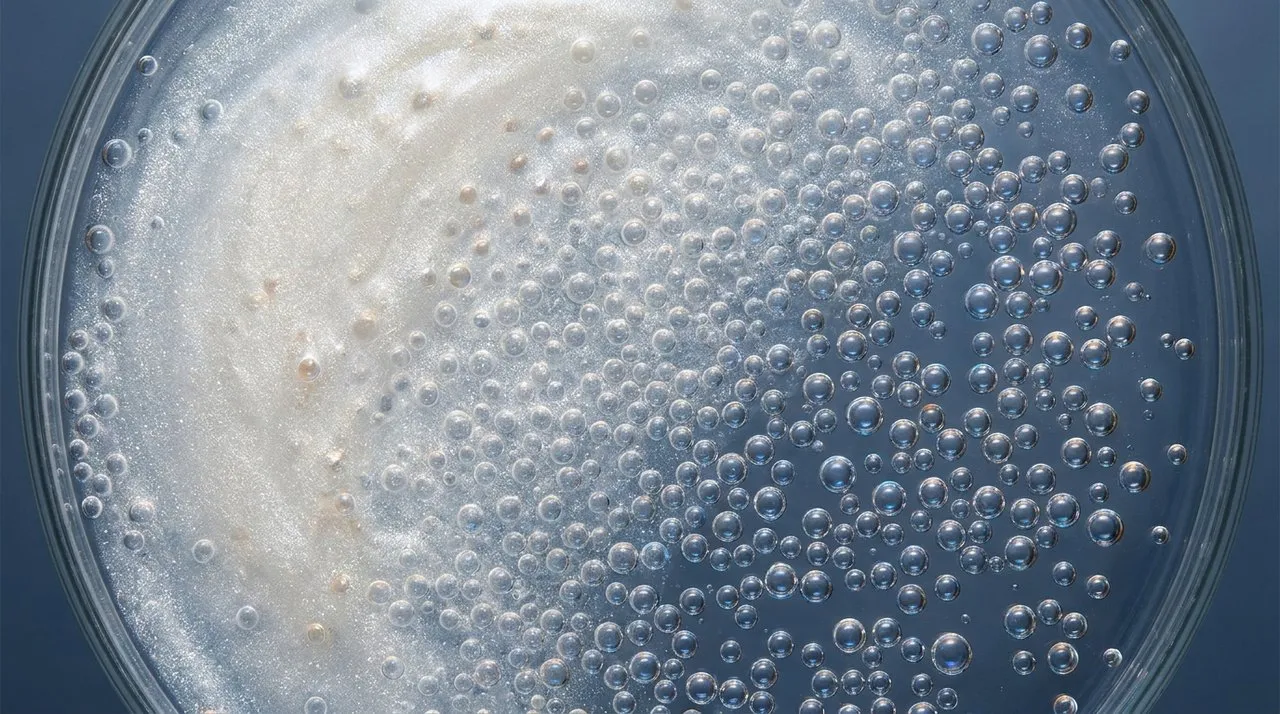
You spec a silicone emulsifier to carry a dimethicone phase into a clear body wash. The lab signs off. The first pilot from a new lot breaks into two layers inside a week. The CoA reads “PEG-12 dimethicone, CAS 68937-54-2,” which is what you ordered. The problem is that the CAS is generic, the ethylene-oxide count drifted between lots, and the emulsifying power you validated walked out the door with it. The emulsion did not fail on chemistry you got wrong. It failed on a specification line you left blank.
By the RawSource Sourcing Desk, Commercial & Sourcing Desk.
This guide covers what gives PEG-12 dimethicone its emulsifying power, how the PEG block sets hydrophilic-lipophilic balance (HLB) and decides between water-in-silicone and oil-in-water systems, which sister grades sit where on that scale, and the CoA lines that keep an emulsifier lot from surprising you.
What makes PEG-12 dimethicone an emulsifier and not just another silicone oil?
The answer is in the structure. PEG-12 dimethicone keeps the polydimethylsiloxane backbone of a silicone oil but replaces some of its methyl groups with polyoxyethylene side chains. The “12” is the average count of ethylene-oxide units on those chains. Those EO segments are hydrophilic; the siloxane backbone is hydrophobic. Bolt the two together and you get an amphiphile, one molecule with a water-loving end and a silicone-loving end. That dual character is the entire reason the material emulsifies. Its older trade name, dimethicone copolyol, says the same thing.
A surfactant works by parking at an interface. PEG-12 dimethicone sits at an oil-water or silicone-water boundary with its silicone tail in the nonpolar phase and its PEG head in the water, lowering interfacial tension so one phase can be broken into stable droplets in the other. Plain dimethicone (CAS 9006-65-9) cannot do this. Every exposed group on its chain is a methyl, so it has no hydrophilic end to anchor in water. It lubricates and films; it does not emulsify.
The catalog files PEG-12 dimethicone in the silicone fluids and oils family with an emulsifier and wetting role, and lists it as a polymer with grade-dependent properties instead of a single fixed molecular weight. That last point matters for buying: you specify it by EO number and HLB, with a viscosity grade, not by one number on a spec sheet.
How does the PEG block set HLB and decide W/Si versus O/W?
HLB is the number formulators use to predict what an emulsifier will do. Griffin’s system runs from 0 to about 20: low values mark a lipophilic emulsifier that stabilizes water-in-oil systems, high values mark a hydrophilic one that favors oil-in-water. As a rough map, the water-in-oil band sits near 4 to 6, wetting agents land around 7 to 9, and oil-in-water emulsifiers run from roughly 8 up into the teens. For a nonionic ethoxylate, HLB climbs as you add ethylene oxide, because each EO unit adds hydrophilic mass.
That single relationship is the lever behind every silicone emulsifier decision. A copolyol with a short EO block and a propylene-oxide segment carries a low HLB and stabilizes a water droplet inside a continuous silicone phase, the water-in-silicone geometry used in long-wear color and sun care.
Add ethylene oxide and the HLB rises, the molecule grows more hydrophilic, and the same chemistry flips toward oil-in-water and toward dispersing in water on its own. PEG-12 dimethicone, with about twelve EO units and no propylene-oxide block in the name, sits on the hydrophilic side of that line.
The table below places PEG-12 dimethicone against its nearest silicone relatives. HLB tendency is shown as a direction band, because the published HLB of any given grade depends on its exact EO and PO counts, which is precisely why you confirm it on the TDS.
| INCI / CAS | Structure | HLB tendency | Primary emulsion type | Water behavior |
|---|---|---|---|---|
| Cetyl PEG/PPG-10/1 Dimethicone (144243-53-8) | Low EO, PO present, alkyl-modified | Low | Water-in-silicone (W/Si), W/O | Disperses in oil and silicone |
| PEG/PPG-14/4 Dimethicone (68937-55-3) | Moderate EO with a PO block | Low to moderate | W/Si to balanced | Partial water dispersion |
| PEG-12 Dimethicone (68937-54-2) | ~12 EO, no PO block | Higher | Oil-in-water (O/W), wetting | Water-dispersible |
| Dimethicone (9006-65-9) | No PEG, all methyl | Not an emulsifier | Sits in the oil phase | Insoluble |
One practical trade-off lives in that table. The higher HLB that makes PEG-12 dimethicone easy to disperse in water is the same property that makes it a poor choice for a stiff water-in-silicone system. If your product is a high-internal-phase W/Si foundation, reaching for PEG-12 dimethicone will cost you stability; the low-HLB cetyl PEG/PPG-10/1 grade is the right tool there. Match the emulsifier HLB to the emulsion you want, then confirm the grade delivers it.
Why does the PEG block make it disperse in water?
Water is polar and holds things by hydrogen bonding. The methyl-coated dimethicone chain offers no hydrogen-bonding sites, so water molecules cannot solvate it and the silicone phase beads up and separates. That is the property you buy a straight silicone oil for, and it is also why a silicone oil cannot be rinsed clean.
The ethylene-oxide units change the energy balance. Each EO oxygen accepts a hydrogen bond from water. String about twelve of them onto a side chain and the hydrophilic pull is strong enough to disperse the whole molecule, even with the hydrophobic silicone still attached.
The molecule then reports to the water-silicone boundary on its own, which is what lets PEG-12 dimethicone emulsify and wet instead of only lubricating. The delivery consequence is direct: it goes into a water phase without the volatile carrier a straight dimethicone would need, which trims both cost and VOC load in a water-based formula.
There is a limit worth naming. Water-dispersible is not the same as infinitely water-soluble, and dispersion quality still depends on shear, temperature, and electrolyte load in the water phase. Validate the dispersion under your real process conditions, not in a clean beaker of deionized water, before you lock a formula.
What are the spec red flags on a silicone-emulsifier CoA?
Most emulsifier failures trace back to a missing line on the specification, not to exotic chemistry. Use this checklist on the spec sheet and on every incoming lot.
- EO number or HLB. This is the identity that decides emulsifying behavior, and the CAS will not give it to you. Require the ethylene-oxide count or a stated HLB so the lot matches what you formulated.
- Full INCI grade against the CAS. CAS 68937-54-2 covers more than one copolyol. Confirm the lot reads “PEG-12 dimethicone,” not a sibling grade filed under the same number.
- Viscosity. Copolyol grades ship across a viscosity range; fix the grade you validated instead of accepting whatever sits in the supplier’s tank.
- Residual cyclic siloxanes (D4, D5, D6) in ppm. Require this on any silicone material. For EU wash-off products, hold the lot to the 0.1 percent Annex XVII limit and ask for the test method.
- Residual 1,4-dioxane in ppm. Ethoxylation creates this byproduct, so an ethoxylated emulsifier needs the line. Set a ceiling and require it on the CoA.
- Water content and appearance. Ethoxylated materials pick up moisture, which can shift performance over a long hold; specify a maximum and a clarity standard.
The trap that catches buyers is the shared CAS. In the RawSource catalog, 68937-54-2 also files PEG/PPG-20/20 dimethicone, a different copolyol with a different EO/PO balance and a different emulsifying profile. A purchase order written to the CAS alone can be filled, in good faith, with a material that emulsifies differently in your tank. Pin the order to the INCI grade and the EO number.
Packaging, grades, and what varies between lots
PEG-12 dimethicone ships as a liquid copolyol, typically in drums and IBCs for production volumes and smaller pails for lab and pilot work. Because it is a polymer with a molecular-weight distribution, not a single compound, the grade descriptors carry the information: an EO number and HLB, supported by a viscosity grade on the TDS. Two lots that both pass an identity test can still differ in EO content enough to change emulsion stability, which is why grade qualification, not CAS matching, is the control point.
The actionable rule is to qualify a single grade from a single supply route, lock the EO number and viscosity into the purchase specification, and require origin and lot number on every CoA so a failing result is traceable to a specific lot. Related copolyol grades such as PEG/PPG-14/4 dimethicone shift the HLB balance for water-in-silicone work, so screen the grade against the emulsion type before you approve a route, not after a batch breaks.
Which regulations apply to PEG-12 dimethicone as an emulsifier?
Two regulatory lines attach to this material, and both come from how it is made. The first is residual cyclic siloxanes. Dimethicone copolyols are built from cyclic monomers, and trace cyclics, mainly octamethylcyclotetrasiloxane (D4) and decamethylcyclopentasiloxane (D5), can survive into the finished fluid. These carry hazards the polymer does not.
PubChem lists D4 with a closed-cup flash point of 55 C (131 F) and D5 at 73 C (163 F). The EU added D4, D5, and later D6 to REACH Annex XVII, capping them at 0.1 percent by weight in wash-off cosmetic products. ECHA has flagged the cyclics as substances of high concern (SVHC) on persistence and bioaccumulation grounds.
The second line is unique to ethoxylated materials: 1,4-dioxane. The reaction that attaches the PEG chains generates 1,4-dioxane as a trace byproduct. FDA names this byproduct directly, listing ingredients identifiable by “PEG,” “polyethylene glycol,” “polyoxyethylene,” or “-eth-” as the source class and citing survey data that fell from a 50 ppm average in 1981 to a 19 ppm average in 1997 in finished products, per the FDA contaminant page. PEG-12 dimethicone is squarely in that PEG class, so its specification needs the 1,4-dioxane line that a non-ethoxylated silicone would not.
One contrast is worth a procurement note. Plain dimethicone holds an FDA OTC drug status as a skin-protectant active under 21 CFR Part 347. PEG-12 dimethicone carries no such status; it is a cosmetic formulation aid, not an active. If a label makes a drug claim, the qualifying active has to be the right grade, and it is not the copolyol.
Which RawSource verticals use it and how?
In beauty and personal care, PEG-12 dimethicone earns its place wherever silicone or oil has to live in a water phase: it emulsifies silicone fluids into shampoos and body washes, wets pigments and powders, and leaves a light, rinsable conditioning feel in sprays and rinse-off care. The catalog also maps it into textile processing, where silicone surfactants wet fiber surfaces and carry silicone softeners through aqueous baths.
The selection logic stays the same across both: identify the continuous phase, choose the HLB that stabilizes it, and confirm the grade delivers that HLB. For deeper background on the material itself, see why PEG-12 dimethicone is used in personal care, and browse the wider silicone fluids and oils range to place each grade against an application.
To move a spec into a quote, send the EO number, target HLB, viscosity grade, residual-cyclics ceiling, and volume with the request on the PEG-12 dimethicone product page, so the response carries grade-specific numbers instead of a generic line-card entry.
Frequently asked questions
Is PEG-12 dimethicone a good emulsifier for cosmetics? Yes, for the right job. It is a nonionic silicone emulsifier that bridges silicone or oil phases into water and adds a light, rinsable feel. It suits oil-in-water and silicone-in-water systems and wetting tasks. It is the wrong tool for a stiff water-in-silicone color or sun-care emulsion, which needs a low-HLB emulsifier instead.
Does PEG-12 dimethicone make water-in-silicone or oil-in-water emulsions? It leans oil-in-water and water-dispersion. Its ethylene-oxide content pulls the HLB toward the hydrophilic end, away from the low-HLB band that stabilizes water-in-silicone emulsions. Low-EO copolyols such as cetyl PEG/PPG-10/1 dimethicone are the W/Si workhorses; PEG-12 dimethicone sits on the opposite side of that lever.
What is the HLB of PEG-12 dimethicone? There is no single published figure, because HLB rises with ethylene-oxide content and EO content varies by grade. PEG-12 dimethicone sits in the water-dispersible, higher-HLB range relative to low-EO silicone emulsifiers. Treat HLB and the EO number as grade-specific values to confirm on the supplier TDS, not as one fixed constant.
Why is PEG-12 dimethicone water-dispersible when dimethicone is not? The PEG block. Each ethylene-oxide oxygen accepts a hydrogen bond from water, so a chain of about twelve gives water enough to hold and the molecule disperses. Plain dimethicone is coated in methyl groups that offer no hydrogen-bonding sites, so water cannot solvate it and the silicone beads and separates.
What should be on the CoA for PEG-12 dimethicone bought as an emulsifier? EO number or HLB, viscosity, water content, residual cyclic siloxanes (D4/D5/D6) in ppm, and residual 1,4-dioxane in ppm. Confirm the full INCI grade against the CAS, since 68937-54-2 covers more than one copolyol. For EU wash-off products, hold the supplier to the 0.1 percent Annex XVII cyclics limit and ask for the test method.
Sources and method: physical constants for D4 and D5 are PubChem experimental values; the 1,4-dioxane source class and survey figures are from FDA; the OTC skin-protectant status links to the US Electronic Code of Federal Regulations (eCFR). CAS numbers, INCI identities, and the shared-CAS flag are drawn from the RawSource product catalog. The HLB bands describe Griffin’s general HLB system, not a measured value for any single grade. Cyclic-siloxane limits reflect REACH Annex XVII.
Frequently asked questions
Is PEG-12 dimethicone a good emulsifier for cosmetics?
Does PEG-12 dimethicone make water-in-silicone or oil-in-water emulsions?
What is the HLB of PEG-12 dimethicone?
Why is PEG-12 dimethicone water-dispersible when dimethicone is not?
What should be on the CoA for PEG-12 dimethicone bought as an emulsifier?
Sources & methodology
Regulatory citations are current as of publication. Chemical identities verified by CAS number against the RawSource catalog.
Search 1,300+ industrial chemicals by name or CAS, or send us your spec — we quote by the drum, tote, or container.
Browse the Chemical Index → Request a Quote