

By RawSource Sourcing Desk, Commercial & Sourcing Desk, RawSource
A formulator orders a clear aqueous serum and reaches for cyclopentasiloxane to add slip. The fluid beads on the surface and refuses to blend. Nothing is contaminated, and nothing is off-spec. The behavior is chemistry. Cyclopentasiloxane, the volatile silicone known as D5, is practically insoluble in water. PubChem puts its water solubility at 0.017 mg/L at 25 °C, roughly four orders of magnitude below what a chemist would call soluble.
That single number governs how you formulate with the fluid and how you clean it up. It also decides which grade belongs on a request for quote. Here is what the measured data shows, why the molecule behaves this way, and how the EU’s 2024 REACH restriction reshapes the sourcing math for anyone selling into Europe.
Is cyclopentasiloxane water soluble?
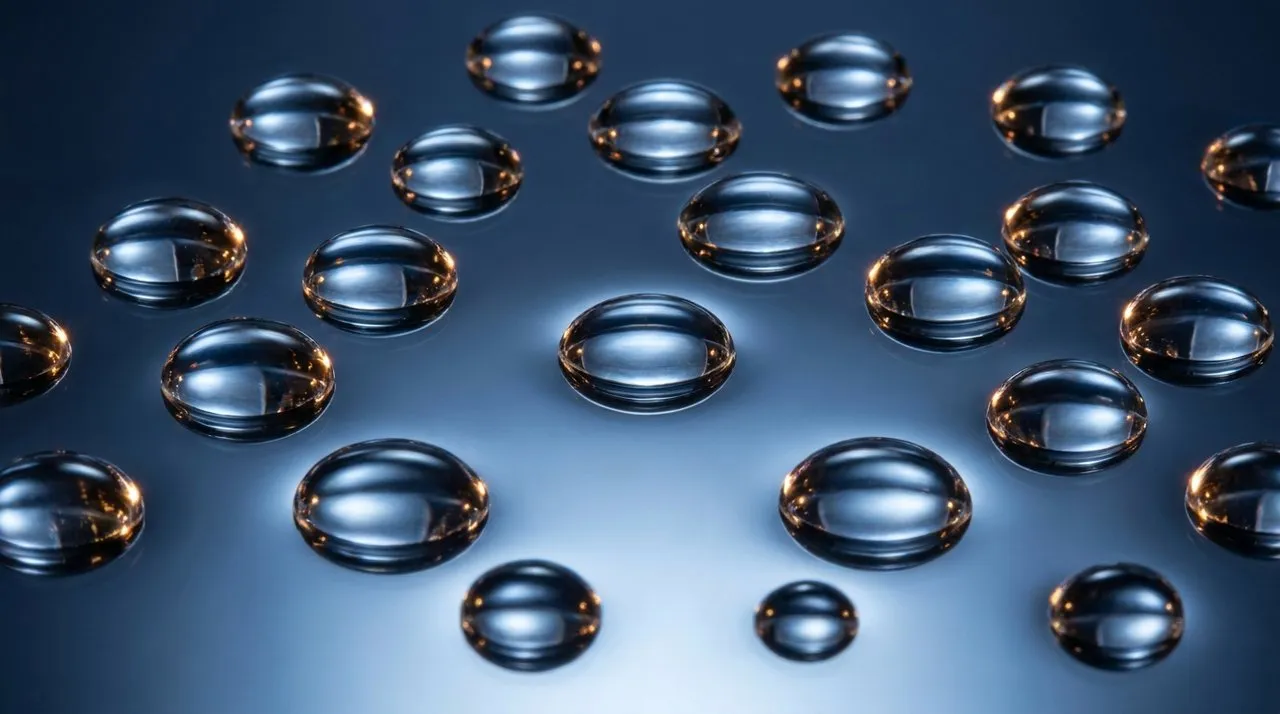
No. Cyclopentasiloxane (D5) is practically insoluble in water. The measured value reported on PubChem is 0.017 mg/L at 25 °C, written there as 1.7 x 10⁻² mg/L. To make that concrete: a teaspoon of D5 dropped into a swimming pool would not meaningfully dissolve. It would spread, bead, and float.
For a procurement or formulation decision, treat that figure as zero functional solubility. You cannot dissolve D5 into a water phase, thin it with water, or rinse it off with water alone. Cyclohexasiloxane (D6), the next homolog up, is even less soluble at 0.0051 mg/L. Both fluids partition out of water and into oils and other silicones, and any datasheet reports their water solubility in micrograms per liter, not percent.
What are cyclopentasiloxane’s key physical properties?
D5 is a colorless, volatile, low-viscosity silicone fluid that is lighter than water. It flows like a thin oil at room temperature, evaporates without residue, and carries a flash point low enough that the SDS treats it as a combustible liquid. Those traits, not any water affinity, are why it earned its place as a cosmetic carrier and a dry-feel emollient.
The table below compares D5 against D6 using experimental values from PubChem. The two fluids sit one ring size apart, and the property gradient is consistent: add a siloxane unit and the molecule gets heavier and less volatile, and its water solubility drops even further. Stored cool and sealed, the fluid is stable. The low flash point, not water uptake, is the handling constraint that sets its transport classification.
| Property | Cyclopentasiloxane (D5) | Cyclohexasiloxane (D6) |
|---|---|---|
| CAS / EC number | 541-02-6 / 208-764-9 | 540-97-6 / 208-762-8 |
| Molecular formula | C10H30O5Si5 | C12H36O6Si6 |
| Molecular weight | 370.77 g/mol | 444.92 g/mol |
| Appearance | colorless volatile liquid | oily, odorless liquid |
| Boiling point | 210 °C | 245 °C |
| Melting point | -38 °C | -3 °C |
| Density | 0.959 g/cm3 (20 °C) | 0.967 g/cm3 (25 °C) |
| Kinematic viscosity | 3.9 cSt (25 °C) | 6.62 cSt |
| Vapor pressure | 0.2 mmHg | 0.0169 mmHg (25 °C) |
| Flash point (closed cup) | 73 °C | 91 °C |
| Water solubility | 0.017 mg/L (25 °C) | 0.0051 mg/L (23 °C) |
A fourth cyclosiloxane shows up in any D5 conversation: octamethylcyclotetrasiloxane (D4, CAS 556-67-2, C8H24O4Si4, 296.61 g/mol). D4 is the smaller, more volatile ring and a common low-level residual in commercial D5. It carries its own restriction, so its presence is a sourcing question, not a footnote. More on that below.
Why doesn’t cyclopentasiloxane dissolve in water?
Because the molecule is nonpolar and has nothing for water to grab. D5 is a five-membered ring of alternating silicon and oxygen atoms, with every silicon capped by two methyl groups (the structure behind the formula C10H30O5Si5). Those methyl groups wrap the polar Si-O backbone in a nonpolar shell. The fluid has no hydrogen-bond donor and almost no exposed polarity.
Water dissolves what it can hydrogen-bond to or solvate as ions. D5 offers neither, so the two phases separate to minimize contact area. The same nonpolarity that blocks water solubility makes D5 highly compatible with oils and esters and with other silicone fluids, which is the property formulators want. For a buyer, the consequence is operational: any process step that depends on a water rinse, a water dilution, or an aqueous extraction will not move D5, so plan solvent or surfactant handling into the line from the start.
The honest trade-off sits inside that volatility. A 0.2 mmHg vapor pressure and a 210 °C boiling point let D5 flash off the skin or substrate, leaving a dry, non-greasy finish with no water needed. The same volatility and persistence are what put the cyclosiloxanes on the regulators’ radar. The feature that sells the fluid is the feature that now constrains it.
How do you add silicone slip to a water-based formula?
You do not use neat D5. You either switch to a water-soluble silicone or emulsify the D5 into the system. There is no formulation trick that makes raw cyclopentasiloxane dissolve in a water phase.
Two routes cover most cases:
Use a water-soluble silicone. PEG-modified dimethicones, also called dimethicone copolyols, graft polyethylene-glycol chains onto the silicone backbone. Those chains hydrogen-bond with water, so the material disperses or dissolves where D5 cannot. PEG-12 dimethicone is a common choice for clear aqueous systems and surfactant blends.
Emulsify the D5. Keep the cyclopentasiloxane for its dry-down feel, then stabilize it with a silicone emulsifier into a water-in-silicone or oil-in-water system. This preserves the volatile sensory that a PEG-dimethicone alone will not reproduce.
For cleanup and handling the rule follows the chemistry. D5 will not rinse off a vessel or skin with water; remove it with a nonpolar solvent or a surfactant system. If your application needs a non-volatile silicone film instead of a fast-evaporating carrier, dimethicone is the linear, non-volatile counterpart, and the broader silicone oil families cover the viscosity range between them. The grade decision is a sensory and regulatory decision, not a solubility one, because none of these dissolve in water.
How does REACH restrict cyclopentasiloxane?
Under REACH, D5 is restricted in the EU, and the deadlines are close. Commission Regulation (EU) 2024/1328 of 16 May 2024 amended entry 70 of Annex XVII to REACH and entered into force on 6 June 2024. It extended the restriction to cover D4, D5, and D6 across cosmetic uses. The substances are classified as very persistent and very bioaccumulative (vPvB) and as substances of very high concern (SVHC), and ECHA identifies cosmetic release as the dominant environmental pathway.
The placing-on-market thresholds are concentration-based and phased:
| Use category | Restriction trigger | Effective date |
|---|---|---|
| Wash-off cosmetic products | D4, D5, or D6 at or above 0.1% by weight | 6 June 2026 |
| Leave-on cosmetic products | D4, D5, or D6 at or above 0.1% by weight | 6 June 2027 |
The 0.1% limit applies whether the substance is present on its own, as a constituent of another substance, or in a mixture. The constraint is EU-market-facing: it governs what can be placed on the EU market, so it bites on any buyer formulating products bound for Europe even if the blending happens elsewhere. D6 (PubChem CID 10911) was pulled into the same entry, which closes the substitution loophole of swapping one cyclosiloxane for another.
What should buyers verify before sourcing D5?
Confirm the substance identity and the residual D4 content before the line goes onto a purchase order, then verify the regulatory posture for the destination market. The fluid is well characterized, so a complete certificate of analysis (CoA) and technical data sheet (TDS) should answer every question below without back-and-forth.
Lock the identity. Specify cyclopentasiloxane, CAS 541-02-6, EC 208-764-9 on the RFQ. The INCI name is the same. This separates pure D5 from the multi-ingredient silicone blends that also list D5 on the label.
Ask for residual D4. Octamethylcyclotetrasiloxane (D4, CAS 556-67-2) rides along as a low-level residual in commercial cyclopentasiloxane and carries its own Annex XVII restriction. Require the residual D4 figure on the CoA and reject lots that exceed your target.
Pin the REACH status for EU-bound product. If any finished good ships into the EU, map your formula against the 6 June 2026 and 6 June 2027 deadlines now, and ask the supplier to state the cyclosiloxane content in writing.
Read the SDS for handling. The 73 °C closed-cup flash point makes D5 a combustible liquid. Confirm storage and transport classification before the first container moves.
Match the grade to the phase system. If the end use is a water-based product, the data above says D5 is the wrong tool. Route the spec toward a water-soluble PEG-dimethicone instead.
Frequently asked questions
Is cyclopentasiloxane soluble in water? No. Its measured water solubility is about 0.017 mg/L at 25 °C (PubChem). For formulation purposes that is insoluble: D5 separates and floats on a water phase instead of dissolving.
If D5 will not dissolve in water, what does it mix with? Cyclopentasiloxane is a nonpolar, lipophilic fluid. It blends with oils and esters and with other silicone fluids, which is why it works as a fast-drying carrier in the oil phase, not the water phase.
What is the difference between cyclopentasiloxane and dimethicone? Cyclopentasiloxane (D5) is a small cyclic siloxane that is volatile and evaporates after application. Dimethicone is a linear polydimethylsiloxane that is non-volatile and stays on the surface as a film. Both are water insoluble.
Is cyclopentasiloxane being banned? In the EU it is restricted, not banned outright. REACH Regulation (EU) 2024/1328 prohibits placing D5 on the market at or above 0.1% in wash-off cosmetics from 6 June 2026 and in leave-on cosmetics from 6 June 2027.
What can replace cyclopentasiloxane in a water-based product? Use a water-soluble silicone. PEG-modified dimethicones such as PEG-12 dimethicone carry polyethylene-glycol chains that hydrogen-bond with water, so they disperse where neat D5 cannot.
Sourcing the right silicone for the phase
The solubility question is a grade-selection question in disguise. Specifications and viscosity data for cyclopentasiloxane (D5), cyclohexasiloxane (D6), and the water-soluble PEG-dimethicones sit on their individual product pages, and the Beauty & Personal Care hub groups the silicones used in skin and hair care.
Match the fluid to the phase first, then confirm the REACH position before the line goes through a request for quote. For the consumer-facing side of the same molecule, the breakdown of whether cyclopentasiloxane is good or bad for hair covers the performance trade-offs a formulator will field from the marketing team.
Physical-property and solubility values cited here are experimental data reported on PubChem for CID 10913 (D5) and CID 10911 (D6); regulatory thresholds are drawn from Commission Regulation (EU) 2024/1328 and ECHA’s cyclosiloxanes guidance.
Frequently asked questions
Is cyclopentasiloxane soluble in water?
If D5 will not dissolve in water, what does it mix with?
What is the difference between cyclopentasiloxane and dimethicone?
Is cyclopentasiloxane being banned?
What can replace cyclopentasiloxane in a water-based product?
Sources & methodology
Regulatory citations are current as of publication. Chemical identities verified by CAS number against the RawSource catalog.
Search 1,300+ industrial chemicals by name or CAS, or send us your spec — we quote by the drum, tote, or container.
Browse the Chemical Index → Request a Quote