
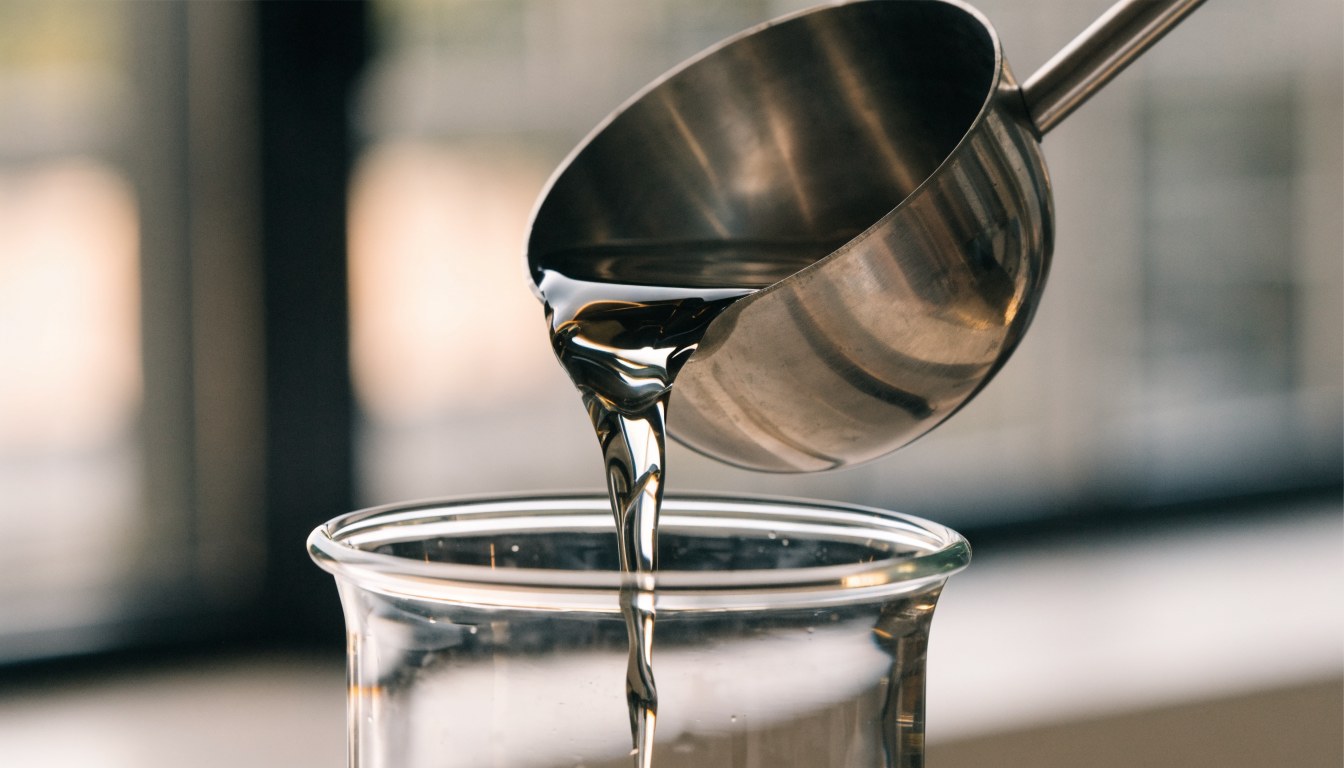
Your purchase order reads “silicone oil, CAS 9006-65-9.” The supplier ships a drum that pours like water. Maintenance wanted a fluid for a rotary damper, where the viscosity sets the damping torque, and this one will run straight through the mechanism. Nobody shipped the wrong chemical, and the supplier can show the order was filled as written. The name and the registry number describe a family of fluids. The specification lives in a number the order left out.
Reviewed and updated July 2026 by the RawSource technical team.
What is silicone oil, and what does the name leave out?
Silicone oil most often means polydimethylsiloxane (PDMS), also sold as dimethicone or silicone fluid: a chain of alternating silicon and oxygen atoms, two methyl groups on each silicon, capped at both ends by trimethylsiloxy units. The term also covers the modified fluids in the types table below. For PDMS, chain length sets viscosity, so the grade you buy is a viscosity in centistokes (cSt), not a name or a CAS number.
The Cosmetic Ingredient Review (CIR) Expert Panel’s 2022 amended safety assessment defines dimethicone as a mixture of fully methylated linear siloxane polymers end-blocked with trimethylsiloxy units. The word mixture matters. FDA’s Global Substance Registration System (GSRS) agrees. Its dimethicone record, as retrieved in 2026, classes the substance as a mixture and lists the components as viscosity-named grades: dimethicone 20, 100, 200, 350, 410, 500, 1000 and 12500.
Synonym lists for dimethicone include both silicone oil and silicone fluid. That is why a buyer, a formulator and a maintenance planner can all say silicone oil and mean three different drums.
Why does CAS 9006-65-9 not identify your fluid?
GSRS codes CAS 9006-65-9 as GENERIC (FAMILY), not as a single substance, and EPA’s Substance Registry Services gives its molecular formula as Unspecified. PubChem shows what that means in practice. Of its 62 depositor substance records for the number, 37 standardize to discrete small molecules: 25 to hexamethyldisiloxane (PubChem CID 24764) and 12 to octamethyltrisiloxane (PubChem CID 24705). The other 25 have no standardized structure.
The visible symptom is the molecular weight. A record filled from PubChem lists dimethicone at 236.53 g/mol, with the formula C8H24O2Si3 and the IUPAC name dimethyl-bis(trimethylsilyloxy)silane. That is octamethyltrisiloxane, a three-silicon oligomer. It does not describe the long chains in a 1000 cSt fluid. Treat a single molecular weight on a silicone oil specification sheet as a database artifact until the supplier shows otherwise, and never use it to compare lots.
Other registries add names, not precision. ECHA’s name list for 9006-65-9 includes “Trimethyl-trimethylsilyloxy-silane”, the two-silicon member, alongside polydimethylsiloxane. The EU CosIng inventory (2023 entry) lists the INCI name DIMETHICONE against three registry numbers, including 63148-62-9 as well as 9006-65-9. Two correct documents for the same drum can therefore carry different CAS numbers. Use the CAS to confirm the chemical family, and the viscosity and grade documents to confirm the fluid.
Viscosity is the specification, and the references disagree on its range
Kinematic viscosity follows chain length, and it is the number that separates one silicone oil from another. The trouble starts when a buyer assumes the name dimethicone implies a range. The reference texts do not agree on one:
| Reference | Viscosity range attached to dimethicone | How to read it |
|---|---|---|
| FDA GSRS dimethicone record | 50 to 1000 cSt | a property field, non-defining and unreferenced in the record |
| JECFA specification, cited secondhand | 100 to 1500 cSt | a food-additive specification range; no edition given |
| USP monograph, cited secondhand | 20 to 30,000 cSt | a pharmacopeial range; no edition given |
Across the three, the name alone admits anything from 20 cSt to 30,000 cSt. A specification that says “dimethicone, pharmaceutical grade” or “silicone oil, medium viscosity” has handed the choice of fluid to the supplier.
Watch the unit as closely as the number. GSRS records two blends of dimethicone and dimethiconol at 3200 cP and 6500 cP at 25 °C, centipoise being a dynamic viscosity, in a field labeled kinematic. If a public registry can mix the two units, so can a quote. For a silicone fluid the two numbers sit close together but are not equal. A Certificate of Analysis (CoA) reported in one unit cannot be checked line by line against an order written in the other.
Viscosity also explains why silicone oil is chosen over a hydrocarbon in the first place. Its viscosity changes less with temperature than a mineral oil’s does, so a grade picked at the bench stays closer to its rated value in a hot engine bay or a cold warehouse.
Types of silicone oil: what end groups and side groups change
Linear dimethicone is the baseline. The other silicone oils swap the end groups or hang a functional group off the chain, and each change moves the fluid into a different job. The generic names below are the ones to put on a specification.
| Type | Generic name and CAS | What changes in the molecule | Where it is used |
|---|---|---|---|
| Linear, methyl-capped | dimethicone, 9006-65-9 | trimethylsiloxy end caps; chain length sets viscosity | damping, foam control, slip, cosmetic emollient |
| Volatile cyclic | cyclopentasiloxane, 541-02-6 | a five-silicon ring, C10H30O5Si5, boiling at 210 °C (PubChem) | personal-care carrier, dry-cleaning solvent, feedstock for higher-molecular-weight silicones |
| Hydroxyl-terminated | dimethiconol, 31692-79-2 | hydroxyl end groups in place of trimethylsiloxy | hair and skin-care blends; name the end use and the diluent on the RFQ |
| Amino-functional | amodimethicone | amino groups on the siloxane backbone (CIR) | hair-conditioning agent |
| Polyether-modified | PEG-12 dimethicone, 68937-54-2 | polyethylene glycol chains on the siloxane | silicone surfactant: emulsifier and wetting agent |
| Phenyl-modified, cosmetic small molecule | phenyl trimethicone | one phenyl group on a small branched siloxane, not a phenylmethyl polymer fluid | hair shine: a 2003 image-analysis study measured higher luster on hair tresses after application |
In personal care, a cyclic grade is chosen because it evaporates and a linear dimethicone because it stays. A formulator who swaps one for the other on price changes how the product dries. Linear is not a guarantee of persistence, though: hexamethyldisiloxane and octamethyltrisiloxane, the two- and three-silicon oligomers, are linear and volatile too. A maintenance buyer who receives a volatile grade in place of a damping fluid gets a fluid that leaves the mechanism it was meant to fill.
Silicone oil uses, sorted by the property doing the work
Whether the label says silicone oil or silicone fluid, each use leans on one property, and that property narrows the grade.
Foam control. Low surface tension lets a small dose of silicone oil spread over a foam film and break it. In oil-based service such as petroleum processing, the fluid itself does that work. Water-based systems, including laundry detergents, use a silica-filled compound or its emulsion, not the neat fluid: a separate order line from the oil. In coatings the same property gives slip and leveling, but the wrong silicone at the wrong dose can cause the surface defects it was added to prevent.
Viscous damping. Silicone oil fills torsional vibration dampers on crankshafts and drivelines and the viscous couplings that transfer torque. It also damps vibration and pulsation in rotary dampers, control valves, dashpots and aviation gyroscopes. Crankshaft and driveline service calls for heat- and shear-stable grades. In soft-close hinges, lids and knobs the viscosity sets the damping torque, so the grade is a design parameter, and a substitute of another viscosity changes how the product feels in the hand.
Slip and release. As a lubricant, the fluid gives slip to films, yarn and fillers, and in plastics it serves as a slip and mold-release additive. The boundary matters here: melt-blended masterbatch uses an ultra-high-molecular-weight silicone gum, not the fluid, so an order for silicone oil to make a masterbatch has named the wrong form. The engineering side of lubrication, release and damping service is covered in more depth in silicone oil industrial uses.
Personal care. CosIng lists dimethicone under antifoaming, emollient and skin-conditioning functions, and product records add an antistatic role in cosmetics. Cyclopentasiloxane serves as a volatile carrier and solvent in skin, hair and make-up products, and as the vehicle in antiperspirants and aerosols that contain insoluble powders. PEG-12 dimethicone emulsifies water and silicone phases, which plain dimethicone cannot do because it does not mix with water.
What should a silicone oil purchase order specify?
-
The type by generic name: linear dimethicone, cyclopentasiloxane, dimethiconol, or a functional variant by its INCI name.
-
Kinematic viscosity in cSt, the measurement temperature, and the tolerance you will accept on the CoA.
-
The unit the CoA must report, so it can be checked against the order without a density conversion.
-
The qualification the end use needs (food, pharmaceutical, cosmetic or general industrial) and the document that proves it.
-
The registry number the Safety Data Sheet (SDS) and CoA will carry, agreed in advance, since CosIng lists dimethicone under more than one.
-
Notice before any change of grade or source, for any mechanism designed around a viscosity.
Methodology: identity, registry and viscosity-range data come from PubChem, FDA GSRS, EPA Substance Registry Services, ECHA, the EU CosIng inventory, the CIR Expert Panel’s 2022 assessment and a 2003 hair-luster study; application examples come from catalog product records. The JECFA and USP ranges are cited secondhand with the GSRS viscosity entry, not from the monographs, and carry no edition. No figure here is a product specification; the CoA for the lot governs.
This is general technical information without warranty; the buyer qualifies the grade for its intended use.
Frequently asked questions
What can replace silicone oil?
It depends on which property you bought it for. For lubrication and hydraulics, mineral oils, polyalphaolefins (PAOs), and synthetic esters handle steel-on-steel service better, inside a narrower temperature window. For heat transfer, polyalkylene glycols and aromatic heat-transfer fluids stand in at moderate temperatures. For foam control where silicone carryover would contaminate coatings or downstream processes, mineral-oil and polyether defoamers are the usual swap. No single fluid replaces the whole PDMS stack of wide service temperature, chemical inertness, and 20-21 mN/m surface tension, so substitution is decided application by application.
Is WD-40 the same as silicone oil?
No. WD-40 Multi-Use Product is a petroleum-derived blend, not a silicone. The manufacturer’s safety data sheet (revised November 2024) lists 45-50 percent LVP aliphatic hydrocarbon and up to 35 percent petroleum base oil, with no siloxane on the ingredient list.
Silicone oil is polydimethylsiloxane, a single synthetic polymer fluid graded by viscosity. The two are not interchangeable: PDMS covers a much wider service-temperature range and is compatible with plastics and elastomers that petroleum products can attack. Where a process spec names silicone oil, a petroleum penetrating product is not a substitute.
What is silicone oil used for?
Is silicon oil the same as silicone oil?
What is silicone oil made of?
Is silicone oil safe?
Can a quote in cP be compared with a specification in cSt?
Sources & methodology
Figures are RawSource sourcing data unless attributed to a named source. Regulatory citations are current as of publication. Chemical identities verified by CAS number against the RawSource catalog.
Search 1,300+ industrial chemicals by name or CAS, or send us your spec — we quote by the drum, tote, or container.
Browse the Chemical Index → Request a Quote