

The data center thermal problem has changed
Air cooling tops out around 20–30 kW per rack in most real deployments. AI training and high-density GPU racks now push past 50–100 kW, and roadmap parts are heading higher. That is the gap forcing liquid into the white space, whether as direct-to-chip cold plates or single-phase immersion. Once you commit to liquid, the fluid stops being a commodity line item and becomes a design parameter that sets heat-removal capacity, electrical safety margin, materials compatibility and service interval.
This page lays out where silicone-based polydimethylsiloxane (PDMS) fluids fit, with the property numbers an engineer actually qualifies against, and the honest trade-offs against the alternatives. It is written for the thermal and procurement teams specifying the fluid, not for marketing.
Why the fluid choice is a real engineering decision
The fluid in a direct-to-chip loop or an immersion tank drives heat-removal efficiency, pump energy, maintenance interval, materials compatibility and total cost of ownership. Two properties carry most of the weight: thermal conductivity (how fast heat moves through the fluid) and electrical behavior (whether the fluid can sit against live silicon without shorting it). Those two pull in opposite directions, which is the heart of every coolant trade-off below.
Silicone (PDMS) heat-transfer fluids: the numbers
PDMS fluids (dimethicone; the fluid grades are commonly listed under CAS 63148-62-9) have been used in electronics and industrial thermal management for decades. For electronics cooling, the relevant properties of a mid-viscosity grade such as a 350 cSt PDMS are roughly:
- Thermal conductivity: about 0.15 W/m·K at 25 °C. This is in the normal band for dielectric fluids (typically 0.1–0.2 W/m·K) and is the property to be honest about, because it is well below water.
- Specific heat: roughly 1.5 J/g·K, which sets how much heat a given mass of circulating fluid can carry per degree of temperature rise.
- Dielectric strength: on the order of 14 kV/mm, with high volume resistivity. PDMS is inherently non-conductive, so it can contact live electronics directly.
- Thermal stability: usable continuously to roughly 150–200 °C with good oxidation resistance; flash points for mid and high grades run above 300 °C.
- Viscosity range: grades span from a few cSt to over 10,000 cSt. Low grades (for example 5–50 cSt) favor pumped loops and low pressure drop; higher grades reduce evaporation and misting but cost pumping energy.
- Low pour point and low vapor pressure: PDMS stays fluid in cold starts and loses little to evaporation over long service, which limits top-up.
The practical recommendation: pick the viscosity grade to the architecture. A pumped direct-to-chip loop wants a low-cSt grade to keep pump energy and pressure drop down; an open immersion tank may favor a higher grade to suppress misting and evaporation. Always qualify the specific lot for low moisture content and outgassing, since trace water and volatiles, not the bulk fluid, are what cause field problems near electronics.
Silicone versus the alternatives
There is no free lunch in coolant selection. Water moves heat far better than any dielectric but conducts electricity, so it stays in sealed cold plates and never touches live parts. Dielectric fluids accept lower thermal conductivity in exchange for electrical safety. The table compares the families an immersion or direct-to-chip program will actually evaluate.
| Fluid family | Thermal conductivity (W/m·K) | Dielectric? | Key trade-off |
|---|---|---|---|
| Water / glycol | ~0.4–0.6 | No (conductive) | Best heat transfer, but must stay in sealed cold plates; a leak onto live parts is catastrophic. |
| Silicone (PDMS) | ~0.15 | Yes | Strong thermal stability and long service life; broad viscosity range; lower conductivity than water. |
| Synthetic hydrocarbon (PAO) | ~0.13–0.15 | Yes | Low cost and good heat capacity; generally lower service temperature and oxidation margin than silicone. |
| Mineral oil | ~0.13–0.15 | Yes | Cheapest immersion option; more prone to oxidation and sludging over long runs. |
| Fluorinated (PFAS-based) | ~0.06–0.07 | Yes | Excellent dielectric and clean evaporation, but lowest thermal conductivity and rising regulatory and cost pressure. |
The honest read: water-glycol still wins on raw heat transfer by roughly threefold, which is why direct-to-chip cold plates keep using it inside a sealed loop. Among the dielectrics that can be poured around live hardware, silicone, PAO and mineral oil land close on thermal conductivity, and the decision comes down to service temperature, oxidation life, materials compatibility and cost rather than a single headline number. Silicone’s case is long-term thermal stability and a wide viscosity range; PAO’s is cost; fluorinated fluids buy clean dielectric behavior at the price of the lowest conductivity and growing PFAS scrutiny.
Where silicone fluids fit in the data center
Silicone-based materials already appear across several thermal jobs, not only as a circulating fluid:
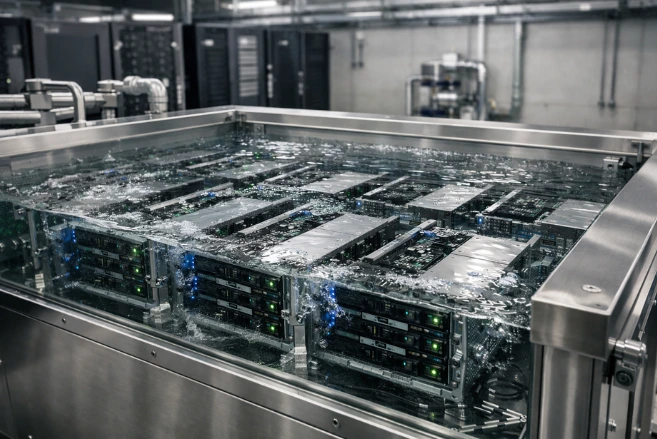
- Single-phase immersion: dielectric PDMS fluids are evaluated as the bath in single-phase tanks, where thermal stability and electrical safety matter more than the last few percent of conductivity.
- Thermal interface materials (TIMs): silicone greases, gap fillers and pads bridge the chip-to-coldplate interface. This is the most established silicone role in server hardware.
- Power electronics and infrastructure: PDUs, voltage regulators and auxiliary electronics use silicone-based thermal management materials.
What to qualify before you specify a fluid
Viscosity and thermal conductivity get the attention, but field reliability usually turns on the secondary properties. Before committing a fluid to a fleet, qualify:
- Moisture content (low water is essential near electronics) and a per-lot certificate of analysis.
- Dielectric strength and volume resistivity at operating temperature, not just nameplate.
- Volatility and outgassing behavior over the expected service temperature.
- Long-term thermal-aging data, since a 24/7 load runs for years without shutdown.
- Materials compatibility with the specific elastomers, seals, plastics and metals in your hardware. Well-specified PDMS is broadly compatible, but seals and gaskets should still be tested in the actual fluid.
One genuine open question worth naming: like all silicones, PDMS faces environmental scrutiny over certain cyclic siloxanes, which is part of why fluorinated fluids are also under pressure. Linear PDMS fluids are the relevant grade here, but a serious program tracks the regulatory picture for whichever chemistry it standardizes on.
Sourcing silicone heat-transfer fluids
A common starting point for evaluation is a mid-viscosity grade such as Silicone Oil 350 cSt, with lower-cSt grades available for pumped loops and higher grades for misting control, all qualifiable to your architecture. See our silicones range for the full lineup.
To request a quote, send the viscosity grade and quantity, your cooling architecture (direct-to-chip, cold plate or immersion), and any spec limits on moisture, resistivity or outgassing, and we will scope sourcing and qualification samples to the application.
Frequently Asked Questions
What is the thermal conductivity of silicone heat-transfer fluid?
A typical mid-viscosity PDMS fluid is around 0.15 W/m·K at 25 °C, within the normal 0.1–0.2 W/m·K band for dielectric coolants. That is well below water-glycol (about 0.4–0.6 W/m·K), which is why water stays in sealed cold plates while dielectric silicone can be used in direct contact with electronics.
Why use silicone instead of water for data center cooling?
Water moves heat better but conducts electricity, so a leak onto live hardware can be catastrophic and it must stay in a sealed loop. Silicone (PDMS) is dielectric with a dielectric strength on the order of 14 kV/mm, so it can sit directly against electronics in single-phase immersion. The trade is lower thermal conductivity for electrical safety.
How does silicone compare to fluorinated (PFAS) cooling fluids?
Fluorinated fluids have excellent dielectric behavior but the lowest thermal conductivity of the common families (about 0.06–0.07 W/m·K) and face rising PFAS regulatory and cost pressure. Silicone offers higher thermal conductivity (~0.15 W/m·K), strong thermal stability and a wide viscosity range, which is why operators are evaluating it as an alternative.
Which viscosity grade should I use?
Match the grade to the architecture. Low-cSt grades (roughly 5–50 cSt) suit pumped direct-to-chip loops where pressure drop and pump energy matter. Higher grades reduce evaporation and misting in open immersion tanks but cost more pumping energy. A 350 cSt grade is a common middle-ground starting point for evaluation.
What should I qualify before committing to a fluid?
Beyond viscosity and thermal conductivity, qualify moisture content, dielectric strength and resistivity at operating temperature, volatility and outgassing, long-term thermal-aging data, and materials compatibility with your specific seals, elastomers and metals. Trace water and volatiles, not the bulk fluid, are the usual cause of field problems near electronics.
Search 1,300+ industrial chemicals by name or CAS, or send us your spec — we quote by the drum, tote, or container.
Browse the Chemical Index → Request a Quote