
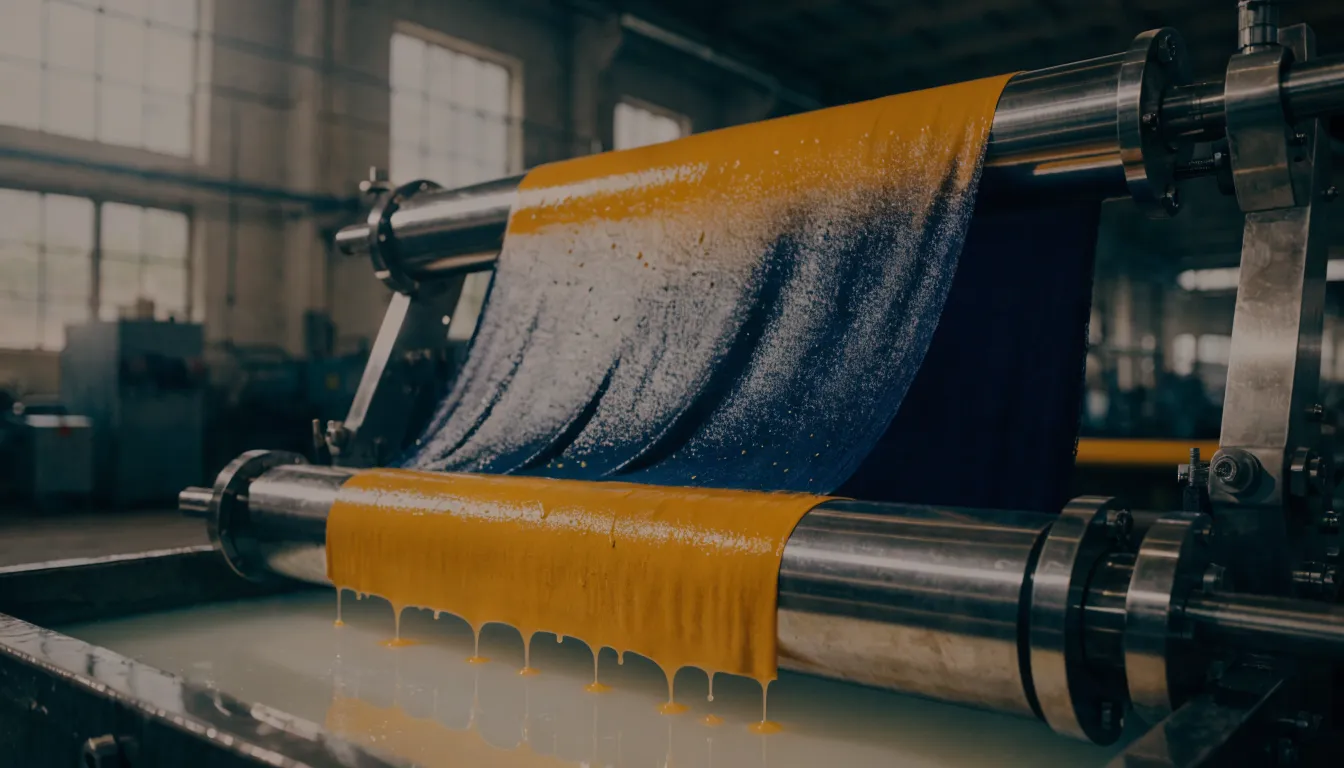
Whiteness is unforgiving. A finisher running white or pastel goods can spec the softest amino silicone on the market and still lose the lot to yellowing, because the same amine groups that anchor the softener to the fiber oxidize under heat. That is one of several places in a mill where the plain, non-reactive silicone emulsion (no amine, no anchor, no yellowing chemistry) is the right tool for the job.
The short version: a non-reactive silicone emulsion is polydimethylsiloxane (PDMS, CAS 63148-62-9) dispersed in water, diluted at the mill into sizing, softening, and lubrication baths. The PDMS film lowers fiber-to-fiber and fiber-to-metal friction, which reads as a softer hand, smoother yarn running, and fewer needle-heat problems in sewing. It is less durable on the fiber than an amino-functional softener, because no amino group bonds it in place, but it does not yellow, costs less, and covers fabric sizing and thread-lubrication duties the reactive grades are overkill for. See the silicone emulsion product page.
What the silicone does on the fiber
Hand, drape, and sewability are mostly friction phenomena. PDMS has one of the lowest surface energies of any common fluid, and a thin film of it on fiber, yarn, or fabric lowers the friction between fibers and between fiber and metal. Lower fiber-to-fiber friction is what fingers read as softness and what lets a fabric drape. Lower fiber-to-metal friction is what keeps a sewing thread from snagging, shredding, or overheating at the needle at industrial stitching speeds.
A non-reactive emulsion delivers that film without bonding it to the fiber. The film sits on the surface, does its job through processing and early use, and progressively washes off. That is the defining trade-off of this chemistry, and the recommendation that follows: use the plain emulsion where the benefit is needed during manufacture (sizing, sewing, cutting) or where non-yellowing matters more than wash-durability, and step up to an amino-functional grade when the softness must survive fifty home launderings.
The three textile duties it covers
| Duty | What the emulsion does | Practice notes |
|---|---|---|
| Fabric sizing | Lubricant component in the size formulation; smoother weaving, less fiber abrasion | A TDS-named application for the RS-EM grades; effective at low concentration |
| Softening / hand-building | Surface PDMS film lowers fiber friction for a softer, smoother hand | Non-yellowing; validate hand and wash-durability on your own goods |
| Thread and yarn lubrication | Low-friction film for sewing thread, spinning, and knitting | The heavier 1,000 cSt-base film often earns its keep here |
Two duties deserve a caution each. In softening, a plain PDMS film is hydrophobic, and like every silicone softener it can reduce a fabric’s water absorbency, an issue for towels and activewear, where hydrophilic-modified silicones exist for a reason. In sizing and lubrication, more is not better: the emulsion is formulated to be effective at low concentration, and overloading a bath buys residue, not performance.
Non-reactive vs amino-functional: the honest split
| Factor | Non-reactive PDMS emulsion | Amino-functional silicone |
|---|---|---|
| Softness / hand | Good, surface-level | Softest; oriented, anchored film |
| Durability to washing | Lower (non-substantive film) | High (amino groups anchor to fiber) |
| Yellowing risk on whites | None from the silicone (no amine) | Real; low-yellowing grades exist |
| Relative cost | Lower | Higher |
| Typical fit | Sizing, thread lube, non-yellowing softening, process-side duties | Premium garment and towel finishing |
Neither column wins outright, and a mill that runs both is usually running both correctly. The full amino story, including microemulsion vs macroemulsion and the hydrophilic-modified grades, is in our amino silicone textile softener guide. If a supplier quotes “silicone softener” without saying which chemistry, ask; the two are not interchangeable on white goods or on wash-durability specs.
Running it in the mill: dilution and bath stability
The RS-EM grades are 60%-class concentrates (typical 63% solids; the class arithmetic is in what a 60% silicone emulsion is), and the bath is only as stable as the dilution practice. Dilute with cold water, adding the concentrate under low, gentle shear. Keep dilution water below roughly 200 ppm hardness; by the USGS scale that already covers “very hard” municipal water, but mills on hard well water should qualify softened water before blaming the emulsion for a split bath. Agitate standing baths gently before use, and store the concentrate at 5–32 °C, never frozen, within its 12-month shelf life.
The non-ionic emulsifier system is the quiet advantage in a finishing bath: it carries no charge, so it is far less likely to react with the dyes, salts, and auxiliaries already in the liquor than an ionic system would be. Compatibility is still your test to run; a bench-scale bath with your actual auxiliaries is an hour well spent before a production trial.
Buying silicone emulsion for textile work
See the Amino-Functional Silicone product page. Tell us your fabric, bath auxiliaries, and water hardness, and request a sample to validate hand and compatibility on your own goods.
To source the 60%-class grades in drums or totes, see the silicone emulsion supplier page: base viscosity, certified solids, dilution, and storage terms.
Frequently asked questions
What is silicone emulsion used for in textiles?
Three duties: as a lubricant component in fabric sizing, as a non-yellowing surface softener for fabric and garments, and as a friction-reducing lubricant for sewing thread and yarn processing. In each case a thin PDMS film lowers fiber-to-fiber and fiber-to-metal friction.
Is a plain silicone emulsion or an amino silicone better for fabric softening?
They solve different problems. Amino-functional silicone anchors to the fiber and gives the softest, most wash-durable hand, but its amine groups can yellow whites. A plain non-reactive PDMS emulsion cannot yellow (no amine), costs less, and softens well at the surface, but the finish is less durable to washing. Whites and process-side duties favor the plain emulsion; premium durable softness favors amino.
Does silicone softener yellow white fabric?
Amino-functional softeners can: the amine groups oxidize under heat, which is why low-yellowing modified grades exist. A non-reactive PDMS emulsion has no amine and does not contribute that yellowing mechanism, which is exactly why it is chosen for whites and pastels.
Will a silicone finish make fabric less absorbent?
It can. PDMS is hydrophobic, and any silicone film may reduce water absorbency, a genuine concern for towels and activewear. Validate absorbency on your own goods, and where absorbency must be preserved, hydrophilic-modified silicones are the usual answer.
How is a silicone emulsion added to a finishing bath?
Dilute the 60%-class concentrate into cold water under low shear before it goes to the bath, keep dilution water under roughly 200 ppm hardness, and agitate standing baths before use. The non-ionic system is broadly compatible with common auxiliaries, but bench-test the actual liquor before a production run.
Editorial note. This article is general technical guidance for textile finishers and industrial buyers. Softening, sizing, lubrication, and compatibility outcomes depend on your fiber, construction, bath auxiliaries, and process, and must be validated on your own goods; property values quoted (solids, hardness tolerance, storage range, shelf life) are typical values, not guaranteed specifications; the Certificate of Analysis governs the lot you buy. Products are sold for industrial and professional use only, and nothing here is a performance guarantee or a consumer fabric-care claim. Always consult the current Safety Data Sheet (SDS) before handling. RawSource makes no warranty, express or implied, and assumes no liability for use of this information.
Search 1,300+ industrial chemicals by name or CAS, or send us your spec — we quote by the drum, tote, or container.
Browse the Chemical Index → Request a Quote