
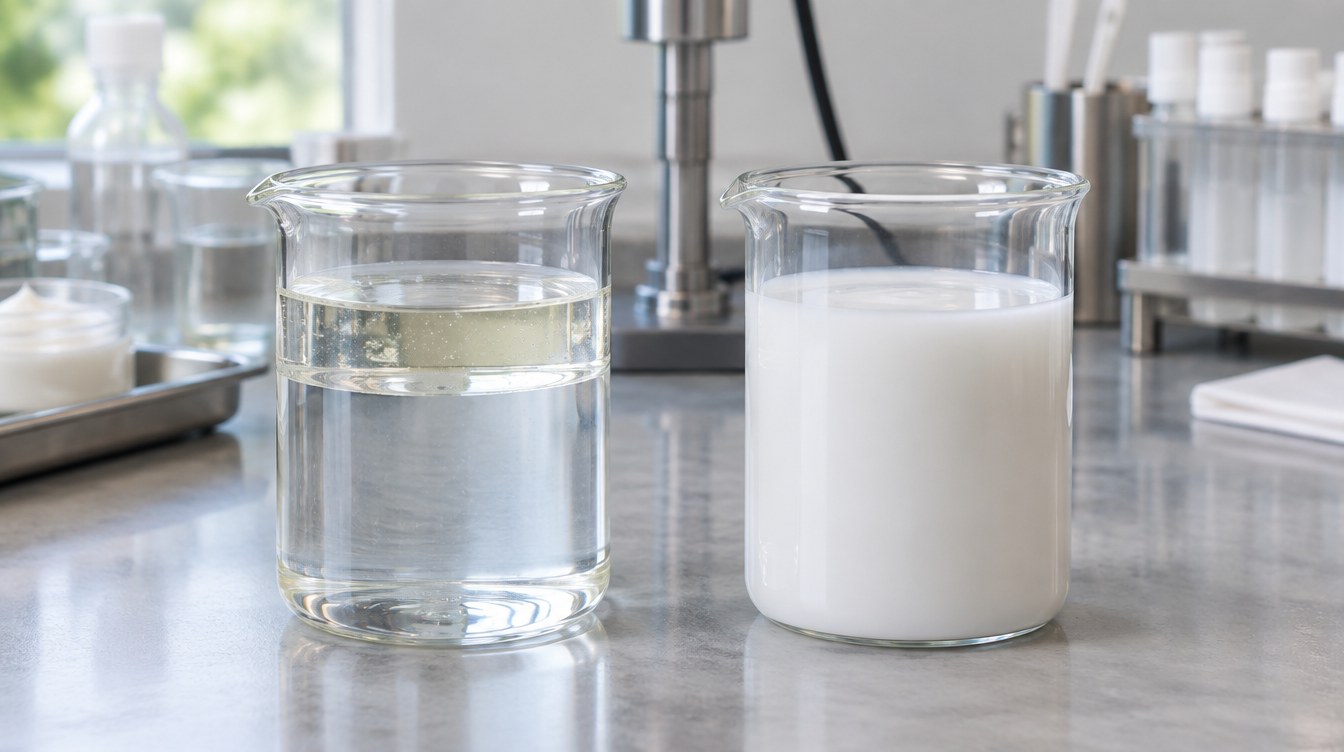
A clear serum base turns cloudy as the cyclopentasiloxane goes in, and by the next shift an oily film sits on top of the tank. The formulator asks purchasing whether the lot was off-spec. Before you reject it, read the batch record. If it adds the D5 straight to the water phase, the lot is not the problem: without an emulsifier no water phase holds this fluid, and the same separation will follow whichever lot you buy.
Is cyclopentasiloxane water soluble?
No. Cyclopentasiloxane (D5), CAS 541-02-6, is practically insoluble in water: PubChem records its water solubility as 1.7 × 10⁻² mg/L at 25 °C, too little to matter in a formula. D5 belongs in the oil phase. A water-based product can hold it as emulsion droplets, never as a solution.
The reason is the molecule’s surface. Cyclopentasiloxane is a ring of five silicon atoms alternating with five oxygen atoms, and each silicon carries two methyl groups (C10H30O5Si5). Its ten methyl groups face outward, and the siloxane oxygens, the only sites water could hydrogen-bond to, are partly shielded by them, so the molecule behaves much like a hydrocarbon toward water.
PubChem gives an octanol-water partition coefficient (log Kow) of 8.06, the average of three measurements: on a logarithmic scale, a preference for oil over water of many orders of magnitude. Mixing alone will not hold more than a trace of D5 in a water phase.
What happens to cyclopentasiloxane that reaches water?
Three other PubChem values say where D5 goes when it meets water.
Density comes first. At 0.9593 g/cu cm at 20 °C, D5 is slightly lighter than water, so separated D5 rises: in a failed emulsion it collects as a top layer, and on a wet floor it spreads as a film. The density gap is small, which slows creaming. An unstable emulsion can pass a first look and separate later in storage, so give stability samples time before you approve a new lot or a new emulsifier.
The Henry’s law constant, 33.0 atm-cu m/mole at 25 °C, describes the trace that does dissolve: it leaves water for air readily. The log Kow describes the rest, which moves onto oils, sludge and other organic matter. Insoluble does not mean inert in water. D5 that reaches a drain partitions to air and to solids, not into the water column.
Where D5 ends up also bears on market access. Commission Regulation (EU) 2024/1328 of 16 May 2024 restricts placing D4, D5 and D6 on the EU market at 0.1% by weight or more, on their own or in mixtures, after 6 June 2026, with listed derogations; for cosmetic products other than wash-off products the restriction applies after 6 June 2027. The brief on cyclopentasiloxane safety and the EU restriction covers those dates.
Two plant rules follow from the physics. Plain water will not clean D5 out of a vessel or a line, because a rinse leaves it floating as a film; flush with a compatible solvent or oil first and handle that flush as oily waste. And a spill belongs at the surface: contain it there, keep it out of drains and follow the current Safety Data Sheet (SDS) for clean-up.
What is cyclopentasiloxane, and is it a silicone?
Yes, cyclopentasiloxane is a silicone. It is a cyclic methylsiloxane, the five-unit ring described above, with the systematic name decamethylcyclopentasiloxane and a molecular weight of 370.77 g/mol. PubChem describes it as a colorless volatile liquid. Unlike dimethicone, a polymer sold in viscosity grades, D5 is one small molecule with one CAS number. It is also a feedstock for high-molecular-weight silicone polymers.
The shorthand D5 means D for a dimethylsiloxane unit and the digit for how many units close the ring. The four-unit and six-unit rings, D4 and D6, are separate substances with their own CAS numbers.
That is why the name on the order matters. Older labels and supply documents use cyclomethicone, a name that has covered other ring sizes and blends of them, so it does not pin down the molecule. If the purchase order, the specification and the certificate of analysis (CoA) all carry CAS 541-02-6, you know which ring you are buying. If any of the three says only cyclomethicone, you do not.
What does cyclopentasiloxane dissolve in?
Cyclopentasiloxane mixes with oils, not with water. It blends with other silicone fluids such as low-viscosity dimethicone, and it carries silicone gums such as high-molecular-weight dimethiconol as solutions that would be too thick to handle on their own. Those blends trade as raw materials in their own right, so confirm which one a drum holds. D5 also mixes with many hydrocarbon and ester oils.
It stays out of water, glycerin and propylene glycol, which belong to the water phase. Short-chain alcohols that carry little water can hold it. Water in the alcohol is the variable to watch: the more water an alcohol carries, the less D5 it will hold, so test a hydroalcoholic base at your ratio before it goes into a batch record.
Haze is a diagnostic. D5 blended with a compatible oil should run clear, so a hazy oil phase points first to water: from the lot, from another raw material or from a wet vessel. Run a Karl Fischer water test on the D5 and the other oils before you call it a solubility failure.
Which cyclopentasiloxane numbers matter to a buyer?
All values are from PubChem’s record for cyclopentasiloxane (CID 10913); the right-hand column is the purchasing reading.
| Property | PubChem value | What it tells the buyer |
|---|---|---|
| Water solubility | 1.7 × 10⁻² mg/L at 25 °C | Emulsify or carry it; never plan a water-phase addition |
| log Kow | 8.06 | Belongs with oils; ends up on organic matter |
| Henry’s law constant | 33.0 atm-cu m/mole at 25 °C | Dissolved traces move from water to air |
| Density | 0.9593 g/cu cm at 20 °C | Lighter than water; separated D5 rises |
| Vapor pressure | 0.3 mm Hg at 25 °C | Evaporates at room temperature; keep containers closed |
| Melting point | -38 °C | Stays liquid at ordinary storage temperatures |
| Viscosity | 3.9 cSt at 25 °C | Identity check on receipt; a gum blend or the wrong fluid reads differently |
| Surface tension | 18.5 dyne/cm at 25 °C | Spreads thinly over skin, hair and powders |
| Flash point | 73 °C (163 °F), closed cup | Confirm storage and transport class on the current SDS |
Why does evaporation matter more than solubility in the plant?
Solubility tells you which phase D5 joins. Evaporation tells you how much of it is still in the batch when it is packed. A boiling point of 210 °C suggests a fluid that stays put, but a vapor pressure of 0.3 mm Hg at 25 °C is enough for D5 to leave an open surface at room temperature.
PubChem’s experimental-properties record cites a study of evaporation from leave-on cosmetics and personal care products under realistic consumer exposure conditions. D5 left exposed aluminum surfaces at mean rates of 0.029 mg per cm² per minute at 23 °C and 0.060 mg per cm² per minute at 32 °C, so the warmer surface roughly doubled the rate. Formulation changed the rate; the largest effect reported was a 2-fold decrease for a face cream at 32 °C.
Those rates come from open test surfaces, not a mixing vessel, so do not scale them to a tank. The direction still holds: heat speeds the loss and a formula matrix can slow it. Add D5 to the cooled phase where the process allows, keep the vessel covered while it mixes and weigh the batch against the formula after the D5 step. A warm, open hold costs D5 that no certificate on the incoming lot will show.
Evaporation is also why D5 is bought. Its listed uses: a volatile emollient, solvent and viscosity-control fluid in skin, hair and make-up products; a carrier in antiperspirants and aerosols that hold insoluble powders; a dry-cleaning solvent for textiles; and a feedstock for silicone polymers. In personal care it spreads other ingredients thin and then leaves, so a non-volatile silicone is no drop-in substitute.
What should a cyclopentasiloxane specification say?
Write the order around identity, water content and evaporation loss.
-
Identity by CAS 541-02-6 on the purchase order, the specification and the CoA, not the name cyclomethicone.
-
Viscosity and refractive index as receipt checks against PubChem’s 3.9 cSt at 25 °C and 1.3982 at 20 °C. Agree the acceptance window with the supplier, because a reference value is not a specification limit.
-
Water content by Karl Fischer titration, with a maximum on the CoA, since water shows up as haze in an anhydrous blend.
-
Assay and the ring-size breakdown by gas chromatography, with D4 and D6 reported for each lot against a limit agreed on the specification, since the EU restriction counts each ring separately.
-
Sealed containers. With a vapor pressure of 0.3 mm Hg at 25 °C, an open drum loses product to the air, so reseal part-used containers. Storage planning starts from the flash point, 73 °C (163 °F) by closed cup, and the current SDS for your grade sets the storage and transport classification.
Methodology: physical values, the evaporation study and the molecular identity come from PubChem’s record for cyclopentasiloxane (CID 10913); uses come from the catalog record; the EU restriction is cited from Commission Regulation (EU) 2024/1328 as published in the Official Journal of the European Union on 17 May 2024.
Frequently asked questions
Is cyclopentasiloxane water dispersible?
Is cyclopentasiloxane the same as cyclomethicone?
Does cyclopentasiloxane dissolve in alcohol?
Is cyclopentasiloxane safe?
Sources & methodology
Figures are RawSource sourcing data unless attributed to a named source. Regulatory citations are current as of publication. Chemical identities verified by CAS number against the RawSource catalog.
Search 1,300+ industrial chemicals by name or CAS, or send us your spec — we quote by the drum, tote, or container.
Browse the Chemical Index → Request a Quote