
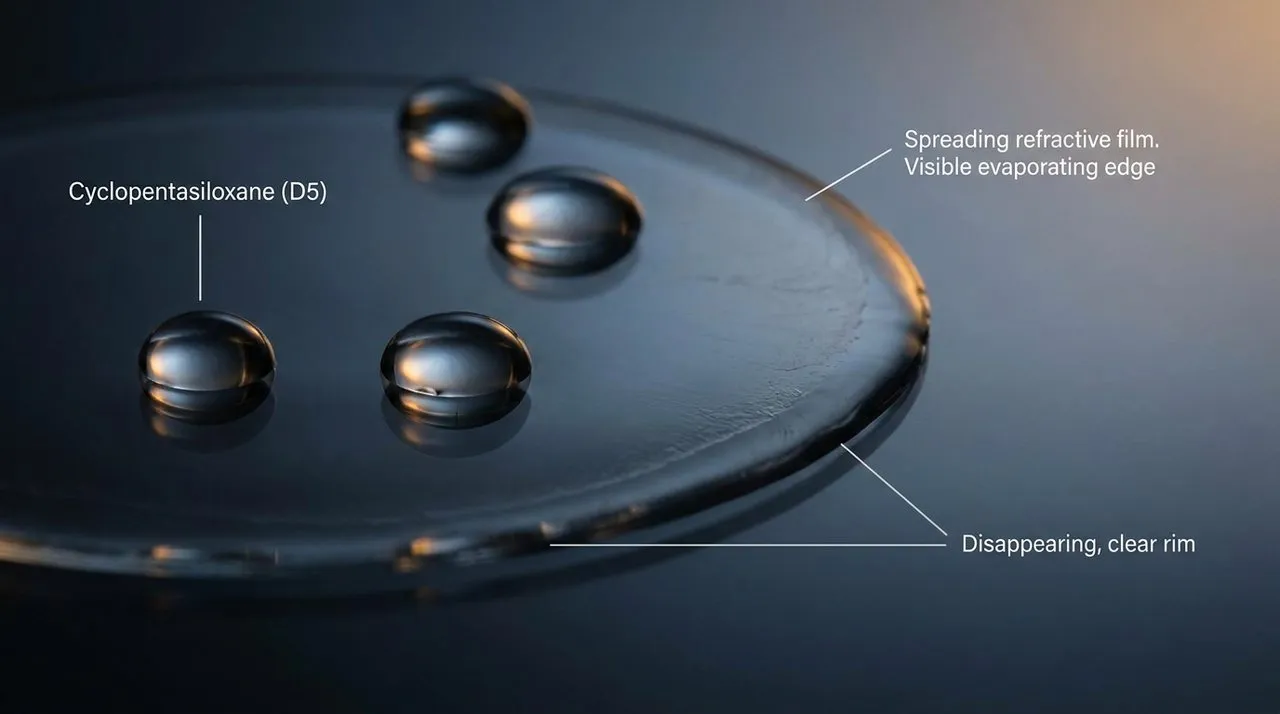
Your formulation team specs cyclopentasiloxane as the volatile carrier in a leave-on hair serum. It is 30% of the formula, the sensory work is finished, and the batch is ready. Then procurement pulls the certificate of analysis (CoA) on the incoming silicone lot: residual octamethylcyclotetrasiloxane (D4) reads 0.14% by weight. Under EU REACH Annex XVII entry 70, that single number can hold the lot at the border. The carrier performs exactly as designed. The trace impurity it carries is the sourcing problem.
That split, between a material that does its job in the formula and a material that clears a regulator, is where most cyclopentasiloxane sourcing decisions now sit. If you formulate, source, or private-label personal-care products across more than one market, you are buying two things at once: a functional ingredient with a specific physical profile, and a moving regulatory position. This guide separates them, with the chemistry that explains the formulation behavior and the named deadlines a buyer puts on a calendar.
The short version: Cyclopentasiloxane (the INCI name for decamethylcyclopentasiloxane, D5, CAS 541-02-6) is a low-viscosity volatile silicone fluid. Low surface tension (about 18.5 dyne/cm) gives fast, thin spreading; high volatility (boiling point 210 C) means it flashes off within minutes and leaves no oily residue. Formulators use it as a carrier and solvent for heavier silicones, pigments, and actives, and for a light, dry finish. The constraint is regulatory: EU REACH entry 70 restricts wash-off use now and bars leave-on cosmetic use from 6 June 2027, while D5 stays permitted in the US. Specify residual D4 below 0.1% by weight on every CoA.
What cyclopentasiloxane is
Cyclopentasiloxane is the INCI name for decamethylcyclopentasiloxane, the cyclic silicone the trade calls D5. Its CAS number is 541-02-6, molecular formula C10H30O5Si5, molecular weight 370.77 (PubChem, CID 10913). It is a colorless, low-odor liquid with a viscosity of 3.9 cSt at 25 C and a surface tension near 18.5 dyne/cm.
Two of those constants set its formulation behavior. The low surface tension lets a drop spread fast and thin across a substrate, which is the slip a formulator wants in a primer, a foundation, or an antiperspirant base. The high volatility (boiling point 210 C, vapor pressure roughly 0.2 to 0.3 mmHg at 25 C) means the fluid flashes off within minutes and leaves a dry, residue-free finish rather than an oily film. That combination is why D5 appears as the carrier in foundations, hair serums, sunscreens, and roll-on antiperspirants: it spreads, delivers other ingredients, then evaporates.
What cyclopentasiloxane does in a formula
D5’s role in a formula is mechanical. It is effectively water-insoluble (1.7 x 10⁻² mg/L at 25 C, log Kow 8.06), so it functions as a non-aqueous carrier and solvent. Formulators dissolve or disperse higher-molecular-weight silicones in it, most often dimethicone gum and high-viscosity polydimethylsiloxane (PDMS), to make those heavy, tacky materials spreadable. The D5 carries the non-volatile silicone onto the substrate, spreads it thin, then evaporates and leaves the functional silicone behind as a uniform film. Phenyl trimethicone rides the same carrier when a formula needs added gloss and a higher refractive index for shine or pigment wetting.
The evaporation behavior is measurable, and most formulas are built around it. Reported release rates from cosmetic surfaces run about 0.029 mg/cm²/min at 23 C and 0.060 mg/cm²/min at 32 C (PubChem). Faster flash-off at higher temperature is why the dry-down reads quick during application. It also sets a design limit: any pigment or active the fluid carries has to deposit during application, because the carrier has a short window before it is gone. Against the persistent slip of a non-volatile emollient, D5 gives initial spread and a dry finish but no lasting film of its own. For non-silicone alternatives that shift that balance, see our cosmetic emollient esters selection guide.
What changed in the EU regulation, and when
The formulation behavior has not changed in years. The supply position has. The EU has been tightening the cyclic siloxanes since 2018, and the 2024 revision widened the scope. The driver is environmental persistence and bioaccumulation, and the controlling parameter is residual D4.
On 13 June 2018 the Member State Committee identified D4, D5, and D6 as Substances of Very High Concern (SVHC). D4 is classified persistent, bioaccumulative, and toxic (PBT), and as vPvB. D5 and D6 inherit the PBT classification when they contain 0.1% or more by weight of D4, which is why the D4 trace, not the headline silicone, governs the whole family.
Commission Regulation (EU) 2018/35 created REACH Annex XVII entry 70, barring D4 and D5 from wash-off cosmetics at 0.1% or more by weight after 31 January 2020. Commission Regulation (EU) 2024/1328, dated 16 May 2024, rewrote that entry. It adds D6 and sets a general rule: the three siloxanes shall not be placed on the EU market at 0.1% or more by weight after 6 June 2026, with a separate leave-on cosmetics deadline of 6 June 2027. ECHA keeps the consolidated picture on its siloxanes hot-topics page.
The United States runs on a different clock. D5 remains permitted in US cosmetics. EPA granted a manufacturer-requested risk evaluation for D4 under TSCA in October 2020 and released the draft risk evaluation for D4 in September 2025 for public comment and peer review. Nothing forces a US reformulation today, but for a dual-market SKU the direction of travel is worth tracking.
How D5 compares to the other cyclic siloxanes
When you reformulate away from D5, the obvious neighbors carry the same restriction. The spec table makes the trade clear.
| Property | D4 (Cyclotetrasiloxane) | D5 (Cyclopentasiloxane) | D6 (Cyclohexasiloxane) |
|---|---|---|---|
| CAS number | 556-67-2 | 541-02-6 | 540-97-6 |
| Molecular formula | C8H24O4Si4 | C10H30O5Si5 | C12H36O6Si6 |
| Molecular weight | 296.61 | 370.77 | 444.92 |
| Boiling point | 175 C | 210 C | 245 C |
| Flash point (closed cup) | 55 C | 73 C | 91 C |
| Viscosity at 25 C | 2.30 cSt | 3.9 cSt | 6.62 cSt |
| EU REACH entry 70 status | Restricted; SVHC, PBT/vPvB | Restricted; PBT if D4 ≥ 0.1% | Restricted; PBT if D4 ≥ 0.1% |
Constants from PubChem (CIDs 11169, 10913, 10911). Heavier D6 flashes off more slowly and feels less dry; lighter D4 evaporates fastest but is the regulated impurity the whole family is measured against. None of the three clears the EU leave-on rule on its own, which pushes formulators toward non-siloxane volatiles such as isododecane when a leave-on EU claim has to hold.
Where D5 sits in your catalog
Map the rule to where D5 sits in your range. The exposure is widest in beauty and personal care, where leave-on products are the workhorse: foundations, primers, color cosmetics, sunscreens, hair serums, and stick or roll-on antiperspirants all rely on volatile silicones for spread and dry-down. Those SKUs hit the 6 June 2027 EU leave-on deadline.
Beyond personal care, D5 appears in household and institutional cleaning, textile finishing, and as a carrier in industrial care products; the 2024 regulation also bars its use as a dry-cleaning solvent after 6 June 2026. A buyer running an EU cosmetics line and US distribution off the same cyclopentasiloxane SKU faces the hardest case: one material, compliant in one market and on a countdown in the other.
Private-label and contract-manufacturing arrangements widen the exposure. If a third party blends your brand, the D5 sits inside their base and the residual D4 rides on their incoming silicone lots, so the liability lands on a spec you may never see. A brand selling into the EU through a contract manufacturer inherits the deadline regardless of who blended the product.
Compliance steps, each with a deadline
1. Inventory now. List every SKU that contains D5, D4, or D6, by INCI and by weight percent. A label that reads only “cyclomethicone” is a flag, because the term can cover a D4/D5/D6 blend. 2. Pull CoAs now. Confirm residual D4 is below 0.1% by weight on each lot. This single spec governs whether D5 and D6 inherit the PBT classification. 3. Wash-off EU products: already in force. D4 and D5 above 0.1% have been barred since 31 January 2020. Verify, do not assume. 4. Other products and mixtures into the EU: before 6 June 2026 for the general 0.1% placing-on-market limit, and the same date for dry-cleaning solvent uses. 5. Leave-on EU cosmetics: before 6 June 2027. This is the long pole for most personal-care lines, and the date to build a reformulation schedule around. 6. US SKUs: no action required today, but track the EPA D4 draft risk evaluation opened in September 2025 and keep dual-market formulas separable.
Documentation gaps buyers miss
The most common miss is a CoA that certifies D5 assay but says nothing about residual D4. Ask the supplier for D4 quantified by GC-MS against the 0.1% threshold, in writing, per lot. A purity figure for the main ingredient does not answer the question the regulator asks.
The second gap is the “cyclomethicone” label. The trade name is generic and can describe different ring sizes or blends, so confirm the exact CAS numbers present instead of accepting the family name. The third gap is treating US permissibility as EU permissibility; the two markets have diverged, and a single global spec sheet no longer covers both. The fourth is forgetting D6, which the 2024 regulation pulled in alongside D4 and D5.
Cost and timeline of staying compliant
The real cost here is calendar time, not unit price. A leave-on reformulation is not a drop-in swap. Moving from D5 to another volatile changes the evaporation curve and the dry-down, and it can shift refractive index, SPF performance, or pigment dispersion, so each affected SKU needs fresh sensory work plus a new stability and compatibility study before it ships.
Count backward from 6 June 2027 for EU leave-on lines. A reformulation, a stability hold, then dossier and artwork updates consume most of the runway that looks generous today. An accelerated stability study alone occupies a fixed block of calendar that does not compress because a deadline is near. The recurring analytical cost is smaller: GC-MS confirmation of residual D4 below 0.1% on incoming lots is the test that keeps a compliant formula compliant. For US-only lines, the near-term cost is monitoring, with the EPA draft as the trigger to revisit. The trade-off is real: hold D5 for its spreading and dry-down and absorb a hard EU exit date, or move early to a non-siloxane volatile and accept a finish that testers can usually tell apart from the original.
Grades, specs, and bulk supply
Cosmetic-grade D5 is a single material, but the spec that matters most to a buyer is the one many CoAs leave off. Put these on the purchase order, not on the post-delivery complaint:
- INCI cyclopentasiloxane (CAS 541-02-6), not a generic “cyclomethicone” blend, unless a defined D4/D5/D6 ratio is what you want.
- Residual D4 quantified by GC-MS against the 0.1% by-weight threshold, per lot.
- Viscosity (nominal 3.9 cSt at 25 C) and assay, with the CoA governing the lot you receive.
- Packaging: drums and IBCs for production volumes, with lot-level documentation.
See the Dimethicone product page. Material sourced domestically can ship on a shorter, more predictable lead time than an overseas reorder, which matters when a reformulation window or a customs hold is already on the calendar. Send your target viscosity, your residual-D4 limit, your market (US, EU, or both), and your annual volume, and request a sample to qualify on your own system.
Sources: physical constants are drawn from PubChem (CIDs 10913, 11169, 10911); regulatory dates and thresholds are quoted from Commission Regulations (EU) 2018/35 and 2024/1328, ECHA, and the EPA TSCA D4 risk-evaluation page, each linked above. No proprietary RawSource figures are used in this article.
Frequently asked questions
What does cyclopentasiloxane do in a cosmetic formula?
It works as a volatile carrier and solvent. Low surface tension spreads it fast and thin, it dissolves or disperses heavier silicones, pigments, and actives, and then it evaporates (boiling point 210 C), depositing what it carried and leaving a dry, residue-free finish. The role is physical: spread, deliver, flash off.
Cyclopentasiloxane vs dimethicone — which gives better spreadability?
They do different jobs. Cyclopentasiloxane (D5) is volatile: it gives fast initial spread and a dry finish, then evaporates, so it leaves no lasting film of its own. Dimethicone is non-volatile and stays on the substrate as a persistent, slip-giving film. Formulators routinely use D5 as the carrier to spread a high-viscosity dimethicone thin, getting both the easy application and the durable film.
What grade and viscosity of cyclopentasiloxane should I specify?
Cosmetic D5 is nominally 3.9 cSt at 25 C and CAS 541-02-6. Specify INCI cyclopentasiloxane rather than an undefined “cyclomethicone” blend, unless you want a set D4/D5/D6 ratio, and require residual D4 below 0.1% by weight, quantified by GC-MS, per lot. The CoA governs the lot you receive.
Is cyclopentasiloxane restricted, and where?
In the EU, REACH Annex XVII entry 70 restricts it: wash-off cosmetics at 0.1% or more are already barred, and leave-on cosmetics are barred from 6 June 2027. D5 and D6 inherit the PBT classification only when residual D4 is 0.1% or more by weight. In the US, D5 remains permitted, with EPA’s D4 TSCA draft risk evaluation (September 2025) worth tracking for dual-market SKUs.
How is cyclopentasiloxane sourced in bulk?
In drums and IBCs with per-lot CoAs. The spec to insist on is GC-MS residual D4 below 0.1% by weight, alongside viscosity and assay. Material sourced domestically can ship on a shorter, more predictable lead time than an overseas reorder; send your viscosity target, D4 limit, market, and annual volume to scope a quote and a qualification sample.
Editorial note. This article is general technical guidance for cosmetic formulation, R&D, and procurement professionals. Formulation behavior, sensory performance, and regulatory status depend on your specific formula, the substrate, the residual-impurity content, and the market you sell into, and must be validated on your own system; the Certificate of Analysis (CoA) governs the grade you buy. Regulatory status differs by jurisdiction and changes over time, so confirm current REACH, TSCA, and local cosmetic requirements for your market before you formulate or ship. Review the current Safety Data Sheet (SDS) and use appropriate handling controls before use. Products are sold for industrial and professional use only. Nothing here is a medical, health, cosmetic-efficacy, or product-safety claim. RawSource makes no warranty, express or implied, and assumes no liability for use of this information.
Search 1,300+ industrial chemicals by name or CAS, or send us your spec — we quote by the drum, tote, or container.
Browse the Chemical Index → Request a Quote