
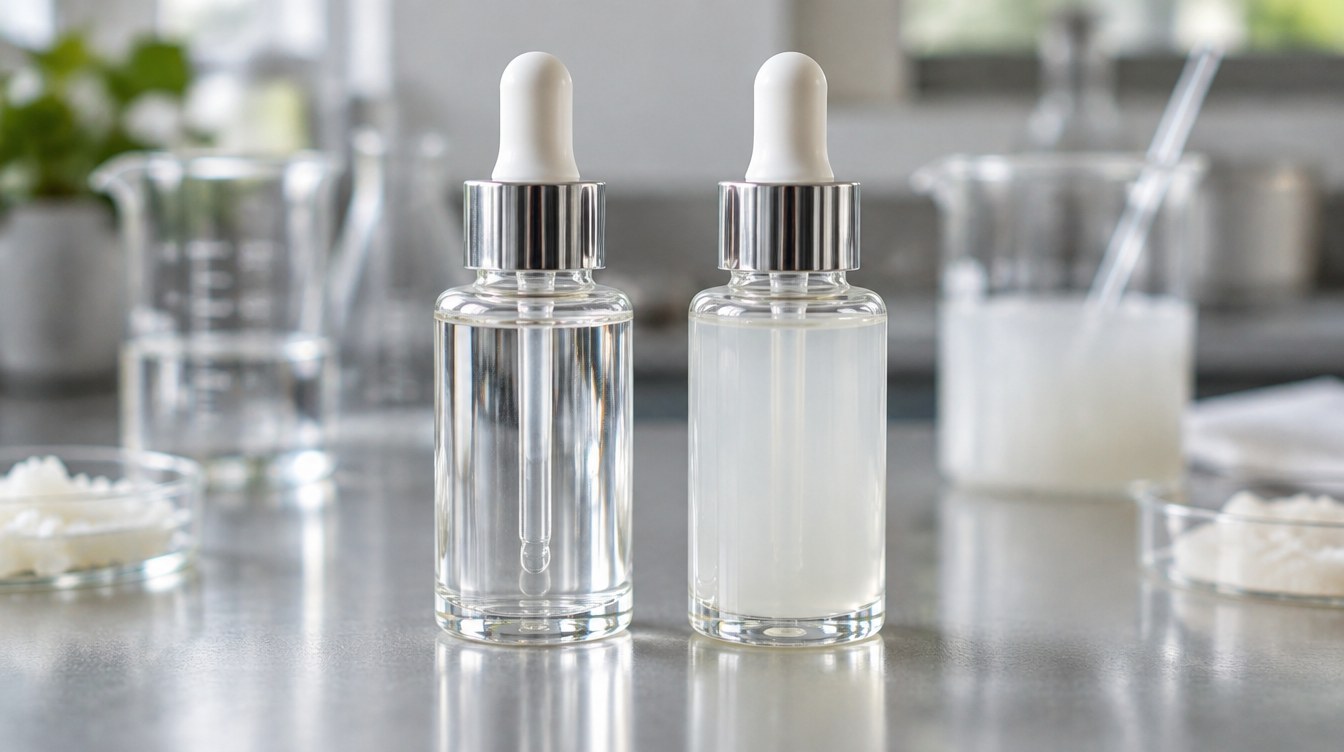
A formulator signs off a hair shine serum on the bench, and the bill of materials reaches procurement with one line: “silicone fluid.” In production, a cheaper dimethicone quote replaces the phenyl trimethicone the signed-off sample was built on, and the swap looks harmless, since both are clear silicones that refuse to mix with water. The pilot batch comes back satin instead of glossy, and the ester-rich oil phase has gone hazy. Nobody bought the wrong grade. They bought the wrong ingredient.
The two fluids differ on four properties you can write into a request for quotation (RFQ): refractive index, a main driver of gloss; compatibility with oils and esters; volatility and feel; and viscosity.
How does phenyl trimethicone differ from dimethicone?
Phenyl trimethicone (CAS 2116-84-9) is a single defined compound, C15H32O3Si4 at 372.75 g/mol in its PubChem record. Its synonym, phenyltris(trimethylsiloxy)silane, describes the shape: one silicon atom carrying a phenyl ring and three trimethylsiloxy arms.
Dimethicone (CAS 9006-65-9) is a different kind of material. The Cosmetic Ingredient Review (CIR) Expert Panel’s 2022 amended safety assessment defines it as a mixture of fully methylated linear siloxane polymers end-blocked with trimethylsiloxy units. The average chain length, and with it the molecular weight, sets a grade’s viscosity, which is why dimethicone is sold as a ladder of viscosity grades, from thin fluids to gums.
Both are silicones, built on silicon-oxygen-silicon links, so phenyl trimethicone does count as a silicone. “Trimethicone” on its own is a name stem shared by several silicone ingredients: methyl trimethicone, for one, is a separate ingredient and a different compound, so the prefix matters on an ingredient list and a purchase order.
The difference is what hangs off the silicon: dimethicone carries only methyl groups, while phenyl trimethicone puts an aromatic ring on its central silicon. That ring raises the refractive index and makes the fluid more at home in organic oils and esters.
The split has a purchasing consequence. “Dimethicone” on a purchase order is not a specification until a viscosity grade follows it. “Phenyl trimethicone” with its CAS number names one compound, so the questions become how pure and how clear. Product descriptions sometimes call it a polymer, but the CAS record describes one molecule, so ask for the assay on the certificate of analysis (CoA).
| Property | Phenyl trimethicone | Dimethicone |
|---|---|---|
| CAS number | 2116-84-9 | 9006-65-9 |
| What the name covers | One compound, C15H32O3Si4, 372.75 g/mol (PubChem) | A mixture of fully methylated linear siloxane polymers, trimethylsiloxy end-blocked (CIR) |
| Refractive index (a gloss driver) | Raised by the phenyl ring; specify on the RFQ | Methyl groups only; specify on the RFQ |
| Compatibility with oils and esters | Better, from the phenyl ring; confirm clarity in your oil phase | Lower, and falls as chain length rises; confirm clarity in your oil phase |
| Water solubility | Insoluble | Insoluble |
| Volatility | Specify on the RFQ (evaporation or weight-loss data) | Grade-dependent: the thinnest grades evaporate, heavier grades stay |
| Viscosity | One low-viscosity fluid; specify on the RFQ | A ladder of grades; specify grade, unit and test temperature on the RFQ |
Which gives more gloss, and why?
Phenyl trimethicone, for an optical reason. A film’s refractive index governs how much light its surface returns as a mirror reflection, and the phenyl ring’s easily polarized electrons lift the index above that of an all-methyl chain. Ask for the figure, with its measurement temperature, on the supplier’s technical data sheet (TDS); refractive index drifts with temperature.
Gloss on hair has been measured. A 2003 Journal of Cosmetic Science study used image analysis of hair tresses and found that phenyl trimethicone raised luster by changing the contrast between specular and diffuse reflection. Amodimethicone and castor oil did the same, so luster is a contrast effect with several routes. That study did not test dimethicone: the case for phenyl trimethicone over dimethicone rests on the refractive-index argument above, and each fluid’s TDS figure will show the gap.
Buy it when the gloss has to come with a clear oil phase and a light, non-tacky film. Clarity matters as much as the index: haze adds the diffuse scattering that flattens luster, and a yellow cast shows in a clear product. Put appearance and a color limit on the RFQ next to the refractive index.
How do they compare on solubility and compatibility with oils?
Neither dissolves in water, so a water phase needs an emulsifier system for either; the split is on the oil side. Dimethicone mixes freely with other silicones but less readily with esters and plant oils, and the heavier the grade, the likelier a blend is to haze or separate. The phenyl ring gives phenyl trimethicone more affinity for esters and organic oils, so it is easier to keep clear in an anhydrous lip oil or serum.
The check is cheap and can save a pilot batch. Blend each candidate lot into your production oil phase at use level, hold it beside the approved sample, and write the result into the specification. Compatibility is a property of the pair, not of the silicone alone, so no TDS can answer it for you.
Volatility and feel: which one stays on the film?
Dimethicone’s feel tracks its grade. The lowest-viscosity grades spread fast, feel dry and evaporate; mid grades give the slip a lotion needs; heavy grades and gums lay down a cushioned, longer-lasting film. The grade is a bench decision, and the number that has to survive onto the purchase order intact.
Phenyl trimethicone spreads as a light, non-tacky, glossy film, with no grade to choose. Its volatility is easy to assume and worth checking. At 372.75 g/mol it has almost exactly the molecular weight of cyclopentasiloxane (CAS 541-02-6, 370.77 g/mol), a volatile cyclic silicone that PubChem lists with a boiling point of 210 °C.
That mass match settles nothing either way, because molecular weight is only one input to volatility. Ask the supplier for evaporation or weight-loss data when a claim depends on what stays on skin or hair.
Which should you specify for hair, skin and color cosmetics?
| Product | Lead silicone | What it is there for |
|---|---|---|
| Rinse-off conditioner | Dimethicone | Slip and combing feel, with film weight set by grade |
| Leave-on shine serum or finishing oil | Phenyl trimethicone | Gloss with a clear oil phase |
| Lotion or body cream | Dimethicone | Slip and cushion, tuned by viscosity grade |
| Lip gloss or lip oil | Phenyl trimethicone | A clear, glossy oil phase alongside esters |
| Foundation or tinted base | Both | Dimethicone for slip, phenyl trimethicone for a luminous finish |
In skin products, phenyl trimethicone is chosen for feel and finish.
One hair-care caution comes from a 2023 International Journal of Cosmetic Science study of an amino-functional silicone, not of phenyl trimethicone or dimethicone. Adding 2% amodimethicone to a test conditioner, over three wash cycles, raised measured silicone on virgin hair from 71 ± 9 to 1273 ± 676 micrograms per gram, but on platinum-bleached hair only from 10 ± 1 to 74 ± 21. Force measurements put hydrophobic interaction as a key driver of deposition on virgin hair and electrostatic interaction as the most important on bleached hair.
Neither phenyl trimethicone nor dimethicone carries a charge. By inference from that study, a rinse-off shine claim aimed at bleached hair should not rest on either fluid alone. A leave-on serum does not depend on deposition through a rinse, and that is where phenyl trimethicone earns its line.
What should each RFQ line say?
-
Name both lines by INCI name and CAS number, and refuse a quote that says only “silicone fluid.”
-
For dimethicone, write the viscosity grade, its unit and its test temperature. CIR notes that this ingredient class is reported in kinematic (cSt) and dynamic (Pa·s) units, and that converting to Pa·s means multiplying the cSt figure by the relative density and dividing by 1,000. A cP (mPa·s) quote skips the division, because the milli prefix absorbs the 1,000: cP is cSt times the relative density alone, so dividing a cP quote by 1,000 puts the comparison off a thousandfold. Use the relative density at the viscosity test temperature.
-
For phenyl trimethicone, ask for the refractive index, the appearance with a color limit, and an assay on the CoA.
-
For both, make clarity in your oil phase at use level an acceptance check against the approved bench sample, and require the supplier’s current Safety Data Sheet (SDS) for each product. Read its hazard statements, and take handling and protective measures from its handling and exposure-control sections.
Size the two buys separately, from the formulator’s use levels. For scale, CIR’s 2003 group review of dimethicone-family ingredients, dimethicone among them, described most as conditioning agents used at concentrations of 15% or less.
The rule that prevents the satin serum fits on one line of the specification. Dimethicone is bought by viscosity grade for slip, phenyl trimethicone by refractive index, clarity and assay for gloss, and neither is accepted as the other.
Methodology: identity data come from PubChem (CID 62427) and the product catalog; the dimethicone definition and viscosity-unit note from the CIR Expert Panel (2022); luster and deposition data from the Journal of Cosmetic Science (2003) and the International Journal of Cosmetic Science (2023). Refractive index, viscosity and volatility figures are left to the supplier’s TDS.
Frequently asked questions
Is phenyl trimethicone a silicone?
Is phenyl dimethicone the same ingredient as phenyl trimethicone?
Can dimethicone replace phenyl trimethicone in a shine serum?
What does phenyl trimethicone do in skin care?
Does phenyl trimethicone have side effects?
Sources & methodology
Figures are RawSource sourcing data unless attributed to a named source. Regulatory citations are current as of publication. Chemical identities verified by CAS number against the RawSource catalog.
Search 1,300+ industrial chemicals by name or CAS, or send us your spec — we quote by the drum, tote, or container.
Browse the Chemical Index → Request a Quote