
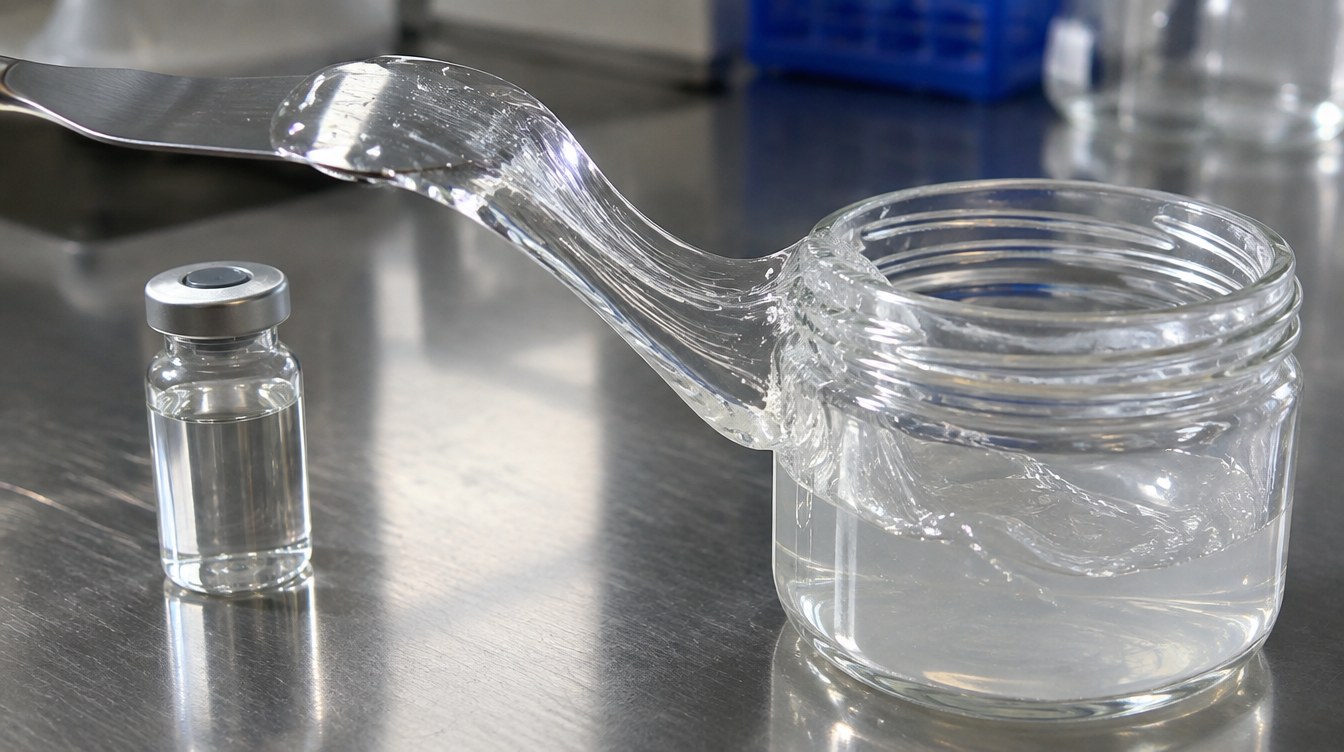
Your formulator approves a shine serum built on a lab sample labeled dimethiconol, and purchasing sends out an RFQ carrying the INCI name and CAS 31692-79-2. Three quotes come back: a pourable fluid, a gum cut in cyclopentasiloxane, and a gum cut in dimethicone. Each supplier answered the question as asked. The viscosities arrive in different units, the active levels are missing, and at most one quote can match the sample, with nobody yet able to say which.
The dimethiconol versus dimethicone question takes one table to answer. The costlier mix-up sits inside the dimethiconol name itself, and it is a specification problem before it is a chemistry problem.
What separates dimethiconol from dimethicone?
Both are linear polydimethylsiloxanes, and the difference is the chain end. The Cosmetic Ingredient Review (CIR) defines dimethicone as a mixture of fully methylated linear siloxane polymers end-blocked with trimethylsiloxy units. Dimethiconol is the same backbone with hydroxyl end groups, the definition US Patent 6,719,967 (2004) gives, and PubChem cross-references its CAS number to CAS Common Chemistry under the name hydroxy-terminated poly(dimethylsiloxane).
The end group decides what each polymer can still become. A trimethylsiloxy cap is unreactive under formulating conditions, so a dimethicone’s chain length is set when it is made and you choose it by viscosity. A silanol end can still condense with another silanol. That lets short hydroxy-terminated chains serve as one starting point for emulsion polymerization: they are emulsified first, then condensation-polymerized into a high-molecular-weight silicone. Cyclic monomers are the other route.
| Property | Dimethiconol | Dimethicone |
|---|---|---|
| CAS | 31692-79-2 | 9006-65-9 |
| Chain end | Hydroxyl (silanol) | Trimethylsiloxy |
| Can the chain end still condense? | Yes | No, the cap is unreactive |
| PubChem identity record | Dimethylsilanediol, C2H8O2Si, 92.17 g/mol | Dimethyl-bis(trimethylsilyloxy)silane, C8H24O2Si3, 236.53 g/mol |
Why the PubChem molecular weight is the wrong number for a spec
PubChem cross-references CAS 31692-79-2 to CID 14014, a merged record titled dimethylsilanediol, with the IUPAC name dihydroxy(dimethyl)silane and a molecular weight of 92.17 g/mol. That is one silicon atom with two hydroxyl groups: the monomer, not the polymer in the drum. The dimethicone record does the same, listing a three-silicon siloxane at 236.53 g/mol.
If a Safety Data Sheet (SDS) template or an ERP item master pulls dimethiconol’s molecular weight from PubChem, every molar calculation built on it is wrong by more than an order of magnitude, even for the lightest grade below. The identity slip reaches EU paperwork too. ECHA assigns dimethiconol the List number 608-658-6, while the EC number 213-915-7 in the same PubChem record belongs to the related monomer. A document pairing dimethiconol with 213-915-7 has borrowed the monomer’s identity.
One CAS number, six grade records
The FDA/NCATS Global Substance Registration System (GSRS), a substance-identity database, carries CAS 31692-79-2 on the six dimethiconol grade records below as a generic family code, not as a primary code. Each grade has its own UNII, the non-proprietary identifier FDA assigns to one substance. A UNII identifies a substance; it is not an approval.
| UNII | Grade as named | Reported kinematic viscosity at 25 °C | Reported average molecular weight |
|---|---|---|---|
| MOT8IL21AR | 70 cSt | 70 cSt | 5,000 Da |
| T74O12AN6Y | 2,000 cSt | 2,000 cSt | 35,000 Da |
| M2HW98ZA4V | 14,000 cSt | 13,740 cSt | 75,000 Da |
| R2285D73YT | 50,000 cSt | 50,000 cSt | 100,000 Da |
| OSA9UP217S | 100,000 cSt | 100,000 cSt | 140,000 Da |
| RKI3S914RT | 600,000 cSt | 600,000 cSt | 250,000 Da |
Read the table three ways. First, the span is wide. The 70 cSt grade is a pourable fluid, while the 600,000 cSt grade, at 250,000 Da, falls inside the 200,000 to 1,000,000 molecular-weight band that US Patent 6,719,967 uses to define silicone gums (the patent states no unit). “Dimethiconol is a gum” holds only at the top of this ladder.
Second, grade names are nominal. The record named 14,000 cSt reports 13,740 cSt. Your specification should carry a viscosity window and a test temperature, with the measured lot value printed on the Certificate of Analysis (CoA).
Third, molecular weight is a softer number than viscosity. GSRS names its own 600,000 cSt record both “250000 MW” and “260000 MW”, and it calls its values average molecular weights without stating whether they are number-average or weight-average, two figures that differ for any polymer with a spread of chain lengths. Buy on viscosity, which you can test on receipt, and treat molecular weight as a supplier-stated nominal: ask which average it is and how it was measured.
Blends: the active level, the unit and the carrier
Gums at the top of that ladder are hard to dose neat, so they also trade as blends. Three GSRS blend records carry CAS 31692-79-2 as the major-component code:
| UNII | Blend | Approximate viscosity at 25 °C | Approximate refractive index at 25 °C |
|---|---|---|---|
| YCY6JX5TA2 | Dimethicone and dimethiconol | 6500 cP | 1.396 |
| GZL8QE6X6L | Dimethicone and dimethiconol | 3200 cP | not asserted (invalid source entry) |
| P83WYJ7NW3 | Cyclopentasiloxane and dimethiconol | 6000 cP | 1.397 |
The active level is not in the name. Each record describes the blend as approximately 12-20 of an ultra-high viscosity dimethiconol in low-viscosity diluents, and none says 12-20 of what. Your RFQ has to close that gap: ask for the nominal dimethiconol content as weight percent of the blend on the technical data sheet, and for non-volatile content per lot on blends in a volatile carrier, because that figure sets both dose and cost-in-use.
The unit is the smaller gap. In the GSRS records the blends are in cP, a dynamic viscosity filed under a kinematic label, and the neat grades in cSt. The CIR notes that converting kinematic to dynamic viscosity means multiplying by the fluid’s relative density and dividing by 1000 to reach Pa·s. With cyclopentasiloxane at 0.9593 g/cu cm at 20 °C (PubChem), that conversion shifts the cyclopentasiloxane blend’s figure by only a few percent.
Method is the larger gap. A blend built on a high-molecular-weight gum thins under shear, so its reading depends on the instrument, the spindle or shear rate and the temperature, and two methods can differ by more than the unit does. ASTM D445-19, now a superseded edition, times gravity flow through a calibrated glass capillary, and its scope names liquid petroleum products. Ask which method produced a gum-blend figure.
The carrier either stays or leaves. Cyclopentasiloxane is sold as a volatile carrier (PubChem lists its boiling point at 210 °C), and in a leave-on product it evaporates and leaves the gum behind. A non-volatile dimethicone carrier stays in the film and changes the after-feel. The carrier is its own substance, CAS 541-02-6, so check the EU restriction status of any cyclopentasiloxane carrier, and its status in your other markets.
Emulsions: which monomer built the polymer?
Rinse-off products can take dimethiconol as an emulsion, and the emulsion’s history matters as much as its silicone content. Two patent documents describe the design space. Their ranges are published claims and examples, not current practice and not a recommendation to work inside them.
Patent application WO1998018434A1 (published 1998) covers a conditioning shampoo. It describes an emulsion-polymerized silicone made from linear, hydroxy-terminated starting material of the dimethiconol type, chain length n above about 10, at 0.005-10 wt% of the shampoo and 0.2-3 wt% most preferred. The applicants hypothesize that silicone polymerized from cyclic monomers leaves residual cyclics that leach into the surfactant phase and act as an antifoam, cutting lather.
They attribute the absence of that effect in the linear route to a more complete polymerization and a starting material heavy enough not to leach. The shampoo is preferably substantially free of cyclic-derived emulsion silicone, defined as less than about 1 wt%. For a buyer, that makes the monomer route a question to ask, and residual cyclic silicone by gas chromatography on the CoA the testable line.
US Patent 6,274,130 (2001) covers a rinse-off conditioner. It pairs a cationic surfactant at about 0.05 to about 5 wt% with emulsion-polymerized dimethiconol at 0.01-10 wt%, chain length n of 2700 or more, which the patent equates to a molecular weight above 200,000. Claim 1 requires a dimethiconol viscosity of 1 to 20 million cSt and less than 1% anionic surfactant.
That viscosity floor already sits above the 600,000 cSt top grade in the GSRS table, while the emulsion carrying it pours. Specify the polymer inside an emulsion by its own viscosity, never by the emulsion’s. The same patent prefers average particle sizes below 20 microns, and below 2 microns, because smaller particles spread the silicone more uniformly on hair at the same concentration.
Check the emulsifier as well: ask for the emulsion’s full INCI composition and the emulsifier’s charge, because an anionic emulsifier counts against any anionic limit in your formula. A 1994 review of two-in-one shampoo technology describes anionic surfactant and cationic conditioner complexing so that neither cleans nor conditions fully.
What a dimethiconol RFQ line should carry
-
Form: neat grade, blend with the carrier named, or emulsion.
-
Viscosity: a window around the target, with unit, temperature and test method, and the measured lot value on each CoA.
-
Active level: dimethiconol content as weight percent of any blend or emulsion.
-
Identity: CAS 31692-79-2, the full INCI string, and the GSRS UNII where the supplier can match one.
-
Emulsions only: monomer route, residual cyclic silicone by gas chromatography, internal polymer viscosity, average particle size with its method, and the emulsifier’s charge.
-
Documents: a CoA per lot, a Technical Data Sheet (TDS), and the current SDS for the exact grade or blend. Take hazard and handling information from that SDS.
Methodology: identity data from PubChem (CID 14014), CAS Common Chemistry and ECHA; grade and blend data from the FDA/NCATS GSRS records listed by UNII; formulation ranges from US Patent 6,274,130 (2001), US Patent 6,719,967 (2004) and PCT application WO1998018434A1 (1998), cited as published data; the dimethicone definition and the viscosity conversion from CIR.
Frequently asked questions
Is dimethiconol the same ingredient as dimethicone?
Why does PubChem list dimethiconol at 92.17 g/mol?
Should a formulator buy dimethiconol as a blend, an emulsion or a neat gum?
Does dimethiconol dissolve in water?
Sources & methodology
Figures are RawSource sourcing data unless attributed to a named source. Regulatory citations are current as of publication. Chemical identities verified by CAS number against the RawSource catalog.
Search 1,300+ industrial chemicals by name or CAS, or send us your spec — we quote by the drum, tote, or container.
Browse the Chemical Index → Request a Quote