
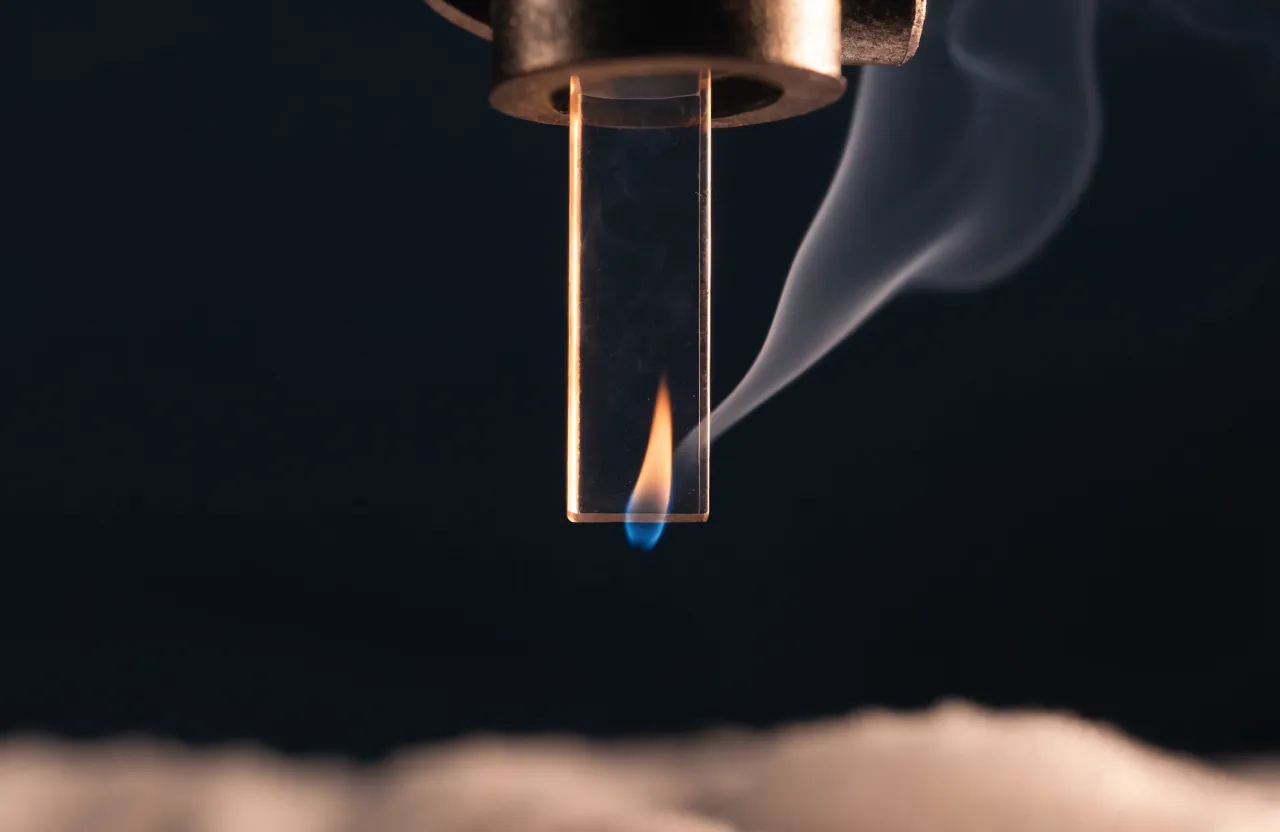
The drawing release adds one line to the bill of materials: the enclosure must now carry a UL 94 V-0 rating at 1.5 mm wall thickness. The resin is the same glass-filled nylon you have molded for two years, the tool is paid for, and the first set of test bars drips flaming beads onto the cotton and comes back V-2. Between that result and a part that clears the spec sits a flame-retardant package, a wall-thickness decision, and a test that most formulators quote from memory and still get wrong. Before you reformulate or recut steel, it pays to know exactly what V-0 measures, how the test is scored, and how far the rating actually travels.
The short version: UL 94, harmonized internationally as IEC 60695-11-10, is a small-flame laboratory classification for how a plastic behaves when a 20 mm flame is held to a bar specimen. It is not a measure of real-fire safety. In the vertical burning test, a set of five bars is lit twice for 10 seconds each. A material earns V-0 when no specimen flames for more than 10 seconds after either application, the five bars total no more than 50 seconds of afterflame, nothing burns up to the holding clamp, and no flaming drip ignites the cotton 300 mm below. V-1 loosens those limits to 30 and 250 seconds; V-2 is V-1 that is permitted to drip flaming particles. HB is a slower horizontal burn-rate test and the lowest classification. Every rating is tied to the exact thickness tested: a V-0 at 3.0 mm can fall to V-1 at 1.5 mm, so a rating quoted without a thickness is meaningless. Phosphorus flame retardants move a formulation toward V-0 two ways: by releasing radicals that quench the flame in the gas phase, and by building a protective char in the condensed phase. Intumescent packages built on ammonium polyphosphate swell that char into an insulating foam. No additive guarantees a V-0; the result is specific to your polymer, loading, and wall thickness, and a UL listing requires testing at the certification body.
What UL 94 V-0 actually is
UL 94 is the Standard for Tests for Flammability of Plastic Materials for Parts in Devices and Appliances, and it is now harmonized with IEC 60695-11-10 (often written UL94 in data sheets). The standard contains two everyday small-flame methods: a horizontal burn-rate test (HB) and a vertical self-extinguishing test that returns the V classifications. V-0 is the most demanding of those three vertical grades.
Read what that sentence does and does not promise. The vertical test, IEC Method B, is designed to determine “whether materials self-extinguish under specific test conditions” using an ignition source of nominal 50 W thermal power. It is a *relative, bench-scale comparison* of a small bar exposed to a small flame in still air.
It says nothing about heat release, smoke, toxic gas, or how a finished assembly behaves in a developed fire. UL Solutions states the limitation plainly in its own guidance: a UL 94 rating is a comparison under controlled laboratory conditions and is not by itself an indicator of fire-hazard or fire-risk performance for an end product. Treat V-0 as a material screening and qualification class, then design and certify your part to the fire test and building or product code that actually governs it.
The V-0, V-1, V-2 and HB criteria
The three vertical classifications are separated by how long each bar keeps flaming, how much the whole set flames in total, and whether it drips burning material onto a cotton indicator. The table below is the scored criteria for the vertical test; t1 and t2 are the afterflame times following the first and second flame applications, and the afterglow is the glowing combustion after flaming stops.
| Criterion (vertical test) | V-0 | V-1 | V-2 |
|---|---|---|---|
| Afterflame time for each individual specimen (t1 or t2) | ≤ 10 s | ≤ 30 s | ≤ 30 s |
| Total afterflame time for the five specimens in a set (Σ of t1 + t2) | ≤ 50 s | ≤ 250 s | ≤ 250 s |
| Afterflame plus afterglow for each specimen after the second application (t2 + t3) | ≤ 30 s | ≤ 60 s | ≤ 60 s |
| Flaming or glowing combustion up to the holding clamp | No | No | No |
| Flaming drips that ignite the cotton 300 mm below | No | No | Yes (allowed) |
Two points decide most real qualifications. First, V-0 and V-1 differ only in the timing numbers; the chemistry usually has to extinguish the flame roughly three times faster to clear V-0. Second, V-1 and V-2 share identical timing, and the *only* difference between them is dripping: a V-2 material is one that would otherwise be V-1 but throws flaming drips that light the cotton. Many formulations that fail V-0 fail on that drip line alone, which is why anti-drip and char-forming strategy is so often the lever that separates the two.
HB sits below all three. It is a horizontal test in which a 125 mm bar is clamped on its long axis, marked at 25 mm and 100 mm, and lit for 30 seconds; the material qualifies if it self-extinguishes before the flame front reaches the 100 mm mark, or if its burn rate stays under 40 mm/min for specimens 3 to 13 mm thick (under 75 mm/min below 3 mm). HB only proves slow horizontal burning, so a great many enclosure and electrical specs require a V rating instead.
How the vertical test is run
The procedure is specific, and the specifics are where ratings are won or lost.
- Specimen. A bar 125 mm long and 13 mm wide, molded at the thickness you intend to claim (commonly 0.8, 1.5, 1.6, 3.0 or 3.2 mm). The thickness is part of the result, not a detail.
- Conditioning. Two sets of five bars are tested under two conditioning regimes: one set held at 23 °C and 50% relative humidity for at least 48 hours, and a second set aged for 168 hours at 70 °C and then cooled in a desiccator for at least 4 hours. Both sets must meet the criteria, because flame retardants can migrate or hydrolyze, and aging exposes that.
- Flame. A 20 mm high blue flame from a calibrated burner (nominal 50 W) is applied to the free lower end of the vertically clamped bar.
- Two applications. The flame is held for 10 seconds and removed; once flaming stops, it is reapplied for a second 10 seconds and removed. The operator records the afterflame after each application, the afterglow, and whether any flaming drip ignites a layer of surgical cotton placed 300 mm beneath the bar.
Every one of the five bars in a set has to satisfy the limits in the table. One bar that flames 12 seconds, or one drip that lights the cotton, drops the whole set from V-0. That all-or-nothing scoring is why a formulation needs margin, not a borderline pass, before you commit it to a listing.
A rating is only valid at the thickness tested
This is the caveat that costs the most money when it is missed. A UL 94 rating is thickness-dependent, and a result at one wall does not transfer to a thinner one. UL Solutions is explicit that ratings are established at specific tested thicknesses; thinner sections lose heat more slowly relative to their fuel load and are generally harder to extinguish, so the same compound can earn V-0 at 3.0 mm and only V-1 at 1.5 mm.
Two rules follow for the buyer. A rating is only meaningful when quoted with its thickness, so read “V-0 at 1.6 mm,” never a bare “V-0.” And you must qualify at your part’s *minimum* wall thickness, not the nominal one. A housing that is 2.0 mm across most of its area but thins to 1.2 mm at a vent slot has to survive the test at 1.2 mm if the thin wall sees the flame. Pull the thinnest section into the test plan early, because discovering it after the tool is cut is the expensive way to learn this.
How to formulate toward V-0
Reaching V-0 is a systems problem: the right flame-retardant chemistry, at a high enough loading, matched to a polymer that will either char or be made to char, with the drip problem solved. The dominant halogen-free lever for that work is phosphorus, and it acts through two complementary routes (covered in depth in our guide to flame-retardant types and mechanisms).
Gas phase (radical quenching). As the additive decomposes it releases phosphorus radicals such as PO•, PO₂• and HPO• into the flame, where they scavenge the H• and OH• radicals that drive the combustion chain reaction. Slowing that chain shortens the afterflame time, which is exactly the number V-0 scores. Aryl phosphate esters lean toward this mechanism (phosphorus flame-retardant review, Frontiers in Materials).
Condensed phase (char). On heating, the same chemistry breaks down to phosphoric and polyphosphoric acid, which catalyze dehydration and cross-linking of the polymer surface into a carbon-rich char. That char does two jobs at once for a V-0 attempt: it shields the polymer from heat and starves the flame of fuel gas, and it holds the melt together so the bar stops dripping onto the cotton. A comparison in unsaturated polyester shows the split clearly, with ammonium polyphosphate driving condensed-phase char while triphenyl phosphate works more in the gas phase.
A practical sequence that gets formulators to V-0:
- Match the mechanism to the polymer. Char-forming engineering resins (polycarbonate, PPO blends, many polyamides) reward condensed-phase phosphorus at modest loading. Non-charring polyolefins such as polypropylene will not char on their own and usually need an intumescent package or a high mineral loading to clear V-0.
- Use an intumescent package where the polymer won’t char. A classic ammonium polyphosphate (APP) system pairs the APP acid source with a carbon source such as pentaerythritol and a nitrogen-based blowing agent; the three react in sequence to swell a thick insulating char foam, and such packages commonly reach V-0 in polyolefins at total loadings on the order of 30 to 40 phr.
- Solve dripping directly. Because V-2 and V-0 often differ only on the cotton, an anti-drip strategy (a char-former, a high-melt-strength resin, or a small anti-drip additive) is frequently the final step from a dripping V-2 to a clean V-0.
- Screen with LOI, then qualify on the real test. Use the Limiting Oxygen Index to rank candidate loadings cheaply before you burn UL bars, but remember the two tests measure different things and correlation is limited; an LOI lift suggests a direction, it does not certify a V-0.
The chemistry you reach for depends on the polymer and on whether you can accept some plasticization. Solid triphenyl phosphate (TPP) preserves stiffness in rigid and engineering thermoplastics, while liquid aryl phosphates such as cresyl diphenyl phosphate (CDP), 2-ethylhexyl diphenyl phosphate (DPOP) and isopropylated triphenyl phosphate (IPPP) double as plasticizing flame retardants in flexible PVC and engineering blends. Low-viscosity triethyl phosphate (TEP), about 17 wt% phosphorus, carries phosphorus efficiently into foams and low-viscosity systems, and tricresyl phosphate (TCP) is a long-established phosphate-ester flame retardant and plasticizer.
The trade-off to weigh out loud: liquid phosphates that plasticize can lower modulus and heat-deflection temperature and may migrate or volatilize over the part’s service life, while solid additives such as TPP and APP protect stiffness but demand attention to dispersion and processing. If you are deciding between this halogen-free route and a brominated one, our halogenated vs non-halogenated flame retardants comparison weighs the smoke, loading and regulatory differences. There is no free V-0 point: set the rating and thickness from your governing spec, then qualify the lowest loading of the right chemistry that clears it on your own compound.
Buying phosphate-ester flame retardants
Tell us your base polymer, the rating and wall thickness you are qualifying to (for example V-0 at 1.5 mm), and your constraints on stiffness, plasticization, volatility and processing, and request a sample to qualify the result on your own compound and at your own listing lab.
Frequently asked questions
What is UL 94 V-0?
UL 94 V-0 is the most demanding of the three standard vertical-burning classifications in UL 94 (harmonized as IEC 60695-11-10). A plastic earns V-0 when, in the vertical flame test, no bar specimen keeps flaming for more than 10 seconds after either of two 10-second flame applications, the five bars in a set total no more than 50 seconds of afterflame, nothing burns up to the holding clamp, and no flaming drip ignites the cotton placed 300 mm below. It is a small-flame laboratory classification of self-extinguishing behavior, not a measure of real-fire safety.
What is the difference between V-0, V-1 and V-2?
V-0 allows up to 10 seconds of afterflame per specimen and 50 seconds total for the set; V-1 and V-2 both loosen those limits to 30 seconds per specimen and 250 seconds total. V-1 and V-2 are otherwise identical, and differ only on dripping: V-1 must not drip flaming particles that ignite the cotton indicator, while V-2 is allowed to. In practice V-0 demands much faster self-extinguishing, and the step from V-2 to V-0 is often a matter of stopping the bar from dripping.
What thickness does a UL 94 rating apply to?
Only the thickness it was tested at. A UL 94 rating is thickness-dependent, because thinner sections are generally harder to extinguish, so the same compound can be V-0 at 3.0 mm and only V-1 at 1.5 mm. Always read a rating with its thickness (“V-0 at 1.6 mm”), and qualify your part at its minimum wall thickness rather than its nominal one.
How do flame retardants help a material pass UL 94 V-0?
Phosphorus flame retardants help in two ways. In the gas phase, phosphorus radicals released as the additive decomposes scavenge the combustion radicals driving the flame, which shortens the afterflame time the test scores. In the condensed phase, the additive forms phosphoric and polyphosphoric acid that build a protective char, which both insulates the polymer and holds the melt together so it stops dripping onto the cotton. Intumescent ammonium polyphosphate packages swell that char into an insulating foam and are the usual route to V-0 in polyolefins that will not char on their own.
Is a UL 94 V-0 rating a guarantee that my part is fire-safe?
No. V-0 is a relative, small-flame classification measured on a small bar in still air under controlled conditions. It does not measure heat release, smoke, toxic gas, or how a finished assembly behaves in a developed fire, and UL Solutions itself states it is not by itself an indicator of end-product fire hazard or risk. Use it to screen and qualify materials, then design and certify your part to the fire test and building or product code that governs your application.
Does a V-0 result from my lab mean my product is UL listed?
Not on its own. A V-0 result you measure in-house tells you a material classification; a UL Listing or Recognition is a separate certification that requires testing and follow-up auditing through the certification body. If your spec calls for a recognized material or a listed component, plan and budget for that listing process, and confirm the current requirements with the listing lab rather than relying on an internal burn result.
Editorial note. This article is general technical guidance for plastics, electronics and enclosure formulation professionals. UL 94 is a small-flame screening classification, not a fire-safety guarantee, a real-fire prediction, or a building/product code pass by itself; classifications and the loadings needed to reach them depend on the specific polymer, additive grade, loading, dispersion, specimen geometry, wall thickness and test conditions, and must be validated on your own compound and verified with the listing or certification lab. The criteria summarized here reflect publicly available UL 94 and IEC 60695-11-10 information at the time of writing; the governing edition of the standard controls, and a UL Listing or Recognition is obtained only through the certification body. Nothing here is a fire-safety, medical, health or environmental claim, and no flame retardant referenced is characterized as “safe,” “non-toxic” or “green.” Regulatory status for flame retardants varies by jurisdiction, end use and date and is actively changing; confirm the current position for your jurisdiction and application before use. The Certificate of Analysis governs the grade you buy. Products are sold for industrial and professional use only. RawSource makes no warranty, express or implied, and assumes no liability for use of this information.
Search 1,300+ industrial chemicals by name or CAS, or send us your spec — we quote by the drum, tote, or container.
Browse the Chemical Index → Request a Quote