
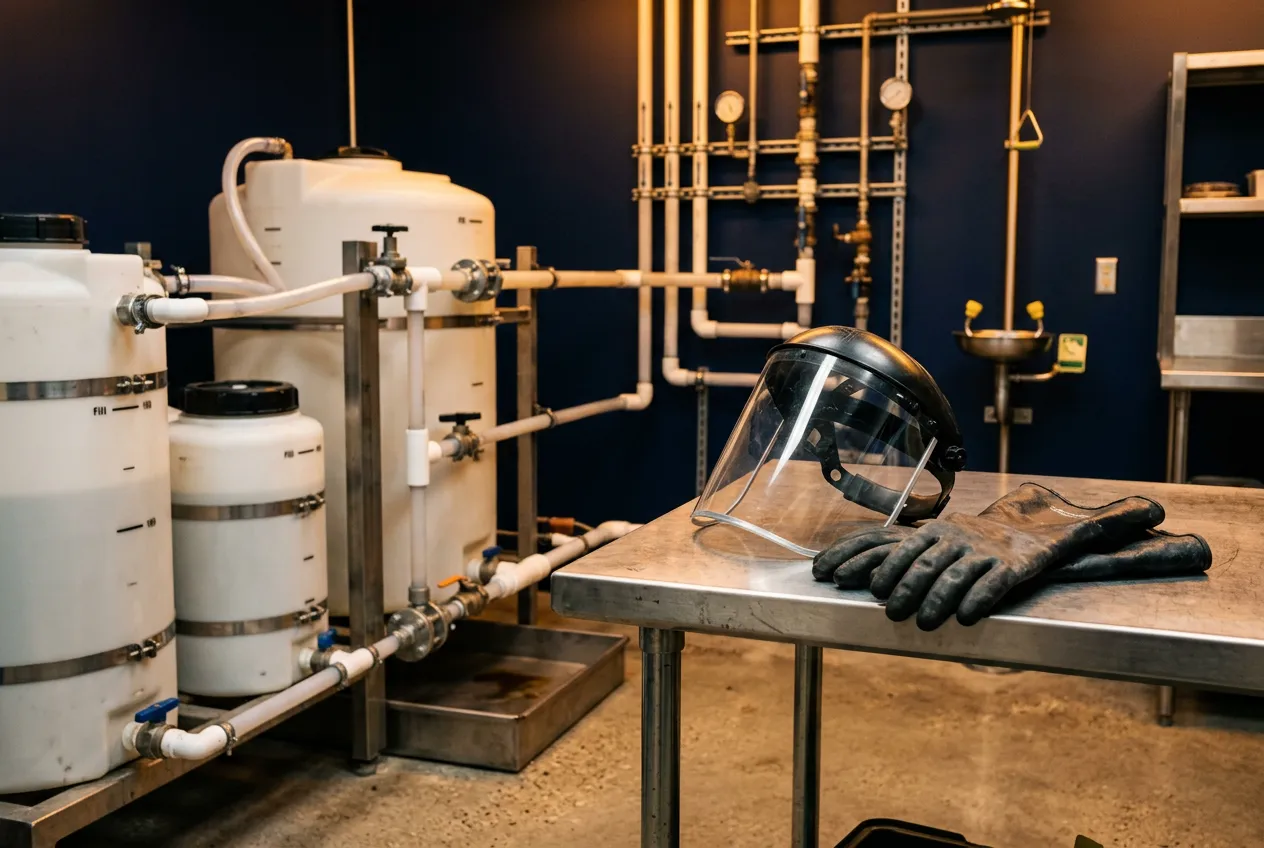
Hydrofluoric acid breaks the rule every other lab and plant runs on, because the default container, glass, is the one material it destroys. And a storage or handling error with HF is not a cleanup; free fluoride makes even dilute exposures a medical emergency. The materials, the limits, and the on-site readiness all have to be settled before the first drum arrives, not after.
The short version: store and handle hydrofluoric acid only in compatible materials, polyethylene (HDPE/XLPE) and fluoropolymers (PTFE, PFA, PVDF), with lead and, for anhydrous HF, steel cylinders. Never glass, silica, ceramic, concrete, or most metals. The OSHA permissible exposure limit is 3 ppm; the NIOSH IDLH is 30 ppm. Industrial practice, per occupational-safety sources, keeps a calcium gluconate antidote on-site. None of this is do-it-yourself; HF is for trained personnel under a real EHS program.
Why glass is the one container you cannot use
HF dissolves silica. The reaction is direct: SiO2 + 4 HF gives silicon tetrafluoride gas plus water (SiO2 + 4 HF to SiF4 plus 2 H2O). That is exactly why HF is used to etch glass, and exactly why glass, quartz, ceramics, and silica-bearing concrete are all the wrong materials to store or handle it in. The same reaction that frosts a window will weaken a glass vessel.
Materials of construction
The compatible-materials list is well established in the occupational-safety literature (NIOSH Pocket Guide).
| Use | Material |
|---|---|
| Acceptable, aqueous HF | HDPE and crosslinked (XLPE) polyethylene; PTFE, PFA, PVDF fluoropolymers; lead |
| Acceptable, anhydrous HF (dry) | Carbon steel and stainless steel cylinders (UN1052) |
| Avoid | Glass, quartz, silica, ceramics, concrete, and most metals (with aqueous HF) |
Confirm a full compatibility chart for your exact concentration, temperature, and component against a current vendor or SDS table before specifying tanks, piping, gaskets, and pumps.
Exposure limits
HF is regulated tightly as an airborne hazard. The NIOSH Pocket Guide and OSHA give the numbers an EHS program is built around:
- OSHA PEL: 3 ppm (2.5 mg/m3), 8-hour TWA.
- NIOSH ceiling: 6 ppm (5 mg/m3) over 15 minutes.
- IDLH: 30 ppm.
- Conversion: 1 ppm is about 0.82 mg/m3.
The danger is the fluoride, not the pH
Hydrofluoric acid is, by the textbook, a weak acid (pKa around 3.17, PubChem CID 14917). That is exactly what makes it deceptive. The hazard is not corrosivity alone; it is the fluoride ion, which penetrates tissue and binds calcium, driving systemic hypocalcemia that can follow even a modest skin exposure. Concentrated HF and anhydrous HF are additionally aggressive superacids.
Burns can be delayed, which is part of why HF is so dangerous: per occupational-safety references, exposures to lower concentrations may not produce pain for hours (commonly cited as up to 24 hours below about 20%, one to eight hours at 20 to 50%), while high-strength and anhydrous HF cause immediate deep injury. A worker may not feel the exposure until tissue damage is advanced.
On-site readiness (sourced occupational practice, not advice)
Standard industrial practice for HF, per the CDC and supplier medical-treatment references, is to keep a calcium gluconate antidote on hand, because calcium binds the fluoride. Occupational-safety sources describe a 2.5% calcium gluconate gel for skin contact and additional calcium protocols administered by medical professionals. Treat these as cited facts about how HF operations are equipped, not as medical or treatment advice; your SDS, EHS program, occupational physician, and local emergency services define what you actually do.
Transport and packaging
Aqueous hydrofluoric acid ships as UN1790, Class 8 (corrosive) with a 6.1 (toxic) subsidiary risk, Packing Group I above 60% strength and Packing Group II at or below 60%. Anhydrous HF ships separately as UN1052.
A lower-hazard path where it fits
Because HF handling is this demanding, the honest first question is whether the job needs HF at all. For lighter glass frosting, metal brightening, and cleaning, ammonium bifluoride, a solid that releases HF gradually in water, can do the work with easier storage and lower acute hazard, as compared in ammonium bifluoride vs hydrofluoric acid. Where the application genuinely needs HF, the controls above are non-negotiable.
Buying hydrofluoric acid
See the Hydrofluoric Acid product page. Tell us your application, concentration, and materials of construction, and we will confirm the right product, grade, and packaging. Background on the material is in what is hydrofluoric acid.
Frequently asked questions
What materials are compatible with hydrofluoric acid?
Polyethylene (HDPE, XLPE) and fluoropolymers (PTFE, PFA, PVDF), plus lead, are standard for aqueous HF; anhydrous HF uses steel cylinders. Glass, quartz, silica, ceramics, concrete, and most metals are not compatible with aqueous HF.
Why can’t you store hydrofluoric acid in glass?
HF dissolves silica: SiO2 + 4 HF gives silicon tetrafluoride gas and water. The reaction that lets HF etch glass also attacks glass containers, so HDPE and fluoropolymers are used instead.
What is the OSHA exposure limit for hydrofluoric acid?
The OSHA PEL is 3 ppm (2.5 mg/m3) as an 8-hour TWA; NIOSH lists a 6 ppm 15-minute ceiling and an IDLH of 30 ppm.
Why is hydrofluoric acid so dangerous if it is a weak acid?
Because the hazard is the fluoride ion, not the pH. Fluoride penetrates tissue and binds calcium, causing systemic hypocalcemia even from dilute exposures, and burns can be delayed for hours. Concentrated and anhydrous HF are also strong corrosives.
What antidote is kept on-site for hydrofluoric acid?
Occupational-safety references describe keeping calcium gluconate on hand (commonly a 2.5% gel for skin), because calcium binds the fluoride. This is a cited fact about how HF operations are equipped; follow your SDS, EHS program, and medical professionals for actual response.
Editorial note. This article is general technical and regulatory reference for industrial and professional users of hydrofluoric acid, and is not medical, safety, or treatment advice. Hydrofluoric acid is acutely hazardous and can be fatal on skin contact, inhalation, or ingestion, with systemic toxicity even from dilute solutions and potentially delayed burns. Hazard, exposure-limit, materials-compatibility, transport, and antidote references (NIOSH, OSHA, PubChem, CDC, supplier SDS) are stated as sourced facts to verify and apply through your own SDS, EHS program, and qualified professionals. HF is for industrial and professional use only by trained personnel with appropriate engineering controls and medical support. Always consult the current Safety Data Sheet (SDS) before handling. RawSource makes no warranty, express or implied, and assumes no liability for use of this information.
Search 1,300+ industrial chemicals by name or CAS, or send us your spec — we quote by the drum, tote, or container.
Browse the Chemical Index → Request a Quote