
What is ammonium bifluoride and what is it used for?
Ammonium bifluoride (ammonium hydrogen fluoride, CAS 1341-49-7) is an acid-fluoride salt. It is used for glass and porcelain etching and frosting, aluminum and metal brightening and pickling, oil-well acidizing, electroplating and surface prep, and equipment sanitation.
- ▸ Glass etching: Etching and frosting of glass and porcelain.
- ▸ Metal treatment: Brightening and pickling of aluminum and other metals.
- ▸ Oilfield acidizing: Acid-stimulation chemistry for wells.
- ▸ Electroplating: Plating-bath and surface-prep chemical.
- ▸ Equipment sanitation: Cleaning/sterilizing dairy and food equipment.
- ▸ Technical Data Sheet (TDS) PDF · TDS
- ▸ Typical Certificate of Analysis (CoA) PDF · COA
Values shown are typical for the current commercial grade. A lot-specific Certificate of Analysis accompanies every shipment; the grade-specific SDS is available on request.
A grade-specific Safety Data Sheet (SDS) — with the complete hazard classification, handling precautions, and transport information — is supplied with every shipment and available on request. Confirm all safety and regulatory details against the SDS for your specific grade.
Request SDS →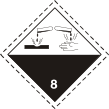
Transport classification per the UN Model Regulations / 49 CFR 172.101 Hazardous Materials Table. Confirm against the grade-specific SDS (Section 14) before shipping.
Ammonium bifluoride (ammonium hydrogen difluoride, NH4HF2; CAS 1341-49-7) is a white crystalline solid that is a convenient, shippable source of fluoride and acidic HF activity. It is used to etch and brighten glass, metal and ceramics, to dissolve silica and clay scale in oilfield and industrial cleaning, and as a pickling and surface-treatment chemical. It is corrosive and toxic and generates hydrofluoric acid in solution, so it is handled only by trained personnel under the controls in its SDS. Identity: PubChem.
What is ammonium bifluoride?
Ammonium bifluoride (ABF) is the acid salt NH4HF2. As a solid it is far easier and safer to ship and meter than liquid hydrofluoric acid, but in water it behaves as an acidic fluoride source — it liberates HF activity that attacks silica, silicates and metal oxides. That combination of solid handling and HF chemistry is exactly why it is specified where controlled fluoride etching or descaling is needed. It remains a hazardous material and must be treated as such.
Applications by sector
Metal finishing. Pickling, descaling and brightening of stainless steel, aluminum and titanium, and as a component of aluminum and metal surface-treatment baths. Glass & ceramic. Etching, frosting and polishing of glass and ceramics. Oil & gas. A solid source for sandstone-acidizing (“mud acid”) systems that dissolve clays and silica fines, and for dissolving silica/silicate scale. Industrial cleaning. Removal of rust, scale, beerstone and mineral deposits where fluoride activity is required. Electronics. Etching and surface preparation. Use level and method are application- and safety-critical; design them with your EHS team.
Forms and grades
Ammonium bifluoride is supplied as a solid (flake, granule or powder) and is also formulated into acidic cleaning and treatment solutions. Specify the form, assay and particle size on the RFQ; the CoA documents the lot.
Handling, hazards and documentation
This is a hazardous, corrosive, toxic material. In contact with water or acids it generates hydrofluoric acid, which causes severe burns and systemic fluoride toxicity that may be delayed. It must be handled only by trained personnel with the personal protective equipment, engineering controls, calcium-gluconate first-aid provisions and waste handling specified in the current Safety Data Sheet (SDS) and your site procedures. A solid fluoride source is easier to handle than liquid HF, but it is not “safe” — treat it with the same respect as HF. Each lot ships with a CoA; all hazard, exposure and transport data come from the SDS.
Bulk supply and RFQ
RawSource supplies ammonium bifluoride in bulk to metal-finishing, glass, oilfield and industrial-cleaning buyers, with CoA and SDS per lot. Submit an RFQ with your form, assay and target quantity; shipments are made under the applicable hazardous-materials transport requirements.
Typical Properties
Typical reference values, not a specification; the Certificate of Analysis (CoA) for the lot governs.
| Property | Typical Value |
|---|---|
| Chemical Name | Ammonium bifluoride (ammonium hydrogen difluoride, ABF) |
| CAS Number | 1341-49-7 |
| Molecular Formula | NH4HF2 (F2H5N) |
| Appearance | White crystalline solid (flake / granule / powder) |
| Solubility | Soluble in water (acidic; generates HF activity) |
| Hazard class | Corrosive and toxic — generates hydrofluoric acid; refer to the current SDS |
| Function | Acidic fluoride source: etching, pickling, descaling, acidizing |
Regulatory & registration requirements
- TSCA (US):
- REACH (EU):
- EC number: 215-676-4
Source: EPA TSCA Inventory (July 2025 release) · ECHA CHEM — retrieved 2026-07-12
Solutions Using This Product
Process-solution guides on this site that specify this chemistry:
- Acidizing & Well Stimulation Chemicals (Oil, Gas & Mining)
Frequently Asked Questions
What is ammonium bifluoride used for?
Ammonium bifluoride (ABF, CAS 1341-49-7) is used to etch and brighten glass, metal and ceramics, to pickle and descale metals, as a solid source for oilfield sandstone-acidizing (mud acid), and to remove silica/silicate scale in industrial cleaning.
Is ammonium bifluoride dangerous?
Yes. It is corrosive and toxic and generates hydrofluoric acid in solution, which causes severe, potentially delayed burns and systemic fluoride toxicity. It must be handled only by trained personnel with the PPE, controls and first-aid provisions in the SDS. A solid fluoride source is easier to ship than liquid HF but is not “safe.”
How is ammonium bifluoride different from hydrofluoric acid?
Ammonium bifluoride is a solid salt that is easier to ship and meter than liquid HF, but in water it releases the same aggressive HF activity. It is chosen where a controllable solid fluoride source is preferred; the hazard profile remains HF-like.
What is the formula and CAS of ammonium bifluoride?
It is NH4HF2 (F2H5N), CAS 1341-49-7 (PubChem CID 14935). The CoA documents assay and form for each lot.
How is bulk ammonium bifluoride supplied and quoted?
RawSource supplies it as a solid (flake/granule/powder) in bulk, with CoA and SDS per lot, shipped under hazardous-materials transport rules. Submit an RFQ with your form, assay and target quantity for a current quote.
What is the REACH and TSCA regulatory status of Ammonium Bifluoride (Ammonium Hydrogen Fluoride)?
Ammonium Bifluoride (Ammonium Hydrogen Fluoride) (CAS 1341-49-7) is subject to U.S. TSCA Inventory requirements; supplying it into the EU requires valid REACH registration ((EC) No 1907/2006). RawSource cannot verify a third-party supplier's registrations — buyers should require documented TSCA and REACH compliance for their jurisdiction and volume (EC 215-676-4).
What is the pH of ammonium bifluoride?
HSDB (via PubChem) gives a pH of 3.5 for a 5% aqueous solution of ammonium bifluoride. CAMEO Chemicals describes the solid as dissolving in water to form a weak solution of hydrofluoric acid.
How soluble is ammonium bifluoride?
Ammonium bifluoride is very soluble in water: 6.02 x 10^5 mg/L (602 g/L) at 20 °C, per the CRC Handbook of Chemistry and Physics as reproduced in PubChem. In 90% ethanol, HSDB gives 1.73 x 10^5 mg/L.
What happens when ammonium bifluoride is mixed with water?
CAMEO Chemicals states that ammonium bifluoride dissolves in water and forms a weak solution of hydrofluoric acid. It is very soluble: the CRC Handbook (via PubChem) gives 602 g/L at 20 °C. HSDB also describes the solid as hygroscopic above 50% ambient relative humidity and deliquescent.
What is the density of ammonium bifluoride?
The density of ammonium bifluoride is 1.50 g/cm³ at 25 °C, per the U.S. Department of Energy PAC Chemical Database as reproduced in PubChem. HSDB gives the same 1.50, and CAMEO Chemicals gives a specific gravity of 1.5 at 68 °F.
What is the chemical structure of ammonium bifluoride?
PubChem (CID 14935) gives the molecular formula F2H5N, written conventionally as NH4HF2, a molecular weight of 57.044, the computed IUPAC name azanium;fluoride;hydrofluoride and the SMILES [NH4+].F.[F-]: an ammonium ion with a fluoride ion and a molecule of hydrogen fluoride.
What does ammonium bifluoride look like?
CAMEO Chemicals describes solid ammonium bifluoride as a white crystalline solid and keeps a separate record for ammonium bifluoride solution. HSDB describes it as odorless.
Is ammonium bifluoride used with nitric acid?
Yes, in stainless steel pickling. US patent 3,419,440 replaces the conventional nitric-hydrofluoric acid bath with ammonium bifluoride in nitric acid; its Example 3 bath is 15 wt% nitric acid plus 4.59 wt% of a solid product that is 98% ammonium bifluoride and 2% disodium acid phosphate, giving 3 wt% fluorine ion in the working bath.
What is the molecular weight of Ammonium Bifluoride?
The molecular weight of Ammonium Bifluoride is 57.044 g/mol (PubChem).