
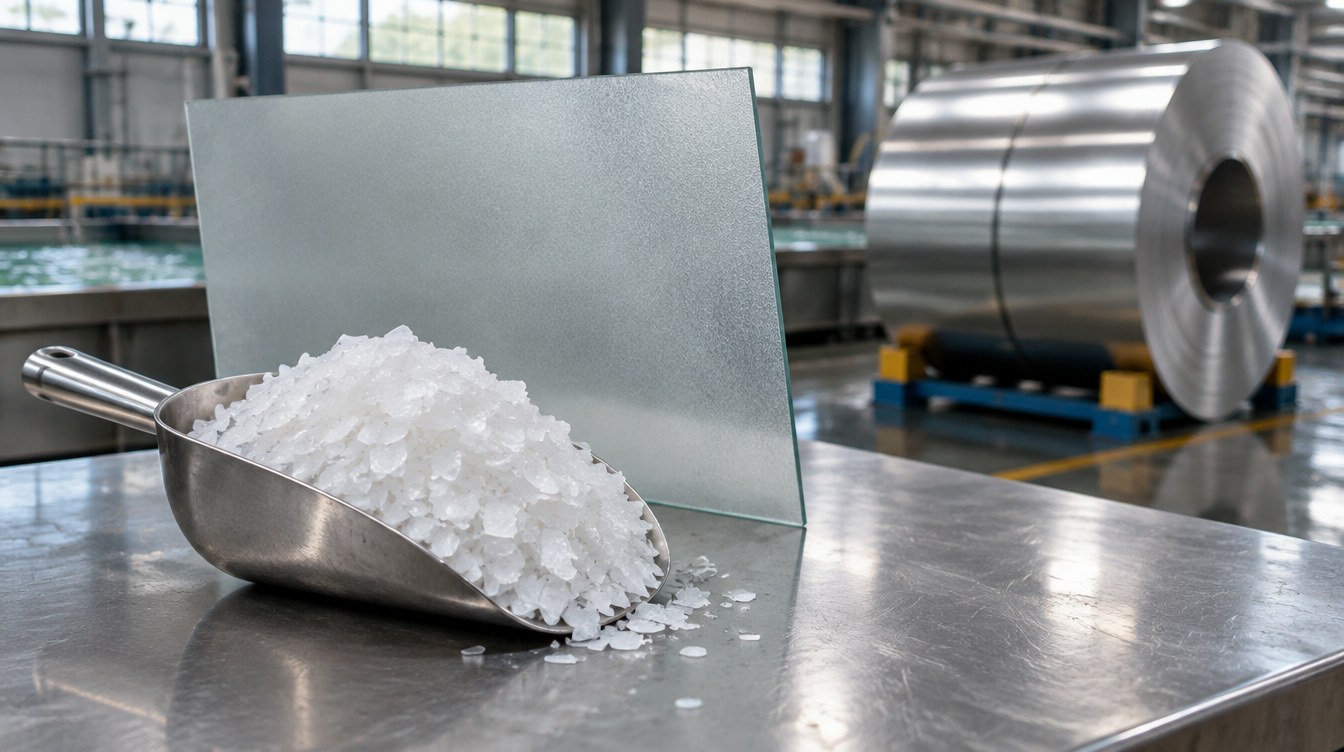
Two plants send the same request for quotation: ammonium bifluoride, technical grade, bagged. One runs a stainless steel pickling line in dilute nitric acid. The other blends a sandstone treatment fluid for a well hotter than 200 °F. Both are buying fluoride, and both must stop the dose short of the point where it attacks the substrate as well as the deposit.
What are the main ammonium bifluoride uses?
Ammonium bifluoride (NH4HF2, CAS 1341-49-7) is a solid that dissolves in water to a weak hydrofluoric acid solution. Its main uses are glass etching and frosting, oxide and nitride etching on silicon wafers, stainless steel pickling, sandstone well treatment, and aluminum brightening and fleet wash. Each runs at its own strength, stated on its own basis.
The common thread is the bifluoride ion. A 5% solution measures pH 3.5 (HSDB, in PubChem’s ammonium bifluoride record), and its fluoride attacks silica and silicates, which most other mineral acids barely touch. So one bag can frost glass, lift oxide scale from stainless steel or dissolve clay in a sandstone pore, and attack whatever sits under the deposit. Every use below is a decision about dose, temperature and contact time.
Buyers who run hydrofluoric acid ask why the salt exists. It ships as a white crystalline solid, but not an inert one: it reacts with moisture, and in water it forms a weak hydrofluoric acid solution (CAMEO Chemicals). The ammonium bifluoride versus hydrofluoric acid comparison sets out the trade-offs, and ammonium bifluoride properties and reactions covers the chemistry.
Where each use runs, by published strength
Each strength below comes from the source that publishes it; where none is published, the cell says so. Watch the basis: the patents state weight of fluoride acid, HF-equivalent, fluorine ion or weight of the salt, so convert before comparing a quoted dose with your bath.
| Use | Published strength or condition | Source | What the number is |
|---|---|---|---|
| Anti-glare glass texturing | 0.5-6 wt% fluoride acid (HF and/or ammonium bifluoride) with 1-20 wt% potassium salt | US 11,009,736 B2 (2021) | Patent formulation |
| Silicon nitride and silicon dioxide etch on wafers | 0.07-0.7% by weight HF-equivalent at 60-96 °C; preferred 0.3% at 90 °C | US 3,607,480 (1971) | Patent claim on an HF-equivalent basis; its worked example used hydrofluoric acid |
| Stainless steel pickling | 0.5-8% fluorine ion in water or dilute nitric acid, 20-70 °C | US 3,419,440 (1968) | Patent composition |
| Sandstone well treatment | 0.5-6 wt% ammonium bifluoride, most preferred 1-2 wt%, with diammonium EDTA; pH 5-6.5 most preferred (description), pH 3-6.5 (granted claim) | US 7,589,050 B2 (2009) | Patent description and claims |
| Aluminum brightening and fleet wash | No published figure | HSDB use list in PubChem | Listed use |
| Beer-line cleaning; laundry sour | No published figure | HSDB use list in PubChem | Listed use, no dose |
All four published windows come from patents, some of which may still be in force: they are published data, not a recommendation to practice the claimed compositions. Use them to read a quoted dose, not in place of your own trials. The use lists in PubChem also name electroplating, beryllium processing, magnesium alloy manufacture and magnesium fluoride synthesis, with no dose given.
Glass etching, frosting and semiconductor etch
A standard chemical dictionary reproduced in PubChem lists ammonium bifluoride for etching glass, as “white acid”. A newer use is texturing: in US 11,009,736 B2, an anti-glare etchant carries 0.5 to 6 wt% of a fluoride acid (hydrofluoric acid, ammonium bifluoride or both) plus 1 to 20 wt% of a potassium salt. Insoluble potassium fluorosilicate or fluoroaluminate crystals form on the glass during the etch and mask parts of it, so the surface etches unevenly into a light-scattering texture.
A 1971 patent, US 3,607,480, published an electronics version of the same chemistry at a fraction of the strength. It names ammonium bifluoride solution among acceptable etchants and claims 0.07 to 0.7% by weight, expressed as the equivalent hydrofluoric acid concentration, at 60 to 96 °C: the window where silicon nitride and silicon dioxide etch at substantially equal rates. Its preferred point is 0.3% at 90 °C, held constant by adding water to replace evaporation.
US 3,607,480 is a published patent example, not current fab practice. On a fluoride-equivalence basis, that window is about 0.10-1.0 wt% ammonium bifluoride; the conversion is arithmetic, not the patent’s figure. See how ammonium bifluoride works as an etching agent for the mechanism and ammonium bifluoride in glass and metal processing for plant practice.
Stainless steel pickling and descaling
In stainless pickling, ammonium bifluoride stands in for the hydrofluoric acid half of a fluonitric (nitric plus hydrofluoric acid) bath. Patent US 3,419,440 (1968) made the case: the conventional fluonitric bath, it said, etches and pits the base metal along with the oxide scale, leaving parts unfit for further treatment. Its replacement dissolves in water or dilute nitric acid to give 0.5 to 8% by weight fluorine ion, at 20 to 70 °C.
Check your own bath against its worked example: 15 wt% nitric acid plus 4.59 wt% of a solid that is 98% ammonium bifluoride and 2% disodium acid phosphate, giving 3 wt% fluorine ion, tested on two austenitic stainless steels. The phosphate is not filler. The patent credits it with a protective film that completes the nitric acid’s passivation, and with less fume and gas-bubble evolution during dipping.
If the job is rust, mill scale or heat tint, the rust, scale and pickling post covers descaling and anodizing preparation.
Sandstone well treatment: a patent’s numbers, not field practice
Oil-well acidizing is on the salt’s use list in a 1984 trade listing reproduced in PubChem. The detailed numbers come from one patent, US 7,589,050 B2: its inventors’ claims and core tests, not a dose any operator is known to run.
The patent specifies 0.5 to 6 wt% ammonium bifluoride, preferably 1 to 5 wt% and most preferably 1 to 2 wt%, with a chelating acid, preferably diammonium EDTA. An ammonium buffer or amine lifts the fluid to pH 5 to 6.5 in the description’s most preferred range, which matters because a plain 5% solution of the salt sits at pH 3.5. The granted claim limits the fluid to pH 3 to 6.5 and its use to formations above 200 °F.
Its sharpest result is a threshold. At 250 °F (121 °C), a fluid with 20 wt% active diammonium EDTA and 3 wt% ammonium bifluoride stimulated Berea sandstone cores; the same fluid at 5 wt% damaged them.
Yet the inventors put the usable dose up to 250 °F at about 2 wt%, below the 3 wt% that worked in their own cores, and expected 1 wt% to be the concentration of choice in most cases. That gap between the working figure and the damaging dose is worth noting; the patent ties the lower dose to temperature and carbonate content.
Against conventional 9:1 mud acid (hydrochloric plus hydrofluoric acid), the patent reports its fluid dissolves as much clay with minimal zeolite dissolution, and harms acid-sensitive clays and feldspars less than hydrochloric acid or high-strength hydrofluoric acid fluids. Treat it all as a hypothesis for core-flood tests on your own formation.
What is an ammonium bifluoride cleaner?
An ammonium bifluoride cleaner is a formulated product that uses the salt as its fluoride active. Aluminum brighteners are one such family, including truck and trailer acid washes; others use hydrofluoric acid directly.
Aluminum brightening is on the HSDB use list in PubChem: the fluoride strips the dull oxide skin from trailers, tanks and wheels. Neither HSDB nor the patents give a working strength; take dose and dwell from the formulation’s technical data sheet (TDS) and the aluminum brightening and fleet wash post.
Masonry and concrete cleaning is not on HSDB’s use list; the masonry and concrete cleaning post treats it as its own application. HSDB’s reactivity entry is the caution: with moisture present, the salt attacks glass, cement and most metals, so a fluoride cleaner left too strong or too long can etch window glass, metal trim or a cement face.
HSDB’s use list also carries entries with no dose: beer-line cleaning and duty as a laundry sour.
What should the purchase order say for each use?
Name the use on the order, not just the salt. Three lines cover most of the risk:
-
Grade by end use. An electronics etch line buys a finished etch solution, not salt: a 2015 Chinese patent, CN103112872B, builds one from purified ammonia and hydrogen fluoride to individual anion impurities below 50 ppb, individual metal impurities below 1 ppb and fewer than 100 particles per mL above 0.2 micrometers. For pickling baths, well fluids and cleaners, the line that matters is the assay on each lot’s certificate of analysis (CoA); see ammonium bifluoride grades and bulk buying.
-
Dry storage. The salt is hygroscopic above 50% relative humidity and deliquescent (HSDB), so an opened bag in a humid plant cakes and weighs out wet. Specify sealed, lined packaging and order lot sizes the line uses quickly. Water solubility of 602 g/L at 20 °C (CRC Handbook, 86th edition, via HSDB) sets the ceiling for any concentrate you make up.
-
Safety documents. Take the hazard classification, handling and first aid from the current Safety Data Sheet (SDS) for the grade you buy and from the safety section of the ammonium bifluoride product page, not from a use summary like this one.
Methodology: uses, pH, solubility, hygroscopicity and reactivity come from PubChem’s ammonium bifluoride record (CID 14935, with its HSDB entries) and CAMEO Chemicals, and the EC number 215-676-4 from the ECHA substance record. Concentrations are the inventors’ compositions and test results in the patents named, not field recommendations.
Frequently asked questions
What is ammonium bifluoride used for in cleaning products?
Why use ammonium bifluoride instead of hydrofluoric acid?
What concentration of ammonium bifluoride is used for well acidizing?
Does the grade matter if the salt only goes into a cleaner or pickling bath?
Sources & methodology
Figures are RawSource sourcing data unless attributed to a named source. Regulatory citations are current as of publication. Chemical identities verified by CAS number against the RawSource catalog.
Search 1,300+ industrial chemicals by name or CAS, or send us your spec — we quote by the drum, tote, or container.
Browse the Chemical Index → Request a Quote