
Why It Works: The HF Chemistry
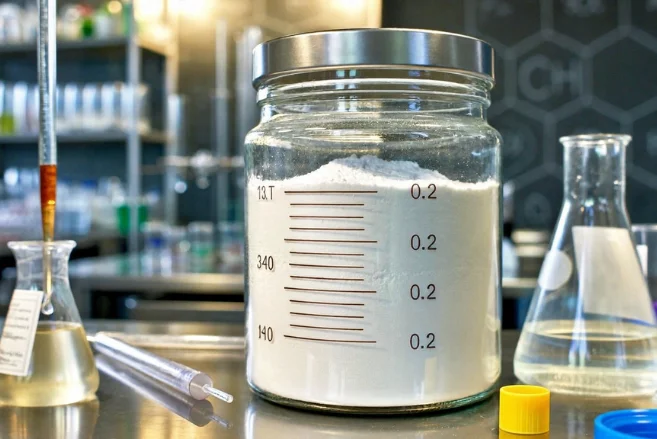
Dissolved in water, ABF dissociates to ammonium, fluoride, and bifluoride (HF₂⁻) ions, releasing hydrofluoric acid in situ. That HF is what attacks silica and metal oxides. On glass, the reaction strips silicon dioxide as gaseous silicon tetrafluoride:SiO₂ + 4 HF → SiF₄↑ + 2 H₂O
Because the HF is generated from a buffered salt rather than poured as a concentrated acid, the effective attack rate is gentler and more controllable, which is why frosting and architectural etch baths favor ABF. It is not a milder hazard, only a milder etch rate at a given concentration.Applications in Glass Processing
Etching and Frosting
Commercial frosting and decorative etch creams typically run roughly 4 w/v% ABF or less, the level that produces an even matte without excessive undercut. The same chemistry serves privacy panels, lighting diffusers, etched mirrors, and architectural glass. Higher concentrations etch faster but lose pattern fidelity, so match the bath strength to the texture spec rather than maximizing it.Surface Polishing and Cleaning
A dilute ABF dip dissolves the outermost micro-rough layer, cutting surface haze and lifting grease, oxides, and residues before coating, tinting, or mirroring. Optical lenses and solar-panel glass use this to raise light transmission and improve coating adhesion. The trade-off is dimensional: any etch removes glass, so polishing baths are kept dilute and time-controlled to avoid pulling the part out of optical tolerance.Applications in Metal Processing
Pickling and Scale Removal
In stainless and carbon steel pickling, fluoride from ABF dissolves the chromium-rich oxide and heat-tint scale that nitric acid alone leaves behind, exposing bright, passivatable metal. It does the same job as the HF in a nitric-hydrofluoric pickle line but is easier to dose as a solid. Watch the free-fluoride balance: too aggressive a bath over-pickles and pits the base metal.Surface Preparation
Before painting, electrocoating, plating, or adhesive bonding, a controlled ABF etch cleans and micro-roughens the surface so the next layer keys in. Automotive body panels, aerospace components, and electronic enclosures all rely on this step. The honest limit: ABF is a cleaning and etching agent, not a corrosion inhibitor. It leaves a clean, reactive surface that flash-rusts if left wet, so rinse, neutralize, and move straight to the protective coat rather than treating the ABF step as protection in itself.| Task | Typical ABF strength | What it removes / does | Key control |
|---|---|---|---|
| Glass frosting | ~4 w/v% or less | Matte SiO₂ surface (SiF₄ off-gas) | Concentration vs. pattern fidelity |
| Optical polish / clean | Dilute | Haze, grease, oxide film | Time, to hold optical tolerance |
| Steel pickling | Bath-dependent free F⁻ | Heat-tint and chromium oxide scale | Avoid over-pickle / pitting |
| Pre-coat prep | Dilute | Clean + micro-roughen | Rinse and coat before flash rust |
Safety and Handling: Treat It As HF
The single most important fact a buyer can carry to the plant floor: ABF is safer to ship and dose than anhydrous HF, but exposure is HF exposure, and HF burns are a medical emergency, not a first-aid event. Fluoride ion penetrates skin and binds calcium in deep tissue and bone, so a burn can be painless at first and still cause life-threatening hypocalcemia. Skin contamination beyond roughly 160 cm² (about a hand-sized area) of even dilute solution can drop serum calcium to a dangerous level.Exposure Limits and Antidote
The OSHA PEL for ammonium bifluoride is 2.5 mg/m³ as fluoride (8-hour TWA). The HF it generates carries an OSHA PEL of 3 ppm (8-hour TWA), with ACGIH treating 3 ppm as a ceiling. Stock 2.5% calcium gluconate gel at every workstation and confirm it is in date; it is the standard topical antidote that binds fluoride before it reaches bone. Train operators that any HF/ABF skin or eye contact goes to medical evaluation, not just a rinse.PPE, Storage, and Disposal
Use fluoride-rated gloves (nitrile or neoprene, double-gloved for immersion work), chemical splash goggles plus a face shield, and a chemical-resistant apron. Provide ventilation or local exhaust to stay under the HF PEL; ABF off-gasses HF when wetted or heated. Store the solid cool and dry, away from acids, bases, and glass containers (it etches glass and silica). For shipping the solid is UN1727 (ammonium hydrogendifluoride, solid), Class 8 corrosive, Packing Group II; a solution ships as UN2817 instead. Neutralize spent baths with lime or another calcium base to precipitate calcium fluoride before disposal, per local regulation. Always work from the current product SDS.Sourcing and RFQ
Specify ABF by purity (technical 98%+ vs. higher-purity grades for electronics/optical work), particle form (crystal vs. fine), and packaging (drums, bags, or totes). State the application so the right grade ships, name your volume, and reference UN1727 for freight.FAQs
What is the function of ammonium bifluoride?
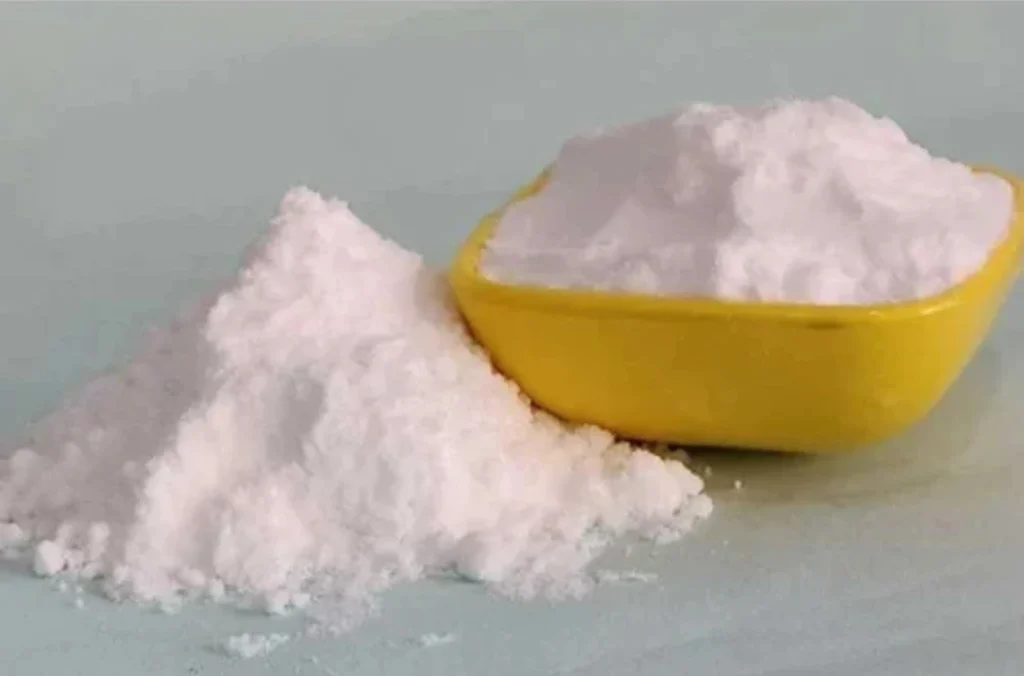
Ammonium bifluoride (CAS 1341-49-7) is a solid fluoride source used for cleaning, etching, and surface preparation. Dissolved in water it releases hydrofluoric acid in situ, which dissolves silica, oxides, and scale. That makes it the working chemistry behind glass etching, steel pickling, and pre-coat metal prep.
Does ammonium bifluoride etch glass?
Yes. In water it releases HF, which reacts with silica (SiO₂) to form gaseous silicon tetrafluoride and remove surface layers, producing frosted finishes and patterns. Commercial frosting baths typically run about 4 w/v% ABF or less, trading etch speed for even matte and pattern fidelity.
Why is HF used for etching?
Hydrofluoric acid is the only common acid that dissolves silica, so it is essential for glass etching, semiconductor processing, and quartz work. It also strips chromium-oxide scale that other acids leave on stainless steel. Its reactivity gives fine finishes, but it is acutely toxic and corrosive and demands HF-specific handling and medical response.
What is ammonium bifluoride used for in cleaning?
It removes rust, heat-tint, scale, and oxide films from metal and dissolves residues on glass and ceramics, which is why it appears in pickling lines and pre-coat prep. It is a cleaner and etchant, not a corrosion inhibitor, so a cleaned surface must be rinsed, neutralized, and coated promptly before it flash-rusts.
Is ammonium bifluoride the same as hydrofluoric acid?
No. ABF (NH₄HF₂) is a crystalline salt; HF is the fuming liquid acid. ABF is easier to ship, weigh, and dose, and it releases HF only when dissolved or heated. But the exposure hazard is the same HF chemistry: fluoride burns penetrate skin, bind calcium, and can cause hypocalcemia, so handle ABF with full HF precautions and calcium gluconate on hand.
What are the OSHA exposure limits for ammonium bifluoride?
The OSHA PEL for ammonium bifluoride is 2.5 mg/m³ as fluoride (8-hour TWA). The hydrogen fluoride it generates carries an OSHA PEL of 3 ppm (8-hour TWA), with ACGIH applying 3 ppm as a ceiling. For shipping it is UN1727, a Class 8 corrosive solid. Always work from the current SDS.
Methodology and sources
Identity and property context for Ammonium Bifluoride (Ammonium Hydrogen Fluoride) (CAS 1341-49-7) in this guide is anchored to the compound's PubChem record. Hazard-communication framing follows OSHA's Hazard Communication Standard, 29 CFR 1910.1200. Always defer to the supplier's current SDS and CoA for the specific grade and lot you handle.
Search 1,300+ industrial chemicals by name or CAS, or send us your spec — we quote by the drum, tote, or container.
Browse the Chemical Index → Request a Quote