
Your settled-water turbidity climbs after a storm, and the operator turns up the coagulant pump. Sometimes that fixes it; sometimes the next sample comes back worse. A storm’s organic load can raise the optimum dose, but past an optimum a coagulant can reverse the charge it was fed to neutralize and redisperse the particles. Only a jar test bracketed on both sides tells you which. In a US conventional filtration plant, that dose may also have to meet a total organic carbon (TOC) removal table and a polymer monomer limit.
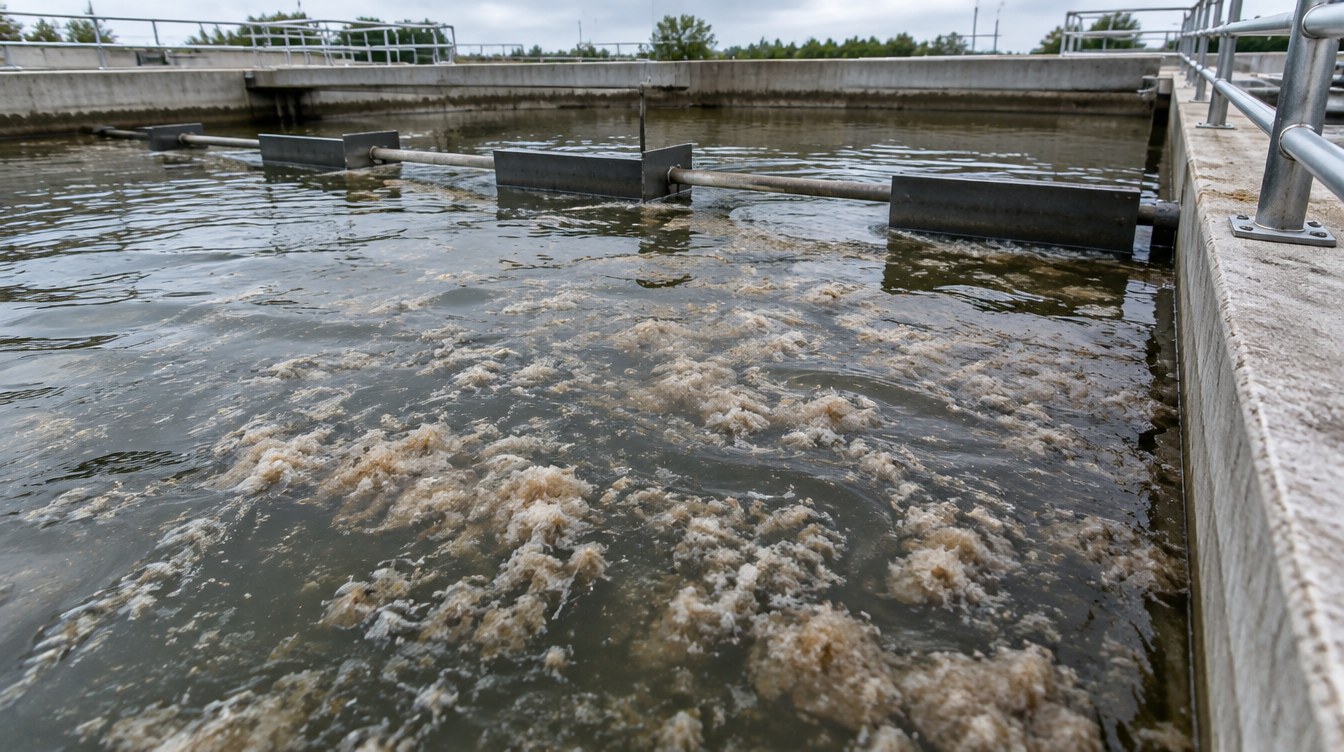
Flocculation in water treatment is the slow-mixing stage after coagulation. Once a coagulant has destabilized the suspended particles, gentle stirring lets them collide and stick into floc heavy enough to settle in a clarifier or be held on a filter. A flocculant, such as a high-molecular-weight polyacrylamide (PAM), helps that growth.
What do coagulation and flocculation do in water treatment, and in what order?
Coagulation comes first. EPA’s Enhanced Coagulation and Enhanced Precipitative Softening Guidance Manual (EPA 815-R-99-012, May 1999) explains that aluminum and iron salts work as primary coagulants because they are trivalent and form insoluble hydrolyzed species that destabilize negatively charged material. Its jar-test examples use aluminum sulfate and ferric chloride, and it adds that poly aluminum chloride (PAC) can serve as a primary coagulant in low-turbidity water.
The manual rates the two stages by velocity gradient, G. Conventional rapid-mix chambers that hold the water for 10 to 30 seconds at 0.25 to 1.0 hp/mgd give G values of 300 to 1000 s⁻¹. Flocculation then needs gentle mixing at 20 to 70 s⁻¹ for approximately 20 minutes to grow flocs of 0.1 to 2.0 mm effective size. Both are guidance, not requirements.
For polymer flocculants, the manual says anionic polymers are usually most efficient fed after alum, once pin-point flocs have formed, and that a high-molecular-weight cationic or nonionic polymer can aid floc settleability at higher coagulant doses.
How is the dose found?
A jar test is only as good as its match to your plant’s mixing. EPA’s enhanced coagulation protocol asks for mixing that reflects plant conditions at maximum daily flow, and uses the default below only when plant mixing is unknown. Protocols differ widely, so re-run the series under your own mixing before carrying a dose across.
| Protocol (water, year) | Fast mixing | Slow mixing | Settling |
|---|---|---|---|
| EPA default (1999) | 100 rpm, 1 minute | 30 rpm, 30 minutes | 60 minutes |
| Alabama plant, spiked river water (2019) | 70 rpm for 1 min, then 180 rpm for 30 s | 40, 30 and 20 rpm for 15 min each, then 15 rpm for 25 min | 21 min |
| Kaolin, cationic polyacrylamide (2018) | 200 rpm, 5 min | 50 rpm, 15 min | 30 min |
Why can more coagulant past the optimum make water worse?
A 2019 study on sediment-spiked Tennessee River water (Int. J. Environ. Res. Public Health 16(15):2808) ran poly aluminum chloride (PAC), alum and ferric chloride from 15 to 480 mg/L. Under its simulated severe-weather conditions, with initial pH 7.47 and alkalinity 67 mg/L as CaCO3, the optimum for all three sat around 75 mg/L. Higher doses gave no advantage, because charge reversal restabilized the particles.
The products differed in strength (a 49% aluminum sulfate solution with 10% Al2O3, a 39% FeCl3 solution, a PAC with 16% Al2O3), so equal mg/L is not equal metal. Run your own series well past the expected optimum, as that study did, to see where turbidity turns back up.
Polymers show the same window. In a 2018 study (RSC Advances 8:15119) on a 0.5 g/L kaolin suspension at 143 NTU, residual turbidity with four cationic polyacrylamides fell as the dose rose from 0.5 mg/L. It bottomed at 2.0 mg/L, then climbed rapidly toward 3.5 mg/L. The authors’ explanation: excess cationic polymer surrounds the particles, repulsion between fine aggregates grows, and the floc turns fluffy and uncompacted.
Overdosing also shows in the jar-treated water. In a 2021 study on Malaysian river and plant waters (same journal, 18(17):9164), alum doses above 15 mg/L in 25.6 NTU water raised residual aluminum above the 0.106 mg/L the water started with. The authors link it to the pH drop from alum hydrolysis, which forms soluble aluminum species.
The window moves with the water. In the 2019 study’s tests at 7 °C, raising natural organic matter to 6.14 mg/L as TOC left 16.15 NTU at 30 mg/L of PAC; 90 mg/L brought every case to 1.00 NTU or less. EPA’s guidance warns that the lower-pH, higher-dose conditions that remove TOC can restabilize particles and raise settled-water turbidity, particularly in waters coagulated by charge neutralization.
What should a polymer flocculant order specify?
Write the charge type, the charge density with its basis (molar or weight), the molecular weight and, for drinking water, the residual acrylamide monomer content on the order (the limit it feeds is in the next section).
Dose bases differ by industry: a 2025 mining-tailings study (Polymers 17(8):1055), not a drinking-water study, dosed an anionic polyacrylamide of 18 × 10^6 g/mol and 30 to 50% anionic charge density at 10 and 30 g/t of dry solid, not mg/L. For choosing between coagulant and flocculant products, see coagulants vs flocculants: how to choose.
They are not the whole specification. In the 2018 kaolin study at 2.0 mg/L, the authors’ block-structured cationic polyacrylamide left 5.8 NTU, a non-templated copolymer of the same monomers 8.9 NTU, and two commercial products 13.9 and 15.8 NTU. All four had a cationic monomer molar content of 30.0% and intrinsic viscosity of 8.49 to 8.51 dL/g; the authors credit the microblock structure. Equal data-sheet numbers did not mean equal floc, so jar-test the lot you will buy.
What caps the polyacrylamide dose in a US plant?
Under 40 CFR 141.111 (eCFR, up to date as of 2026-10-07), the combination (or product) of dose and monomer level must not exceed 0.05% acrylamide dosed at 1 ppm, or equivalent. Acrylamide is the residual monomer in polyacrylamide flocculant. For epichlorohydrin, the same 2026-10-07 text sets 0.01% dosed at 20 ppm. Each public water system must certify to the State in writing every year, using third-party or manufacturer’s certification, that these limits are not exceeded.
Read as arithmetic, which is this article’s reading and not rule text, the residual monomer on each lot’s certificate of analysis (CoA) limits how much polyacrylamide flocculant a plant can feed. On that reading, a jar test can find an optimum that a lot’s monomer level leaves no room for, and your monomer specification decides how much of the rule’s allowance each lot uses. Put residual acrylamide in your purchase specification and on every CoA.
Directive (EU) 2020/2184, as published in OJ L 435 on 23.12.2020, sets parametric values of 0.10 μg/L each for acrylamide and epichlorohydrin, calculated from the polymer’s maximum-release specification. As labelled arithmetic only: if all the residual monomer in a dose reached the water, the US line of 0.05% at 1 ppm would mean 0.5 μg/L of acrylamide, five times the EU value. The bases differ, so read that as scale, not equivalence.
Which rules and goals bound the coagulant dose?
TOC can set your coagulant dose as firmly as turbidity. Under 40 CFR 141.135 (eCFR, up to date as of 2026-10-07), Subpart H systems using conventional filtration must run enhanced coagulation or enhanced softening to meet its Step 1 TOC removal table, measured from source water to combined filter effluent. Alternative compliance criteria include source or treated water TOC below 2.0 mg/L, or source or finished water SUVA (specific ultraviolet absorbance) at or below 2.0 L/mg-m, each calculated quarterly as a running annual average.
Required TOC removal, 40 CFR 141.135(b)(2) Step 1 table (eCFR, 2026-10-07); softening systems must meet the >120 mg/L column:
| Source-water TOC | Alkalinity 0-60 mg/L as CaCO3 | Alkalinity >60-120 mg/L as CaCO3 | Alkalinity >120 mg/L as CaCO3 |
|---|---|---|---|
| >2.0-4.0 mg/L | 35.0% | 25.0% | 15.0% |
| >4.0-8.0 mg/L | 45.0% | 35.0% | 25.0% |
| >8.0 mg/L | 50.0% | 40.0% | 30.0% |
If your plant cannot meet its cell, Step 2 of 40 CFR 141.135 (eCFR, 2026-10-07) applies. Bench or pilot tests add alum in 10 mg/L increments, or the equivalent ferric salt, until the pH is at or below a target set by alkalinity: 5.5 at 0-60 mg/L as CaCO3, 6.3 at >60-120, 7.0 at >120-240 and 7.5 above 240. Where one increment removes 0.3 mg/L of TOC or less, the percent removal reached becomes your minimum once the State approves.
This is where coagulant and polymer budgets part. EPA’s 1999 guidance says significant TOC removal by organic polymers in conventional plants has not been demonstrated, that they may raise TOC, and that polymers are not allowed in the Step 2 jar protocol. Their value is settleable floc at high aluminum or iron doses. If your plant is short of its Step 1 number, budget for coagulant and pH control, not more polymer.
Dose alone may not close the gap: in the 2019 study, PAC removed only about 20% of the TOC regardless of dose.
If removal is consistently below 0.3 mg/L of TOC per 10 mg/L of alum at every dose, 40 CFR 141.135(b)(4)(v) (eCFR, 2026-10-07) deems the TOC not amenable to enhanced coagulation, and the system may apply to the State for a waiver.
TOC is the target of 141.135 because the section controls disinfection byproduct precursors. The 2019 study adds a result, not a recommendation. In its simulated storm water at 7 °C and 60 mg/L of PAC, pre-oxidation lifted TOC removal from about 19% to 46% with 1 mg/L of free chlorine and over 50% with 0.5 mg/L of sodium permanganate.
Coagulant also leaves a residual. 40 CFR 143.3 (eCFR, up to date as of 2026-10-07) lists secondary maximum contaminant levels, reasonable goals for drinking water quality that States may set higher or lower: 0.05 to 0.2 mg/L for aluminum, 0.3 mg/L for iron and pH 6.5-8.5. Directive (EU) 2020/2184 (OJ L 435, 23.12.2020) lists aluminum and iron as indicator parameters at 200 μg/L each, values set for monitoring and for remedial action under Article 14.
The same Directive sets operational monitoring of turbidity at the water supply plant: a reference value of 0.3 NTU in 95% of samples, none above 1 NTU. Maximum-use limits based on ANSI/NSF Standard 60 are product-specific, EPA’s 1999 guidance notes, so ask for yours.
Methodology: eCFR title 40 (up to date as of 2026-10-07), Directive (EU) 2020/2184 (OJ L 435, 23.12.2020), EPA 815-R-99-012 (May 1999), the cited open-access studies and PubChem.
Frequently asked questions
What is the difference between coagulation and flocculation in water treatment?
Which chemicals are used for flocculation?
Does cold water affect flocculation?
Should a jar test vary pH as well as dose?
Is polyacrylamide allowed in drinking water treatment?
Sources & methodology
Figures are RawSource sourcing data unless attributed to a named source. Regulatory citations are current as of publication. Chemical identities verified by CAS number against the RawSource catalog.
Search 1,300+ industrial chemicals by name or CAS, or send us your spec — we quote by the drum, tote, or container.
Browse the Chemical Index → Request a Quote