
Your clarifier ran clean all winter, and this morning the overflow weir is carrying a faint haze of fine particles that refuse to settle. Or the opposite problem: floc is forming, but it is a light, fluffy mass that settles slowly, blinds your filters, and fills the sludge press faster than you can dewater it. Somewhere in your coagulant or flocculant dose, something is off, and the first thing to pin down is *which* chemical is the problem. Coagulants and flocculants both clarify water, they sit side by side on the same chemical-feed skid, and operators routinely use the two words interchangeably. They do two different jobs, in a fixed order, by two different mechanisms, and dosing or selecting the wrong one is the most common reason a clarifier underperforms.
The short version: Coagulation comes first. An inorganic salt (alum, polyaluminum chloride, ferric chloride) or a high-charge cationic polymer neutralizes the negative surface charge on fine, colloidal particles so they stop repelling each other and clump into tiny microflocs. Flocculation comes second: a high-molecular-weight polymer (usually polyacrylamide) bridges those microflocs into large, dense, fast-settling flocs. Coagulant first, flocculant second, and that order is not negotiable, because a flocculant has nothing to bridge until the colloids have been destabilized. You choose the specific chemistry and the dose by running a jar test on your actual water, since both depend on the particles, pH, alkalinity, and temperature in front of you. Overdose the coagulant and you reverse the particle charge and re-stabilize the very solids you were trying to drop.
What coagulation actually does
Fine suspended solids (clay, silt, color-causing organics, oil droplets) carry a negative surface charge. That charge makes them repel one another, so they stay dispersed and never settle on their own; a true colloidal particle can stay suspended for days. Coagulation destabilizes them.
A coagulant supplies positive charge that neutralizes the particles’ negative zeta potential, collapsing the electrostatic repulsion that holds them apart. Once the charge is driven toward zero, particles can approach and stick, building pinpoint microflocs. This happens in the rapid-mix (flash-mix) stage, where high-energy mixing disperses the coagulant through the water in seconds before it is consumed. The practical target is to move the particle zeta potential into roughly the −10 to +5 mV window where colloids destabilize; many plants track this directly with a zeta meter or streaming-current detector to hold the coagulant dose.
There is a second mechanism. At higher doses, metal-salt coagulants also work by sweep coagulation: they precipitate as aluminum or iron hydroxide and physically enmesh particles in the settling floc. Most plants run somewhere between pure charge neutralization and sweep, which is part of why the right dose is water-specific.
What flocculation actually does
Microflocs are too small and too light to settle in a reasonable time. Flocculation grows them. A flocculant is a long-chain, high-molecular-weight polymer whose chain adsorbs onto several microflocs at once and physically ties them together into large, dense flocs by a mechanism called interparticle bridging. Polyacrylamide (PAM) is the workhorse, with molecular weights running into the millions to tens of millions of grams per mole; that long chain is what does the bridging.
This is the slow-mix (flocculation) stage. Gentle, prolonged stirring brings microflocs into contact and lets the polymer bridge them without tearing the fragile floc apart. Mixing energy matters as much as dose: stir too hard and you shear the bridges open, so the flocculation basin runs at a small fraction of the rapid-mix intensity. Feed the polymer where the water is already coagulated, and feed it dilute, because neat polymer that has not been properly made down will not disperse and is wasted.
Bridging also needs the right surface coverage. Too little polymer leaves microflocs unlinked; too much saturates every particle surface, eliminates the open adsorption sites the bridges depend on, and re-stabilizes the floc. More polymer is not automatically more clarity.
Coagulant vs flocculant: the comparison
| Coagulant | Flocculant | |
|---|---|---|
| What it does | Destabilizes / neutralizes colloid charge → pinpoint microflocs | Bridges microflocs → large, settleable flocs |
| Primary mechanism | Charge neutralization (plus sweep at higher dose) | Interparticle bridging |
| Typical chemistry | Inorganic metal salts (alum, PAC, ferric, PFS, ferrous) or high-charge cationic polymer (PolyDADMAC) | High-MW polyacrylamide (anionic / cationic / nonionic); some natural polymers |
| Charge | Cationic (positive) | Anionic, cationic, or nonionic, matched to the floc |
| Molecular weight | Low (salts) to moderate (PolyDADMAC, ~10⁵–10⁶ g/mol) | Very high (~10⁶–10⁷ g/mol) |
| Mixing stage | Rapid / flash mix (high energy, seconds) | Slow mix (gentle, minutes) |
| Dose order | First | Second |
| Typical dose | Higher (mg/L up to tens or hundreds of mg/L, water-specific) | Low (often well under a few mg/L) |
| Result | Tiny microflocs | Large, dense, fast-settling flocs |
The pattern to remember: a coagulant changes the *charge* on small particles; a flocculant changes their *size*. You almost always need both.
The chemistry options
Inorganic coagulants
The metal-salt coagulants are the oldest and most economical option, and each trades off pH range, sludge, and residual differently.
| Coagulant | Type | pH behavior | Notes |
|---|---|---|---|
| Aluminum sulfate (alum) | Inorganic Al salt | Narrow window, roughly pH 6.0–7.4 | Lowest cost per pound; consumes alkalinity and can depress pH; the classic, widely used choice |
| Polyaluminum chloride (PAC) | Pre-hydrolyzed Al | Wide; consumes little alkalinity | Works at a lower dose, performs well in cold and low-alkalinity water, typically less sludge |
| Ferric chloride | Inorganic Fe(III) salt | Wide band, roughly pH 4–11 | Strong on color and organics, forms a dense fast-settling floc; corrosive feed; reddish residual if overdosed |
| Polyferric sulfate (PFS) | Pre-hydrolyzed Fe | Wide | The iron analog of PAC; good floc strength, lower dose than plain ferric for comparable performance |
| Ferrous sulfate | Inorganic Fe(II) salt | Application-dependent | An iron(II) coagulant, used where it is oxidized to the ferric form or where its reducing character is useful |
Alum is the default many plants start from on cost. PAC and the pre-hydrolyzed grades earn their premium where alkalinity is low, water is cold, or sludge handling is the real expense.
Cationic polymer coagulants
Not every coagulant is a metal salt. PolyDADMAC (poly-diallyldimethylammonium chloride) is a cationic organic polymer with a high cationic charge density that neutralizes negative colloids (clay, humic substances, other organics) directly, without adding aluminum or iron. It carries a moderate molecular weight, hundreds of thousands up to about a million g/mol, so it works mainly as a charge-neutralizing coagulant. Run as the primary coagulant or as a coagulant aid ahead of a high-MW polymer, it can cut the metal-salt dose, the sludge volume, and the residual-metal load.
Flocculants: anionic, cationic, nonionic
Polyacrylamide (PAM) is supplied in three charge types, and matching the charge to your solids is what makes it work.
| PAM type | Charge | Use it when |
|---|---|---|
| Anionic | Negative | Most common after an inorganic coagulant; bridges metal-hydroxide and mineral flocs; raw-water clarification, mineral and mining solids |
| Cationic | Positive | Negatively charged organic solids; municipal sewage sludge, biosolids, food and protein wastewater, especially dewatering |
| Nonionic | Neutral | Acidic conditions, or water chemistries where ionic grades are too sensitive; general bridging duty |
Sodium lignosulfonate is a wood-derived (lignin-based) polymer used mainly as a dispersant and auxiliary additive. It is a lower-cost natural option for specific waters, but it functions as a dispersant rather than a primary settling flocculant, so confirm any clarification role by jar test before you build it into the program.
How to choose: the jar test, dose order, and pH
There is no universal coagulant and no universal dose. The right answer depends on your water’s particle type and load, its pH, alkalinity, and temperature, all of which shift with season and source. You find it the way every plant does, with a jar test.
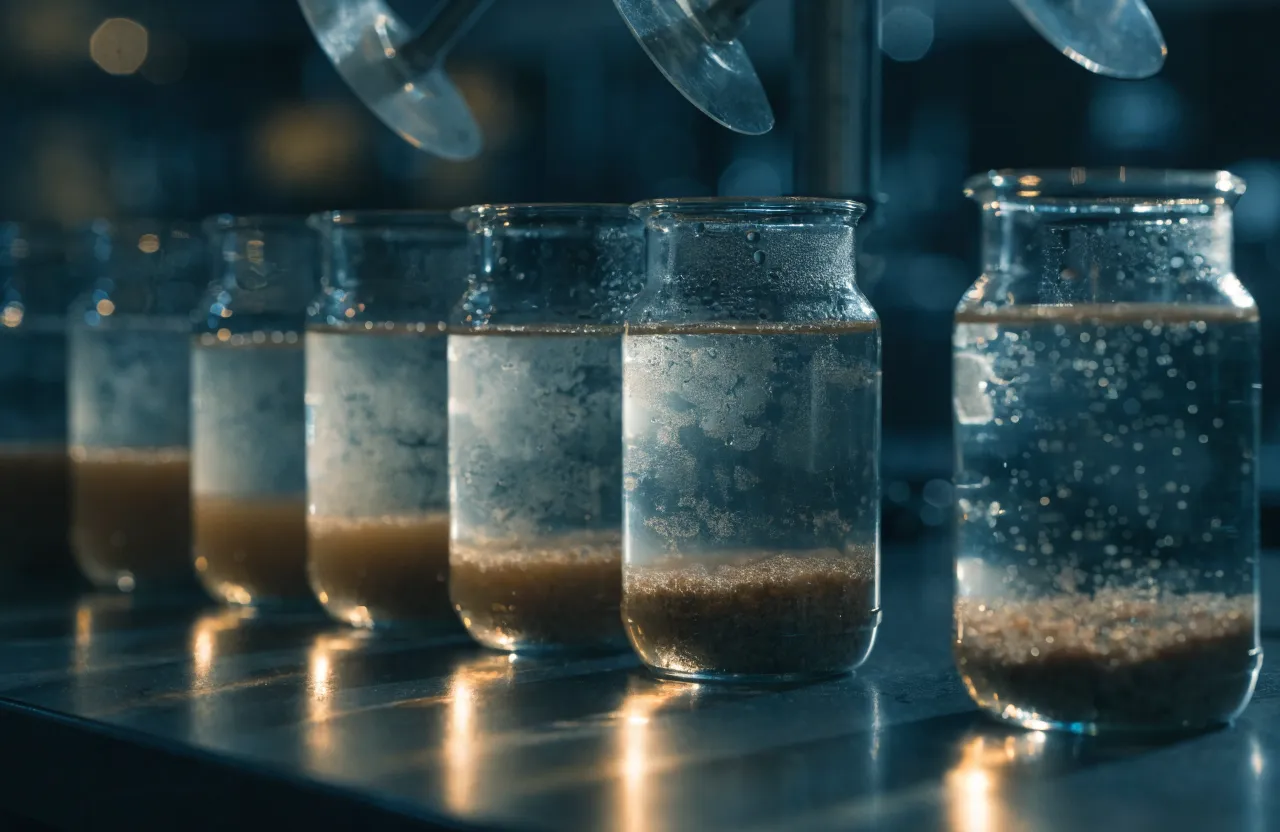
Run a row of beakers of your raw water on a gang stirrer and dose each jar with a different coagulant or a different dose. Flash-mix for about a minute to simulate the rapid mix, drop to a slow stir for 15–20 minutes to simulate flocculation, then stop the paddles and let the jars settle. Compare floc formation, settling speed, and supernatant clarity (turbidity), and read the pH of each jar. Good practice is to test several doses across several pH set-points (for example 5.5, 6.0, 6.5, 7.0, 7.5, 8.0) to find the dose-and-pH combination that gives the clearest water, then add the polymer flocculant at a low dose (often around 0.1–1 mg/L) after the coagulant to confirm the aid improves settling.
Dose order follows the mechanism. Coagulant into the rapid mix first; flocculant into the slow mix second. A flocculant added before or with the coagulant has no destabilized microflocs to bridge, so it is wasted, and it can coat still-charged colloids and interfere with neutralization. Give the coagulant its few seconds of high-energy mixing to disperse, then introduce the polymer gently downstream.
pH sets coagulant performance. Alum has a narrow effective window and consumes alkalinity, so low-alkalinity water may need supplemental alkalinity (lime or caustic) to hold pH in range. PAC and the iron coagulants tolerate a wider pH band, and PAC consumes little alkalinity, which is why it is often chosen for soft, cold, or low-alkalinity supplies. Confirm the working pH in the jar test rather than from a textbook, because your alkalinity decides how far a given dose moves it. Re-run the jar test on a schedule and after any source change; a dose that was right in summer is usually wrong in cold, high-turbidity spring runoff.
The honest trade-offs
More coagulant is not better. As the dose rises, particles pass through stabilization, then charge neutralization (the dose you want), then restabilization, and finally sweep coagulation. Push past the neutralization point and you reverse the surface charge from negative to positive: the particles repel again, re-stabilize, and the water turns cloudier instead of clearer. Too much polymer flocculant does the same thing by saturating the floc surfaces and starving the bridges of open sites. If clarity gets *worse* as you add chemical, suspect an overdose and back the dose down.
Every coagulant also generates sludge, and the choice drives how much. Metal-salt coagulants, alum especially, produce voluminous metal-hydroxide sludge that is costly to dewater and dispose of; PAC and polymer coagulants typically generate less. Weigh sludge volume and dewatering into the cost comparison, because the cheapest coagulant per pound is often not the cheapest per gallon treated once you count sludge handling.
Residuals are the third trade-off. Overdosed aluminum coagulants can leave residual aluminum in the treated water, and overdosed iron coagulants can leave a reddish iron residual and color. Both are controlled by dialing the dose to the jar-test optimum rather than running rich. Where the treated water feeds a downstream process or a discharge that carries a residual-metal limit, the coagulant choice and dose have to respect that limit.
One regulatory note that sits above performance: if the water is destined for potable (drinking-water) use, grade and regulatory approval matter as much as clarification. Confirm the specific grade and its regulatory approval for potable contact in your jurisdiction before use. Nothing here asserts potable-water or NSF compliance for any product.
Buying coagulants and flocculants
Tell us your water (source, turbidity, pH, alkalinity, target clarity, and whether it is municipal, industrial, or potable) and request samples to run your own jar test. For the wider treatment program, see our water treatment chemicals guide and our overview of wastewater treatment chemicals.
For the full chemical list by treatment stage, coagulants through biocides and defoamers, with grades and packaging, see the water treatment chemicals supplier page.
Frequently asked questions
What is the difference between coagulation and flocculation?
Coagulation is the first step: a coagulant neutralizes the negative surface charge on fine colloidal particles so they stop repelling and clump into tiny microflocs. Flocculation is the second step: a high-molecular-weight polymer bridges those microflocs into large, dense flocs that settle. Coagulation destabilizes; flocculation aggregates. Different mechanisms (charge neutralization versus bridging), different chemistry, different mixing, and a fixed order.
Should I add the coagulant or the flocculant first?
Coagulant first, flocculant second. The coagulant goes into the rapid (flash) mix to destabilize the colloids into microflocs; the flocculant goes into the slow mix afterward to bridge those microflocs into settleable flocs. A flocculant dosed first has nothing to bridge, so it is wasted, and it can interfere with the charge neutralization the coagulant is trying to do.
What is the best coagulant for water treatment?
There is no single best coagulant; it depends on your water. Alum is cheapest but works in a narrow pH range and consumes alkalinity. PAC works across a wider pH range with less sludge and performs well in cold, low-alkalinity water. Ferric chloride and PFS handle a wide pH band and are strong on color and organics. PolyDADMAC neutralizes charge without adding metal. Run a jar test on your actual water to choose.
Anionic vs cationic flocculant: which do I use?
Match the polymer charge to the solids. Anionic polyacrylamide is the usual choice after an inorganic coagulant and for mineral or inorganic solids (raw-water clarification, mining tailings). Cationic polyacrylamide is for negatively charged organic solids such as municipal sewage sludge, biosolids, and food or protein wastewater, especially in dewatering. Nonionic grades suit acidic conditions. Confirm the pick with a jar test.
Is PolyDADMAC a coagulant or a flocculant?
PolyDADMAC is primarily a cationic coagulant. Its high cationic charge density neutralizes negative colloids directly, so it can replace or reduce a metal-salt coagulant and cut both sludge and metal residual. Because it is a polymer it contributes some bridging too, but it is used mainly for charge neutralization, often ahead of a high-molecular-weight polyacrylamide flocculant.
How much coagulant and flocculant should I dose?
The dose is water-specific and is set by jar testing, not by a rule of thumb. Coagulant doses are typically far higher than flocculant doses, and polymer flocculants often work at well under a few mg/L. Overdosing either one reverses the benefit: too much coagulant flips the particle charge and re-stabilizes the colloids, and too much polymer saturates the floc and stops the bridging. Dose to the jar-test optimum and re-test after any change in source water.
Editorial note. This article is general technical guidance for water and wastewater treatment professionals. Coagulant and flocculant selection, dose, dose order, and pH depend on your specific source water, equipment, and discharge or potable requirements, and must be validated by jar testing on your own water; the Certificate of Analysis governs the grade you buy. Nothing here asserts potable (drinking-water) or NSF compliance for any product — confirm the grade and its regulatory approval for your application and jurisdiction before use. Many of these chemicals are corrosive or otherwise hazardous; review the current Safety Data Sheet (SDS) and use appropriate PPE before handling. Products are sold for industrial and professional use only. Nothing here is a medical, health, or safety claim. RawSource makes no warranty, express or implied, and assumes no liability for use of this information.
Search 1,300+ industrial chemicals by name or CAS, or send us your spec — we quote by the drum, tote, or container.
Browse the Chemical Index → Request a Quote