
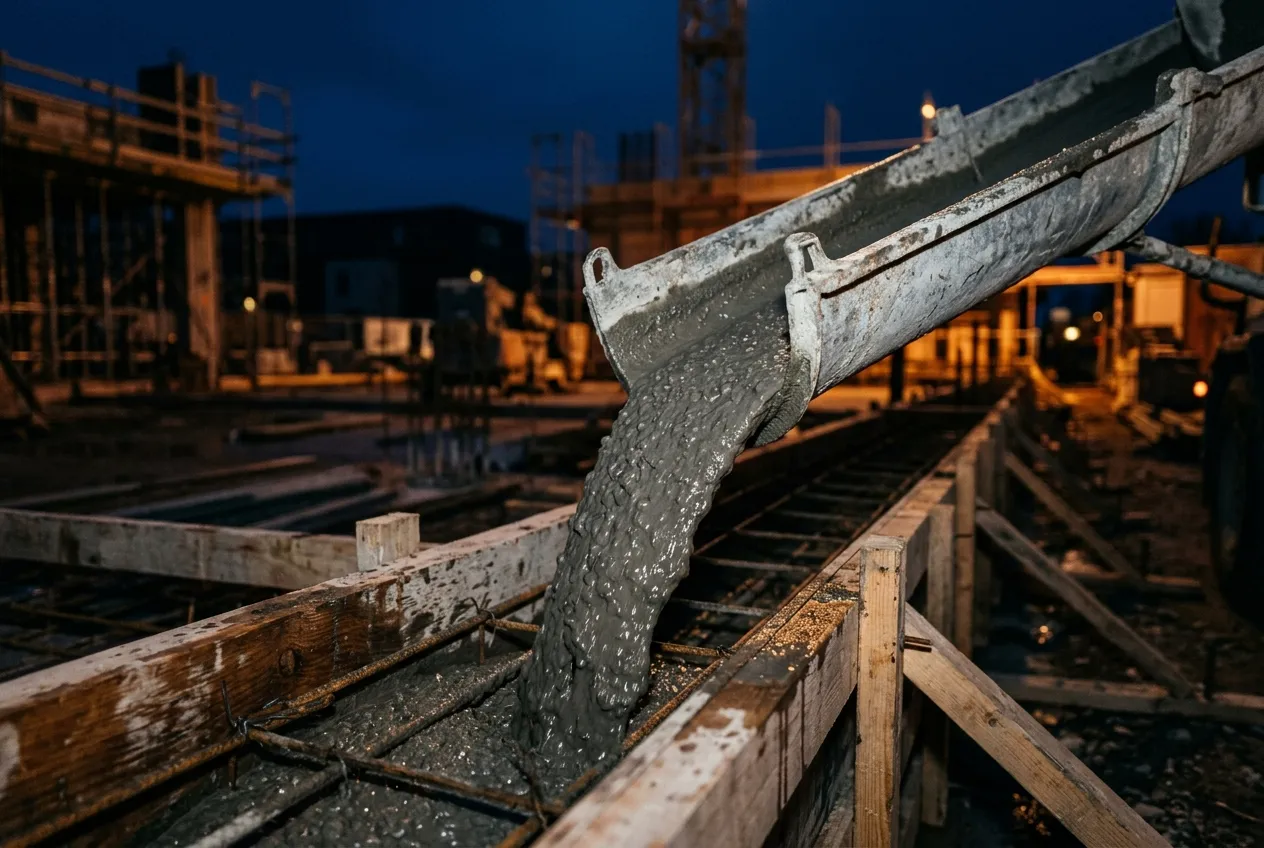
Concrete has a built-in conflict. You need enough water to place and finish the mix, but every extra liter of water above what the cement needs to hydrate weakens the hardened concrete and invites bleeding, shrinkage, and cracking. The cheapest way out of that trade-off, used in billions of cubic meters of concrete, is a lignosulfonate water reducer: it makes a stiff mix flow without adding water, or lets you pull water out without losing workability.
The short version: lignosulfonate is a natural, anionic, wood-derived surface-active agent and the classic, economical water-reducing and plasticizing admixture for concrete. Used at roughly 0.25 to 0.30% by weight of cement, it cuts water demand by about 10 to 14% while improving workability, and it retards slump loss in hot weather. It is a normal-range (Type A) water reducer, often the workhorse base that is compounded with a high-range superplasticizer for stronger effects.
The problem it solves: water versus workability
Cement only needs a low water-to-cement ratio to hydrate, but a mix at that ratio is too stiff to place. Crews add water for workability, and that excess water lowers strength and durability. Lignosulfonate (CAS 8061-52-7, PubChem) breaks the trade-off by dispersing the cement.
Cement grains carry charges that make them clump (flocculate), trapping water inside the clumps where it does no good for flow. The anionic lignosulfonate adsorbs onto the cement particles, gives them a like charge, and pushes them apart, releasing that trapped water as free, lubricating water. The same mix flows more at the same water content, or you can remove water and keep the original workability.
What you gain
| Goal | What lignosulfonate does |
|---|---|
| More workable mix, same water | Disperses cement so the mix flows and places easier |
| Same workability, less water | Cuts water 10 to 14%, lowering the water-to-cement ratio |
| Higher strength | The lower water-to-cement ratio raises strength and durability |
| Cement economy | Hold strength while trimming cement, since less water is needed |
| Hot-weather placing | Retards slump loss so the mix stays workable longer |
Used at 0.25 to 0.30% of cement weight, these are the typical results, to confirm in trial batches per ASTM C494 on your own materials.
The honest limits
Lignosulfonate is a normal-range water reducer, not a superplasticizer; its water reduction tops out around the mid-teens of percent, where high-range PCE or naphthalene superplasticizers reach 20 to 30% or more. It also retards set, because it carries sugars and reducing substances; that retardation is helpful in hot weather and for some structural pours, but it must be accounted for in cold weather and where fast turnover is needed. In practice it is often used as the economical base admixture, compounded with a superplasticizer for high-performance mixes.
Calcium versus sodium lignosulfonate
Both work as water reducers. Calcium lignosulfonate is the common, economical choice for general concrete. Sodium lignosulfonate is preferred where the calcium ion is undesirable or where higher solubility and lower-sugar, more-purified grades are wanted, and it is also the more common dispersant grade. Match the cation and grade to the mix and any other admixtures, and validate in trial batches.
Buying lignosulfonate for concrete
See the calcium lignosulfonate product page. Tell us your mix, target water reduction, and any superplasticizer you compound with, and request a sample to trial-batch on your own materials. Its other industrial uses are in lignosulfonate as a pelletizing and briquetting binder and lignosulfonate for dust suppression and soil stabilization.
Frequently asked questions
What is lignosulfonate used for in concrete?
It is a water-reducing and plasticizing admixture. By dispersing cement particles it lets a stiff mix flow without adding water, or lets you remove water while keeping workability, which lowers the water-to-cement ratio and raises strength. It also retards slump loss in hot weather.
How much does lignosulfonate reduce water in concrete?
Typically about 10 to 14% at a dose of 0.25 to 0.30% by weight of cement, the normal-range water-reduction band. High-range superplasticizers reach 20 to 30% or more; lignosulfonate is the economical normal-range option, often compounded with them.
Does lignosulfonate retard concrete set?
Yes. Lignosulfonate carries sugars and reducing substances that retard setting, which helps in hot weather and slump retention but must be accounted for in cold weather or fast-turnover work. The dose and any retardation are confirmed in trial batches.
Calcium or sodium lignosulfonate for concrete?
Calcium lignosulfonate is the common economical choice for general concrete; sodium lignosulfonate suits cases where the calcium ion is undesirable or higher-purity, higher-solubility grades are wanted. Both reduce water; validate on your mix.
Is lignosulfonate the same as a superplasticizer?
No. Lignosulfonate is a normal-range (Type A) water reducer; superplasticizers (PCE or naphthalene) are high-range water reducers with much greater water reduction. Lignosulfonate is often the economical base admixture compounded with a superplasticizer.
Editorial note. This article is general technical guidance for concrete and construction professionals. Dose and performance figures are typical reference values to validate by trial batch per ASTM C494 on your own materials; the Certificate of Analysis governs the grade you buy, and admixture compatibility (especially with superplasticizers and in cold weather, given the set retardation) must be confirmed. Lignosulfonate is a wood-derived material not classified as hazardous or flammable per its SDS; it is a water-soluble alkaline material that can irritate skin and eyes, so use appropriate PPE. Always consult the current Safety Data Sheet (SDS) before handling. RawSource makes no warranty, express or implied, and assumes no liability for use of this information.
Search 1,300+ industrial chemicals by name or CAS, or send us your spec — we quote by the drum, tote, or container.
Browse the Chemical Index → Request a Quote