
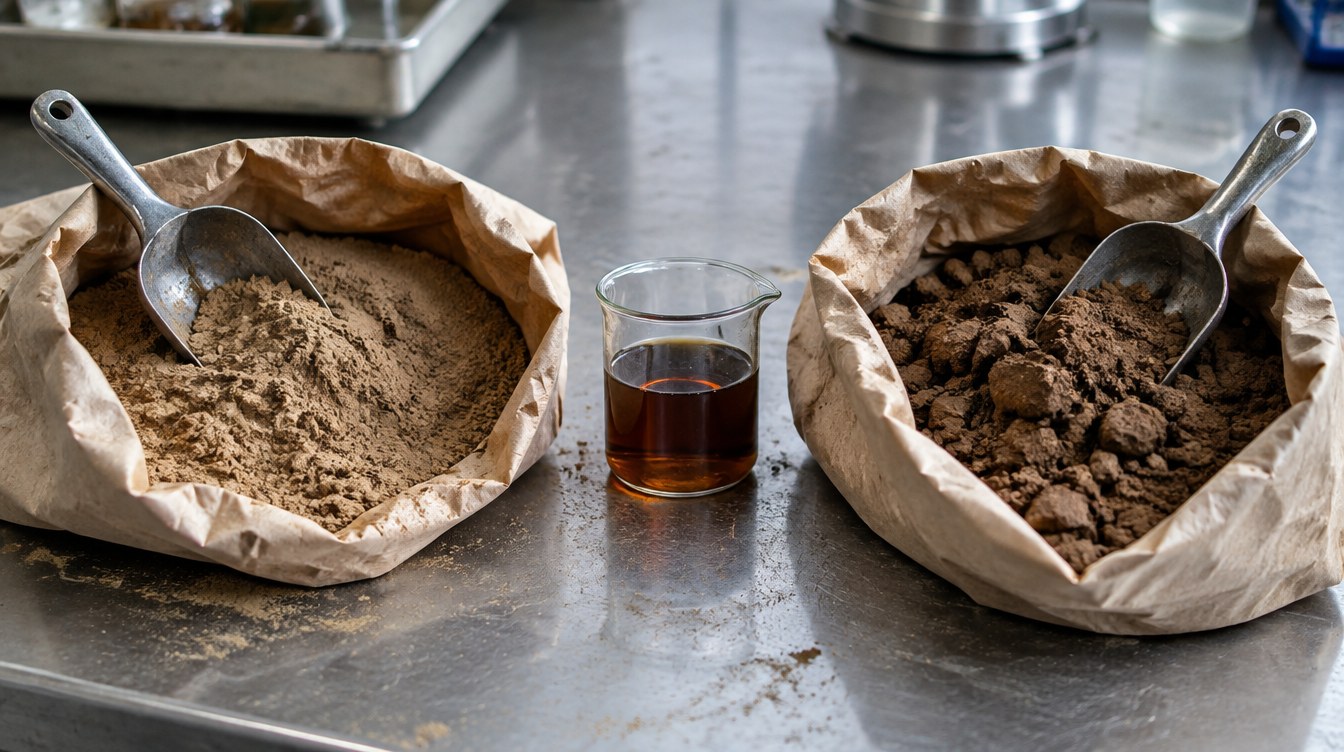
You switch lignosulfonate suppliers to cut freight, the new certificate of analysis (CoA) carries the same CAS number as the old one, and within a week the plant calls. The concrete is setting later than it did, or the dye paste has thickened, or the pellet mill is throwing more fines. Nothing on the paperwork changed. The product did, because a lignosulfonate is not one molecule with one set of properties. It is a family of polymer mixtures, and the registry number mostly tells you which salt you bought.
What is a lignosulfonate, chemically?
Lignin is the polymer that glues cellulose fibers together in wood, and on its own it does not dissolve in water. Sulfite pulping cooks wood chips in sulfurous acid with a bisulfite salt to free the cellulose for paper. The cook breaks lignin into fragments and attaches sulfonate groups to their side chains. Those charged groups make the fragments water-soluble, and the spent liquor leaving the digester carries them out along with dissolved wood sugars and inorganic salts.
Concentrated and usually spray-dried, that material is a lignosulfonate: an anionic polymer that adsorbs onto particle surfaces and pushes the particles apart by charge repulsion. That one mechanism covers most of its dispersant uses, from cement and gypsum slurries to oil-well drilling muds and dye pastes. Used at a higher dose in a drier system, the same polymer dries to a film that holds particles together, which is why it also works as a pellet binder in feed manufacture.
The PubChem record for sodium lignosulfonate (CID 44135711) gives the formula C20H24Na2O10S2 and a molecular weight of 534.5 g/mol. Read the structure behind that figure and you find two methoxyphenyl-propane units joined by an ether bond, each carrying one sulfonate group. That is a model fragment chosen to stand for the repeating chemistry. A commercial lot is a spread of chains, from short oligomers to large branched polymers, so the formula weight identifies the substance and tells you nothing about how it will perform.
Where does one lignosulfonate differ from another?
Six things separate one lot from the next. The salt is the one printed in the product name, and in most applications it is the one that matters least. The table sets out what each variable changes and what to ask a supplier for.
| Variable | What it changes in use | What to ask for |
|---|---|---|
| Counter-ion (sodium, calcium, magnesium, ammonium) | Which ion you add to the system; compatibility with hard water and with other salts in a formulation | Salt form on the technical data sheet (TDS) |
| Residual wood sugars | Set retardation in cement, caking of the powder in storage, extra binding in feed | A reducing-sugar limit on every CoA |
| Molecular weight distribution | Dispersing strength, slurry viscosity, film strength as a binder | The distribution itself, not the formula weight |
| Degree of sulfonation | Solubility and charge density, and with them dispersing power | Organic sulfur or sulfonate content |
| Pulping route and wood species | The base structure: sulfite liquor or sulfonated kraft lignin, softwood or hardwood lignin | Process route and wood type, declared in writing |
| Physical form | Powder or liquid: freight paid on water, storage life, dosing equipment | Solids content and solution pH on every batch |
Does the salt matter: sodium, calcium, magnesium or ammonium?
The base used in the cook sets the counter-ion. Calcium bisulfite was the traditional cooking base, and magnesium and ammonium bases followed. Sodium liquor comes either from sodium-base cooks or from base exchange, where sodium sulfate or carbonate is added to calcium liquor and the calcium precipitates, as sparingly soluble gypsum or as calcium carbonate, and is filtered off. A sodium lignosulfonate may therefore have started life as a calcium one, and its name tells you nothing about the wood or the cook behind it.
Commercial calcium lignosulfonate dissolves readily in plain water, just as the sodium salt does. PubChem’s record for the sodium salt lists it as soluble (NTP, 1992). The practical difference is the ion, not whether the powder goes into solution.
Where the salt does matter, it is because of what the ion does in your system. Sodium is the default where you do not want to add a divalent ion, as in agrochemical concentrates and dye pastes. Calcium lignosulfonate (CAS 8061-52-7) puts calcium into the mix, which cement and feed tolerate and some liquid formulations do not. Ammonium grades give off ammonia when they meet an alkaline system such as fresh concrete, and they add nitrogen where they end up in fertilizer granules.
Why do sugar and chain length decide more than the salt?
Spent sulfite liquor carries hemicellulose sugars alongside the lignosulfonate. Left in, they retard cement hydration and make the powder more prone to caking in storage, while in feed pellets they add some binding of their own. Removed by fermentation or ultrafiltration, they leave a cleaner dispersant with a more predictable setting time. The name sodium lignosulfonate covers both a raw, sugar-rich liquor product and a desugared, fractionated one, and the two are not interchangeable in a concrete admixture.
Chain length works the same way. Larger chains generally adsorb more strongly onto cement and mineral particles and disperse them better, while the smallest fractions contribute little dispersing power. Two suppliers can ship powders with identical salt, color and solubility whose chain-length profiles differ enough to change your dose. Without a molecular weight distribution on the TDS, the only way to see that difference is to test the lot before it reaches the line.
Then there is the pulping route. Most lignosulfonate comes from sulfite mills, but some products sold as sodium lignosulfonate are kraft lignin sulfonated after pulping. The two differ in structure: the kraft cook has already broken the lignin into smaller, more phenolic pieces, and the sulfonate groups are added afterwards at different positions on the molecule. In some dispersant duties the kraft-based product performs better and in others worse, which is reason enough to know which one you are buying.
Wood species shifts the base structure too. Softwood lignin is built mostly from guaiacyl units, the single-methoxy ring type in the PubChem model, while hardwood lignin adds syringyl units with a second methoxy group. Neither is better across the board, but a change of wood source is a change of product, whatever the label says.
What should a lignosulfonate specification say?
A specification that names only the salt and the CAS number will pass every lot a supplier ships, including the one that stalls your setting time. Write in the variables that move performance:
- State the salt, the process route (sulfite liquor or sulfonated kraft lignin) and the wood type, and require written notice before any of them changes.
- Put a reducing-sugar limit on the CoA for concrete and gypsum work. For feed pellet binding, where sugars help, set a floor instead of a ceiling, and buy a grade sold and labelled for feed use.
- Require solids content and solution pH on every batch, and insolubles where the product goes into a spray mix or a wettable powder.
- Ask for a molecular weight distribution. If the supplier cannot give one, qualify each new source with a performance test in your own system at your current dose.
- Keep a retained sample from every approved lot, so that when a complaint arrives you can run old against new on the same day.
As a rough map of grade to use: desugared sodium or calcium grades with a heavier chain profile suit concrete admixtures and gypsum slurries; sodium grades with low insolubles suit dye, pesticide and carbon black dispersions; sugar-bearing grades sold for feed use, sodium or calcium, suit feed pellet binding; metal-complexed grades, chrome-based or chrome-free, are the usual drilling mud thinners; and sodium grades serve as an emulsifier in asphalt production.
When is a lignosulfonate the wrong choice?
Lignosulfonate is a low-cost workhorse, not a high-performance additive. In concrete it is a normal-range water reducer. Where a mix design calls for high-range water reduction, synthetic superplasticizers such as polycarboxylate ethers or naphthalene sulfonate condensates do what an overdose of lignosulfonate cannot, because pushing the dose raises retardation and entrained air faster than it raises flow.
Its brown color rules it out of white or pale products, and its lot-to-lot spread means a tight process window needs either a tight specification or a different chemistry. If your process cannot absorb a shift in setting time or viscosity, budget for incoming testing on every lot, or price a synthetic dispersant against the cost of a failed batch.
Methodology: identity data (formula, molecular weight, model structure and solubility) come from the PubChem compound record for sodium lignosulfonate, CID 44135711, and CAS Registry Numbers from the product records. The pulping, sugar and chain-length chemistry is general technical knowledge, stated without figures because no lot-specific test data were used.
Frequently asked questions
Is lignosulfonate the same thing as lignin?
What is the difference between sodium lignosulfonate and calcium lignosulfonate?
Why does PubChem list sodium lignosulfonate at 534.5 g/mol if it is a polymer?
Can I swap one lignosulfonate for another in an existing formulation?
Sources & methodology
Figures are RawSource sourcing data unless attributed to a named source. Regulatory citations are current as of publication. Chemical identities verified by CAS number against the RawSource catalog.
Search 1,300+ industrial chemicals by name or CAS, or send us your spec — we quote by the drum, tote, or container.
Browse the Chemical Index → Request a Quote