
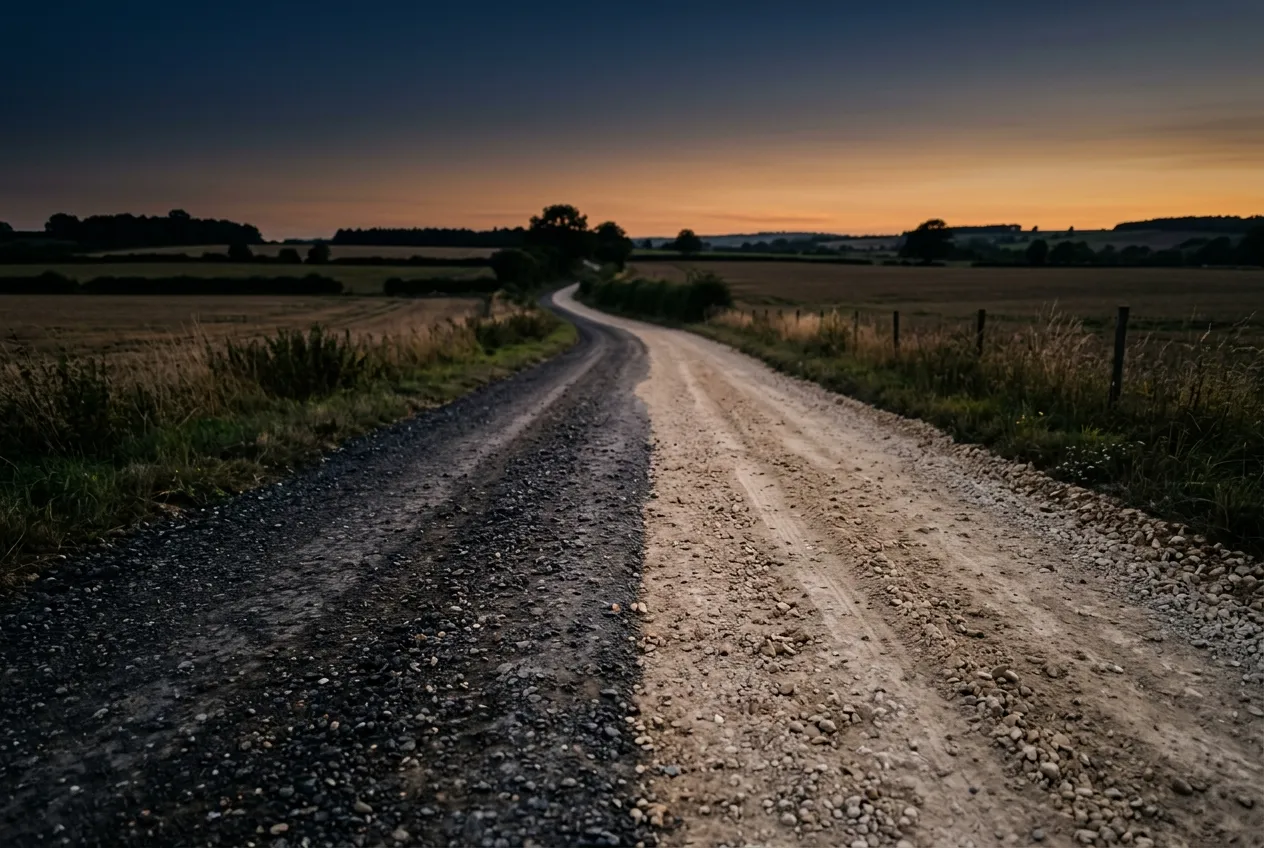
A gravel road throws a plume of dust behind every truck, washboards under traffic, and slowly loses its fines until it is all loose stone. The dust is a visibility and health hazard, an air-permit problem, and the road literally blowing away. One of the oldest and cheapest fixes is a lignosulfonate treatment: a wood-derived binder that glues the fines together into a firm, dust-free crust.
The short version: lignosulfonate, sprayed in solution onto an unpaved road or soil surface, binds the fine particles and aggregate together as it dries, forming a firm crust that suppresses dust and stabilizes the surface against traffic and erosion. It is non-corrosive and biodegradable, unlike the chloride salts also used for this, and it is widely used on haul roads, rural gravel roads, lots, and construction sites. Its honest limit is that it is water-soluble, so heavy rain leaches it and it needs periodic reapplication.
The problem: dust and a road that won’t hold together
An unpaved road holds together because of its fines, the silt and clay that bind the stone. Traffic grinds those fines loose, and they leave as dust, so the road ravels and washboards. Lignosulfonate (CAS 8061-52-7, PubChem) replaces and reinforces that binding.
As the sprayed solution dries, the lignosulfonate cements the fines and the surface aggregate into a cohesive, slightly flexible crust, so the fines stay in the road instead of becoming airborne, and the surface resists raveling. It is also mildly hygroscopic, holding a little moisture that keeps the surface knit.
What it does
| Problem | What lignosulfonate does |
|---|---|
| Fugitive dust off gravel roads and sites | Binds fines into a crust so they do not go airborne |
| Washboarding and raveling unpaved roads | Stabilizes the surface so it holds together under traffic |
| Soft, dusty lots and shoulders | Firms and binds the surface |
| Soil stabilization and erosion | Binds the surface against wind and water erosion |
This is the same surface-binding behavior used in soil stabilization conservation practice, applied to roads and disturbed ground.
How it is applied
Lignosulfonate is applied as a water solution, sprayed onto the road or soil, often after light grading and watering so it penetrates, then allowed to dry into a crust. It can also be mixed into the top layer for a deeper-bound surface. The crust is renewed periodically as traffic and weather wear it, and it is reapplied after heavy rain leaches it, far less labor than the constant watering an untreated road needs.
The honest trade-off versus chlorides
The two common unpaved-road dust palliatives are lignosulfonate and chloride salts (calcium or magnesium chloride). Chlorides pull moisture from the air and hold dust well in humid conditions but are corrosive to vehicles and infrastructure and can harm roadside vegetation. Lignosulfonate is non-corrosive, low-toxicity, and biodegradable, and it builds a firmer bound crust, but being water-soluble it leaches in heavy rain and is better suited to drier climates and roads that are resealed periodically. Choose by climate, traffic, corrosion concerns, and reapplication tolerance.
Buying lignosulfonate for dust and soil
See the calcium lignosulfonate product page. Tell us your surface, traffic, and climate, and request a sample to trial on your own road or site. Its concrete and binder uses are in lignosulfonate concrete water reducer and lignosulfonate as a pelletizing and briquetting binder.
Frequently asked questions
How does lignosulfonate control dust on a road?
Sprayed in solution, it binds the road’s fine particles and surface aggregate into a firm crust as it dries, so the fines stay in the road instead of becoming airborne dust. It also holds a little moisture that keeps the surface knit, reducing the dust plume and the watering a road would otherwise need.
Is lignosulfonate better than calcium chloride for dust control?
It depends on conditions. Lignosulfonate is non-corrosive, low-toxicity, and biodegradable and builds a firmer crust, but it leaches in heavy rain. Chlorides hold dust well in humid air but are corrosive and can harm vegetation. Choose by climate, corrosion concerns, and reapplication tolerance.
Does lignosulfonate stabilize soil?
Yes. It binds soil and aggregate surfaces into a cohesive crust that resists wind and water erosion and firms soft surfaces, which is why it is used on unpaved roads, shoulders, lots, and disturbed ground.
How often do you reapply lignosulfonate on a road?
Periodically, as traffic and weather wear the crust, and after heavy rain leaches the water-soluble binder. It is far less frequent than the continuous watering an untreated road needs; the interval depends on traffic and climate.
Is lignosulfonate safe for roads?
It is a wood-derived material that is non-regulated for transport (not classified as hazardous or corrosive) and biodegradable, which is a specific advantage over corrosive chloride palliatives. As with any product, follow local guidance for water-adjacent application and consult the SDS.
Editorial note. This article is general technical guidance for road, construction, and land-management professionals. Application and performance guidance is general and must be validated on your own surface, traffic, and climate; the Certificate of Analysis governs the grade you buy. Lignosulfonate is a wood-derived material not classified as hazardous or flammable per its SDS, and biodegradable; it is a water-soluble alkaline material that can irritate skin and eyes, so use appropriate PPE, and follow local guidance for water-adjacent application. Always consult the current Safety Data Sheet (SDS) before handling. RawSource makes no warranty, express or implied, and assumes no liability for use of this information.
Search 1,300+ industrial chemicals by name or CAS, or send us your spec — we quote by the drum, tote, or container.
Browse the Chemical Index → Request a Quote