
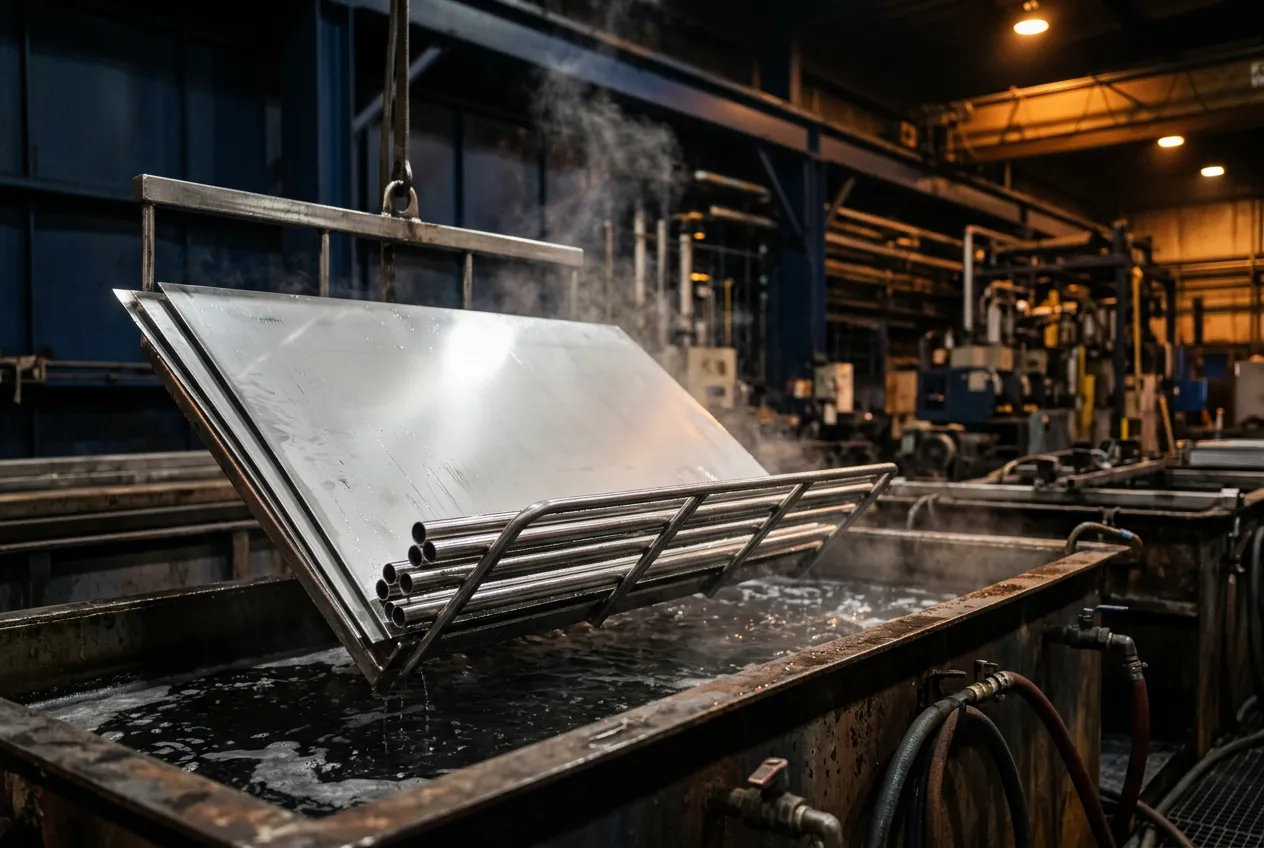
A run of stainless tube comes off the anneal line, or a superalloy weldment leaves the booth, carrying a tight, chromium-rich oxide scale that ordinary acids slide right off. To get to a clean, passive surface, fabricators reach for the pickle that actually works on it: a mixed bath of hydrofluoric and nitric acid. It is effective and it is demanding, both to run safely and to treat afterward.
The short version: stainless steel and superalloys are pickled in a mixed HF and nitric acid (HNO3) bath. The hydrofluoric acid dissolves the tenacious chromium-rich scale that nitric alone cannot remove, while the nitric oxidizes and re-passivates the surface and limits base-metal loss. Typical baths run roughly 1 to 8% HF with 15 to 20% HNO3, an HF-to-nitric ratio around 1:5 to 1:10, adjusted to the alloy and the scale. For lighter scale, a fluoride-salt pickle is a lower-hazard route.
Why stainless needs HF to pickle
Stainless steels and nickel-based superalloys owe their corrosion resistance to a chromium-rich passive oxide. After annealing, hot working, or welding, that same chemistry produces a heat-tint and scale layer enriched in chromium oxides that is extremely stable. Sulfuric or hydrochloric acid struggles to lift it. Hydrofluoric acid (PubChem CID 14917) dissolves the chromium-rich and silica-bearing scale that the other acids leave behind, which is why it is the active ingredient in stainless and superalloy pickling.
The HF-nitric bath
The two acids do different jobs, and the balance between them is the whole art of the bath.
- Hydrofluoric acid attacks and dissolves the oxide scale and some base metal, opening up the surface.
- Nitric acid oxidizes the freshly exposed metal, re-forms the passive layer, holds dissolved metals in solution, and moderates how aggressively the HF removes base metal.
| Parameter | Typical range |
|---|---|
| Hydrofluoric acid | ~1 to 8% |
| Nitric acid | ~15 to 20% |
| HF : HNO3 ratio | ~1:5 to 1:10 |
| Variables | concentration, ratio, temperature, immersion time, alloy |
Higher HF and temperature pickle faster but remove more base metal and can over-etch; the recipe is set to the alloy, the scale, and the finish. The grade and concentration of HF to specify are covered in HF grades and concentrations.
Where it is used
HF-nitric pickling cleans stainless tube, sheet, plate, bar, and fittings; descales nickel-based superalloys such as the nickel-chromium alloys; and removes weld heat-tint and scale on fabricated assemblies. It is a standard step ahead of passivation in stainless and superalloy production.
The hazards and the effluent
This process carries two burdens. The first is handling: HF is acutely hazardous (the OSHA permissible exposure limit is 3 ppm, per the NIOSH Pocket Guide), and the bath also evolves nitrogen-oxide (NOx) fumes from the nitric, so ventilation, materials of construction, and trained operation are essential, as set out in HF storage and handling. The second is effluent: spent pickle carries fluorides, nitrates, and dissolved metals that require neutralization and treatment before discharge. Both belong in the process design from the start.
Lower-hazard routes for lighter scale
Not every job needs the full HF-nitric pickle. For lighter scale, maintenance descaling, and metal brightening, ammonium bifluoride based pickles and nitric-HF-free formulations can do the work with lower acute hazard and easier handling. Reserve the HF-nitric bath for heavy, chromium-rich, or superalloy scale where its strength is genuinely required, and use a milder route where it suffices.
Buying for pickling
See the Hydrofluoric Acid product page. Tell us your alloy, scale condition, bath chemistry, and effluent constraints, and we will help you specify the right HF grade and concentration, or a lower-hazard fluoride route.
Frequently asked questions
Why is hydrofluoric acid used to pickle stainless steel?
Because it dissolves the chromium-rich oxide scale that forms on stainless and superalloys after annealing or welding, which sulfuric and hydrochloric acids cannot effectively remove. It is paired with nitric acid, which re-passivates the surface.
What is the ratio of HF to nitric acid in a pickling bath?
Typical stainless pickling baths run roughly 1 to 8% HF with 15 to 20% nitric acid, an HF-to-nitric ratio around 1:5 to 1:10, adjusted to the alloy, the scale, and the target finish. Validate the recipe for your process.
Can I pickle superalloys with hydrofluoric acid?
Yes. HF-nitric baths are used to descale nickel-based superalloys such as the nickel-chromium alloys, where the scale is especially tenacious. The bath chemistry and time are tuned to the alloy.
Is there a safer alternative to HF for pickling?
For lighter scale and maintenance descaling, ammonium bifluoride based or HF-free pickles offer lower acute hazard. Heavy chromium-rich and superalloy scale generally still needs the HF-nitric bath.
How is spent pickling acid handled?
Spent HF-nitric pickle contains fluorides, nitrates, and dissolved metals and must be neutralized and treated before discharge per your permit. Effluent treatment should be designed into the line.
Editorial note. This article is general technical guidance for industrial and professional metal-finishing operations and is not safety or treatment advice. Hydrofluoric acid is acutely hazardous and can be fatal on skin contact, inhalation, or ingestion, with systemic toxicity even from dilute solutions; HF-nitric baths also evolve toxic NOx fumes. Bath compositions are typical reference ranges to validate for your alloy and process, not a specification. Hazard and property references (PubChem, NIOSH, supplier SDS) are sourced facts to apply through your own SDS, EHS program, and qualified professionals. For industrial use only by trained personnel with proper controls. Always consult the current Safety Data Sheet (SDS) before handling. RawSource makes no warranty, express or implied, and assumes no liability for use of this information.
Search 1,300+ industrial chemicals by name or CAS, or send us your spec — we quote by the drum, tote, or container.
Browse the Chemical Index → Request a Quote