
A purchase order lands for “hydrofluoric acid, 1 IBC.” No concentration. No grade. No note on what it touches downstream. That single missing number decides whether the right material is a dilute 19% descaler, a 49% semiconductor etchant, or a 70% pickling acid, and whether the receiving plant is rated to handle any of them. Hydrofluoric acid is one of the few chemicals where guessing the spec can put a worker in an emergency room and the buyer in front of a regulator.
So before the quote, get the chemistry and the hazard profile straight. This guide covers what HF is, its real measured properties, why it eats glass, the grades you will be quoted, and the costs that live outside the per-pound price.
What hydrofluoric acid is
Hydrofluoric acid is hydrogen fluoride gas (formula HF, CAS 7664-39-3, molar mass 20.01 g/mol) dissolved in water. The IUPAC name is fluorane; the catalog and trade names you will see on a CoA include hydrogen fluoride, fluorhydric acid, and the synonym list on PubChem CID 14917. See the Hydrofluoric Acid product page.
Two things make HF unusual. First, it is a weak acid by dissociation, yet it is among the most aggressive industrial acids by what it dissolves. Second, the commercial product is defined by concentration, not just identity. The same CAS number covers a mild 19% solution and an anhydrous grade above 99.8%, and those behave nothing alike in a tank, a pipe, or a glovebox.
Manufacturing is consistent worldwide. Per PubChem, nearly all hydrogen fluoride is made by reacting fluorspar (calcium fluoride) with sulfuric acid, at yields above 90% in commercial plants. That single feedstock route is why HF supply tracks fluorspar availability, not crude or natural-gas chemistry.
How does HF differ from a strong mineral acid?
By dissociation, HF is a weak acid; PubChem records it as a weak acid in water. That is the paradox a buyer has to hold in mind, because its corrosive reach has little to do with pH. The fluoride ion drives the chemistry. It dissolves silica that sulfuric and hydrochloric acid leave untouched, and it carries systemic organ toxicity, reflected in the GHS statements H370 and H372 for organ damage.
The practical read for a buyer is that standard acid-handling assumptions do not transfer. A lining or gasket rated for hydrochloric service is not automatically rated for HF, and a pH reading alone will not tell you how aggressive a lot is. The corrosion path runs through fluoride attack on metals (GHS H290) and on silicates, not through proton concentration. Treat HF as a fluoride problem first and an acid second.
What are the real physical properties of HF?
Procurement specs and TCO models need measured numbers with units, not adjectives. The table below quotes the experimental values on PubChem for a 70% aqueous solution, which is the concentration most of the ICSC 2024 property data references. Fahrenheit values are as published; Celsius conversions are noted in parentheses.
| Property | Value (70% aqueous HF) | Source |
|---|---|---|
| Molecular formula | HF | PubChem CID 14917 |
| Molar mass | 20.01 g/mol | PubChem |
| CAS number | 7664-39-3 | RawSource catalog (VALID) |
| Appearance / odor | Colorless fuming liquid, strong irritating odor | PubChem |
| Density | 1.23 g/mL, denser than water | ICSC 2024 / PubChem |
| Boiling point | 152F (66.7C) at 760 mmHg | ICSC 2024 / PubChem |
| Melting point | -92.2F (-69.0C) | ICSC 2024 / PubChem |
| Vapor pressure | 150 mmHg at 77F (25C) | ICSC 2024 / PubChem |
| Water solubility | Miscible | ICSC 2024 / PubChem |
| Flash point | Not flammable | EPA 1998 / PubChem |
| pH in water | Weak acid | PubChem |
The density figure matters operationally. At 1.23 g/mL the 70% solution sinks in water, so a spill does not float and disperse the way a lighter solvent would. The vapor pressure of 150 mmHg at 25C tells you it off-gases readily at warehouse temperatures, which is the whole reason the exposure limits later in this guide are set in single-digit ppm.
Why does hydrofluoric acid etch glass?
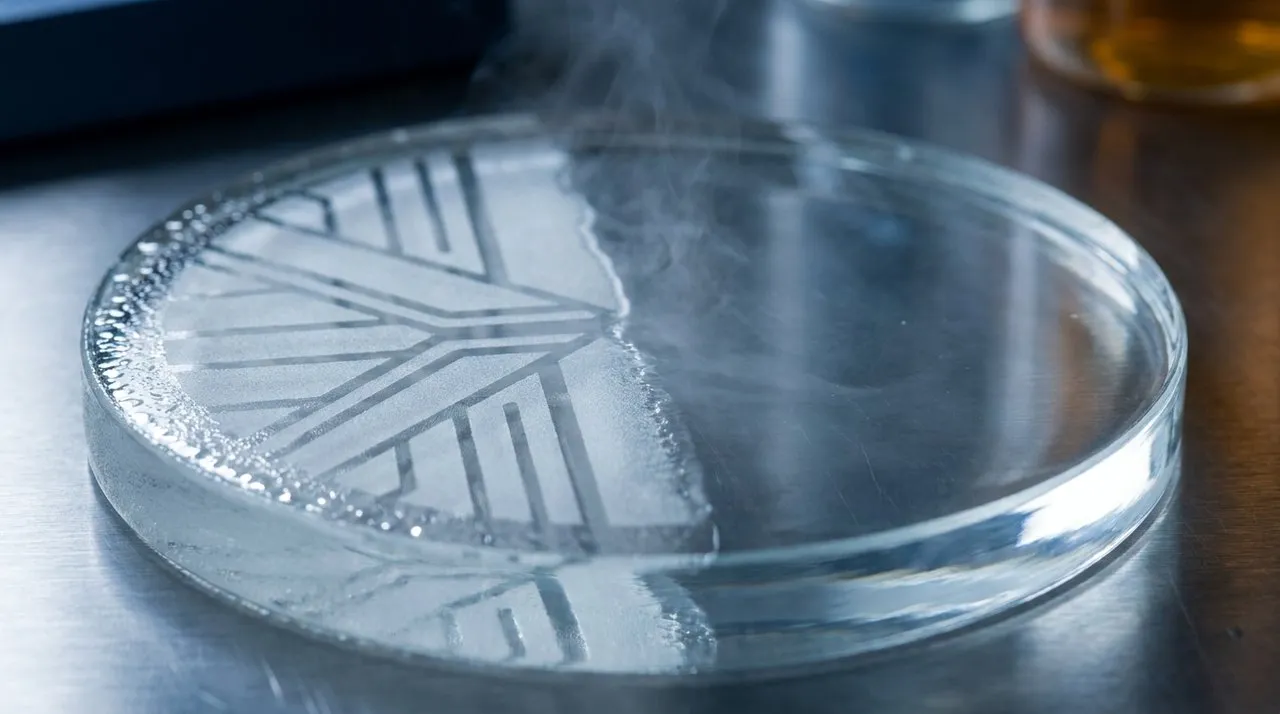
This is the property most buyers know HF by, and it controls how you store and ship it. Fluoride ion attacks silica, the silicon dioxide that forms glass and quartz, dissolving the surface instead of just wetting it. PubChem lists “etching glass” as the primary use of HF and adds frosting and polishing glass, decomposing silicates, and purifying quartz to the list.
The practical consequence: HF is never stored in glass. It ships and sits in fluoropolymer or polyethylene containers, and any glass sight-glass, level gauge, or lab vessel in contact with it will be consumed. When you specify packaging, you are also specifying chemical compatibility, and glass is disqualified before the conversation starts.
The same reactivity drives the semiconductor use case. A 49% solution is the standard wet etchant in chip and photovoltaic fabrication (ACGIH, via PubChem), often buffered with ammonium fluoride to control the etch rate on silicon oxide layers.
What grades and concentrations will you be quoted?
HF is sold across a concentration ladder, and the right rung depends entirely on the application. The grades below are the ones you will encounter; concentrations cited as specific figures are taken from PubChem’s use and hazard data.
| Concentration (HF) | Common designation | Representative use | Buyer note |
|---|---|---|---|
| ~19% | Dilute aqueous | Rust and scale removal, mild etching | Still GHS Danger; H318 serious eye damage applies even at this tier (PubChem) |
| 49% | Standard / semiconductor grade | Semiconductor and PV wet etch (ACGIH), glass etching | Bought to a trace-metal and particle spec, not just assay; fabs want ppb-level metals |
| 70% | Concentrated aqueous | Stainless-steel pickling, metal surface treatment | The ICSC reference grade: density 1.23 g/mL, boiling point 152F (66.7C) |
| >99.8% | Anhydrous HF | Alkylation catalyst, fluorochemical feedstock | Most hazardous tier; H310/H330/H300 (fatal by skin, inhalation, ingestion); specialized transport |
Concentration also changes how the material behaves in the building, not just what it costs. Density climbs with assay, the 70% grade off-gasses HF vapor at the 150 mmHg vapor pressure noted above, and the anhydrous grade demands pressure-rated containment. A plant tooled for dilute descaling work is not tooled for 70% pickling acid, and neither is set up for anhydrous feedstock. Match the grade to the receiving plant’s ventilation, containment, and PPE before you match it to the process chemistry.
A buyer’s most expensive mistake here is treating assay percent as the only variable. A 49% semiconductor lot and a 49% industrial-etch lot can carry the same headline number and sharply different trace-metal limits, and the price gap between them is real. Confirm the grade against the downstream process, then match the CoA limits to it. Other acid options sit in the broader acids product category when HF is heavier than the job needs.
What hazards must you price into an HF order?
This is the section that separates HF from an ordinary acid buy. The chemistry is manageable; the hazard is what carries cost, and underpricing it is the common procurement error.
HF carries the GHS signal word Danger, with the corrosive, acute-toxic, and health-hazard pictograms. The hazard statements on PubChem are unambiguous: H310 fatal in contact with skin, H330 fatal if inhaled, H300 fatal if swallowed, H314 causes severe skin burns and eye damage, H372 damage to organs through prolonged or repeated exposure, and H290 may be corrosive to metals. Fluoride toxicity is systemic, not just a surface burn, which is why HF gets specialized first-aid protocols that ordinary acids do not.
Airborne exposure limits are set in single-digit ppm. The table below pulls the regulatory and recommended limits from the primary sources.
| Limit | Value | Authority |
|---|---|---|
| OSHA PEL, 8-hr TWA | 3 ppm | 29 CFR 1910.1000 |
| NIOSH REL, TWA | 3 ppm (2.5 mg/m3) | CDC NIOSH Pocket Guide |
| NIOSH ceiling, 15-min | 6 ppm (5 mg/m3) | CDC NIOSH |
| IDLH | 30 ppm | CDC NIOSH |
Because HF can cause severe burns and systemic organ damage (GHS H314 and H370), it carries its own first-aid protocol. Calcium gluconate gel for skin contact is the recognized response, and PubChem’s precautionary statements call for immediate medical attention (P-codes including P301+P316 and P302+P352). A site that stocks HF without calcium gluconate on hand, trained responders, and a poison-control contact is not ready to receive it. Budget the response capability alongside the acid, because the exposure limits above leave no room for an improvised reaction.
Disposal is the cost that buyers forget. Hydrofluoric acid is an EPA RCRA-listed hazardous waste, U134, identified in the synonym record on PubChem and listed under 40 CFR 261. Spent acid, rinse water, and contaminated containers are regulated waste streams, so the project budget needs a disposal line, neutralization capacity, and a calcium-based treatment plan before the first drum arrives. For a deeper read on how the corrosive gas and the acid differ in handling, see hydrofluoric acid vs hydrogen fluoride.
What to question on the CoA
A clean certificate of analysis (CoA) for HF answers four questions. Make the supplier fill in any blank before the lot ships.
- Assay (HF %). The headline concentration, confirmed by titration. A 70% lot that runs 66% changes your dilution math and your dosing.
- Trace metals. For semiconductor or PV use, iron, copper, and other metals belong at ppb levels. For pickling, the bar is looser. The grade is meaningless without this number.
- Fluosilicic acid / silica content. A byproduct of the fluorspar route; high levels signal a less refined lot and can affect etch behavior.
- Water and non-volatile residue. Tells you what is left behind after the HF flashes off, which matters for high-purity etching.
If a CoA shows only an assay percent and a date, treat it as incomplete. The trace-metal panel is where grade fraud and lot-to-lot drift hide.
Packaging, handling, and the cost outside the price
HF pricing is concentration- and volume-specific, and the landed cost is dominated by handling, not by the acid itself. The drivers, in rough order of impact:
- Container compatibility. Fluoropolymer-lined or HDPE packaging only; no glass, and carbon steel is out for aqueous grades. Anhydrous HF uses dedicated carbon-steel pressure vessels under controlled conditions.
- Hazmat freight. A corrosive, acutely toxic material carries higher transport cost, placarding, and routing constraints than a commodity acid.
- PPE and engineering controls. Calcium gluconate gel on site, fluoride-rated gloves and face protection, scrubbed ventilation, and trained responders are non-optional for the ppm exposure limits above.
- Waste and neutralization. The RCRA U134 disposal stream, covered above.
Container format follows volume and concentration. Dilute and 49% grades move in HDPE drums, lined totes, and IBCs; 70% pickling acid ships in lined IBCs and dedicated totes; anhydrous HF moves only in pressure-rated vessels under contract. Confirm that the receiving dock, secondary containment, and storage area are sized and rated for the format before the order ships, because a corrosive, acutely toxic load cannot sit on a standard pallet rack while the site improvises. The packaging line on an HF quote is a safety specification, not a logistics afterthought.
None of these show up on a per-pound quote, and all of them belong in the TCO model. A cheap drum of HF that lands in a plant with no calcium gluconate, no scrubber, and no waste plan is the most expensive HF you can buy.
Which industries use HF, and how
The use pattern follows the concentration ladder. In oil and gas, anhydrous and concentrated HF is the alkylation catalyst in refineries and a pH-control and stimulation acid in well operations; see the oil and gas industry page for the broader sourcing picture. In metals and industrial manufacturing, 70% grade pickles stainless steel and cleans castings. In electronics, the 49% wet etch shapes silicon-oxide layers.
In specialty chemicals, HF is the feedstock for aluminum fluoride, fluoropolymers, and other fluorochemicals, a fluorinating agent in the aluminum industry, and a step in uranium isotope separation and refining (PubChem). It also appears in dye chemistry and exotic-metal extraction. The common thread is fluorine delivery: when a process needs fluoride introduced at scale, HF is usually the cheapest route to it, which is why demand holds across otherwise unrelated sectors.
Each of these moves a different grade. A refinery alkylation unit takes anhydrous HF under pressure; a pickling line takes 70% aqueous in lined totes; a fab takes 49% to a ppb-metal spec. One CAS number, four supply chains.
For applications where the fluoride chemistry is needed but liquid HF is too aggressive to handle, a solid alternative is often specified. The trade-offs between the two are laid out in ammonium bifluoride vs hydrofluoric acid.
Hydrofluoric acid
If you need a specific concentration matched to a downstream process, the hydrofluoric acid product page is the place to start a quote; specify the application and the receiving plant’s handling rating, and the desk will match grade, CoA limits, and packaging to it instead of shipping a default drum.
Property figures in this guide are quoted from PubChem CID 14917 and the primary sources named in each table; Fahrenheit-to-Celsius conversions are calculated from the published values.
Frequently asked questions
What is the chemical formula and CAS number of hydrofluoric acid?
What concentrations is hydrofluoric acid supplied in?
What is the density of hydrofluoric acid?
Why is hydrofluoric acid more dangerous than stronger acids?
What materials are compatible with hydrofluoric acid?
Sources & methodology
Regulatory citations are current as of publication. Chemical identities verified by CAS number against the RawSource catalog.
Search 1,300+ industrial chemicals by name or CAS, or send us your spec — we quote by the drum, tote, or container.
Browse the Chemical Index → Request a Quote