
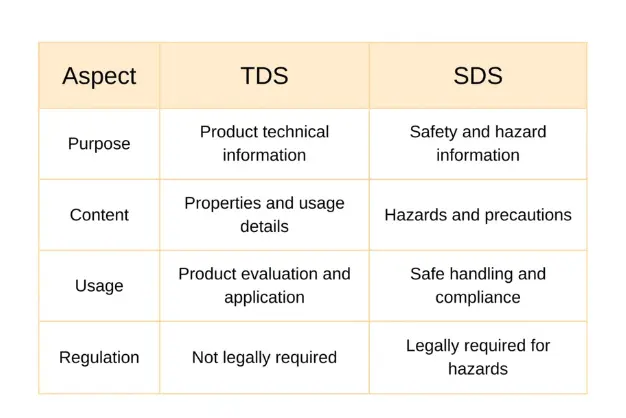
A Safety Data Sheet (SDS) is a standardized 16-section document (per the GHS and OSHA’s Hazard Communication Standard, 29 CFR 1910.1200) that describes a chemical’s hazards, safe handling, storage, and emergency measures. A Technical Data Sheet (TDS) is a manufacturer document that describes a product’s physical, chemical, and performance properties and specifications — in short, it tells you how a product performs, while an SDS tells you how it is hazardous. The two are complementary, not interchangeable: procurement, formulation, and EHS teams use both for every chemical they buy, store, or ship.
What is a Safety Data Sheet (SDS)?
A Safety Data Sheet (SDS) is a standardized, 16-section document that communicates the hazards of a chemical and the precautions needed to handle, store, transport, and dispose of it safely. Its format is set by the United Nations’ Globally Harmonized System of Classification and Labelling of Chemicals (GHS) and is required in the United States under OSHA’s Hazard Communication Standard (29 CFR 1910.1200). The supplier or manufacturer of the chemical is responsible for authoring the SDS and providing it to downstream users.
Every compliant SDS follows the same fixed order, so an EHS or warehouse team can find the same information in the same place on any product, from any manufacturer, in any country that has adopted the GHS. The 16 sections are:
- Identification — product identifier, supplier details, recommended use and restrictions, emergency phone number.
- Hazard(s) identification — GHS hazard classification, signal word, hazard and precautionary statements, and label elements.
- Composition / information on ingredients — hazardous ingredients, concentrations, and any trade-secret claims.
- First-aid measures — required first response by route of exposure (inhalation, skin, eye, ingestion).
- Fire-fighting measures — suitable extinguishing media, specific hazards, and protection for firefighters.
- Accidental release measures — spill containment, cleanup, and environmental precautions.
- Handling and storage — safe handling practices and storage conditions, including incompatibilities.
- Exposure controls / personal protection — exposure limits (PELs/TLVs), engineering controls, and required PPE.
- Physical and chemical properties — appearance, odor, pH, flash point, boiling point, and other characteristics.
- Stability and reactivity — chemical stability, conditions to avoid, and incompatible materials.
- Toxicological information — routes of exposure, symptoms, and acute and chronic health effects.
- Ecological information — environmental fate and ecotoxicity (not OSHA-enforced).
- Disposal considerations — safe disposal of the product and contaminated packaging (not OSHA-enforced).
- Transport information — UN number, proper shipping name, hazard class, and packing group (not OSHA-enforced).
- Regulatory information — safety, health, and environmental regulations specific to the product (not OSHA-enforced).
- Other information — date of preparation or last revision, and other relevant data.
Under OSHA, Sections 1–11 and 16 are mandatory; Sections 12–15 are included to keep the document GHS-complete but fall under other agencies’ jurisdiction (EPA, DOT), so OSHA does not enforce their content.
What is a Technical Data Sheet (TDS)?
A Technical Data Sheet (TDS) is a manufacturer-issued document that describes a product’s physical, chemical, and performance properties, specifications, and recommended application — it explains how a product performs, not how it is hazardous. A TDS (sometimes called a product data sheet, PDS, or spec sheet) is the document a formulator, engineer, or quality team uses to confirm a material is fit for purpose before they buy or use it.
Unlike the SDS, the TDS has no government-mandated format, so its layout varies by manufacturer. A typical TDS includes:
What a TDS covers also varies by chemistry: for a commodity like citric acid the working parameters are assay and heavy metals, while buyers of caustic soda watch concentration and iron. The TDS tells you which parameters the supplier is willing to stand behind.
- Product identity — name, grade, and chemical family.
- Physical and chemical properties — appearance, viscosity, density/specific gravity, pH, active content, melting/boiling point.
- Technical specifications — the target ranges and tolerances the product is sold against.
- Performance characteristics — function, efficiency, and application data.
- Recommended use and dosage — how and how much to use, and compatible systems.
- Storage and shelf-life — conditions and stability for quality (distinct from the SDS’s safety storage).
- Packaging and handling — available pack sizes and basic handling notes.
Because specifications drive purchasing decisions, the TDS is often read alongside a Certificate of Analysis (CoA), which reports the actual measured values for a specific lot against those TDS specifications.
TDS vs SDS: key differences
The clearest way to separate the two documents is by purpose: a TDS answers “will this product work for my application?” while an SDS answers “how do I handle this product safely and legally?” The table below summarizes the key differences.
| Aspect | Technical Data Sheet (TDS) | Safety Data Sheet (SDS) |
|---|---|---|
| Primary purpose | Describe how the product performs and its specifications | Describe the product’s hazards and how to handle it safely |
| What it covers | Physical/chemical properties, technical specs, performance, dosage, application | Hazard classification, first aid, fire-fighting, exposure controls, disposal, transport |
| Who issues it | Manufacturer or supplier | Manufacturer or supplier (chemical author) |
| Format | No mandated format; varies by manufacturer | Standardized 16-section GHS format |
| Regulatory status | Not legally required; a commercial/technical document | Legally required under OSHA HazCom (29 CFR 1910.1200) and GHS |
| Sections | Varies (no fixed structure) | 16 fixed sections (1–11 and 16 OSHA-mandatory) |
| Primary users | Formulators, R&D, quality, engineering, purchasing | EHS, safety officers, warehouse, logistics, emergency responders |
| When you use it | Selecting, specifying, or qualifying a product | Receiving, storing, handling, shipping, or responding to an incident |
When do you use a TDS vs an SDS?
Use a TDS when you are choosing or specifying a product, and an SDS when you are handling, storing, or shipping it. In practice, a chemical buyer touches both at different points in the same workflow.
When to use a TDS
- Comparing candidate products and grades during sourcing or formulation.
- Confirming a material meets your specification before purchase.
- Setting incoming-QC criteria and reading them against a Certificate of Analysis.
- Determining correct dosage, application method, and compatibility.
When to use an SDS
- Training workers and writing safe-handling and PPE procedures.
- Receiving, storing, and segregating incompatible materials in the warehouse.
- Classifying and documenting shipments for transport.
- Responding to a spill, exposure, or fire — and meeting OSHA’s requirement that the SDS be readily accessible to employees.
Common misconceptions about TDS and SDS
- “They’re interchangeable.” They are not. A TDS will not satisfy your OSHA HazCom obligations, and an SDS will not tell you whether a product meets your performance spec.
- “The TDS covers safety.” A TDS may mention basic handling, but it is not a hazard-communication document and is not built to GHS requirements.
- “SDSs are only for hazardous chemicals.” Suppliers commonly provide an SDS even for products classified as non-hazardous; many customers and carriers require one on file regardless.
- “A TDS is enough for compliance.” Regulatory compliance for chemical handling rests on the SDS, not the TDS.
Why both documents matter in industry
The two documents answer different questions across the chemical lifecycle, and a well-run operation keeps both current. The TDS drives selection and quality — it lets buyers qualify a material and lets QC verify each lot against spec (with the CoA). The SDS drives safety and compliance — it gives EHS, warehouse, and logistics teams the hazard data they need to store, handle, ship, and respond to incidents within OSHA and GHS rules. Missing or outdated versions of either create real exposure: a wrong spec leads to failed batches and rejected lots, while a missing or stale SDS is a citable HazCom violation.
Methodology and sources
The SDS format and enforcement details in this guide come from primary OSHA materials: the Hazard Communication overview, the full text of 29 CFR 1910.1200, and the OSHA Brief “Hazard Communication Standard: Safety Data Sheets”, which states that Sections 12–15 are included for GHS consistency but not enforced by OSHA because they concern other agencies’ jurisdiction. TDS conventions are supplier-defined; treat the TDS as a starting point and confirm critical values against the CoA for your lot.
Frequently asked questionsWhat is the difference between TDS and SDS?
A Technical Data Sheet (TDS) describes a product’s physical, chemical, and performance properties and specifications — how it performs. A Safety Data Sheet (SDS) is a standardized 16-section document describing the product’s hazards, safe handling, storage, and emergency measures — how it is hazardous. The TDS is a commercial/technical document with no fixed format; the SDS is legally required under OSHA HazCom and follows the GHS 16-section structure.
What is an SDS?
An SDS (Safety Data Sheet) is a standardized 16-section document, required under OSHA’s Hazard Communication Standard and structured per the GHS, that describes a chemical’s hazards, safe handling, storage, exposure controls, and emergency measures. The chemical’s manufacturer or supplier is responsible for providing it.
What is a TDS?
A TDS (Technical Data Sheet) is a manufacturer document that lists a product’s physical and chemical properties, technical specifications, performance characteristics, and recommended use. It is the document buyers and formulators use to confirm a material is fit for their application. Unlike an SDS, a TDS has no government-mandated format.
Is an SDS the same as an MSDS?
They serve the same purpose, but the SDS replaced the older MSDS (Material Safety Data Sheet). When OSHA aligned its Hazard Communication Standard with the GHS, the variable-format MSDS was replaced by the standardized 16-section SDS, with full compliance required by June 1, 2015. “MSDS” is still used colloquially, but the current required format is the SDS.
Who provides the SDS?
The chemical’s manufacturer, importer, or supplier is responsible for authoring the SDS and providing it to downstream users. Under OSHA HazCom, employers must then keep SDSs readily accessible to employees in their work areas.
Does every chemical shipment need a TDS and an SDS?
An SDS is expected with hazardous chemicals and is commonly provided even for non-hazardous products. A TDS (and often a Certificate of Analysis) is provided as the technical reference for the product’s specifications. Reputable suppliers make both available on request and with shipment.
Documentation you can count on with RawSource
Request documentation or a quote and tell us the product and CAS number you need.
Search 1,300+ industrial chemicals by name or CAS, or send us your spec — we quote by the drum, tote, or container.
Browse the Chemical Index → Request a Quote