

By RawSource Sourcing Desk, Commercial & Sourcing Desk, RawSource — About the desk
A plant switches from liquid hydrofluoric acid to a powdered fluoride salt to cut freight and tankage cost, then watches etch rates drop out of spec. The switch was the right call. The grade and the bath concentration were not. That gap, between the right chemistry and the wrong specification, is where most ammonium bifluoride buying decisions go sideways.
This guide explains how ammonium bifluoride does its work as an etchant, how it compares with hydrofluoric acid on the loading dock and in the bath, and what a procurement team should put on the purchase spec so the etch behaves the way the data sheet promised.
What is ammonium bifluoride and how does it etch?
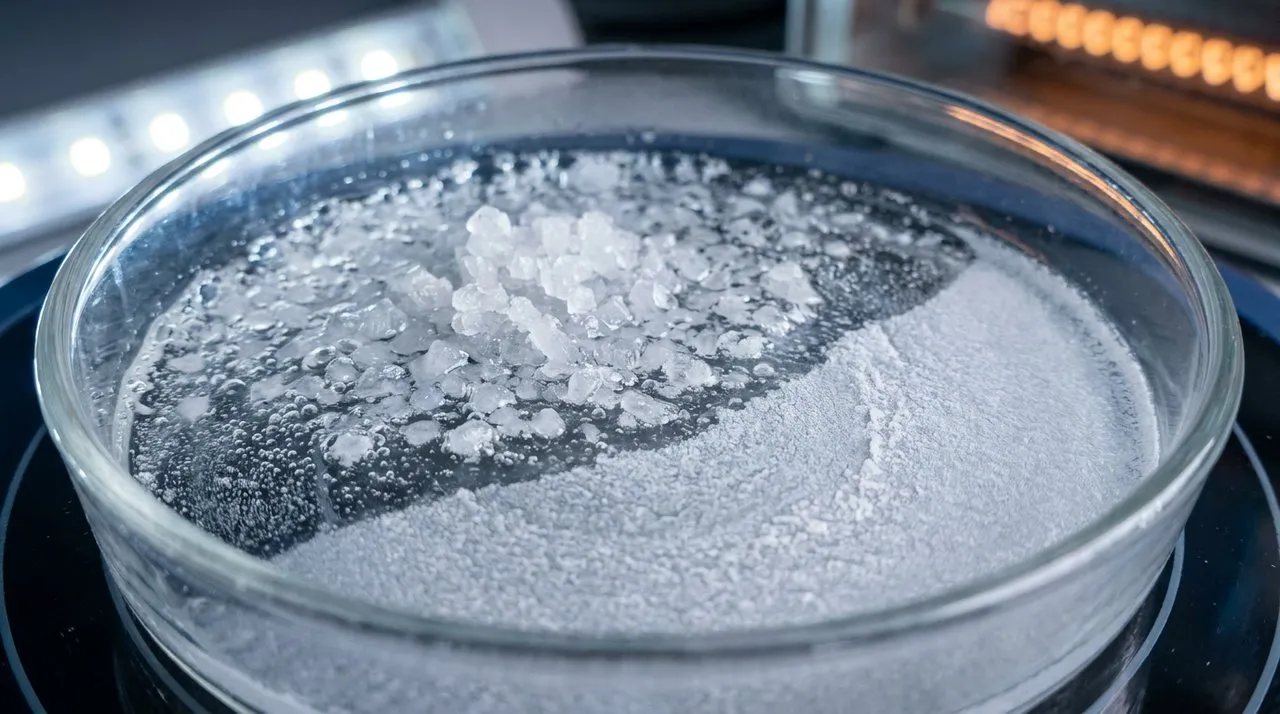
Ammonium bifluoride etches by releasing hydrofluoric acid and the bifluoride ion in solution, and fluoride is the one cheap reagent that dissolves silica. The compound is the acid salt of ammonia and hydrogen fluoride, written NH4HF2 (CAS 1341-49-7, PubChem CID 14935). It is a white, odorless crystalline solid, density 1.5, that dissolves readily in water to give a mildly acidic solution at pH 3.5 for a 5% charge.
Once dissolved, the salt supplies HF and the bifluoride ion, HF2-. Those species attack the silicon-oxygen network that holds glass, quartz, and silicate scale together. The driving force is the strength of the silicon-fluorine bond: fluoride pulls silicon out of the oxide lattice and carries it away in solution. The net reaction on glass is SiO2 + 6 HF, which yields hexafluorosilicic acid (H2SiF6) and water. Charge the bath from the salt and the byproducts also include ammonium fluorosilicate, which stays dissolved until the bath is spent.
Sulfuric, hydrochloric, and nitric acid leave silica untouched. That is why fluoride chemistry owns glass etching and silica descaling, and why a buyer cannot substitute a cheaper mineral acid for it. The corollary matters for cost control: as the etch proceeds, fluoride is consumed into the silicofluoride product, so a working bath loses strength with use and must be titrated and topped up instead of run to exhaustion.
On metal, the same fluoride attacks oxide scale, heat tint, and the silica-rich smut left after casting or welding. The base metal is largely spared while the oxide film lifts, which is the behavior a finishing line wants from a descaling or brightening step. Process temperature and bath strength set how fast that film lifts, so a line that controls both holds a repeatable cycle time.
How much hydrofluoric acid does ammonium bifluoride deliver?
The salt is about 70% HF-equivalent by mass, and that number, not the kilogram price, is what a buyer should cost against. Each formula unit of NH4HF2 (molar mass 57.04 g/mol) carries two fluorides. In an acidic etch bath both convert to HF (molar mass 20.01 g/mol), so 57.04 g of the salt delivers the etching power of roughly 40 g of hydrogen fluoride. That works out to 70.1% available fluoride expressed as HF.
The math also sizes a bath charge. To reach a target available-fluoride concentration C in a tank of volume V, the salt mass needed is C times V divided by 0.70. Working from available fluoride instead of gross salt weight keeps two suppliers’ quotes comparable even when their assays differ by a few points.
For a procurement model the implication is direct. Quote the bath on dollars per kilogram of available fluoride, not dollars per kilogram of salt. A drum of solid that ships at full strength can beat aqueous hydrofluoric acid on landed cost even at a higher unit price, because the liquid forces a buyer to pay freight on 30 to 51% water and to maintain HF-rated tankage. The dry salt removes both penalties.
Why choose ammonium bifluoride over hydrofluoric acid?
Choose the salt when handling and dosing control matter more than maximum etch speed; choose the liquid acid when the process needs concentrated HF on demand. Both reach the same fluoride chemistry. They differ sharply in how they behave before they hit the bath.
| Property | Ammonium bifluoride (NH4HF2) | Hydrofluoric acid (HF, aqueous) |
|---|---|---|
| CAS number | 1341-49-7 | 7664-39-3 |
| Physical form | White crystalline solid | Colorless fuming liquid |
| Active species in bath | HF and HF2- released on dissolution | HF |
| Density | 1.5 (solid, 20 C) | 1.23 (70% solution) |
| Key thermal point | Melts ~125.6 C; decomposes ~230 C | Boils ~66.7 C (70% solution) |
| Solution pH | 3.5 at 5% | Weak acid; aggressively corrosive concentrated |
| Vapor hazard before use | Low until dissolved | High; vapor pressure 150 mmHg at 25 C (70%) |
| Transport profile | Class 8 corrosive solid | Class 8 corrosive, toxic by inhalation |
The liquid fumes at room temperature, which is the property that drives most of its handling cost. Its 70% solution shows a partial vapor pressure of 150 mmHg at 25 C, so a spill or an open tank puts hydrogen fluoride into the air immediately. The solid does not produce that vapor until it is dissolved at the point of use, which is why many lines that need only a moderate fluoride concentration prefer to charge the bath from a powder.
Concentration control is the second advantage. A weighed powder gives a known fluoride charge to the bath, while topping up with a fuming liquid invites both overdose and vapor loss. The salt’s 5% solution pH of 3.5 also points to a gentler, slower etch than concentrated HF, which a fine-feature glass or optical job often wants for surface uniformity.
Physical data above are drawn from PubChem for ammonium bifluoride (CID 14935) and hydrofluoric acid (CID 14917). For a deeper look at the liquid acid as a stand-alone reagent, see the hydrofluoric acid page.
What can you etch with ammonium bifluoride?
The salt covers four buyer-relevant jobs: glass and quartz finishing, metal descaling and brightening, oilfield sandstone acidizing, and light precision etching in electronics. Each job pulls on a different grade and concentration.
| Sector | What it etches or removes | Why the salt fits |
|---|---|---|
| Glass and quartz | Frosting, marking, deburring of silica surfaces | Controlled HF release and solid dosing |
| Metal finishing | Oxide scale, heat tint, silica smut on stainless and aluminum | Lifts oxide without a strong mineral-acid bath |
| Oil and gas | Clay and silica fines plugging sandstone pore throats | Generates HF downhole from a shippable solid |
| Electronics and optics | Native oxide and light glass etch | High-purity grade limits metal contamination |
In glass work the salt frosts and marks architectural and lighting glass, produces matte diffuser surfaces, and deburrs cut edges, and dosing from a weighed powder gives tighter bath control than topping up with a fuming liquid. The slower, more uniform etch from a buffered fluoride solution is what gives a frosted finish its even, satin appearance rather than a streaked one.
In metal finishing the salt strips the heat tint that forms on stainless steel after welding, brightens aluminum, and helps pickle titanium and zirconium where a fluoride is needed to break the tenacious oxide. It clears the silica smut that ordinary mineral-acid pickling leaves behind, a role covered in more depth in the field note on ammonium bifluoride in glass and metal processing and across the broader industrial manufacturing hub.
In oil and gas, ammonium bifluoride is a workhorse of sandstone acidizing. Blended with hydrochloric acid to form a mud-acid system and pumped downhole behind an HCl preflush, it generates HF in place to dissolve the clay and silica fines that plug pore throats and choke production, and it travels to the wellsite as a solid rather than as a tank of HF. That sits alongside the wider chemistry covered in corrosion inhibitors in the oil and gas industry and the oil and gas hub.
In electronics and optics the salt strips native oxide from silicon and lightly etches glass and quartz components, where a high-purity grade keeps trace metals out of the process. Trace iron or copper carried in on the salt can redeposit on a wafer and fail a device, so the assay limits matter as much as the etch chemistry.
What grade and concentration should you specify?
Match grade to the application and write the limits onto the purchase order, because two drums labeled the same can etch differently. Technical grade is the standard for metal cleaning and oilfield acidizing, where trace metals in the salt do not affect the result. Glass optics and electronics need a higher-purity grade with controlled heavy metals, iron, and chloride, because those contaminants surface as haze, staining, or device defects that a finishing line cannot rework.
Put these lines on the CoA and the spec:
- Assay, as percent NH4HF2, with a stated minimum.
- Free acid and free ammonia, since both shift the working pH and the etch rate.
- Heavy metals, iron, and chloride limits for any optical or electronic grade.
- Water-insoluble matter, which leaves residue on the etched surface.
- Particle size, because it sets the dissolution rate when charging a bath.
The Certificate of Analysis (CoA) and Safety Data Sheet (SDS) should arrive with every lot. Assay drives the dosing math, so a two-point swing in stated purity changes the charge weight a bath needs and the available-fluoride cost a buyer is paying.
For high-purity grades, a third-party assay on the first shipment from a new source is cheap insurance against a contamination claim later, where one off-spec lot can scrap a run of optical parts worth far more than the salt. A short qualification audit of a new source, covering its assay method and its heavy-metal control, costs little against that downside. Grade and assay together, not the product name, decide whether the bath holds spec.
How should you handle and ship ammonium bifluoride safely?
Treat it with full hydrofluoric acid precautions, because the burn hazard is identical once the salt contacts moisture. Fluoride ion penetrates skin, binds calcium and magnesium in tissue, and can cause deep, slow-developing burns and systemic hypocalcemia from exposures that look minor at first. Calcium gluconate gel is the standard first-aid response and should be stocked wherever the salt is opened or weighed, with workers trained to apply it before symptoms peak. OSHA’s permissible exposure limit for fluorides is 2.5 mg/m3 (as F), measured over an 8-hour shift.
Personal protection follows the hazard: chemical splash goggles plus a face shield, fluoride-resistant gloves such as nitrile or neoprene, not latex, and an apron and boots for bath work. Weigh and dissolve the powder under local exhaust to keep dust and any released HF out of the breathing zone. For a spill, contain the dry solid before wetting it, since water converts the spill into an active acid.
Storage is straightforward if a few rules hold. Keep it dry and away from glass containers, since it etches them. Segregate it from strong bases and from acids. Use polyethylene or other fluoride-compatible containment, not borosilicate or ordinary metal. When heated to decomposition near 230 C, the solid emits hydrogen fluoride, ammonia, and nitrogen oxides, so keep it clear of open flame and hot work.
On transport, the dry salt moves as a DOT and IMDG Class 8 corrosive solid. That is a lighter regulatory burden than aqueous hydrofluoric acid, which travels as a Class 8 corrosive carrying an additional toxic-by-inhalation hazard. Confirm the packing group, UN number, and any state-level rules against the SDS for the exact grade before booking a load, since the documentation differs by concentration and form.
How do you build the procurement case?
Cost the salt on landed dollars per kilogram of available fluoride, then weigh the handling savings the solid form delivers against any premium on the unit price. Three numbers carry the decision.
First, the HF-equivalent yield, near 70% by mass, lets a buyer compare a solid quote against an aqueous HF quote on the same fluoride basis. Second, freight: a solid at full strength avoids paying to move water and avoids HF-rated tank logistics. Third, on-site cost: powder handling removes the fuming-liquid containment and tankage that aqueous HF demands, though it adds a weighing and dissolution step.
For a finishing or oilfield buyer, the salt usually wins on total landed and handling cost at moderate fluoride concentrations, while a process that genuinely needs concentrated HF on tap may still justify the liquid. Run both quotes through the available-fluoride normalization before deciding, and require origin and lot number on every CoA so a contamination problem can be traced to a batch. For a multi-site program, standardizing on one grade across plants also simplifies the SDS and training footprint that fluoride chemistry demands.
To compare specifications and current grades, the ammonium bifluoride page lists the assay and packaging detail a buyer needs for an RFQ, and the hydrofluoric acid page covers the liquid alternative for the same fluoride chemistry.
Methodology: HF-equivalent figures are stoichiometric calculations from published molar masses (NH4HF2 57.04 g/mol; HF 20.01 g/mol). Physical constants are from PubChem (CIDs 14935 and 14917), converted from the source units. Confirm assay and exposure limits against the current supplier SDS and OSHA or NIOSH tables before specifying a bath.
Frequently asked questions
Is ammonium bifluoride the same as hydrofluoric acid?
Why does ammonium bifluoride etch glass?
How much hydrofluoric acid does ammonium bifluoride produce?
What grade of ammonium bifluoride do I need?
How is ammonium bifluoride shipped and classified?
Sources & methodology
Regulatory citations are current as of publication. Chemical identities verified by CAS number against the RawSource catalog.
Search 1,300+ industrial chemicals by name or CAS, or send us your spec — we quote by the drum, tote, or container.
Browse the Chemical Index → Request a Quote