

By RawSource Sourcing Desk, Commercial & Sourcing Desk, RawSource — about the desk
A purchase order that reads only “HF” can arrive two completely different ways: as a pressurized cylinder of liquefied gas, or as a poly drum of aqueous liquid. Both contain the same molecule. Neither is a drop-in substitute for the other on your process line, your storage pad, or your emergency-response plan.
That ambiguity is the practical reason “hydrofluoric acid vs hydrogen fluoride” gets searched at the buying desk. Spec sheets, search results, and internal POs trade the two names freely. The chemistry difference is small. The handling and packaging difference is large enough to scrap a receiving plan if you order the wrong form.
Key takeaways
- Hydrogen fluoride and hydrofluoric acid are the same compound, HF (CAS 7664-39-3, PubChem CID 14917, molecular weight 20.01 g/mol). “Hydrogen fluoride” is the anhydrous form; “hydrofluoric acid” is the water solution.
- Physical form is the real divide: anhydrous HF boils at 19.51 degC and is handled as a liquefied gas, while a 70% aqueous grade is a drummed liquid with a density of 1.23.
- HF is a weak acid by dissociation but acutely toxic by mechanism. Its GHS classification is Danger, including H310 (fatal in contact with skin) and H330 (fatal if inhaled).
- Anhydrous HF feeds fluorochemical and refinery processes; aqueous HF handles surface etching and metal pickling.
- Exposure control answers to the NIOSH REL of 3 ppm (8-hour TWA) with a 6 ppm 15-minute ceiling, and both forms sit inside OSHA PSM and EPA RMP scope.
Are hydrofluoric acid and hydrogen fluoride the same chemical?
Yes. They are the same molecule, hydrogen fluoride, with the formula HF, a molecular weight of 20.01 g/mol, and a single registry identity: CAS 7664-39-3, PubChem CID 14917. One CAS number covers both names because there is only one substance.
The names describe how that substance is supplied. Anhydrous hydrogen fluoride (often written AHF) is the pure, water-free compound. Dissolve it in water and you have hydrofluoric acid, an aqueous solution. The fluorine-hydrogen bond is identical in each; the difference is whether water is in the package.
For a buyer, that distinction sets everything downstream. Form determines the container, the construction material it can touch, the dominant route of exposure, and the transport classification. A spec that names the chemical but not the form is incomplete, and a supplier should ask which one you mean before quoting.
How do their physical properties compare?
The properties diverge because one form carries water and one does not. The table below pairs the anhydrous compound against a 70% aqueous reference grade, drawn from the PubChem record for CID 14917 (EPA and ICSC source data).
| Property | Anhydrous hydrogen fluoride (AHF) | Hydrofluoric acid (70% aqueous) |
|---|---|---|
| Common name | Hydrogen fluoride, AHF | Hydrofluoric acid, HF acid |
| Formula | HF | HF in water |
| Molecular weight (HF) | 20.01 g/mol | 20.01 g/mol (solute) |
| CAS number | 7664-39-3 | 7664-39-3 |
| PubChem CID | 14917 | 14917 |
| Physical state at 25 degC | Fuming liquid below 19.5 degC; vapor above | Liquid (aqueous solution) |
| Boiling point | 19.51 degC (67.1 degF) | 66.7 degC (152 degF) |
| Melting point | -83.6 degC (-118 degF) | -69 degC (-92.2 degF) |
| Density | approx. 0.99 g/mL (liquid) | 1.23 |
| Solubility in water | Miscible on mixing | Miscible |
| Acidity (pH) | Not applicable as supplied | Weak acid in water |
| GHS signal / hazards | Danger; H300, H310, H314, H330 | Danger; H300, H310, H314, H330 |
| Representative use | Fluorochemical and alkylation feedstock | Etching, pickling, cleaning |
Two rows carry the most operational weight. The boiling point of anhydrous HF (19.51 degC) sits near ambient temperature, so the pure compound behaves as a liquefied gas and must be held under pressure or kept cool. The density rows flip the intuition some buyers carry: anhydrous HF is slightly less dense than water at roughly 0.99 g/mL, while the 70% aqueous grade is denser at 1.23. Spill behavior, tank gauging, and volume-to-weight conversions all follow from that.
A third property the table only hints at is volatility. Both forms fume in air, and the PubChem record reports a vapor pressure of 150 mmHg at 25 degC (77 degF) as the partial pressure over the 70% solution. A value that high means HF off-gasses freely at ambient temperature, so open handling without local exhaust ventilation builds an airborne hazard quickly. The anhydrous form, boiling at 19.51 degC, is the more volatile of the two.
Note that the aqueous figures track a specific 70% concentration. Commercial hydrofluoric acid is supplied across a span of strengths, and properties such as boiling point and density shift with concentration. Always read them off the grade-specific CoA (Certificate of Analysis) and TDS (Technical Data Sheet), not a generic value.
Why is HF a weak acid yet so corrosive to glass and tissue?
Because acid strength and toxicity are two different properties, and HF scores low on one and high on the other. PubChem lists hydrofluoric acid as a weak acid: in water, the molecule only partly dissociates into hydrogen and fluoride ions. That makes it an outlier among the hydrohalic acids, since hydrochloric, hydrobromic, and hydroiodic acids dissociate almost completely and rank as strong acids.
Weak dissociation does not make HF mild. The neutral, undissociated HF molecule moves through skin readily, and once inside, the fluoride ion binds calcium and magnesium in tissue. That mechanism drives the hazard that the deterministic numbers describe: the GHS classification on the PubChem record is Danger, with H300 (fatal if swallowed), H310 (fatal in contact with skin), H314 (severe skin burns and eye damage), and H330 (fatal if inhaled).
The form changes which exposure route does the damage, even though the hazard codes are identical. With anhydrous HF, the vapor route dominates, and H330 (fatal if inhaled) is the controlling risk. With aqueous HF, skin and eye contact moves to the front, and H310 (fatal in contact with skin) is what receiving and handling procedures must defend against first. Same molecule, same GHS table, different primary failure mode.
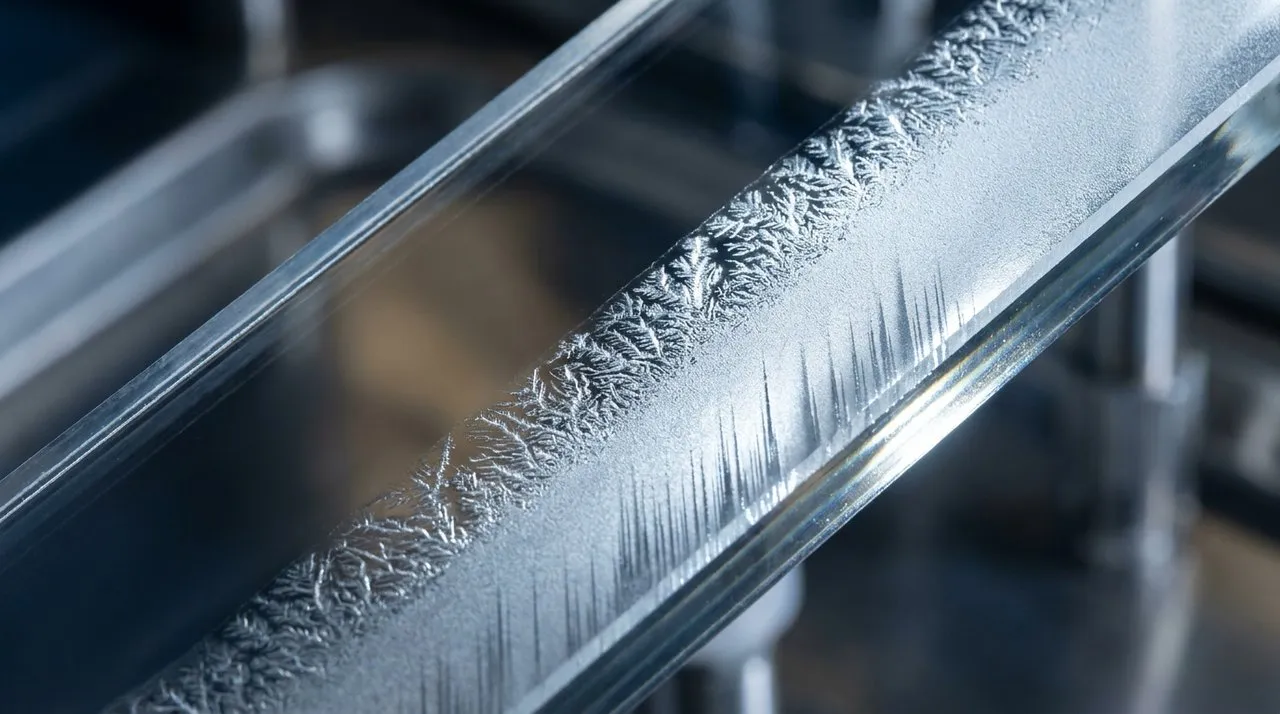
The glass reaction is the same chemistry that defines a major application. HF attacks silicon dioxide, the silica that makes up glass and quartz. That is why aqueous HF etches and frosts glass, why it cannot be stored in glass, and why lab and plant containment for HF is built from fluoropolymers and polyethylene instead.
What is anhydrous hydrogen fluoride used for?
Anhydrous HF is the upstream feedstock for most of the fluorine value chain, used where water would interfere with the reaction. Its applications cluster around synthesis rather than surface treatment.
The largest pull is fluorochemical manufacture: anhydrous HF is the fluorine source for refrigerants and fluorinated intermediates, and for the chemistry that yields fluoropolymers such as PTFE. Downstream of that synthesis sits material a buyer recognizes by name, including a finished fluoropolymer (PTFE) dispersion. Anhydrous HF also serves aluminum smelting through aluminum fluoride and cryolite, and it acts as the alkylation catalyst in some petroleum refineries, where HF alkylation units build high-octane gasoline blendstock.
The common thread is dryness. These reactions need fluorine delivered without water, which is exactly why the anhydrous form exists as a distinct commercial product and ships under its own handling regime. A buyer specifying for any of these processes should confirm anhydrous, not aqueous, before the line on the PO is set.
What is aqueous hydrofluoric acid used for?
Aqueous hydrofluoric acid is the working fluid for surface treatment, where the water solution does the etching and pickling. Its applications are about removing or modifying a surface, not feeding a synthesis.
Glass etching and frosting rely on the silica reaction described above. Metal finishing uses HF to pickle and descale stainless steel and to strip oxide and scale from other alloys. In microelectronics, electronic-grade HF cleans silicon wafers and etches silicon dioxide layers, frequently as a buffered oxide etch blended with a fluoride salt. Analytical and minerals labs use HF to digest silicate samples that other acids leave intact. For a plant working metal and glass surfaces, the industrial manufacturing hub maps where these fluoride chemistries fit alongside other process inputs.
Where a process can accept a solid instead of a liquid acid, ammonium bifluoride is a frequent substitute. It is a milder, easier-to-weigh HF-releasing salt used for the same glass and metal work, covered in detail in ammonium bifluoride in glass and metal processing. Related fluoride salts such as potassium fluoride serve adjacent etching and flux roles. Choosing between liquid HF and a fluoride salt is a handling decision as much as a chemistry one.
How does form change packaging and storage?
Form decides almost every handling rule, so the two products demand different containment and transport profiles. The contrast below is what a receiving and environmental-health-and-safety team needs before either form reaches the dock.
| Handling factor | Anhydrous HF (AHF) | Hydrofluoric acid (aqueous) |
|---|---|---|
| State as shipped | Liquefied gas / fuming liquid | Corrosive liquid |
| Typical containers | Steel cylinders and ISO containers | HDPE drums, IBCs, PE-lined totes |
| Glass compatible | No | No |
| Preferred materials of construction | Carbon steel (dry), nickel-copper alloy, PTFE | HDPE, PTFE, PVDF, polypropylene |
| Dominant exposure route | Inhalation of vapor | Skin and eye contact, plus vapor |
| Handling note | Pressure and temperature control | Secondary containment for spills |
The material-compatibility rows hold a fact that surprises buyers new to HF: dry anhydrous HF can be stored and shipped in carbon steel because, without water, it does not ionize to attack the metal. Add water and that protection disappears, which is why aqueous HF moves in polyethylene and fluoropolymer containers instead. Specifying carbon steel for a wet HF service, or glass for either, is a costly error.
Transport classification follows form as well. Anhydrous HF moves as a higher-hazard, toxic-by-inhalation product under pressure, while aqueous HF moves as a corrosive liquid. The two carry different placarding and carrier requirements, so a freight quote built for one will not cover the other.
What does HF exposure control require?
Engineering controls and exposure limits, because air monitoring is the first line of defense for a compound this toxic. The CDC NIOSH Pocket Guide entry for hydrogen fluoride sets the recognized exposure limits: a NIOSH REL of 3 ppm as an 8-hour TWA with a 6 ppm ceiling over 15 minutes, an OSHA PEL of 3 ppm TWA, and an IDLH (immediately dangerous to life or health) value of 30 ppm. OSHA’s chemical sampling data for hydrogen fluoride lists the analytical methods used to measure against those limits.
The regulatory wrapper is heavier than for most acids. Hydrogen fluoride and concentrated hydrofluoric acid are covered by OSHA’s Process Safety Management standard (29 CFR 1910.119) and listed under EPA’s Risk Management Program (RMP), which means facilities holding threshold quantities carry formal process-safety and accident-prevention obligations. Confirm your site inventory against both before scaling HF on-site.
Air monitoring is how a site proves it stays under those limits. OSHA’s chemical sampling data lists validated analytical methods for hydrogen fluoride, so the monitoring program a supplier or contractor proposes should reference a recognized method rather than a generic badge. Because the IDLH of 30 ppm is only ten times the 3 ppm working limit, the margin between routine exposure and an immediately dangerous atmosphere is narrow, which is why continuous detection is common around bulk HF service.
First-aid readiness is non-negotiable for any HF handling. Because fluoride binds calcium in tissue, calcium gluconate is the standard, pre-staged treatment for HF skin exposure across industrial-hygiene practice, and it must be on hand before the first drum is opened, not ordered after an incident. Train operators on it, post it at the point of use, and verify expiry dates on a schedule.
Which form and grade should you specify on an RFQ?
Decide on form first, then concentration, then grade, because each choice narrows the next. Start by answering whether your process needs water present. A synthesis, fluorination, or alkylation step that water would poison points to anhydrous HF. A surface treatment, etch, or pickling step points to aqueous hydrofluoric acid.
Once form is set, fix the concentration to the substrate and the process window, since boiling point, density, and reactivity all move with it. Then name the grade: technical, ACS reagent, or electronic grade, with the impurity profile your application can tolerate. For surface work that can use a solid, weigh liquid HF against ammonium bifluoride on handling risk before defaulting to the acid.
A complete HF line on an RFQ names the form first, then the concentration and grade, the container type, plus the Incoterms (FOB, CIF, DDP, or EXW). To compare grades or submit a specification, see the hydrofluoric acid product page or the ammonium bifluoride product page; background on industrial HF applications is collected in hydrofluoric acid for industrial uses. The clearer the spec, the tighter and faster the quote.
Frequently asked questions
Is hydrofluoric acid the same as hydrogen fluoride? Chemically, yes. Both are the molecule HF (CAS 7664-39-3, PubChem CID 14917). “Hydrogen fluoride” is the anhydrous, water-free compound; “hydrofluoric acid” is hydrogen fluoride dissolved in water. The names describe the form a buyer receives, not two different substances.
Why is hydrofluoric acid called a weak acid if it is so dangerous? Acid strength measures how completely a compound releases hydrogen ions in water. HF dissociates only partially, so PubChem lists it as a weak acid. Toxicity is a separate property: the fluoride ion crosses skin and binds calcium and magnesium in tissue, which makes even dilute HF acutely hazardous regardless of its weak-acid behavior.
Can you store hydrofluoric acid in glass? No. HF reacts with the silica in glass, the same reaction that makes it a glass etchant. Store aqueous HF in high-density polyethylene, PTFE, PVDF, or polypropylene. Dry anhydrous HF is compatible with carbon steel and nickel-copper alloys because, without water, it does not ionize to attack the metal.
Which form should I order for glass or metal etching? Aqueous hydrofluoric acid is the direct etchant for glass frosting and stainless pickling. If a process can tolerate a solid that is easier to weigh and handle, ammonium bifluoride is a milder HF-releasing salt used for the same glass and metal work. Match the concentration and grade to the substrate before issuing an RFQ.
Sources: physical-property and GHS data from the PubChem record for CID 14917 (EPA and ICSC source entries); occupational exposure limits from the CDC NIOSH Pocket Guide (hydrogen fluoride) and OSHA chemical sampling data; regulatory scope from OSHA 29 CFR 1910.119 and EPA’s Risk Management Program. Property values are grade-specific; verify against the supplier CoA and SDS (Safety Data Sheet) for the exact concentration ordered.
Frequently asked questions
Is hydrofluoric acid the same as hydrogen fluoride?
Why is hydrofluoric acid called a weak acid if it is so dangerous?
Can you store hydrofluoric acid in glass?
Which form should I order for glass or metal etching?
Sources & methodology
Regulatory citations are current as of publication. Chemical identities verified by CAS number against the RawSource catalog.
Search 1,300+ industrial chemicals by name or CAS, or send us your spec — we quote by the drum, tote, or container.
Browse the Chemical Index → Request a Quote