
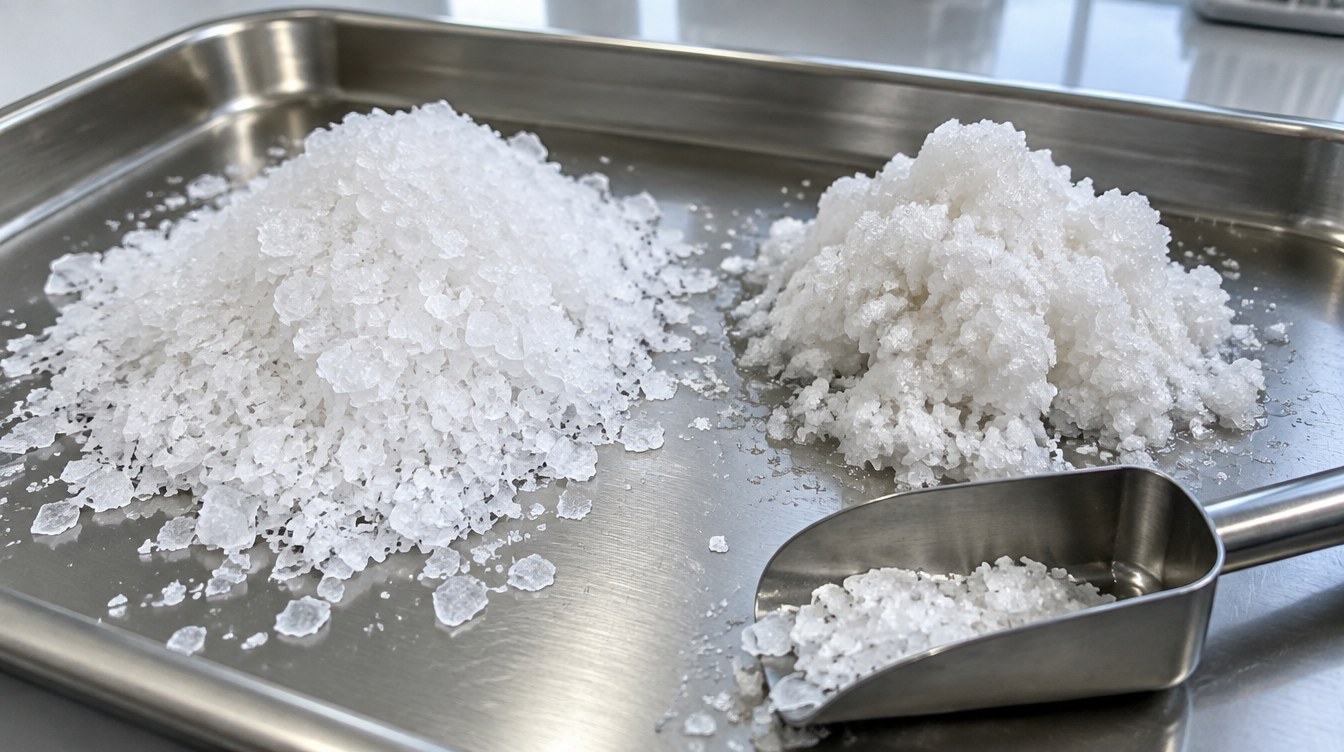
The pallet passed inspection in spring. By late summer the bags nearest the dock door have set hard, one liner has split, and a damp white crust is spreading across the concrete under the rack. Nothing was wrong with the lot. Ammonium bifluoride is hygroscopic above 50% ambient relative humidity and deliquescent, according to HSDB, so the water it pulls from the air does not stop at caking: the salt goes on to dissolve in it.
That property shapes more of a bulk order than the price per pound: it sets the liner, the lot size and where pallets stand. Identity, assay and form each carry a trap that a quote sheet does not show.
Which salt is on the quote?
Ammonium bifluoride (NH4HF2, CAS 1341-49-7, EC 215-676-4, PubChem CID 14935) travels under a long list of names. Its recorded synonyms include ammonium hydrogen difluoride, acid ammonium fluoride and ammonium acid fluoride. ECHA’s registration dossier names it ammonium hydrogendifluoride, the US tariff schedule adds ammonium fluoride hydrofluoride (1:1:1), and the Australian inventory, AICIS, lists it as “Ammonium fluoride, ((NH4)(HF2))”.
Those last names are where an order can go wrong. Ammonium fluoride proper is a different salt with its own CAS number, and PubChem lists it as a related parent compound, alongside hydrogen fluoride, CAS 7664-39-3. A quote or certificate that says “ammonium fluoride” with no CAS number could describe either salt.
| What the paperwork says | CAS | What it is | Check before you accept it |
|---|---|---|---|
| Ammonium bifluoride, ammonium hydrogen difluoride, acid ammonium fluoride | 1341-49-7 | NH4HF2, the salt on this order | Molecular weight 57.044 g/mol on the SDS |
| Ammonium fluoride ((NH4)(HF2)), ammonium fluoride hydrofluoride (1:1:1) | 1341-49-7 | The same salt under an inventory or tariff name | CAS on the SDS reads 1341-49-7 |
| Ammonium fluoride | Its own CAS, not 1341-49-7 | A different salt, the ammonium-side parent | Reject it against a bifluoride order |
| Hydrogen fluoride, hydrofluoric acid | 7664-39-3 | The fluoride-side parent, a gas or an aqueous acid | A different product with its own SDS |
Write the CAS number on the purchase order and require it on the Safety Data Sheet (SDS) and on every certificate of analysis (CoA). Names drift between a tariff schedule, an inventory and a sales sheet; the CAS number is the one identifier two documents cannot spell differently.
Grade: what is the assay a percentage of?
For pickling baths, aluminum brighteners, glass frosting and well-treatment fluids, the grade question is the assay and its basis. Fluorine is about two-thirds of the salt’s mass (two fluorine atoms in a molecular weight of 57.044 g/mol), so the fluoride a bath receives moves with the assay of what you weigh in.
A 1968 patent shows why the basis matters. In the worked example of US 3,419,440, a stainless steel pickling bath of 15 wt% nitric acid takes 4.59 wt% of a solid product that is 98% ammonium bifluoride and 2% disodium acid phosphate, which yields 3 wt% fluorine ion. The 98% there is a blend ratio, not an impurity allowance: the patent credits the phosphate with a protective film on the pickled steel. The patent is a published example, not a current recipe or a recommendation to practice it.
So when a quote says 98%, ask what it is a percentage of, and whether the balance is impurity or an added ingredient. A formulated pickling salt and a technical-grade salt can carry the same headline figure and behave differently in your tank. Add the impurity limits your process qualification found necessary, each as a measured line on the CoA, not a typical value.
Electronics work is a different purchase. A 2015 Chinese patent, CN103112872B, describes a microelectronics-grade ammonium fluoride-series etching solution, the family that includes the bifluoride, and targets individual anion impurities below 50 ppb, individual metal impurities below 1 ppb and fewer than 100 particles per mL larger than 0.2 micrometers. It makes that solution from technical-grade liquefied ammonia and dry hydrogen fluoride, each purified first, not by dissolving technical ammonium bifluoride.
The buying consequence: if your specification is written in ppb, ask for a finished etch solution with impurity data to that specification. A solid sold as “high purity” is not a substitute unless its impurity data are on the same basis.
Flake or powder changes the rate, not the ceiling
The salt is a white crystalline solid (CAMEO Chemicals), and bulk lots come as flake or as powder. Form does not change how much dissolves: water takes up 602 g/L at 20 °C (CRC Handbook, 86th edition, via HSDB) whatever the particle size. It changes how fast the salt dissolves, how much dust a bag throws when it is tipped, and how quickly an opened bag takes on moisture. Each of those rises as the particles get finer.
Choose by the dissolving step. If you make up a concentrate in a stirred tank and wait for it, flake costs you little and puts less dust in the air at the bag tip. If you dose dry into a running bath, or the make-up window is short, powder dissolves faster but needs tighter dust control at the tip station and a shorter open time per bag. The exposure controls for either form come from the current SDS.
Ask for two figures on the technical data sheet (TDS): particle size range and bulk density. The density of 1.50 g/cm³ in HSDB is the density of the solid itself. A bag of flake or powder holds air between the particles, so its bulk density is lower, and a hopper or feeder sized on 1.50 g/cm³ comes out too small.
Why does humidity decide the packaging and the lot size?
HSDB describes the salt as hygroscopic above 50% ambient relative humidity, deliquescent, and with no tendency to form hydrates. Read together, those properties describe the failure. Above that humidity the salt pulls water from the air; with no hydrate to bind the water into the crystal, the salt dissolves in it, first as caking and then as a wet film.
In water, the salt forms a weak solution of hydrofluoric acid (CAMEO Chemicals), and HSDB notes that in the presence of moisture it attacks glass, cement and most metals. That chain turns into storage lines on the specification:
-
Moisture barrier. A sealed plastic liner inside every bag or drum, closed again after each draw. Paper or fiber alone does not keep humid air out.
-
No glass, no bare metal. HSDB’s reactivity note, that the salt etches glass and with moisture attacks most metals, argues against glass containers and unlined metal drums, scoops or hoppers.
-
Off the concrete. Pallets on plastic sheeting or in plastic containment trays, because a wet bag drains onto the floor and the salt attacks cement once wet.
-
Lot size matched to use. Buy the bag or drum size your line empties in one opening, at a delivery rhythm that keeps stock turning. A bigger lot at a lower unit price saves money only in a dry warehouse.
-
Segregation and heat. Strong acids release hydrogen fluoride from fluoride salts, so the SDS incompatibility list decides the aisle. The salt decomposes at 446 °F (CAMEO, citing USCG 1999 data), and HSDB lists fumes of hydrogen fluoride, nitrogen oxides and ammonia on heating to decomposition, which belongs in the site fire plan.
The wet film is also a regulatory point. Under 40 CFR 116.4, Table 116.4A (eCFR text as read in 2026), ammonium bifluoride is designated a hazardous substance under section 311(b)(2)(A) of the Clean Water Act, and the designation is stated to include its solutions and mixtures. On that text, brine from a wet pallet carries the same designation as the dry salt; whether a reporting or discharge duty follows depends on where it goes and how much, so take a release to your environmental lead.
PubChem’s HSDB-derived record (2006) gives a CERCLA reportable quantity of 100 lb (45.4 kg) under 40 CFR 302.4: a release at or above that quantity must be reported to the National Response Center. Whether a given spill counts as a release is a call for your environmental lead; write the spill plan around that threshold before the first pallet arrives.
Documents to have before the first shipment
Ask for three documents with every order. The current SDS for the exact grade and form, showing CAS 1341-49-7; hazard statements, storage and first aid come from it, not from a sales sheet. A CoA for each lot, with the assay, its basis and method, the measured impurity lines your process needs, and a lot number that matches the bag. A TDS with particle size range, bulk density and liner material.
If you are the importer of record, add the tariff file. The US tariff schedule places the salt under heading 2826 (fluorides), subheading 2826.19.10, statistical line 2826.19.10.00, “Of ammonium”.
Chapter 99 subheading 9902.01.41 names ammonium bifluoride by CAS with a general duty rate of Free, but the record as retrieved from the USITC on 30 September 2026 carried no effective period or expiry date. Heading 9902 provisions are temporary, so have your customs broker confirm 9902.01.41 is in force on the entry date before a landed-cost model assumes it.
Methodology: identity, physical properties, humidity behavior, reactivity and uses come from PubChem’s ammonium bifluoride record (CID 14935, with its HSDB and CAMEO Chemicals entries) and the ECHA substance record; tariff lines from the USITC Harmonized Tariff Schedule; designations from the eCFR and PubChem’s regulatory section. Patent figures are the inventors’ published examples, not recommendations to practice them.
Frequently asked questions
Is ammonium fluoride the same thing as ammonium bifluoride?
Can caked or damp ammonium bifluoride still go into the tank?
How can a plant check the assay of a delivered lot?
Why buy the solid instead of hydrofluoric acid?
Sources & methodology
Figures are RawSource sourcing data unless attributed to a named source. Regulatory citations are current as of publication. Chemical identities verified by CAS number against the RawSource catalog.
Search 1,300+ industrial chemicals by name or CAS, or send us your spec — we quote by the drum, tote, or container.
Browse the Chemical Index → Request a Quote