
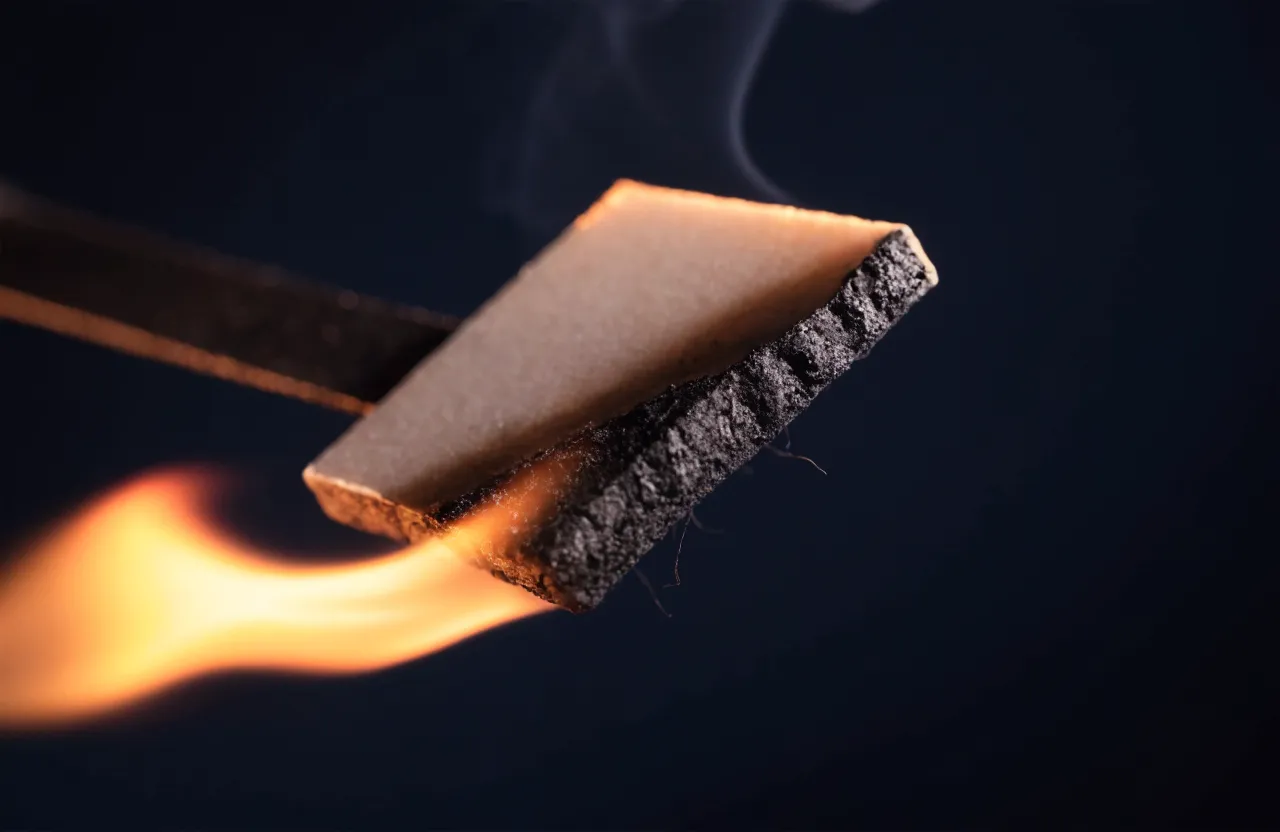
A drawing release lands on your desk with one new line in the bill of materials: the housing must now pass UL 94 V-0 at 1.6 mm. The resin is the same polypropylene you have molded for years, and unfilled polypropylene burns like a candle. Somewhere between that new requirement and the next production run sits a flame retardant, and the wrong one will cost you stiffness, color, processing temperature, or a regulatory problem you did not see coming. Before you lock a grade or a loading, it pays to know what a flame retardant actually does, the handful of genuinely different ways they work, and how the chemistry families trade off against each other.
The short version: A flame retardant is a chemical added to a polymer, coating, foam, textile, or cable compound to make it harder to ignite and slower to spread flame once it is lit. It works through one or more of four mechanisms: quenching combustion radicals in the gas phase, building a protective char in the condensed phase, cooling the material by decomposing endothermically and releasing water, and intumescence, where an additive package swells into a thick insulating char foam. The main chemistry families are phosphorus / phosphate esters, halogenated (bromine and chlorine), mineral hydroxides (aluminium trihydroxide and magnesium hydroxide), and nitrogen-based (melamine derivatives), each with real trade-offs in loading, cost, smoke, processing, and regulatory standing. They are supplied as additive types (blended in, and able to migrate over time) or reactive types (chemically bonded into the polymer, and permanent). The honest bottom line: no flame retardant makes a material fireproof. It slows ignition and flame spread and can help a material self-extinguish once the ignition source is removed under controlled test conditions, which is what fire-test standards such as UL 94 and the Limiting Oxygen Index actually measure.
What a flame retardant actually is
To see what a flame retardant interrupts, picture the cycle that keeps a polymer burning. Heat breaks the polymer surface down (pyrolysis) into small, flammable gas molecules; those gases combust with oxygen in the air; the combustion is exothermic, so it feeds heat back to the surface and pyrolyzes more polymer. Fuel, heat, and oxygen sustain the loop. A flame retardant is any chemistry that interferes with at least one leg of it, whether by poisoning the gas-phase reaction, choking off the fuel with a char barrier, absorbing heat, or diluting the oxygen and fuel at the surface. (flame-retardancy mechanism overview, ScienceDirect)
Two points follow. First, “flame retardant” is a performance role, not one chemical class, which is why materials as different as a liquid aryl phosphate and a powdered mineral all earn the label. Second, slowing the loop is not stopping fire. A treated material can still burn under a large enough heat flux; what good design buys you is a higher ignition threshold, slower flame spread, lower heat release, and a tendency to self-extinguish once the igniter is pulled. Specify to the fire test that governs your part, and treat any “fireproof” claim as a red flag.
How flame retardants work: the four mechanisms
Almost every commercial flame retardant operates through one or a combination of four modes. Knowing which mode an additive uses tells you why it pairs well, or badly, with a given polymer.
| Mechanism mode | What physically happens | Representative chemistries |
|---|---|---|
| Gas-phase radical quenching | Decomposition releases radicals (phosphorus species PO•, PO₂•, HPO•, or halogens Br•, Cl•) that scavenge the H• and OH• radicals driving the flame’s chain reaction, slowing or interrupting combustion | Aryl phosphate esters; brominated and chlorinated FRs |
| Condensed-phase charring | Acid species (phosphoric and polyphosphoric acid) catalyze dehydration and cross-linking of the polymer surface into a carbon-rich char that shields the polymer and blocks the escape of fuel gases | Phosphorus FRs; APP-based systems |
| Endothermic cooling + dilution | A mineral filler decomposes endothermically, absorbing heat and releasing water vapor that cools the surface and dilutes the flammable gas mixture | Aluminium trihydroxide (ATH), magnesium hydroxide (MDH), carbonates and hydrates |
| Intumescence | An acid source, a carbon source, and a blowing agent react in sequence to swell a thick, insulating char foam that physically separates the polymer from the heat and flame | APP + polyol + melamine packages; expandable graphite blends |
The mineral route is the easiest to quantify. Aluminium trihydroxide begins to decompose near 200 to 220 °C, releasing about 35% of its own weight as water, while magnesium hydroxide is more thermally stable and decomposes near 330 °C, releasing around 31%. (ATH / MDH decomposition data, ScienceDirect) That endotherm pulls heat out of the substrate while the released steam dilutes the flame. Intumescent systems are the most engineered: in a classic ammonium polyphosphate (APP) package, the APP supplies the charring acid, a polyol such as pentaerythritol is the carbon source, and a nitrogen compound releases gas that blows the char into a foam, reaching a 30%-plus LOI and a UL 94 V-0 at total loadings around 40 phr. (intumescent APP mechanism, NCBI/PMC) When you read a data sheet, identify the mode first, because it predicts the loading you will need and the side effects you will fight.
The chemistry families, with honest trade-offs
Four families cover the bulk of the market. None is “best” in the abstract; each wins in a specific polymer-and-spec window, and each has a real downside worth naming out loud.
| Family | Primary mode | Where it is strong | Trade-offs to weigh |
|---|---|---|---|
| Phosphorus / phosphate esters | Gas phase + condensed-phase char | Halogen-free; efficient at low loading; many liquid grades double as plasticizers | Liquid grades plasticize (can lower modulus and heat-deflection temperature) and may migrate or volatilize; chlorinated grades face regulatory scrutiny |
| Halogenated (bromine, chlorine) | Gas phase | Very effective at low loading across many polymers; cost-effective | Usually need an antimony trioxide synergist; generate smoke and corrosive acid gas when they burn; several legacy molecules are restricted or under scrutiny |
| Mineral hydroxides (ATH, MDH) | Endothermic cooling + dilution | Halogen-free; low smoke; also act as smoke suppressants; low unit cost | Very high loadings (often 50–65 wt%) degrade processing and mechanical properties; ATH caps process temperature near 200 °C, MDH near 300 °C |
| Nitrogen-based (melamine and derivatives) | Endothermic + char / gas dilution | Halogen-free; low smoke; efficient in nitrogen-rich polymers like nylon | Narrower polymer range; outside polyamides usually needs a phosphorus co-additive |
They act in both the gas phase and the condensed phase, so a few weight-percent can move the needle. Low-viscosity liquids such as triethyl phosphate (TEP), about 17 wt% phosphorus at roughly 1.7 mPa·s, and trimethyl phosphate (TMP) blend easily into rigid polyurethane foam, unsaturated polyester, and coatings where viscosity matters. Aryl and alkyl-aryl phosphates such as solid triphenyl phosphate (TPP), tricresyl phosphate (TCP), cresyl diphenyl phosphate (CDP), 2-ethylhexyl diphenyl phosphate (DPOP), and isopropylated triphenyl phosphate (IPPP) lean on gas-phase quenching while plasticizing the matrix, which is useful in flexible PVC and engineering blends. The trade-off is that same plasticization: it can soften the part and, for some grades, migrate or volatilize over service life.
Halogenated flame retardants (brominated and chlorinated) work mainly in the gas phase, releasing Br• or Cl• that scavenge the H• and OH• radicals feeding the flame. They are potent at low loading, but they almost always need antimony trioxide, which has no flame-retardant activity on its own and acts purely as a synergist. The honest caveats: they tend to produce more smoke and corrosive gas on burning, antimony trioxide carries its own toxicological and regulatory scrutiny, and several legacy brominated molecules have been restricted or phased out. See the Tris(1-chloro-2-propyl) phosphate (TCPP) product page.
Mineral hydroxides (ATH and MDH) use the simplest mechanism and cost the least per kilogram, but they pay for it in loading: reaching a UL 94 V-0 commonly takes 50 to 65 wt% filler, and that much rigid mineral hurts flow, toughness, and finish. ATH’s ~200 °C decomposition onset rules it out of higher-temperature engineering polymers, while MDH’s ~330 °C onset extends it to resins processed up to roughly 300 °C. Nitrogen-based flame retardants, principally melamine and its salts, occupy a narrower lane: melamine cyanurate can take unfilled nylon (PA6, PA66) to a UL 94 V-0 on its own, but outside nitrogen-rich polymers it usually needs a phosphorus partner.
Additive versus reactive flame retardants
A second axis cuts across all four families: how the flame retardant is held in the polymer. Additive flame retardants are physically blended into the polymer during compounding, foaming, or extrusion and are not chemically bonded to it. They are flexible to formulate and can be dropped in at almost any processing stage, but because they are only dispersed, they can migrate, bloom, or volatilize to the surface over time. Reactive flame retardants are covalently built into the polymer backbone as a comonomer or cross-linker, so they cannot migrate out and tend to preserve mechanical properties better, at the cost of process rigidity: they must be designed in at the polymerization stage, not added later. Most of the phosphate esters above are used as additive flame retardants; confirm the binding behavior for your exact chemistry rather than assuming it.
How to choose: match chemistry to polymer, loading, and test target
Selecting a flame retardant is a constrained optimization, not a hunt for the highest single number. Work it in this order:
- Start from the governing fire test, not a generic LOI. Your part is qualified to a specific standard such as UL 94 (with a class and thickness), a glow-wire test, a rail or aerospace spec, or a cable test. That standard sets the real target. Use LOI to screen and rank candidate formulations and bracket loadings, then qualify the final compound to the standard that actually governs.
- Match the mechanism to the polymer. Char-forming engineering resins reward condensed-phase phosphorus at modest loading. Non-charring polyolefins (PP, PE) generally need an intumescent package or a high mineral loading because they will not char on their own. Nitrogen-rich nylons respond to melamine chemistry, and foams or low-viscosity systems favor liquid phosphates that blend without wrecking flow.
- Treat loading as a property budget. Every part you add displaces something else: a 60 wt% mineral loading buys flame retardancy at the direct expense of toughness and processability, while a few percent of a liquid aryl phosphate is gentle on loading but plasticizes. Choose the lowest loading of the right chemistry that clears your test.
- Cost the secondary specs explicitly. Smoke and toxic-gas output, heat-deflection temperature, electrical properties, color and clarity, migration and volatility over service life, processing window, and end-use approvals all factor in, and the additive that maximizes flame retardancy rarely optimizes all of them.
There is no free flame-retardant point. Set the target from the code test, choose the lowest loading of the right chemistry, then validate the lift on your own compound rather than on a base-resin literature value.
A note on chlorinated phosphate esters
If your shortlist includes chlorinated organophosphates such as TCEP, TCPP, or TDCPP, factor their regulatory trajectory into the decision, neutrally and with current sources. In the US, the EPA has finalized a TSCA risk evaluation for TCEP, determining it presents an unreasonable risk and moving toward risk management, and it assesses TCEP, TCPP, and TDCPP together as a chlorinated phosphate ester cluster. The US National Toxicology Program reported evidence of carcinogenic activity for TCPP in rodent studies (NTP Technical Report 602), and in the EU these substances have drawn substance-of-very-high-concern and restriction scrutiny, with ECHA’s restriction work on chlorinated phosphate esters in flexible polyurethane foam still in progress at the time of writing. Status, permitted uses, and timelines differ by jurisdiction, end-use sector, and date, and they continue to change, so confirm the current position for your jurisdiction and application before you design one of these in.
Buying phosphate-ester flame retardants
Tell us your base polymer, your governing fire-test standard and class, your target LOI, and your constraints on plasticization, smoke, volatility, and approvals, and request a sample to qualify the lift on your own system. If you are screening candidates by oxygen index first, our companion guide to the Limiting Oxygen Index explains how to read those numbers, and if your work is in epoxy, our note on amine blush in epoxy covers a related cure-side failure mode.
Frequently asked questions
What is a flame retardant?
A flame retardant is a chemical added to a polymer, coating, foam, textile, or cable compound to make it harder to ignite and slower to spread flame once it is lit, and to help it self-extinguish when the ignition source is removed. It is a performance role rather than a single chemical class, which is why materials as different as a liquid aryl phosphate and a powdered mineral both carry the label. It does not make a material fireproof.
How do flame retardants work?
Through one or more of four mechanisms. In the gas phase, decomposition releases radicals (phosphorus species such as PO•, or halogens such as Br• and Cl•) that scavenge the H• and OH• radicals driving combustion. In the condensed phase, acid species build a carbon-rich char that blocks heat and fuel gases. Mineral hydroxides decompose endothermically, cooling the material and releasing water that dilutes the flame. Intumescent systems swell into an insulating char foam. Many flame retardants use more than one of these at once.
What are the main types of flame retardants?
The major chemistry families are phosphorus / phosphate esters (gas-phase plus char, halogen-free, efficient at low loading), halogenated bromine and chlorine compounds (gas-phase, potent but usually paired with an antimony synergist), mineral hydroxides such as aluminium trihydroxide and magnesium hydroxide (endothermic cooling, high loadings, low smoke), and nitrogen-based melamine derivatives (efficient in nylon and other nitrogen-rich polymers). Each wins in a specific polymer-and-spec window.
What is the difference between additive and reactive flame retardants?
Additive flame retardants are physically blended into the polymer during processing and are not chemically bonded to it, so they are flexible to formulate but can migrate, bloom, or volatilize over time. Reactive flame retardants are covalently built into the polymer chain as a comonomer or cross-linker, so they are permanent and cannot migrate, but they must be incorporated during polymerization rather than added later. Most flame retardant additives sold for compounding are the additive type.
Does a flame retardant make a material fireproof?
No. A flame retardant slows ignition and flame spread, can lower heat release, and can help a material self-extinguish once the ignition source is removed under controlled test conditions, but a treated material can still burn under a sufficient heat flux. Fire tests such as UL 94 and the Limiting Oxygen Index measure these resistance behaviors, not absolute fire immunity. Treat any “fireproof” claim with suspicion, and qualify to the fire-test standard that governs your part.
Are chlorinated phosphate ester flame retardants banned?
Status varies by substance, jurisdiction, end use, and date, and it is actively changing. In the US the EPA has finalized a TSCA risk evaluation for TCEP and assesses TCEP, TCPP, and TDCPP as a chlorinated phosphate ester cluster, the National Toxicology Program has reported evidence of carcinogenic activity for TCPP in rodent studies, and in the EU these substances have drawn substance-of-very-high-concern and restriction scrutiny. This article makes no health or safety claim about any of them; confirm the current regulatory position for your jurisdiction and application before specifying one.
Editorial note. This article is general technical guidance for plastics, coatings, cable, and foam formulation professionals. Flame-retardant performance depends on the specific polymer, additive grade, loading, dispersion, specimen geometry, and test conditions and must be validated on your own system; the Certificate of Analysis governs the grade you buy, and the governing fire-test standard and building or product code govern your end use. Nothing here is a fire-safety, medical, health, or environmental claim, and no flame retardant referenced is characterized as “safe,” “non-toxic,” or “green.” Regulatory status for flame retardants, particularly chlorinated phosphate esters such as TCEP, TCPP, and TDCPP and antimony synergists, varies by jurisdiction, end use, and date and is actively changing; statements here reflect publicly available EPA, NTP, and ECHA information at the time of writing and must be re-confirmed for your jurisdiction and application before use. Products are sold for industrial and professional use only. RawSource makes no warranty, express or implied, and assumes no liability for use of this information.
Search 1,300+ industrial chemicals by name or CAS, or send us your spec — we quote by the drum, tote, or container.
Browse the Chemical Index → Request a Quote