
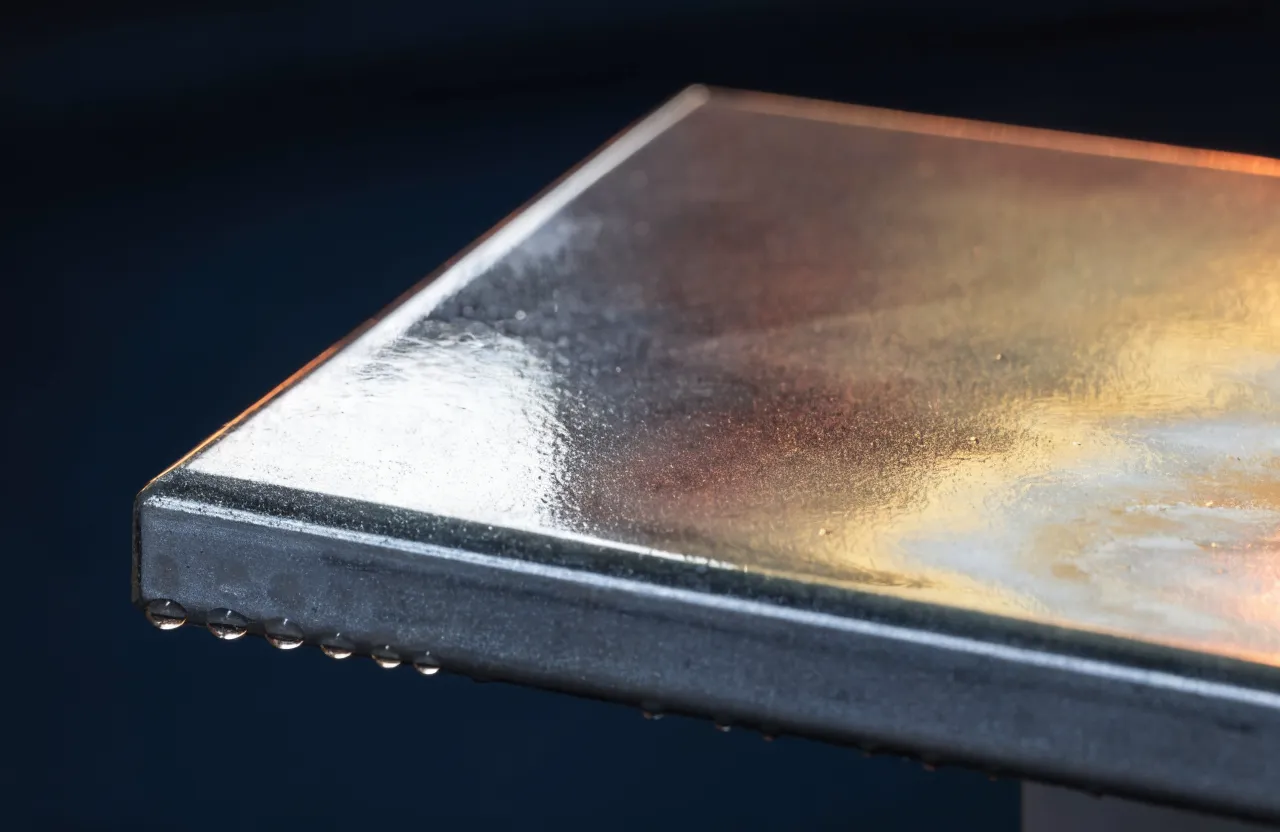
You pulled the part out of the shop this morning and the epoxy that should be glossy has a greasy, hazy film on it — sometimes oily to the touch, sometimes faintly sticky. You wipe it, it smears. You apply the next coat or the topcoat, and it fish-eyes, beads up, or peels later. That film is amine blush, and it is the single most common cosmetic-and-adhesion failure in amine-cured epoxy. The good news: it is predictable, preventable, and removable, and the chemistry tells you exactly which hardeners are prone to it.
The short version: Amine blush (also called carbamation, amine bloom, or sweating) is a waxy, greasy, or hazy film that forms on the surface of curing epoxy when free amine at the surface reacts with carbon dioxide and moisture from the air, forming amine carbamate and carbonate salts. It is worst in cold, humid, poorly ventilated conditions and with unmodified low-molecular-weight aliphatic amines. Prevent it by curing warm, dry, and ventilated; by giving the mix proper induction time; and by choosing modified, cycloaliphatic, or polyether amine hardeners that blush far less. Because the blush salts are water-soluble, you remove it by washing the surface with warm water and lightly abrading before you recoat.
What amine blush actually is
Amine-cured epoxy hardens because amine groups (–NH) react with the epoxide rings of the resin to build a crosslinked network. At the very surface, a thin layer of amine is exposed to the atmosphere before it can react into the polymer. Carbon dioxide and water vapor are always present in air, and a primary or secondary amine reacts readily with both: amine + CO₂ + H₂O forms an ammonium carbamate / carbonate / bicarbonate salt. Those salts are what you see and feel — a greasy, hazy, sometimes tacky bloom sitting on top of an otherwise curing film. It is a surface phenomenon; the bulk of the epoxy underneath usually cures normally.
The practical damage is twofold. Cosmetically, the surface looks hazy, oily, or amber and loses gloss. Functionally — and this is the expensive part — the blush is a contamination layer: it is greasy and water-soluble, so a topcoat or next lift of epoxy applied over it cannot wet out or bond. The result is fish-eyes, craters, delamination, and intercoat adhesion failure that may not show up until the part is in service.
What causes it — and what makes it worse
Blush is driven by how much free amine sits at the surface and how long it lingers there before reacting. Anything that slows the cure or pushes amine to the surface makes it worse:
| Condition | Why it worsens blush |
|---|---|
| Low temperature | Slows the epoxy–amine reaction, so amine stays free at the surface longer and has more time to grab CO₂ and water |
| High humidity | More water at the surface to form the carbamate/carbonate salts; condensation near the dew point is the worst case |
| Poor ventilation | Lets CO₂ and moisture concentrate at the curing surface |
| Unmodified low-MW aliphatic amines | Small, volatile, very reactive toward CO₂/water — the most blush-prone chemistry |
| Amine excess / off-ratio | Extra unreacted amine at the surface, more available to blush |
| Thin films and large cool surfaces | Cure slowly and sit near ambient/dew point conditions |
This is why blush is a cold-weather, high-humidity, garage-and-jobsite problem far more than a warm, ventilated factory problem.
How to prevent amine blush
Prevention is environmental control plus chemistry choice:
- Cure warm and keep the surface above the dew point. Heat the substrate and the space; avoid applying when surface temperature is near or below the dew point, where condensation forms.
- Lower humidity and ventilate. Move air, dehumidify if you can, and don’t cure in a sealed cold room.
- Use the correct mix ratio and give it induction time. Mix thoroughly to the specified ratio (by weight, per the amine hydrogen equivalent weight), and allow the recommended induction / “sweat-in” time so the reaction is well underway before the film is exposed.
- Choose a low-blush hardener. This is the lever most people miss — see the comparison below. Modified amine adducts, cycloaliphatic amines, polyamides, phenalkamines, and polyether amines are formulated specifically to cure cleanly in cool, damp conditions.
How to remove blush before you recoat
If blush has already formed, do not coat over it. Because the blush salts are water-soluble, removal is straightforward: wash the surface with clean warm water, lightly abrade or scuff-sand to give a mechanical key, rinse, and let it dry fully before applying the next coat. Skipping this step is the usual root cause of “my topcoat won’t stick” and “my second lift of epoxy peeled.”
Which hardeners blush less — the chemistry behind the choice
The hardener you select sets your baseline blush risk before any environmental control. From most to least blush-prone:
| Hardener chemistry | Blush tendency | Notes |
|---|---|---|
| Unmodified aliphatic polyamines (DETA, TETA, TEPA) | Highest | Small, fast, cheap, excellent crosslink density — but the most blush-prone, especially cold/damp |
| Modified amines / amine adducts | Lower | Pre-reacting (adducting) the amine raises its molecular weight and ties up free –NH, cutting blush and improving handling |
| Cycloaliphatic amines (IPDA, MXDA-type) | Lower | Larger, less volatile, good color and weathering; common in higher-spec coatings |
| Polyether amines (polyetheramine D/T grades) | Low | Flexible, slow, low-blush; often blended in to toughen and reduce blush |
| Polyamides / phenalkamines | Low | Workhorses for cold, damp, marine cure where blush resistance is the whole point |
The honest takeaway: an unmodified aliphatic amine like diethylenetriamine (DETA) or triethylenetetramine (TETA) gives a hard, fast, tightly crosslinked cure and is the right, economical choice in warm, dry, well-ventilated conditions — but it is the chemistry most likely to blush. When you are fighting cold or humidity, or you need a clean recoat window, move toward a modified or cycloaliphatic amine such as isophorone diamine (IPDA) or its cyanoethylated (Michael-adduct) modification, m-xylylenediamine (MXDA), or blend in a polyoxypropylene diamine of about 230 molecular weight for flexibility and lower blush. Full tradeoffs are in our epoxy curing agent selection guide.
Buying epoxy curing agents
See the Diethylenetriamine product page. Tell us your cure conditions (temperature, humidity), your recoat window, and your color and toughness targets, and request a sample to qualify blush behavior on your own system.
Frequently asked questions
What is amine blush on epoxy?
Amine blush is a greasy, hazy, or tacky film that forms on the surface of curing amine-cured epoxy when free amine at the surface reacts with carbon dioxide and moisture in the air to form amine carbamate and carbonate salts. It is a surface contamination layer; the epoxy underneath usually cures normally.
What causes amine blush?
Free amine at the curing surface reacting with atmospheric CO₂ and water. It is made worse by low temperature, high humidity, poor ventilation, an amine-rich (off-ratio) mix, and unmodified low-molecular-weight aliphatic amine hardeners, all of which leave more free amine at the surface for longer.
How do you prevent amine blush?
Cure warm and keep the surface above the dew point, lower humidity and ventilate, mix to the correct ratio and allow proper induction time, and choose a low-blush hardener — a modified amine adduct, a cycloaliphatic amine, a polyamide, a phenalkamine, or a polyether amine rather than an unmodified aliphatic amine.
How do you remove amine blush before recoating?
Wash the surface with clean warm water (the blush salts are water-soluble), lightly abrade or scuff-sand to create a mechanical key, rinse, and let it dry fully before applying the next coat. Recoating over un-removed blush is the usual cause of fish-eyes, craters, and peeling.
Which epoxy hardeners blush the least?
Modified amines and amine adducts, cycloaliphatic amines (such as IPDA and MXDA types), polyamides, phenalkamines, and polyether amines blush far less than unmodified aliphatic polyamines like DETA, TETA, and TEPA. The unmodified aliphatics give a harder, faster cure but are the most blush-prone, especially in cold, humid conditions.
Does amine blush mean the epoxy is ruined?
Usually not. Blush is a surface layer — the bulk of the epoxy underneath typically cures normally. The risk is to adhesion of any subsequent coat, so the fix is to wash and abrade the blush off before recoating rather than to scrap the part. Confirm cure and adhesion on your own system.
Editorial note. This article is general technical guidance for coatings and industrial formulation professionals. Cure behavior, blush tendency, and recoat performance depend on your specific resin, hardener, ratio, film thickness, and environment, and must be validated on your own system; the Certificate of Analysis governs the grade you buy. Amine hardeners are corrosive and can cause skin and eye burns and sensitization — review the current Safety Data Sheet (SDS) and use appropriate PPE before handling. Products are sold for industrial and professional use only. Nothing here is a medical, health, or safety claim. RawSource makes no warranty, express or implied, and assumes no liability for use of this information.
Search 1,300+ industrial chemicals by name or CAS, or send us your spec — we quote by the drum, tote, or container.
Browse the Chemical Index → Request a Quote