
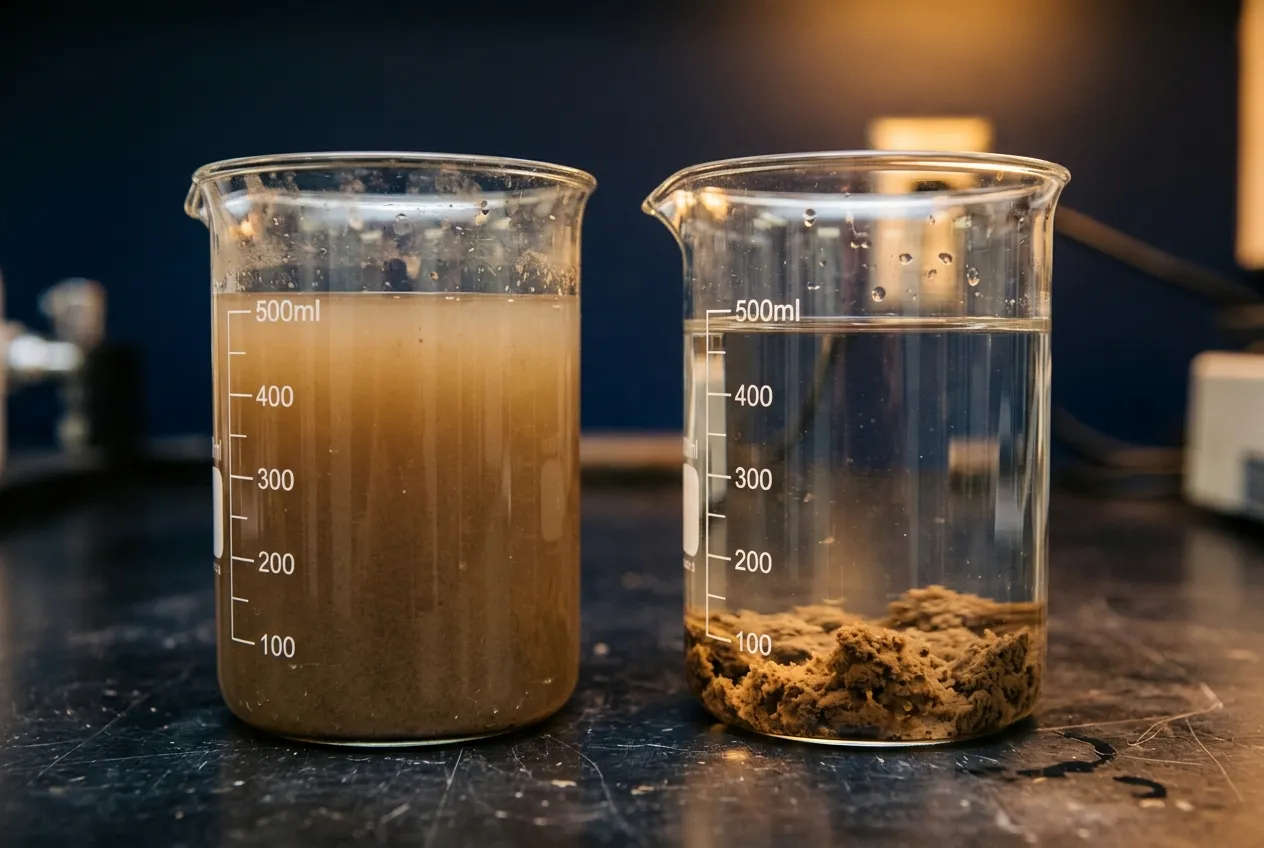
The floc will not form, the sludge will not dewater, the clarifier overflow is still cloudy, and there are three bags of polyacrylamide in the store: anionic, cationic, and nonionic. They look identical and they are not interchangeable. Reach for the wrong charge and almost nothing happens. The charge type, matched to what you are trying to separate, is the entire decision.
The short version: polyacrylamide (PAM) comes in three charge types. Anionic PAM carries a negative charge and flocculates positively-charged and mineral or inorganic solids, the silt, sand, ore fines, and metal-bearing solids found in mining, metals, and high-turbidity wastewater, and it works best at neutral to high pH.
Cationic PAM carries a positive charge and flocculates negatively-charged organic matter and biological sludge, which is why it dominates municipal and organic-sludge dewatering. Nonionic PAM is nearly neutral and suits mildly acidic to neutral systems with fine solids. Molecular weight does the bridging; charge does the neutralization.
Why charge type decides everything
Suspended solids mostly carry a surface charge, usually negative, that keeps them apart and in suspension. Flocculation works in two steps: a charge is neutralized so particles can approach, and then a long polymer chain bridges many particles into a large, fast-settling floc. Polyacrylamide (CAS 9003-05-8, PubChem) is the bridging polymer, and its charge type sets which particles it can grab. Match the polymer charge to the particle charge and you get a strong floc; mismatch it and the polymer cannot attach.
| Type | Charge | Flocculates | Best pH | Typical problems it solves |
|---|---|---|---|---|
| Anionic (APAM) | Negative | Mineral and inorganic solids, positively-charged particles | Neutral to high (6 to 10+) | Mining tailings, metal and steel wastewater, high-turbidity water, sand and silt |
| Cationic (CPAM) | Positive | Organic matter and biological sludge | Acidic to neutral (4 to 9) | Municipal and organic sludge dewatering, oily and food wastewater |
| Nonionic (NPAM) | Near-neutral | Fine solids where low charge suits | Mildly acidic to neutral | Mineral dressing, some paper and neutral-pH clarification |
When you need anionic PAM
Use anionic polyacrylamide when the solids are mineral or inorganic and the problem is settling or dewatering them. That covers mining tailings and ore fines, metal-finishing and steel-mill wastewater, high-turbidity surface water, and sand, silt, and clay. Anionic grades carry a high molecular weight for strong bridging and tolerate neutral-to-high pH. The applications are detailed in polyacrylamide in mining and polyacrylamide in metal finishing and metallurgy.
When you need cationic PAM
Use cationic polyacrylamide when the solids are organic or biological and the problem is dewatering a sludge. Negatively-charged organic matter, the activated sludge in a municipal wastewater plant, food and palm-oil effluent, and oily wastewater all respond to a positive polymer. Cationic PAM is the workhorse of sludge dewatering on belt presses, centrifuges, and screw presses, usually dosed by the kilogram per ton of dry solids, as covered in polyacrylamide for sludge dewatering.
When nonionic PAM fits
Nonionic polyacrylamide carries little charge and works through bridging more than neutralization. It suits mildly acidic to neutral systems and fine mineral solids, and it appears in mineral dressing, some paper applications, and neutral-pH clarification where a charged polymer would over-treat. It is the narrower-use member of the family.
Molecular weight versus charge density
Two dials control performance. Molecular weight sets the bridging power: higher molecular weight builds larger, stronger, faster-settling flocs. Charge density sets the neutralization: more charge destabilizes more strongly but can re-stabilize the suspension if overdosed. High-molecular-weight grades dominate solid-liquid separation; charge is tuned to the solids. The grade detail is in polyacrylamide grades and make-down.
How to choose in practice
Start from the problem and the solids, not the catalog. If the solids are mineral and the water is neutral to alkaline, start anionic. If you are dewatering an organic or biological sludge, start cationic. If the system is neutral with fine solids and charged polymers over-treat, try nonionic. Then run a jar test with two or three candidate grades at a range of doses; the right polymer and dose is the one that makes the largest, fastest-settling, cleanest-releasing floc on your actual stream.
Buying polyacrylamide in bulk
See the Polyacrylamide Flocculant product page. Tell us your stream, solids type, and pH, and request samples of two or three grades to jar-test on your own process.
Frequently asked questions
Which polyacrylamide do I need, anionic or cationic?
Match the charge to the solids. Use anionic for mineral and inorganic solids (mining, metals, high-turbidity water, neutral to high pH); use cationic for organic and biological sludge (municipal and food wastewater dewatering). Jar-test to confirm.
Why isn’t my polyacrylamide forming floc?
The most common cause is the wrong charge type for your solids, so the polymer cannot attach. Other causes are overdosing (which re-stabilizes the suspension), poor make-down so the polymer is not fully dissolved, or a pH outside the grade’s range. Check the charge match first.
What is the difference between anionic and cationic polyacrylamide?
Anionic PAM is negatively charged and grabs positively-charged and mineral solids; cationic PAM is positively charged and grabs negatively-charged organic matter and sludge. They target opposite particle charges and are not interchangeable.
What does molecular weight do in polyacrylamide?
Molecular weight controls bridging. Higher molecular weight forms larger, stronger, faster-settling flocs and is preferred for solid-liquid separation. Charge density, a separate property, controls how strongly the polymer neutralizes the particle surface.
Is polyacrylamide safe?
The polymer itself has low toxicity per its SDS and is not classified as hazardous for transport. The controlled concern is residual acrylamide monomer; for potable-water treatment, use an NSF/ANSI 60-certified grade within its dose limits. Always consult the SDS and confirm certification for your application.
Editorial note. This article is general technical guidance for water-treatment and industrial professionals. Charge-type and dose guidance is general and must be validated by jar testing on your own stream; the Certificate of Analysis governs the grade you buy. Polyacrylamide polymer has low toxicity per its SDS and is not classified as hazardous for transport, but residual acrylamide monomer is a regulated concern: for drinking-water and other potable use, use an NSF/ANSI 60-certified grade within its limits and confirm compliance for your jurisdiction. Spilled product is extremely slippery when wet. Always consult the current Safety Data Sheet (SDS) before handling. RawSource makes no warranty, express or implied, and assumes no liability for use of this information.
Search 1,300+ industrial chemicals by name or CAS, or send us your spec — we quote by the drum, tote, or container.
Browse the Chemical Index → Request a Quote