
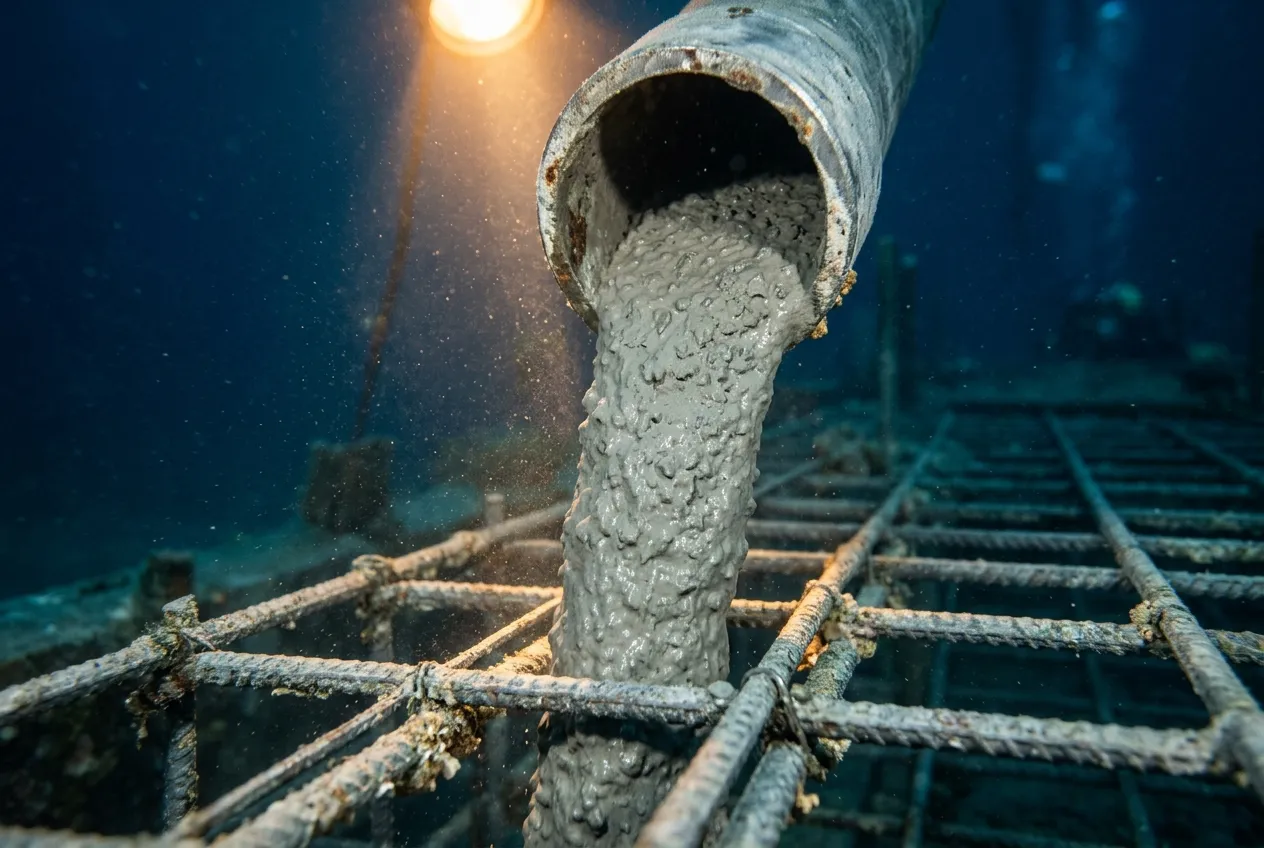
Pour concrete into water and it falls apart. The cement paste washes out of the aggregate, the mix disperses into a cloud, the placed concrete is weak and porous, and the surrounding water is fouled with cement. The same dispersion shows up in air as a mix that segregates and bleeds. The admixture that holds the paste together, underwater or in a demanding placement, is polyacrylamide.
The short version: polyacrylamide is used as an anti-washout admixture (AWA) and a viscosity-modifying admixture (VMA) in concrete. It thickens and binds the cement paste so it resists washing out underwater and resists segregation and bleeding in the air. In underwater non-dispersible concrete it can cut washout mass loss dramatically, from roughly nine percent down to a fraction of a percent, and in self-leveling underwater slurry it gives flocculation and low water demand at around one percent of the cement mass.
The problem: concrete washing out underwater
Underwater placements, marine repairs, bridge foundations, tremie concrete for diaphragm walls and deep foundations, cannot let the cement paste disperse into the water. Polyacrylamide (CAS 9003-05-8, PubChem) works as an anti-washout admixture by attracting and binding the cement particles and the mix water into a cohesive, viscous paste that stays with the aggregate instead of dispersing.
Research on underwater non-dispersible concrete shows anti-washout admixtures of this type cutting washout mass loss from around 9% to about 0.5% at the right dose (ScienceDirect), which is the difference between a sound underwater pour and a failed one.
The problem: segregation and bleeding
Even above water, a fluid or self-consolidating mix can segregate, the aggregate sinking and the paste and water rising, and bleed water to the surface. As a viscosity-modifying admixture, polyacrylamide raises the cohesion and the plastic viscosity of the paste so the mix holds together: the aggregate stays suspended, bleeding is reduced, and the mix places and finishes more uniformly. It is the same thickening action, used to stabilize the mix rather than to resist water.
Water retention and self-leveling underwater slurry
The water-binding behavior also helps in mortars, renders, and cementitious slurries that need to hold their mix water, and in self-leveling underwater grouts and slurries, where polyacrylamide provides flocculation and a low water demand while still flowing to level. The dose is matched to the placement and confirmed by trial mixes.
Dose and selection
Anionic polyacrylamide is the usual choice for cementitious systems, and the dose is small, on the order of a fraction of a percent up to around one percent of the cement mass for demanding underwater slurry, and is tuned to balance washout resistance and cohesion against workability. Too little and the mix still disperses; too much and it becomes too viscous to place. Trial mixes on the actual materials set the dose, and the grade and make-down fundamentals are in polyacrylamide grades and make-down.
Buying polyacrylamide for concrete
See the Polyacrylamide Flocculant product page. Tell us your placement, mix, and washout or cohesion target, and request a sample to evaluate in trial mixes. The charge-type basics are in anionic vs cationic vs nonionic polyacrylamide.
Frequently asked questions
What is an anti-washout admixture in concrete?
It is an admixture, often polyacrylamide, that thickens and binds the cement paste so concrete placed underwater resists washing out and dispersing. It lets tremie and underwater pours stay cohesive, cutting washout mass loss from around 9% to a fraction of a percent at the right dose.
How does polyacrylamide stop concrete from washing out underwater?
It attracts and binds the cement particles and mix water into a cohesive, viscous paste that stays with the aggregate rather than dispersing into the surrounding water, so the placed concrete is sound and the water is not fouled.
Does polyacrylamide reduce concrete bleeding and segregation?
Yes. As a viscosity-modifying admixture it raises the cohesion and plastic viscosity of the paste, keeping aggregate suspended and reducing bleed water, which stabilizes fluid and self-consolidating mixes.
How much polyacrylamide is used in concrete?
A small dose, from a fraction of a percent up to around one percent of the cement mass for demanding underwater slurry, tuned to balance washout resistance and cohesion against workability. Set the dose with trial mixes.
Which polyacrylamide is used as a concrete admixture?
Anionic polyacrylamide is the usual choice for cementitious systems. The exact grade and molecular weight are selected for the placement and confirmed by trial mixes on the actual materials.
Editorial note. This article is general technical guidance for construction and concrete professionals. Admixture dose and performance guidance is general and must be validated by trial mixes on your own materials; the Certificate of Analysis governs the grade you buy, and admixture compatibility with your cement and other admixtures must be confirmed. Polyacrylamide polymer has low toxicity per its SDS and is not classified as hazardous for transport. Spilled product and polymer solution are extremely slippery when wet. Always consult the current Safety Data Sheet (SDS) before handling. RawSource makes no warranty, express or implied, and assumes no liability for use of this information.
Search 1,300+ industrial chemicals by name or CAS, or send us your spec — we quote by the drum, tote, or container.
Browse the Chemical Index → Request a Quote