
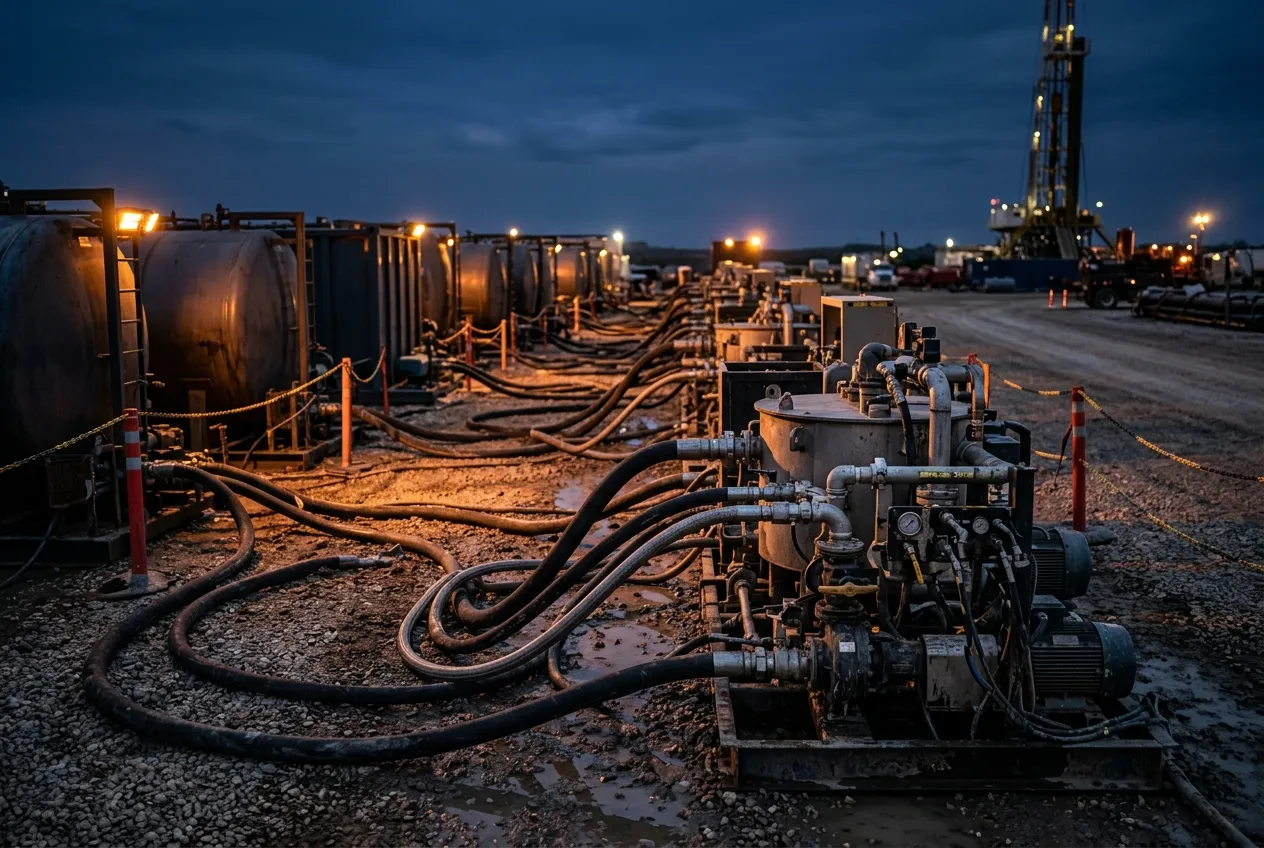
On a slickwater frac, the enemy is friction. Pumping water and sand down the casing at high rate generates enormous friction pressure, and that pressure costs horsepower, fuel, and the risk of exceeding pressure limits. In a mature waterflood, the enemy is a different one: the injected water races through the high-permeability streaks and leaves oil behind because it is too thin to push it. Polyacrylamide is the polymer the industry uses against both.
The short version: as a friction reducer, polyacrylamide added at low concentration to slickwater dramatically cuts the turbulent friction pressure of high-rate pumping, lowering required pump pressure and horsepower and letting more fluid and proppant go downhole per unit of energy. In enhanced oil recovery (EOR), a high-molecular-weight partially hydrolyzed polyacrylamide thickens the injected water so it sweeps the reservoir more evenly, improving the mobility ratio and pushing out oil that plain waterflooding bypasses. It is also used to viscosify and control fluid loss in drilling.
The problem: friction pressure on a slickwater frac
Slickwater fracturing pumps large volumes of low-viscosity fluid at high rate, and most of the surface pressure is simply friction in the pipe. Polyacrylamide (CAS 9003-05-8, PubChem), dosed at a fraction of a percent as a friction reducer, suppresses the turbulence in the flowing fluid, so the same pump rate needs far less pressure.
The practical payoff is lower horsepower and fuel, the ability to pump at higher rate within pressure limits, and more proppant placed. Friction reducers are usually anionic polyacrylamide delivered as a fast-inverting emulsion for rapid hydration on the fly.
The problem: poor sweep in a waterflood
When a reservoir is waterflooded, thin injected water has a high mobility compared with the oil, so it fingers through the easy paths and leaves oil in the rest of the rock. Adding a high-molecular-weight partially hydrolyzed polyacrylamide thickens the water, lowering its mobility and forcing it to push a broader front through the reservoir. That better mobility ratio improves sweep efficiency and recovers oil that ordinary waterflooding leaves behind, the core idea of polymer flooding in EOR.
Drilling and completion
Polyacrylamide also serves in drilling and completion fluids as a viscosifier, a shale-stabilizing additive, and a fluid-loss control agent, where its water-thickening and film-forming behavior helps carry cuttings and protect the formation. The grade and chemistry are matched to the fluid system and the reservoir conditions.
Grade and handling
Oilfield polyacrylamide is selected for very high molecular weight (for friction reduction and viscosity) and for the right degree of hydrolysis and salt and temperature tolerance, since reservoir brine and heat degrade the wrong polymer. Friction-reducer emulsions are built to invert and hydrate in seconds on the blender; EOR polymers are made down and matured with care. As with all polyacrylamide, solutions and spills are extremely slippery, and the make-down fundamentals are in polyacrylamide grades and make-down.
Buying polyacrylamide for oil & gas
See the Polyacrylamide Flocculant product page. Tell us your application, water and reservoir conditions, and dosing setup, and request samples to test friction reduction or viscosity on your own fluid. The charge-type basics are in anionic vs cationic vs nonionic polyacrylamide.
Frequently asked questions
What is a friction reducer in fracking?
A friction reducer is a polymer, usually anionic polyacrylamide, added at low concentration to slickwater fracturing fluid to suppress turbulent friction in the pipe. It lowers the pump pressure and horsepower needed for a given rate, so more fluid and proppant can be pumped efficiently.
How does polyacrylamide reduce friction pressure?
At low concentration it dampens the turbulent eddies in the flowing fluid, reducing the friction pressure of high-rate pumping. The effect is large for a tiny polymer dose, which is why slickwater fracs rely on it.
What is polymer flooding in EOR?
Polymer flooding adds a high-molecular-weight partially hydrolyzed polyacrylamide to injected water to thicken it, lowering its mobility so it sweeps the reservoir more evenly. The improved mobility ratio recovers oil that plain waterflooding bypasses.
Which polyacrylamide is used in oil and gas?
High-molecular-weight anionic grades dominate, delivered as fast-inverting emulsions for friction reduction and as high-purity high-MW polymers for EOR, selected for salt and temperature tolerance to survive reservoir conditions.
Can polyacrylamide be used in drilling fluids?
Yes, as a viscosifier, shale stabilizer, and fluid-loss control additive, where its water-thickening and film-forming behavior carries cuttings and protects the formation. The grade is matched to the fluid system.
Editorial note. This article is general technical guidance for oil and gas professionals. Application, grade, and dosing guidance is general and must be validated on your own fluid and reservoir conditions; the Certificate of Analysis governs the grade you buy. Polyacrylamide polymer has low toxicity per its SDS and is not classified as hazardous for transport; residual acrylamide monomer is a regulated concern, and produced and flowback fluids must be managed per applicable regulations. Spilled product and polymer solution are extremely slippery when wet. Always consult the current Safety Data Sheet (SDS) before handling. RawSource makes no warranty, express or implied, and assumes no liability for use of this information.
Search 1,300+ industrial chemicals by name or CAS, or send us your spec — we quote by the drum, tote, or container.
Browse the Chemical Index → Request a Quote