
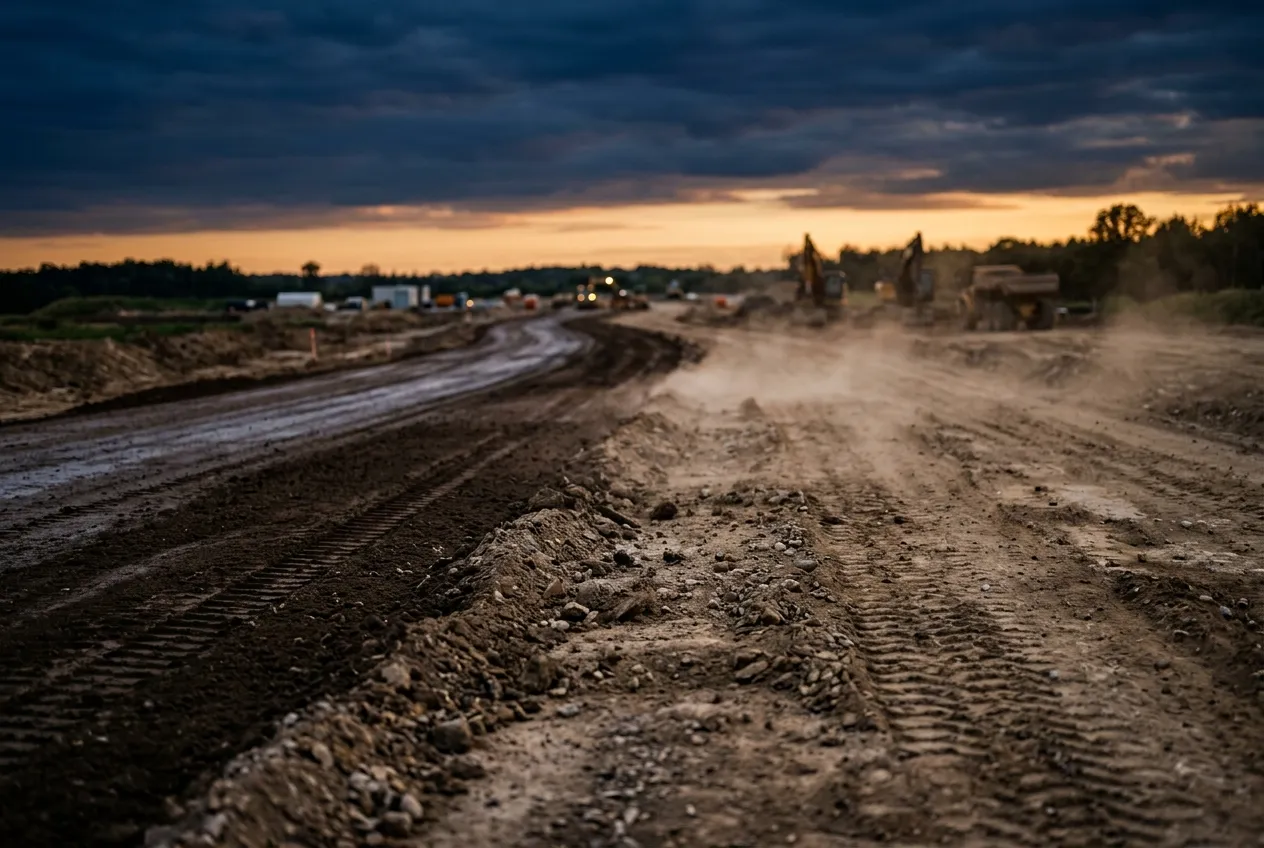
A haul road or unpaved site throws up a cloud of dust behind every truck, which is a nuisance, a visibility and health hazard, an air-permit problem, and a slow loss of the road surface. On a graded slope or a freshly worked field, the first hard rain carries the soil away in muddy runoff, eroding the site and fouling the drainage downstream. Both problems are the same loose soil refusing to stay put, and anionic polyacrylamide is one of the cheapest ways to bind it.
The short version: anionic polyacrylamide, applied in dilute solution to soil, binds the fine soil particles together and to each other, forming a thin, stable crust that holds the surface in place. As a dust suppressant it keeps fines from going airborne off unpaved roads and sites; as a soil erosion control it binds the surface so wind and especially water runoff carry away far less soil. It is dosed at low rates, has low toxicity per its SDS, and is widely used on construction sites, haul roads, slopes, and farmland.
The problem: fugitive dust off unpaved surfaces
Unpaved roads and disturbed sites shed fine particles that vehicles and wind lift into the air. Anionic polyacrylamide (CAS 9003-05-8, PubChem), sprayed as a dilute solution, bridges and binds those fine particles into the surface so they are held down instead of becoming airborne. The treated surface forms a light crust that resists traffic and wind, cutting the dust plume and the road-surface loss that comes with it, and reducing the watering frequency a road would otherwise need.
The problem: soil erosion and muddy runoff
When rain hits bare, worked soil, it detaches particles and washes them downhill as runoff, eroding the surface and sending sediment into drains and waterways. Polyacrylamide binds the soil aggregates and stabilizes the surface, so the soil holds together under rainfall and irrigation, the water infiltrates or runs clear instead of muddy, and far less soil is lost. It is used on construction-site slopes and stockpiles, on graded land, and in agriculture, where applying it to furrow-irrigation water markedly reduces sediment loss.
How it is applied
Polyacrylamide for dust and erosion is applied dilute and at low rates:
- Surface spray: a dilute polymer solution is sprayed onto the road, slope, or soil, where it binds the surface into a crust as it dries.
- In irrigation or runoff water: a small dose in furrow-irrigation or applied water stabilizes the soil it contacts and clarifies the runoff.
- Reapplication: the crust is renewed as traffic and weather wear it, far less often than plain watering.
The grade is an anionic, high-molecular-weight polyacrylamide, and make-down still matters, the polymer must be fully dissolved, as covered in polyacrylamide grades and make-down.
Selection and a safety note
Anionic polyacrylamide is the standard for soil and dust because soil minerals are negatively charged and the anionic polymer binds them without the concerns a cationic polymer can raise in soil and water. Use a grade with low residual acrylamide monomer, and follow local guidance for land and water-adjacent application; the polymer has low toxicity but the residual acrylamide monomer is the controlled component, and the charge-type basics are in anionic vs cationic vs nonionic polyacrylamide.
Buying polyacrylamide for dust and erosion control
See the Polyacrylamide Flocculant product page. Tell us your surface, soil, and application method, and request a sample to trial on your own site. Its closely related water and tailings use is in polyacrylamide in mining.
Frequently asked questions
How does polyacrylamide suppress dust?
Sprayed as a dilute solution on an unpaved road or site, anionic polyacrylamide binds the fine soil particles into the surface and forms a light crust, so they are held down instead of going airborne. It cuts the dust plume and reduces how often the surface must be watered.
Does polyacrylamide stop soil erosion?
Yes. It binds soil aggregates and stabilizes the surface so rainfall and irrigation detach and carry away far less soil, leaving runoff clearer. It is used on construction slopes, stockpiles, graded land, and in furrow-irrigated agriculture.
Which polyacrylamide is used for dust and erosion control?
Anionic, high-molecular-weight polyacrylamide, because soil minerals are negatively charged and bind well to the anionic polymer, which is also preferred over cationic for soil and water-adjacent use. Use a low-residual-monomer grade.
How is polyacrylamide applied for dust control?
As a dilute solution sprayed onto the surface, or dosed into applied or irrigation water. It binds the surface into a crust as it dries and is reapplied as traffic and weather wear it, far less often than plain watering.
Is polyacrylamide safe to use on soil and roads?
The polymer has low toxicity per its SDS; the controlled component is residual acrylamide monomer, so a low-residual grade is used and local guidance for land and water-adjacent application is followed. Confirm requirements for your site and jurisdiction.
Editorial note. This article is general technical guidance for construction, mining, and land-management professionals. Application-rate and method guidance is general and must be validated on your own site and soil, and follow local environmental guidance for land and water-adjacent use; the Certificate of Analysis governs the grade you buy. Polyacrylamide polymer has low toxicity per its SDS and is not classified as hazardous for transport, but residual acrylamide monomer is the regulated component, so use a low-residual-monomer grade. Spilled product and polymer solution are extremely slippery when wet. Always consult the current Safety Data Sheet (SDS) before handling. RawSource makes no warranty, express or implied, and assumes no liability for use of this information.
Search 1,300+ industrial chemicals by name or CAS, or send us your spec — we quote by the drum, tote, or container.
Browse the Chemical Index → Request a Quote