
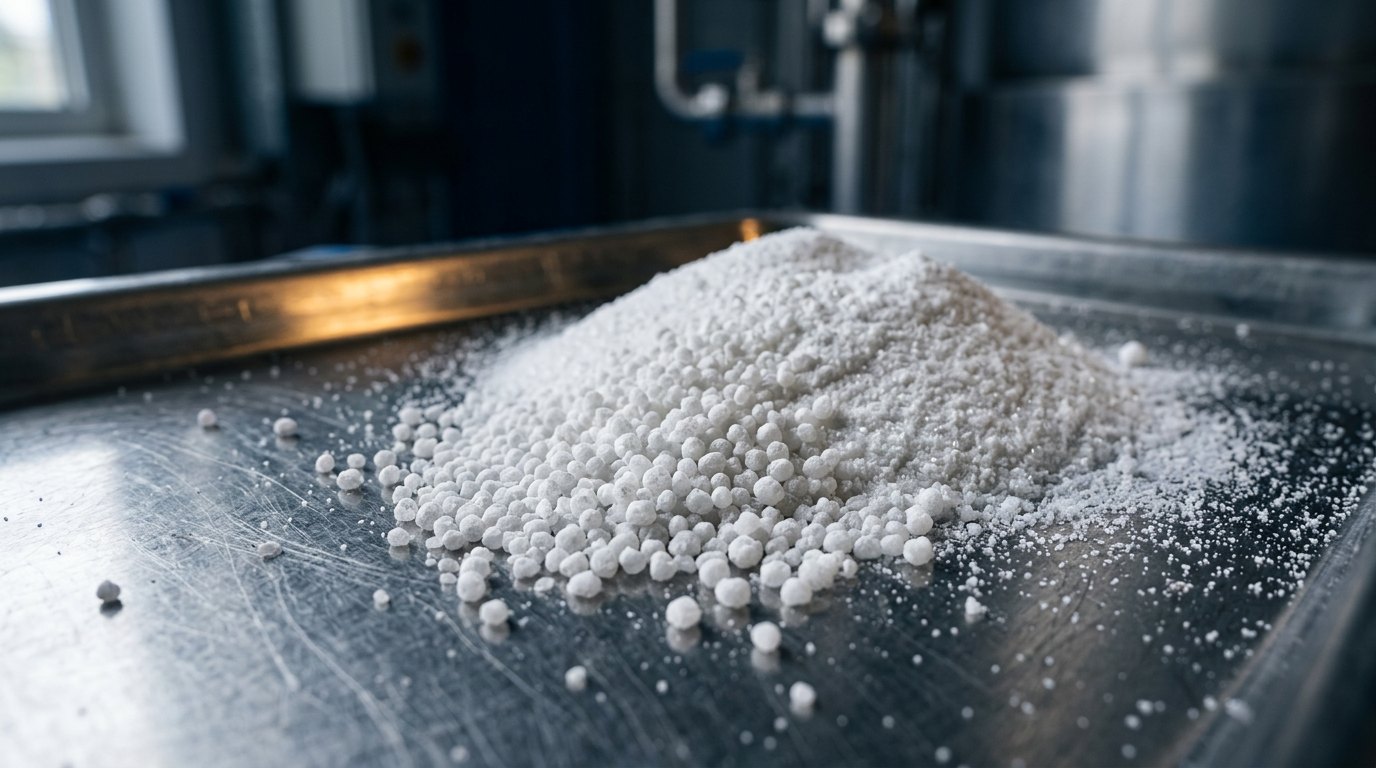
Two sodium tripolyphosphate (STPP) quotes, one at 57.9% P2O5 and one at 44.7%, can name the same salt: anhydrous and hexahydrate. Commercial grades also vary in hydrated share, so an unlabeled form can make the cheaper pound the dearer phosphorus. Before comparing phosphate suppliers, put four things on one line: salt, form, P2O5 on that form, and pH basis.
How do the phosphate salts compare on P2O5, pH and US food status?
P2O5 on PubChem’s anhydrous formulas spans 33.4% for tripotassium phosphate to 69.6% for sodium hexametaphosphate (SHMP). At 1% solution, sodium acid pyrophosphate (SAPP) reads pH 3.7-5.0 and trisodium phosphate (TSP) 11.5-12.5, while the EU specification allows SHMP 3.0 to 9.0. Every sodium and calcium salt has a 21 CFR Part 182 section; five tabled salts have none in either part.
Read P2O5 two ways. The calculated figure uses each salt’s anhydrous formula and PubChem molecular weights; a hydrate of the same salt carries less per pound. The specification range, with the basis it is stated on, and pH at 1% solution both come from Commission Regulation (EU) No 231/2012. US food status cites the 21 CFR section: Part 182 for substances generally recognized as safe (GRAS), Part 184 for the uses it affirms. Ammonium polyphosphate, a polymer with no single formula, cannot be put on this basis.
| Phosphate | Formula (PubChem, anhydrous) | P2O5 on the formula, % | P2O5, EU food specification (basis) | pH (basis) | US food status (21 CFR) |
|---|---|---|---|---|---|
| Monosodium Phosphate | H2NaO4P | 59.2 | 58.0–60.0% (anhydrous basis) | 4.1–5.0 (1%) | GRAS, 21 CFR 182.1778 |
| Disodium Phosphate | HNa2O4P | 50.0 | 49–51% (anhydrous basis) | 8.4–9.6 (1%) | GRAS, 21 CFR 182.6290 |
| Trisodium Phosphate | Na3O4P | 43.3 | 40.5–43.5% (anhydrous basis) | 11.5–12.5 (1%) | GRAS, 21 CFR 182.1778 |
| Sodium Acid Pyrophosphate | H2Na2O7P2 | 64.0 | 63.0–64.5% | 3.7–5.0 (1%) | GRAS, 21 CFR 182.1087 |
| Tetrasodium Pyrophosphate | Na4O7P2 | 53.4 | 52.5–54.0% | 9.8–10.8 (1%) | GRAS, 21 CFR 182.6789 |
| Sodium Tripolyphosphate (STPP) | Na5O10P3 | 57.9 | 56–59% anhydrous; 43–45% hexahydrate | 9.1–10.2 (1%) | GRAS, 21 CFR 182.1810 |
| Sodium Hexametaphosphate (SHMP) | Na6O18P6 | 69.6 | 60–71% (ignited basis) | 3.0–9.0 (1%) | GRAS, 21 CFR 182.6760 |
| Monopotassium Phosphate (MKP) | H2KO4P | 52.2 | 51.0–53.0% (anhydrous basis) | 4.2–4.8 (1%) | No Part 182 or 184 section |
| Dipotassium Phosphate | HK2O4P | 40.7 | 40.3–41.5% (anhydrous basis) | 8.7–9.4 (1%) | GRAS, 21 CFR 182.6285 |
| Tripotassium Phosphate | K3O4P | 33.4 | 30.5–34.0% (ignited basis) | 11.5–12.3 (1%) | No Part 182 or 184 section |
| Tetrapotassium Pyrophosphate | K4O7P2 | 43.0 | 42.0–43.7% (anhydrous basis) | 10.0–10.8 (1%) | No Part 182 or 184 section |
| Potassium Tripolyphosphate | K5O10P3 | 47.5 | 46.5–48% | 9.2–10.5 (1%) | No Part 182 or 184 section |
| Monoammonium Phosphate | H6NO4P | 61.7 | No EU food additive specification | On request | Affirmed GRAS for named uses, 21 CFR 184.1141a |
| Diammonium Phosphate | H9N2O4P | 53.7 | No EU food additive specification | On request | Affirmed GRAS for named uses, 21 CFR 184.1141b |
| Urea Phosphate | CH7N2O5P | 44.9 | No EU food additive specification | On request | No Part 182 or 184 section |
| Monocalcium Phosphate | CaH4O8P2 | 60.6 | 55.5–61.1% (anhydrous basis) | No pH criterion (EU) | GRAS, 21 CFR 182.1217 |
| Dicalcium Phosphate | CaHO4P | 52.2 | 50.0–52.5% (anhydrous basis) | No pH criterion (EU) | GRAS, 21 CFR 182.1217 |
| Tricalcium Phosphate | Ca3O8P2 | 45.8 | 38.5–48.0% (anhydrous basis) | No pH criterion (EU) | GRAS, 21 CFR 182.1217 |
P2O5 per delivered pound is the fair unit only where phosphorus itself is the job, as in fertilizer, or where a limit meters it, as the EU consumer detergent caps do. There, anhydrous TSP delivers 0.75 times the phosphorus per pound of anhydrous STPP, so it matches STPP on phosphorus cost only at 0.75 times the STPP price.
In a cleaning formula the salts do different jobs: HERA describes STPP as a builder that sequesters water hardness, while TSP’s pH of 11.5-12.5 makes it an alkalinity source. Compare on the job first, then on P2O5 within one salt and form.
TSP also shows why the form must be named: Regulation (EU) No 231/2012 says it crystallises anhydrous and with 1/2, 1, 6, 8 or 12 molecules of water, and specifies 40.5-43.5% P2O5 on the anhydrous basis, so a TSP quote must name the hydrate.
Sodium phosphates and polyphosphates: STPP, SHMP, TSP, TSPP and SAPP
An STPP purchase order needs more than the name. HERA (Human and Environmental Risk Assessment on ingredients of household cleaning products) describes STPP mainly as a detergent builder that sequesters water hardness, and lists its other uses as food, animal feed, industrial cleaning and ceramics. Two lots sold under that one name can still differ.
HERA’s targeted risk assessment, a draft dated June 2003, explains why. Anhydrous STPP exists as Phase 1 and Phase 2, in proportions set by calcination temperature, and commercial grades range from 0.45 to 1.15 g/cm3 in bulk density. Name the phase split and bulk density on the purchase order.
Form matters as much. Regulation (EU) No 231/2012 specifies STPP at 56-59% P2O5 for the anhydrous salt and 43-45% for the hexahydrate. HERA names the hexahydrate as the stable form; it decomposes at 85 °C, while the anhydrous salt goes to pyrophosphate around 620 °C.
HERA’s typical analysis is 96% STPP with 4% pyro-, ortho- and metaphosphate together, so require the Certificate of Analysis (CoA) to report the STPP assay and the form. HERA gives solubility as 145 g/l at 25 °C without naming the form; ask which form any solubility figure describes.
Choose the sodium salt by the pH your formula needs: SAPP and monosodium phosphate at the acid end, TSP at the alkaline end, and disodium phosphate, STPP and tetrasodium pyrophosphate (TSPP) between. TSP’s alkalinity barely moves with dilution: the Hazardous Substances Data Bank (HSDB) gives it pH 11.5 at 0.1% and 11.9 at 1.0%.
In consumer detergents, Annex VIa of Regulation (EC) No 648/2004, inserted by Regulation (EU) No 259/2012, bars laundry products at or above 0.5 g phosphorus per standard dose from 30 June 2013, and automatic dishwasher products at or above 0.3 g from 1 January 2017. STPP is 25.3% phosphorus by weight, so the laundry cap equals 1.98 g of anhydrous STPP per dose.
For US food use, 21 CFR Part 182 lists sodium phosphate (mono-, di- and tribasic) at 182.1778, sodium acid pyrophosphate at 182.1087, TSPP at 182.6789, SHMP at 182.6760, and STPP at 182.1810 and 182.6810.
Sodium phosphate product pages (7)
Potassium phosphates: TKPP, TKP, MKP and DKP
Solubility is the case for potassium in a liquid concentrate. Tetrapotassium pyrophosphate (TKPP) dissolves 187 g/100 ml at 25 °C; tetrasodium pyrophosphate manages 6.7 g/100 ml, so TKPP dissolves about 28 times as much, on figures from two compilations (ICSC and HSDB) that do not name the hydrate.
That solubility costs phosphorus. TKPP carries 43.0% P2O5 on its anhydrous formula against 53.4% for TSPP, and tripotassium phosphate (TKP) 33.4% against 43.3% for TSP. Compare potassium quotes on P2O5, then decide whether the liquid format justifies the lower P2O5 per pound. pH at 1% runs from monopotassium phosphate (MKP) at 4.2-4.8 through dipotassium phosphate (DKP) at 8.7-9.4, potassium tripolyphosphate at 9.2-10.5 and TKPP at 10.0-10.8, to tripotassium phosphate at 11.5-12.3.
Food status splits the class. Dipotassium phosphate is a GRAS sequestrant under 21 CFR 182.6285. Parts 182 and 184 (revised as of April 1, 2025) have no section for MKP, TKP, TKPP or potassium tripolyphosphate.
Potassium phosphate product pages (5)
Ammonium phosphates: MAP, DAP and ammonium polyphosphate
A fertilizer grade is not an assay. University of Minnesota Extension gives monoammonium phosphate (MAP) at 11% nitrogen and 52% P2O5 and diammonium phosphate (DAP) at 18% nitrogen and 46% P2O5; on their anhydrous formulas they calculate to 61.7% and 53.7%. A technical buyer specifies assay and form. pH separates them too: HSDB gives MAP 4.2 at 0.2 molar and DAP about 8, with no concentration stated.
Ammonium polyphosphate carries CAS 68333-79-9 in the catalog but has no single formula, so the CAS number alone does not define the product: ask for nitrogen, P2O5 and physical form on the lot. The liquid most buyers meet is the 10% nitrogen, 34% P2O5 product, made by ammoniating superphosphoric acid and holding both ortho- and polyphosphate; University of Minnesota Extension calls it the most common liquid nitrogen-phosphorus product. Whether a lot is that liquid or a solid, name the physical form on the order.
For food, 21 CFR 184.1141a affirms MAP as GRAS as a dough strengthener and pH control agent; 184.1141b affirms DAP for those uses plus firming, leavening and processing aid. The affirmation covers the named uses only, so match the CFR use to your process before you qualify a lot.
Urea phosphate shares the group but is not an ammonium salt. It carries 44.9% P2O5 on its anhydrous formula, has no section in 21 CFR Part 182 or 184, and has no EU food additive specification.
Ammonium and urea phosphate product pages (4)
Calcium phosphates: MCP, DCP and TCP
Hydrates move the calcium numbers. On the anhydrous formula, monocalcium phosphate (MCP) carries 60.6% P2O5, dicalcium phosphate (DCP) 52.2% and tricalcium phosphate (TCP) 45.8%; DCP dihydrate carries 41.2% and MCP monohydrate 56.3%. Regulation (EU) No 231/2012 covers both forms of DCP and sets 50.0-52.5% P2O5 on the anhydrous basis, so name the form on the quote.
For US food use, calcium phosphate (mono-, di- and tribasic) is GRAS for multiple purposes under 21 CFR 182.1217, and MCP also as a sequestrant under 182.6215. The regulation sets no pH criterion for any of the three, so ask for pH with its basis along with form and assay. Buyers weighing calcium against sodium acid salts can compare them under leavening acids and baking-powder systems.
Calcium phosphate product pages (3)
Industries served
Food is the one industry here where the 21 CFR column sets the shortlist before price does; in cleaning and agriculture, the job and the form come first.
Documents and quotes
Put these lines on every phosphate request for quote:
- The form (anhydrous or a named hydrate) and P2O5 on that form, or the basis of the assay.
- For STPP, the Phase 1/Phase 2 split and bulk density; for SHMP, the Na2O/P2O5 ratio; for ammonium polyphosphate, nitrogen and P2O5 on the lot.
- A Certificate of Analysis (CoA) for each lot that reports P2O5, or the assay, on the form delivered, so it can be checked against line 1.
- For food use, the specification the lot must meet, and a check of the CoA against it.
Send the request from the salt’s product page, which carries the quote form.
For a formulation question, use technical support. Products on this page are for industrial formulation and manufacturing use, not for retail or consumer sale.
Related phosphate pages
| Page | What it covers |
|---|---|
| Leavening acids and baking-powder systems | SAPP and calcium phosphates as leavening acids |
| Phosphates for water retention in meat, poultry and seafood | Phosphate blends and yield |
| SHMP for hard-water haze in beverages | Sequestering hardness in brewing and beverage water |
| Phosphate buffer salts in dairy and processed foods | pH control with citrate and phosphate salts |
| Water-soluble fertigation salts | MKP, MAP and urea phosphate in fertigation |
| Phosphate conversion coating chemicals | Metal pretreatment |
| Chelating agents and sequestrants guide | Where polyphosphates sit among sequestrants |
| Phosphonate scale inhibitor guide | Phosphonates (HEDP, ATMP, DTPMP), which this hub does not cover |
Frequently asked questions
What is the difference between STPP and SHMP?
STPP and SHMP are both GRAS sequestrants, under 21 CFR 182.6810 and 182.6760, but SHMP is not one compound with one phosphorus content. Its 69.6% P2O5 is calculated on PubChem’s Na6O18P6 record, while the EU specification lets a lot sit anywhere from 60% to 71% on the ignited basis.
Regulation (EU) No 231/2012, entry E 452 (i), defines soluble sodium polyphosphate as amorphous linear chains of metaphosphate units; its synonyms include sodium hexametaphosphate and Graham’s salt. Lots are usually identified by their Na2O/P2O5 ratio or P2O5 content. STPP is a single defined triphosphate, and HERA lists pH buffering among its builder functions. Never buy SHMP on the name: quote it on stated P2O5 and Na2O/P2O5 ratio. Where the formula needs a predictable pH, specify STPP: its specification holds 9.1-10.2 at 1% against SHMP’s 3.0-9.0.
Which phosphates are GRAS for food in the US?
21 CFR Part 182 lists the sodium phosphates, sodium acid pyrophosphate, calcium phosphate, STPP, SHMP, TSPP and dipotassium phosphate as GRAS under good manufacturing practice. Part 184 affirms MAP and DAP only for the uses it names.
A listing covers the substance, never a particular lot. 21 CFR 184.1141a, for example, ties MAP to the Food Chemicals Codex specification. Name the specification on the purchase order and check the Certificate of Analysis (CoA) against it before release. Phosphoric acid itself sits at 182.1073. These citations are to the edition revised as of April 1, 2025; cite the edition you rely on.
Why choose TKPP over TSPP in a liquid formula?
Choose TKPP when the formula needs pyrophosphate in solution at high strength. At 25 °C it dissolves about 28 times as much in water as TSPP does.
Food status does not travel with the swap. TSPP is a GRAS sequestrant under 21 CFR 182.6789, while Parts 182 and 184 have no section for TKPP, so a food formula that moves to potassium for solubility reopens the regulatory question. In a concentrate, solubility decides before price does. In a powder, where it does not decide, compare the two on cost per unit of P2O5.
Is fertilizer-grade MAP the same as technical MAP?
Fertilizer MAP and technical MAP are different purchases. Fertilizer MAP is graded at 11% nitrogen and 52% P2O5, while NH4H2PO4 calculates to 61.7% P2O5 anhydrous, so a technical or food buyer specifies assay, not a fertilizer grade.
Fertilizer MAP and DAP are made by ammoniating phosphoric acid that has not been heated, and the ratio decides which salt results; their phosphorus is in the orthophosphate form. Regulation (EU) No 231/2012 carries no specification for MAP or DAP, so there is no EU food additive monograph to fall back on. Write the assay, its basis and the specification the lot must meet into the purchase order yourself.
Do the EU phosphate limits apply to industrial detergents?
The EU phosphate limits do not apply to industrial and institutional detergents. Recital 4 of Regulation (EU) No 259/2012 says suitable technically and economically feasible alternatives to phosphates in those detergents were not yet available.
The consumer caps read on total phosphorus, so pyrophosphate, orthophosphate and SHMP count alongside STPP. The 1.98 g of anhydrous STPP per laundry dose is the threshold only when STPP is the sole phosphorus source. These limits are Annex VIa as inserted in 2012; before you set a phosphate level, check the current consolidated text and the destination market’s national rules, especially if an institutional product could reach consumer shelves.
Sources & methodology
Figures are RawSource sourcing data unless attributed to a named source. Regulatory citations are current as of publication. Chemical identities verified by CAS number against the RawSource catalog.
Search 1,300+ industrial chemicals by name or CAS, or send us your spec — we quote by the drum, tote, or container.
Browse the Chemical Index → Request a Quote