
A surfactant supplier’s quote for sodium laureth sulfate can carry the same CAS number as the next quote and still describe a different product: one at 27-28% activity, another at 59-61% solids. The price per pound means little until the content basis, the pH basis and the pack sit on the same line of both quotes. The grade table below puts those three on one line for each grade.
Which surfactant grades are listed here?
Seventeen bulk surfactant grades are listed by RS code: six anionic chemistries (sulfates, ether sulfates, a sulfosuccinate and a soap), three amphoteric (a betaine, a sultaine and an amine oxide), a C9-11 alcohol ethoxylate and cocamide DEA. Each row gives INCI, stated content, pH with its basis, the technical data sheet (TDS) and a quote link, plus CAS and packaging wherever the TDS states them.
| RS code | Chemistry | CAS | INCI | Active or solids (as stated) | pH (basis) | Form | Packaging | Documents |
|---|---|---|---|---|---|---|---|---|
RS-ALES_60 |
Ammonium Laureth Sulfate | 32612-48-9 |
Ammonium Laureth Sulfate |
58–60% | 6.0–8.0 (10%) | Liquid | Drum · Tote · Bulk | TDS · Request quote |
RS-ALS_30 |
Ammonium Lauryl Sulfate | 2235-54-3 |
Ammonium Lauryl Sulfate |
27–29% solids | 6.0–7.0 (10%) | Liquid | Drum · Tote · Bulk | TDS · Request quote |
RS-DLSS_40 |
Disodium Laureth Sulfosuccinate | 39354-45-5 |
Disodium Laureth Sulfosuccinate |
38–40% solids | 6.0–7.0 (10%) | Liquid | Drum · Tote · Bulk | TDS · Request quote |
RS-KCOCO_40 |
Potassium Cocoate | 61789-30-8 |
Potassium Cocoate |
38–40% solids | 10.5–11.0 (5%) | Clear amber liquid | Drum · Tote · Bulk | TDS · Request quote |
RS-SLES_30 |
Sodium Laureth Sulfate | 68891-38-3 |
Sodium Laureth Sulfate |
27–28% | 6.5–8.5 (10%) | Liquid | Drum · Tote · Bulk | TDS · Request quote |
RS-SLES_56 |
Sodium Laureth Sulfate | 68891-38-3 |
Sodium Laureth Sulfate |
54–57% | 7.0–9.0 (10%) | Viscous liquid | Drum · Tote · Bulk | TDS · Request quote |
RS-SLES_60 |
Sodium Laureth Sulfate | 68891-38-3 |
Sodium Laureth Sulfate |
59–61% solids | 7.00–9.00 (10%) | Clear, light amber liquid | Drum · Tote · Bulk | TDS · Request quote |
RS-SLS_30 |
Sodium Lauryl Sulfate | 151-21-3 |
Sodium Lauryl Sulfate |
28–30% solids | 7–9 (10%) | Clear colorless to light yellow liquid | Drum · Tote · Bulk | TDS · Request quote |
RS-CAPB_30-H |
Cocamidopropyl Betaine | 61789-40-0 |
Cocamidopropyl Betaine |
28.8–31.8% | 6.00–7.00 (100%) | Clear pale yellow liquid | Drum · Tote · Bulk | TDS · Request quote |
RS-CAPB_30-P |
Cocamidopropyl Betaine | 61789-40-0 |
Cocamidopropyl Betaine |
28.8–31.8% | 6–7 (100%) | Light yellow, clear liquid | Drum · Tote · Bulk | TDS · Request quote |
RS-CAPB_45 |
Cocamidopropyl Betaine | 61789-40-0 |
Cocamidopropyl Betaine |
44–47% solids | 4.50–5.50 (100%) | Liquid | Drum · Tote · Bulk | TDS · Request quote |
RS-CAHS_45 |
Cocamidopropyl Hydroxysultaine | 39660-17-8 |
Cocamidopropyl Hydroxysultaine |
42.00–45.00% | 7.0–9.0 (as is) | Clear pale yellow liquid | See TDS | TDS · Request quote |
RS-CAHS_50 |
Cocamidopropyl Hydroxysultaine | 39660-17-8 |
Cocamidopropyl Hydroxysultaine |
48–51% solids | 6–7 (100%) | Liquid | Drum · Tote · Bulk | TDS · Request quote |
RS-LAO_30 |
Lauramine Oxide | 1643-20-5 |
Lauramine Oxide |
29–31% amine oxide | 7.0–9.0 (10%) | Clear colorless liquid | Drum · Tote · Bulk | TDS · Request quote |
RS-AE_91-6 |
Alcohols, C9-11 Ethoxylated | Not listed | C9-11 Pareth-6 |
100% | 5.5–7.5 (1%) | Clear to slightly hazy liquid | Drum · Tote · Bulk | TDS · Request quote |
RS-CDEA_11 |
Cocamide DEA | 68603-42-9 |
Cocamide DEA |
99% minimum solids | 9.0–11.0 (1%) | Liquid | Drum · Tote · Bulk | TDS · Request quote |
RS-CDEA_21 |
Cocamide DEA | 68603-42-9 |
Cocamide DEA |
99% minimum solids | 9.0–11.0 (1%) | Liquid | Drum · Tote · Bulk | TDS · Request quote |
Typical values from each grade’s TDS; the lot certificate of analysis (COA) governs. Drum = 55-gallon drum; tote = 275-gallon IBC tote. “Request quote” opens the product page’s quote form for that grade.
Anionic surfactant supplier: sulfates, ether sulfates, sulfosuccinates and soap
Sodium laureth sulfate (SLES, CAS 68891-38-3) is listed in three grades that share the CAS number and differ in what fills the drum: RS-SLES_30 at 27-28% activity, RS-SLES_56 at 54-57% activity and RS-SLES_60 at 59-61% solids.
The RS-SLES_60 solids, measured at 160 °C, include unsulfated matter (0-3%) and sodium sulfate (0-0.5%), so its activity can sit a few points below the solids figure. The sheet also lists 13-15% free alcohol, which that test drives off; ask which alcohol it is (SDS section 3), its flash point and VOC basis, and the activity, before you compare it with the other two.
| Grade | Stated content (TDS) | Free alcohol (TDS) | pH, 10% solution | Form | lb of product per lb of stated content | US DOT transport (SDS section 14) |
|---|---|---|---|---|---|---|
RS-SLES_30 |
27–28% | Not listed | 6.5–8.5 | Liquid | 3.6 (activity) | Not regulated |
RS-SLES_56 |
54–57% | Not listed | 7.0–9.0 | Viscous liquid | 1.8 (activity) | Not regulated |
RS-SLES_60 |
59–61% solids | 13–15% | 7.00–9.00 | Clear, light amber liquid | 1.7 (solids) | Not regulated |
Water is freight. At the midpoint of each stated range, 1 lb of stated content arrives in about 3.6 lb of RS-SLES_30 and 1.8 lb of RS-SLES_56 (activity), and in about 1.7 lb of RS-SLES_60 (solids): 1 ÷ 0.275, 1 ÷ 0.555 and 1 ÷ 0.60. Price each grade per pound of active, delivered, once the solids grade has given you its activity.
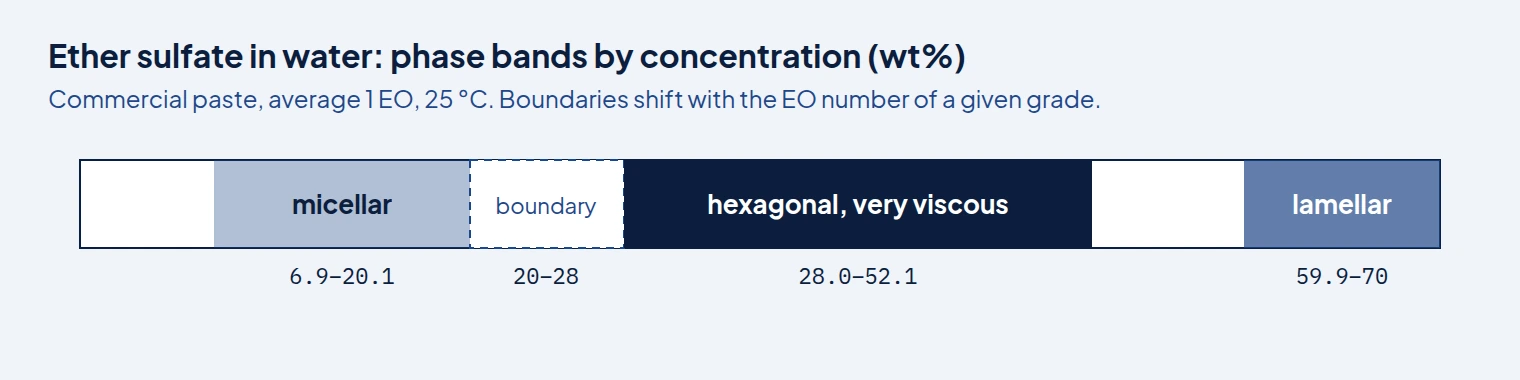
Concentrates also change the dilution step. In a published phase study of a commercial ether sulfate paste (average 1 EO, 25 °C), solutions were micellar at 6.9-20.1 wt%, hexagonal and very viscous at 28.0-52.1 wt%, and lamellar at 59.9-70 wt%; a 58.6 wt% sample was too viscous to measure at low shear (phase study, White Rose eprint).
The boundaries move with the EO number, so the study shows the shape of the problem for a given grade rather than its exact bands. Without a stirred make-up tank, the 27-28% grade costs more in freight and less in handling.
On the purchase order for SLES, name the content basis and its test method, the pH and the dilution it is measured at (10% on these sheets), and, for personal-care use, a 1,4-dioxane limit. Dioxane forms as a by-product when ethoxylates are sulfated: AICIS notes trace amounts in commercial ether sulfates, and HERA’s 2003 industry report (the Human and Environmental Risk Assessment programme for household cleaning ingredients) put in-plant control at typically 30-200 ppm on actives.
Ether sulfates hydrolyse under acid conditions and are sold above pH 7, according to US patent 9,109,152 (2015); the three SLES sheets list 6.5-8.5 to 7.0-9.0 in 10% solution.
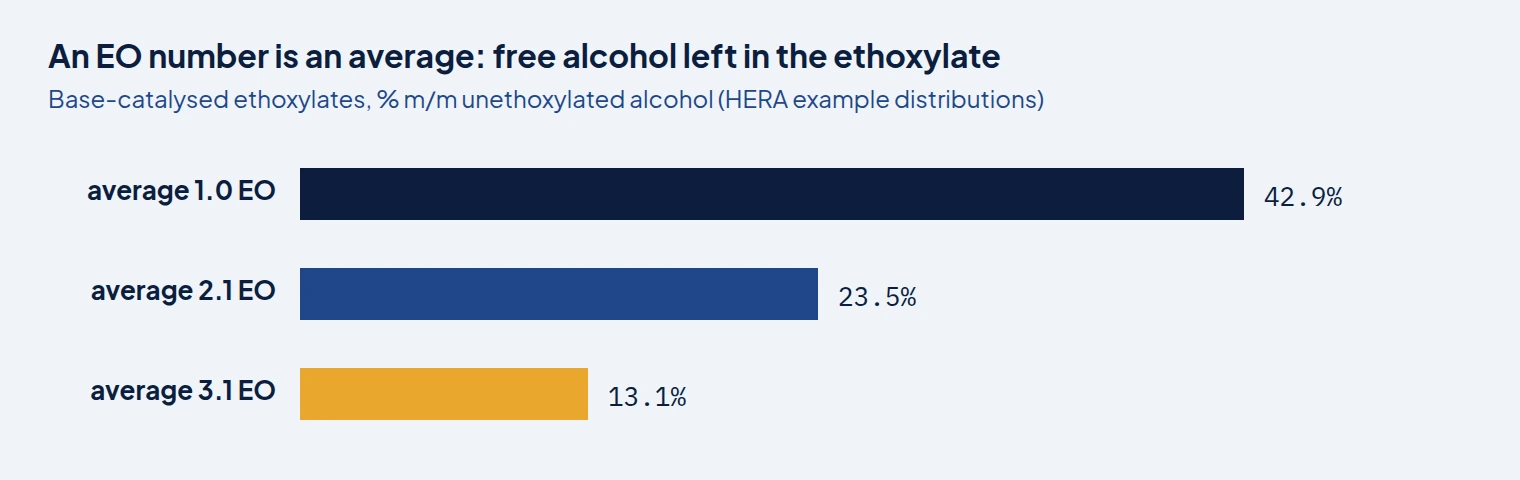
An ether sulfate inherits the distribution of the ethoxylate it was made from. HERA’s example distributions for base-catalysed ethoxylates show 42.9% unethoxylated alcohol remaining at an average of 1.0 EO, 23.5% at 2.1 EO and 13.1% at 3.1 EO, and HERA notes that AES made from them carries a comparable amount of alcohol sulfate. Ask for the EO average on the COA when the ratio of ether sulfate to alkyl sulfate matters to your formula.
For US regulatory status, CAS 68891-38-3 is listed as ACTIVE on the EPA TSCA Inventory (July 2026 file) with two EPA flags: FRI, a polymeric substance whose Inventory name covers the polymer made with any free-radical initiator, and XU, exempt from reporting under the Chemical Data Reporting rule (40 CFR 711).
Sodium lauryl sulfate (SLS, RS-SLS_30, PubChem CID 3423265) is the sulfate made without ethoxylation, at 28-30% solids with unsulfated matter at 1.5% maximum and sodium chloride at 0.5% maximum. The ammonium salts list lower pH ranges in 10% solution: 6.0-7.0 for ammonium lauryl sulfate (ALS, RS-ALS_30, 27-29% solids, viscosity 3,000 cps maximum) and 6.0-8.0 for ammonium laureth sulfate (ALES, RS-ALES_60, 58-60% activity).
ALES is the one anionic grade here regulated for US DOT transport, so take its shipping description from the SDS when you plan freight. Disodium laureth sulfosuccinate (DLSS, RS-DLSS_40) lists 38-40% solids and a viscosity of 0-200 cPs; put both on the PO if your mixing depends on it. Potassium cocoate (RS-KCOCO_40) is a soap at pH 10.5-11.0 in 5% solution, the most alkaline of the anionic grades, so specify the pH basis with the solids.
SLS, ALS, DLSS and potassium cocoate are all specified by solids; ask for activity before you set any of them against an activity-based quote.
Anionic surfactant product pages (41)
Amphoteric surfactant supplier: betaines, sultaines and amine oxides
Cocamidopropyl betaine (CAPB, CAS 61789-40-0) is sold on activity. The CIR safety assessment defines cosmetic-grade activity as what remains once water (62-66%) and sodium chloride (4.6-5.6%) are accounted for, with 30% the typical raw-material activity. The two 30% grades here list 28.8-31.8% activity and 3.7-5.2% sodium chloride; RS-CAPB_45 is specified by solids instead, at 44-47% with salt up to 7.3%.
| Grade | Activity | Solids / non-volatile | Sodium chloride | pH (basis) | Color |
|---|---|---|---|---|---|
RS-CAPB_30-H |
28.8–31.8% | 34.00–37.00% | 3.7–5.2% | 6.00–7.00 (100%) | < 1.5 |
RS-CAPB_30-P |
28.8–31.8 | Not stated | 3.7–5.2 | 6–7 (100%) | Not stated |
RS-CAPB_45 |
Not stated | 44–47% | 7.3% maximum | 4.50–5.50 (100%) | < 2 |
Solids and activity are different numbers. On RS-CAPB_30-H, non-volatile content runs 34.00-37.00% against 28.8-31.8% activity, and the gap is mostly salt. CIR also notes that grades above 30% may contain solvents such as propylene glycol. Compare the 45 grade with a 30% grade on activity and salt, and ask each quote to state both.
For personal-care formulations, write impurity limits into the specification. CIR lists residual amidoamine at 0.3-3.0% and DMAPA at 0.0003-0.02% in commercial CAPB, varying by manufacturer, and identifies both as known sensitizers. RS-CAPB_30-P lists free amine at 0-0.5% on its TDS; ask for amidoamine and DMAPA on the COA as well.
The same basis question applies to cocamidopropyl hydroxysultaine (CAHS). RS-CAHS_45 lists 42.00-45.00% active content with 49.00-51.00% non-volatile content and 5.5-7.0% sodium chloride; RS-CAHS_50 lists 48-51% solids with 6-7% sodium chloride and no activity figure. On solids the two are close, so ask RS-CAHS_50 for its activity before you choose. Lauramine oxide (LAO, RS-LAO_30, PubChem CID 15433) lists 29-31% amine oxide, free amine at 1.0% maximum and residual peroxide at 0.25% maximum; carry those two maxima onto the PO.
A betaine’s charge depends on pH only at the acid end: HERA describes a cationic character that dominates at very low pH and no anionic behaviour in alkaline media, unlike true amphoterics. If the formula is strongly acidic, give its pH when you ask for compatibility data. CAS 61789-40-0 is ACTIVE on the TSCA Inventory with no EPA flag.
Amphoteric surfactant product pages (12)
Nonionic surfactant supplier: alcohol ethoxylates, polysorbates, sorbitan esters and glucosides
The graded nonionic is a C9-11 alcohol ethoxylate, INCI C9-11 Pareth-6 (RS-AE_91-6), at 100% active with a cloud point of 47-58 °C, a hydroxyl number of 116-139 mg KOH/g and moisture at 0.3% maximum. When you replace one ethoxylate with another, match the hydroxyl number and the cloud point, and confirm the cloud-point test method, since both move with the EO average.
Any ethoxylate’s EO number is the average of a distribution, so ask for the EO average and the free-alcohol content on the COA of any nonionic grade. The product pages below also cover polysorbates 20 to 85, sorbitan esters and alkyl glucosides.
Nonionic surfactant product pages (50)
Alkanolamides: cocamide DEA for industrial cleaning
Cocamide DEA (CDEA) is listed in two grades for institutional and industrial cleaning formulations, both at 99% minimum solids, moisture at 1% maximum and pH 9.0-11.0 in 1% solution. The difference is free amine (as DEA): 8% maximum for RS-CDEA_11 and 28% maximum for RS-CDEA_21. The TDS gives no other difference between the two, so choose on the free-amine maximum your formula and its labelling allow, and state that maximum on the purchase order. Both grades are regulated for US DOT transport.
Alkanolamide product pages (5)
| Product page |
|---|
| Cocamide DEA (graded above) |
| Lauramide DEA |
| Lauramide MEA |
| Stearamide MEA |
| Lauramide DEA and Propylene Glycol |
Industries served
The grade records carry four industry tags: household and industrial cleaning, beauty and personal care, industrial manufacturing and textiles. The table links each industry page, its surfactant family pages and the problem pages that list one of the graded chemistries.
Packaging, documents and quotes
For wholesale and bulk orders, standard packaging on these TDS sheets is 55-gallon drums, 275-gallon totes and bulk; RS-CAHS_45 states no standard pack, so name the pack you need in the request. Grades regulated for US DOT transport: RS-ALES_60, RS-CAHS_45, RS-CAHS_50, RS-LAO_30, RS-CDEA_11, RS-CDEA_21; the rest ship as not regulated, per section 14 of the SDS.
The TDS for each grade is linked in the grade table and gives typical values. The safety data sheet (SDS) and a certificate of analysis (COA) for the lot are available on request; the COA governs where it differs from the typical values. Supplied for industrial formulation and manufacturing use; not for retail or consumer sale.
Send the RS code, the quantity and pack, and the delivery point, and we will quote it. For a formulation or specification question, contact technical support.
Related surfactant pages
| Page | What it covers |
|---|---|
| Anionic surfactants catalog | Every anionic product in the catalog |
| Amphoteric surfactants catalog | Every amphoteric product in the catalog |
| Nonionic surfactants catalog | Every nonionic product in the catalog |
| Cationic surfactants and quats catalog | Quats and cationic surfactants |
| Surfactant selection guide for home and industrial cleaning | Which surfactant class for each cleaning job |
| Alcohol ethoxylates guide | Alcohol ethoxylate chemistry and selection |
| HLB system and emulsifier selection | Choosing an emulsifier by required HLB |
| Alkyl polyglucoside ingredient hub | Alkyl polyglucoside surfactants |
| Surfactant performance in hard-surface cleaning | Surfactant performance on hard surfaces |
| Sulfate-free and mild glucoside surfactant bases | Sulfate-free cleansing bases |
Frequently asked questions
What is the difference between sodium laureth sulfate and sodium lauryl sulfate?
Is a 45% cocamidopropyl betaine stronger than a 30% grade?
What is the difference between CAPB and CDEA?
How much 1,4-dioxane is in sodium laureth sulfate?
Are SLES and CAPB on the TSCA Inventory?
Which of these surfactant grades are sulfate-free?
Sources & methodology
Figures are RawSource sourcing data unless attributed to a named source. Regulatory citations are current as of publication. Chemical identities verified by CAS number against the RawSource catalog.
Search 1,300+ industrial chemicals by name or CAS, or send us your spec — we quote by the drum, tote, or container.
Browse the Chemical Index → Request a Quote