
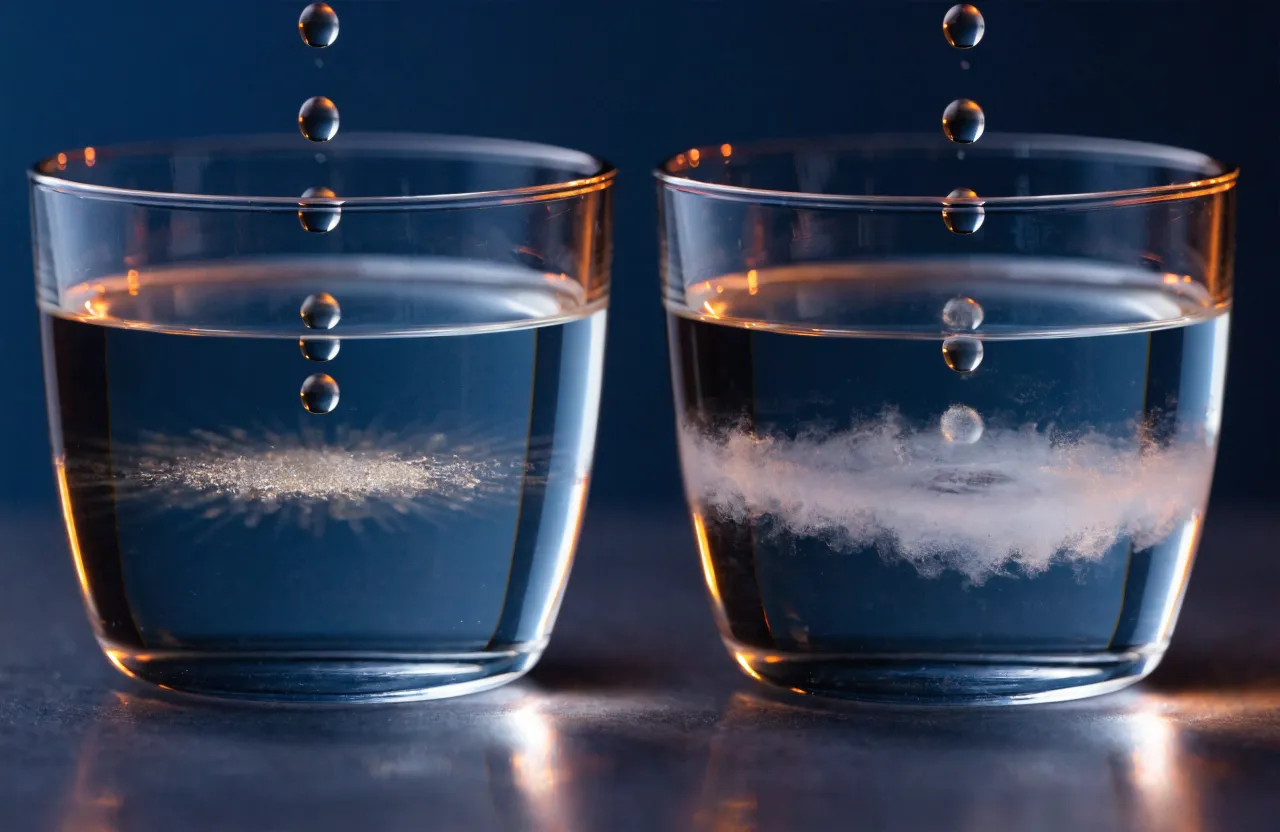
You drop an essential oil or a fragrance oil into water, stir, and instead of a clear scented liquid you get a milky cloud, an oily film on top, or droplets that bead up and refuse to mix. Adding more oil makes it worse, and shaking it harder only buys a few minutes before it separates again. Oil and water do not mix on their own, and for a *clear* product the fix is not an emulsifier that makes a milky lotion. It is a solubilizer, used the right way, at the right ratio, in the right order.
The short version: To get a small amount of essential or fragrance oil into clear water you solubilize it, which is different from emulsifying it. A solubilizer is a high-HLB nonionic surfactant that wraps the oil in micelles so small they do not scatter light, so the solution stays clear instead of going milky. Polysorbate 20 (HLB about 16.7) is the usual pick because it is the most water-loving of the common polysorbates. The reliable method is to pre-blend the solubilizer with the oil first, then add water slowly with gentle stirring, starting near a 1:1 weight ratio of solubilizer to oil and adjusting up until the solution runs clear. Solutions go cloudy when the solubilizer is under-dosed, the oil load is too high, the temperature crosses the surfactant’s cloud point, the water is hard, or the HLB is wrong for that oil. Ratios are starting points: oil composition varies, and high oil loads may never go fully clear.
This is a formulation problem only, getting an oil into clear water for a beverage, a flavor or fragrance concentrate, a toner or mist, or a cleaner. Nothing here is about what an essential oil does to a person; it is about what the chemistry does in the beaker.
Solubilization vs emulsification: clear solution vs milky emulsion
Both jobs put oil into water with a surfactant, but they aim at different droplet sizes and different end results.
Emulsification disperses a meaningful volume of oil as droplets roughly 1 to 100 micrometers across. Those droplets are larger than the wavelength of visible light, so they scatter it, and the product looks milky and opaque, a lotion or a cream. That is the right outcome when you want a bodied, oil-rich product, and it is the job of an emulsifier. Our primer on what an emulsifier is and how it works walks that mechanism.
Solubilization handles a small amount of oil by tucking it inside micelles, surfactant clusters roughly 10 to 100 nanometers across. Those are smaller than the wavelength of light, so they barely scatter it, and the solution stays clear or translucent. The oil is not floating as visible droplets; it sits in the oily core of the micelle, carried in the water phase. That is the outcome you want for a clear scented water, a beverage base, or a transparent gel.
The practical line between them is the look you are after and how much oil you are carrying. A clear toner with 0.3% fragrance is a solubilization job. A 20% oil-phase lotion is an emulsification job. Same family of molecules, different droplet scale, different visual result.
Why Polysorbate 20 is the usual pick for clarity
A solubilizer has to be strongly water-loving so its micelles stay small and stable in water. On the HLB scale, where a surfactant is rated roughly 0 (oil-loving) to 20 (water-loving), solubilizers sit high, around 15 to 18, while oil-in-water emulsifiers sit lower. Polysorbate 20 is a nonionic surfactant, polyoxyethylene (20) sorbitan monolaurate (PubChem CID 443314), and at an HLB of about 16.7 it is the most hydrophilic of the common polysorbates. Like any surfactant, it lowers interfacial tension and concentrates at the oil-water boundary (IUPAC); the high HLB is what biases it toward small, clear micelles rather than larger emulsion droplets.
Its short laurate (C12) tail is part of why it solubilizes cleanly. By contrast, Polysorbate 80 (HLB about 15.0, an oleate tail, PubChem CID 5281955) is a fine general oil-in-water emulsifier but is a notch less hydrophilic, so it tends to favor a slightly hazier or milkier result than Polysorbate 20 at the same job. For a clear solution, reach for Polysorbate 20 first. The full head-to-head is in our Polysorbate 80 vs 20 vs 60 comparison.
How much solubilizer: the solubilizer-to-oil ratio
Clarity is bought with surfactant. You need enough solubilizer to form micelles for every bit of oil you are carrying, and how much that takes depends on the oil. More polar oils (many fragrance oils) go clear at lower ratios; terpene-heavy essential oils and non-polar carrier oils need more, and the most non-polar oils may never go fully clear. Treat these as starting points and adjust to clarity:
| Oil type | Typical starting solubilizer:oil (by weight) | Note |
|---|---|---|
| Fragrance oils (partly polar) | ~1:1, sometimes up to ~3:1 | Many go clear near 1:1; richer or waxier ones need more |
| Essential oils (citrus / terpene-heavy) | ~1:1 to 5:1 | Terpene-rich, less-polar oils need more surfactant |
| Highly non-polar oils (carrier / vegetable oils) | up to ~10:1, may not go fully clear | A small fraction solubilizes; the rest stays an emulsion |
The honest version: a single solubilizer carries only so much oil before the micelles are saturated and the excess shows up as haze. Published guidance and supplier data both land on a 1:1 starting weight ratio for most essential and fragrance oils, then dosing up in small steps until clear. Because composition varies widely between oils, and even between lots of the same oil, the ratio that clears your blend has to be found on your own material, not copied from a table.
The method: pre-blend, then add water
Order of addition is the step most people get wrong. Adding oil straight into water, even with the solubilizer already in the water, usually gives a stubborn cloud, because the oil hits water before it is wrapped in surfactant. The dependable sequence is to marry the surfactant and the oil first:
1. Pre-blend the solubilizer and the oil, cold. Weigh the solubilizer and the oil together at your starting ratio and stir to a uniform, usually clear to pale, blend. This lets the surfactant coat the oil before any water is present. 2. Add water slowly, with gentle stirring. Pour the water (or add the premix into the water) in stages, stirring gently. You will often see the mix go milky and then clear as the micelles form. Give it a minute; some blends clear on standing. 3. Read the result and adjust. If it is clear, you are done. If it stays hazy, add solubilizer in small increments and re-stir, or reduce the oil. Do not fix haze by adding water alone; dilution does not create more micelles.
Two cautions. First, this is not an emulsion, so you do not need high shear; gentle mixing is enough, and over-working it gains nothing. Second, for difficult oils a small amount of a co-solvent pre-mixed into the blend (for example ethanol or a polyol such as glycerin or propylene glycol) can improve clarity, but confirm it is compatible with your product and grade before relying on it.
Why your solution goes cloudy, and how to fix it
Haze has a small number of root causes. Match the symptom to the cause before you change the formula:
| Symptom | Likely cause | Fix |
|---|---|---|
| Hazy right after blending | Under-dosed solubilizer; too little surfactant to form enough micelles | Raise the solubilizer:oil ratio; add solubilizer in small steps until clear |
| Cloudy only at higher oil % | Oil load above what the micelles can carry | Lower the oil percentage, or accept a milky emulsion for that load |
| Clear warm, hazes when cooled | Oil or surfactant nearing a solubility limit at low temperature | Reduce oil load, hold above the cloudy temperature, or add a co-solvent |
| Clear cold, hazes when heated | Cloud point reached; the nonionic surfactant dehydrates and phase-separates above its cloud point | Keep below the cloud point; this behavior is inherent to nonionics |
| Will not clear at any dose | Wrong HLB for that oil, or oil too non-polar for a clean micelle | Switch or blend solubilizers to the oil’s required HLB; add a co-solvent |
| Slowly turns cloudy over days | Hard-water ions or a pH shift destabilizing the system | Use deionized water, check and hold pH, re-verify the dose on the finished formula |
The cloud-point row is worth a note because it surprises people. A nonionic surfactant solution that is perfectly clear at room temperature can turn cloudy when warmed past its cloud point, the temperature at which the surfactant loses water solubility and the system phase-separates. High-HLB surfactants like Polysorbate 20 have high cloud points, which is another reason they suit clear aqueous products, but any hot-fill or hot-process step should be checked against it.
Match the solubilizer to the oil’s required HLB
When a blend will not clear at any sensible dose, the usual culprit is an HLB mismatch. Every oil has a required HLB, the surfactant water-versus-oil balance that handles it best, and forcing the wrong number wastes surfactant. Most solubilization of essential and fragrance oils works in the high-HLB band, which is why Polysorbate 20 is the default, but some oils clear better with a small amount of a low-HLB partner like sorbitan monooleate (HLB about 4.3) blended in to shift the system’s average HLB down toward the oil’s target. The method for calculating an oil’s required HLB and blending two surfactants to hit it is worked step by step in our guide to choosing an emulsifier by required HLB.
Which polysorbate, and pairing options
Polysorbate 20 is the first choice for clear solubilizing, but the family gives you room to tune:
- Polysorbate 20 (HLB ~16.7, laurate tail): the default solubilizer for clear essential and fragrance oil systems.
- Polysorbate 80 (HLB ~15.0, oleate tail): a general oil-in-water emulsifier; usable for some solubilizing but tends toward a hazier result than 20.
- Polysorbate 40 (HLB ~15.6) and Polysorbate 60 (HLB ~14.9): O/W emulsifiers for richer or wax-built systems; Polysorbate 60 ships as a solid and must be melted in.
For a low-HLB partner in a blend, the sorbitan esters share the polysorbate backbone and mix cleanly, with sorbitan monooleate the common pairing. Keeping the chemistry matched across a high/low pair is a small detail that often separates a clear, stable solution from a borderline one.
The honest limits
Solubilization is bounded. A clear micellar solution carries a small oil fraction, not an oil phase; push the oil load up and you eventually run out of micelle capacity and the system turns milky no matter how much surfactant you add. Oil chemistry matters as much as dose, so a ratio that clears one citrus oil may leave another hazy, and a non-polar carrier oil may never go fully clear at any ratio worth using. Temperature, water hardness, pH, and the rest of the formula all move the result. Use the ratios and methods here to set up your first trials, then confirm clarity and stability, including a temperature cycle, on your own oils and your own water.
Sourcing solubilizers and emulsifiers
Tell us the oil you are solubilizing, the clarity and oil load you need, and the grade or specification you must confirm, and request a sample to run your own clarity trials.
Frequently asked questions
How do I mix an essential oil with water?
You cannot mix oil into water directly and keep it clear; you have to solubilize it with a surfactant. Pre-blend a high-HLB nonionic solubilizer such as Polysorbate 20 with the essential oil first, at a starting weight ratio near 1:1, and stir to a uniform blend. Then add water slowly with gentle stirring. The mix often goes milky and then clears as micelles form. If it stays hazy, add more solubilizer in small steps until it clears. Adjust on your own oil, since composition varies.
What is a solubilizer?
A solubilizer is a high-HLB nonionic surfactant that carries a small amount of oil inside micelles, surfactant clusters roughly 10 to 100 nanometers across, so the oil disperses in water as a clear or translucent solution rather than a milky emulsion. Because the micelles are smaller than the wavelength of visible light, they do not scatter it, so the product stays clear. Polysorbate 20 is a common solubilizer for essential and fragrance oils.
What is the difference between a solubilizer and an emulsifier?
Both put oil into water with a surfactant, but at different droplet scales. A solubilizer carries a small amount of oil in micelles around 10 to 100 nanometers across, too small to scatter light, so the result is clear. An emulsifier disperses a larger volume of oil as droplets roughly 1 to 100 micrometers across, large enough to scatter light, so the result is milky. You solubilize a fragrance into a clear water; you emulsify an oil phase into a lotion.
Why is my solubilized solution cloudy?
The most common cause is under-dosing the solubilizer, so there are not enough micelles to carry the oil, fixed by raising the solubilizer-to-oil ratio. Other causes are an oil load above what the micelles can hold, crossing the surfactant’s cloud point when heated, oil falling out at low temperature, hard water or a pH shift, or an HLB mismatch for that specific oil. Match the symptom to the cause before changing the formula, and re-verify on your finished blend.
Polysorbate 20 vs Polysorbate 80 for essential oils?
Polysorbate 20 is usually the better choice for clear solubilizing. It is more hydrophilic (HLB about 16.7 versus about 15.0) with a short laurate tail, which favors small, clear micelles. Polysorbate 80 is an excellent general oil-in-water emulsifier with an oleate tail, but at the same solubilizing job it tends toward a hazier or milkier result. For a milky emulsion or a heavier oil, Polysorbate 80 may suit better; for a clear scented water, start with Polysorbate 20.
What ratio of solubilizer to oil should I start with?
A weight ratio near 1:1 (one part solubilizer to one part oil) is a reasonable starting point for many essential and fragrance oils, dosing up in small steps until the solution clears. More polar fragrance oils may clear below 1:1, while terpene-heavy essential oils can need up to about 5:1, and highly non-polar carrier oils may need far more or never go fully clear. Because oil composition varies between oils and lots, find the ratio that clears your specific blend rather than relying on a table value.
Editorial note. This article is general technical guidance for industrial and formulation professionals and addresses one task only: dispersing a small amount of oil into clear water. It makes no claim about any health, wellness, therapeutic, aromatherapy, or other effect of essential or fragrance oils. The starting ratios, methods, and HLB figures cited are typical published and supplier figures used as a starting point, not a guaranteed specification; clarity and stability depend on your specific oil, water, surfactant, dose, temperature, pH, and the rest of your formula, and must be validated on your own system. The Certificate of Analysis (CoA) governs the grade you buy, and the grade and regulatory status (technical, food, FCC, or pharmacopeial) must be confirmed for your application and jurisdiction. Polysorbates and sorbitan esters are semi-synthetic nonionic surfactants; review the current Safety Data Sheet (SDS) and use appropriate handling for your application. Products are sold for industrial and professional use only. Nothing here is a medical, health, safety, or efficacy claim. RawSource makes no warranty, express or implied, and assumes no liability for use of this information.
Search 1,300+ industrial chemicals by name or CAS, or send us your spec — we quote by the drum, tote, or container.
Browse the Chemical Index → Request a Quote