
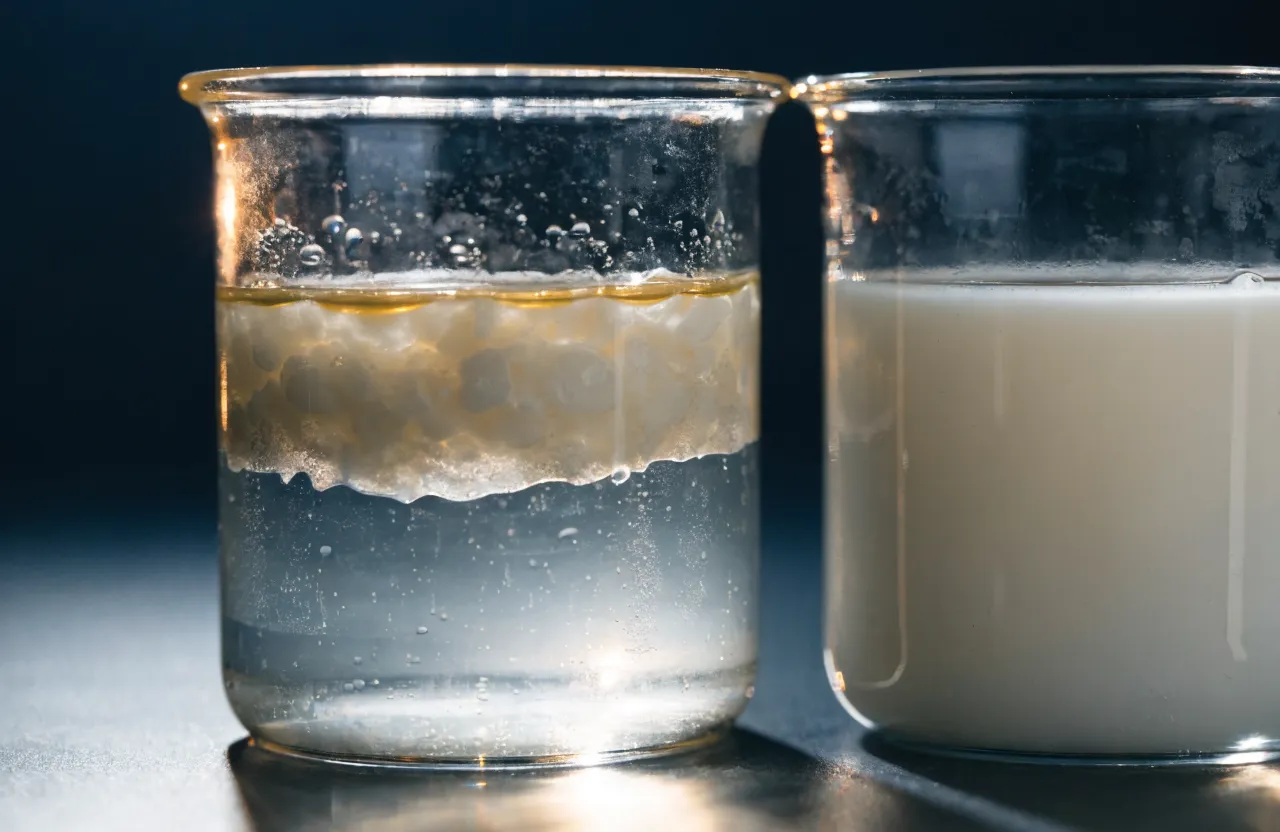
The batch looked perfect coming off the mixer: uniform, opaque, smooth. Two weeks later the drum tells a different story. There is a pale cream layer floating on top, or a film of free oil, or the whole thing has gone grainy and watery. The emulsion separated, and now you are deciding whether to rework it or scrap it. The frustrating part is that an emulsion separating is not a defect you introduced. It is the default. Every emulsion is trying to come apart from the moment you make it, and your formulation only decides how fast.
The short version: Emulsions are thermodynamically unstable, so every one eventually separates; an emulsifier’s job is to slow that down to a usable shelf life, not to stop it forever. Failure shows up as one of a few mechanisms: creaming or sedimentation (droplets float or sink under gravity, and re-disperse on shaking), flocculation (droplets clump but keep their own membranes), coalescence (droplets merge into bigger ones, irreversibly), and Ostwald ripening (dissolved oil diffuses from small droplets into large ones, irreversibly). The most common root cause is an emulsifier whose HLB does not match the oil phase’s required HLB. The fix is to hit that required HLB by blending a high-HLB emulsifier such as polysorbate 80 with a low-HLB one such as sorbitan monooleate, using matched fatty-acid tails. That packs the interface tighter, drives down droplet size, and buys real stability.
The five ways an emulsion dies
There is no single “the emulsion broke.” There are distinct failure modes, and they call for different fixes. The most useful first cut is whether the damage is reversible. Creaming, sedimentation, and flocculation are mostly recoverable, because the droplets are still intact. Coalescence and Ostwald ripening are not, because the droplet population itself has changed.
| Mechanism | What happens | Reversible? |
|---|---|---|
| Creaming | Droplets float to the top (lighter than the continuous phase) | Yes — re-disperses with mixing |
| Sedimentation | Droplets sink to the bottom (heavier than the continuous phase) | Yes — re-disperses with mixing |
| Flocculation | Droplets aggregate into clusters but keep individual membranes | Usually — but it is a precursor to coalescence |
| Coalescence | Droplets merge into a single larger droplet | No |
| Ostwald ripening | Dispersed phase diffuses from small droplets to large ones | No |
| Phase inversion | An oil-in-water emulsion flips to water-in-oil (or vice versa) | Sometimes, but you no longer have the same product |
Most real-world failures are a sequence: creaming concentrates the droplets at the top, that crowding drives flocculation, and flocculated droplets sitting in contact are the ones that go on to coalesce. Stop the early step and you often prevent the irreversible one.
Creaming and sedimentation: gravity wins
Creaming and sedimentation are the same physics with opposite signs. Both are gravitational separation driven by a density difference between the droplets and the continuous phase. Oil droplets in water are usually lighter, so they rise and form a cream layer; that is creaming. When the dispersed phase is denser, the droplets sink, which is sedimentation. Crucially, the droplets have not merged or changed size. The emulsion has only concentrated, which is why a gentle remix often restores it.
The rate is governed by Stokes’ law: bigger droplets and a bigger density mismatch separate faster, and a thicker continuous phase separates slower. That hands you three levers. Shrink the droplets, because settling velocity scales with the square of the radius. Narrow the density gap between the two phases. Or thicken the continuous phase so the droplets simply cannot travel. For an oil-in-water product, building viscosity into the water phase with a thickener is often the cheapest way to add months of shelf stability without touching the emulsifier.
Flocculation: droplets clump but do not merge
In flocculation, droplets stick together into loose clusters while each droplet keeps its own interfacial film. Nothing has fused yet, so flocculation is usually reversible with shear. The danger is what it sets up. A flocculated cluster holds droplets in prolonged close contact, thinning the liquid film between them, and that is exactly the condition coalescence needs. Flocculation also accelerates creaming, because a cluster rises faster than a lone droplet.
Flocculation is typically an interfacial-charge or steric problem: too little emulsifier to fully coat the droplets, the wrong emulsifier type, or an electrolyte that has collapsed the repulsion between droplets. The action item is to confirm you have enough emulsifier to cover the total interfacial area you created, then check whether a salt or pH shift in the formula is screening the repulsive forces that keep droplets apart.
Coalescence: droplets merge for good
Coalescence is when the thin film between two touching droplets ruptures and they fuse into one larger droplet. This is irreversible, and run far enough it ends in two bulk layers, a fully broken emulsion. A dense, well-packed interfacial film is the whole defense here. When the emulsifier layer is too sparse or too weak to resist film drainage, droplets that come into contact merge.
The fixes are interfacial. Raise the emulsifier loading so the film is dense and resilient. Choose an emulsifier whose HLB suits the emulsion direction you want. And reduce droplet size at the make step, because smaller droplets and a well-covered interface resist the film rupture that lets coalescence start. Coalescence is the failure mode that most directly punishes an under-dosed or mismatched emulsifier.
Ostwald ripening: the big droplets eat the small ones
Ostwald ripening is the subtle one, and it is the term most formulators come looking for. Even with zero droplet contact, the average droplet size of an emulsion can creep upward over weeks. The reason is the Laplace pressure inside a droplet, which rises as the droplet gets smaller. Higher internal pressure means the dispersed phase is slightly more soluble in the continuous phase right around a small droplet than around a large one. That solubility gradient drives a diffusion flux: material dissolves out of small droplets, travels through the continuous phase, and deposits onto large droplets. Small droplets shrink and vanish; large droplets grow. The system lowers its total interfacial energy, which is why this is thermodynamically downhill and irreversible.
The lever that makes Ostwald ripening different is the solubility of the dispersed phase in the continuous phase. The more soluble the oil is in water, the faster ripening runs, which is why short-chain, more water-soluble oils and flavor oils are notorious for it. More emulsifier does not stop ripening, and can even speed it up by adding micelles that ferry oil between droplets. The two moves that actually work: start with a tight, narrow droplet-size distribution so there is no large-versus-small gradient to drive diffusion, and lower the oil’s effective solubility, classically by adding a small fraction of a second, far less soluble oil that cannot diffuse and so pins the droplets in place. If your emulsion is going coarse and grainy in storage without visibly creaming, suspect ripening before you blame the emulsifier dose.
Phase inversion: the emulsion flips
Phase inversion is when an oil-in-water emulsion becomes water-in-oil, or the reverse. It can be triggered by temperature (changing how the emulsifier partitions between the phases) or by composition (pushing the internal phase fraction too high). For a formulator, the practical point is narrow: inversion is sometimes used deliberately to make very fine emulsions, but as an uncontrolled storage or processing event it means your product is no longer the product you specified. Hold your process temperature and your phase ratio inside the window where the intended direction is stable, and keep the emulsifier system matched to that direction.
The root cause behind most failures: unmatched HLB
The thread running through coalescence, flocculation, and even creaming is interfacial: an emulsifier that does not properly stabilize the oil-water boundary. The single most common version of that mistake is using an emulsifier whose HLB (hydrophilic-lipophilic balance, a 0–20 scale of how water-loving versus oil-loving a surfactant is) does not match the oil phase. Every oil phase has a required HLB, the value at which it emulsifies most stably. As a rough guide, oil-in-water emulsifiers sit around HLB 8–18 and water-in-oil emulsifiers around HLB 3–6. Feed an oil that wants an HLB of 11 a single emulsifier sitting at 15 and you get a loose, coarse, short-lived emulsion no matter how much you add.
| Emulsifier (generic) | HLB (approx.) | Typical role |
|---|---|---|
| Polysorbate 20 | 16.7 | High-HLB, oil-in-water |
| Polysorbate 80 | 15.0 | High-HLB, oil-in-water |
| Polysorbate 60 | 14.9 | High-HLB, oil-in-water |
| Sorbitan monostearate | 4.7 | Low-HLB, water-in-oil / co-emulsifier |
| Sorbitan monooleate | 4.3 | Low-HLB, water-in-oil / co-emulsifier |
| Sorbitan tristearate | 2.1 | Very low-HLB, water-in-oil |
HLB values above are typical literature figures; confirm against the documentation for the grade you buy.
The fix: hit the required HLB with a high-plus-low blend
Here is the move that separates a stable emulsion from a marginal one. You rarely match a required HLB with one surfactant. You blend a high-HLB emulsifier with a low-HLB emulsifier, because the blended HLB is just the weighted average of the two:
> HLB(blend) = (HLB₁ × weight-fraction₁) + (HLB₂ × weight-fraction₂)
Say your oil phase has a required HLB of 11 for an oil-in-water emulsion. Blend polysorbate 80 (HLB 15) with sorbitan monooleate (HLB 4.3). Solving 15x + 4.3(1−x) = 11 gives x ≈ 0.63, so roughly 63% polysorbate 80 and 37% sorbitan monooleate hits the target. Need a higher target HLB? Lean on the higher-HLB members such as polysorbate 20 (HLB 16.7). Building a stearate-based system instead? Pair polysorbate 60 (HLB 14.9) with sorbitan monostearate (HLB 4.7). For water-in-oil work, a very low-HLB anchor such as sorbitan tristearate (HLB 2.1) does the heavy lifting.
Why a blend beats a single surfactant at the same average HLB is the part formulators underuse. A high-HLB polysorbate and a low-HLB sorbitan ester adsorb at the interface together: the lipophilic sorbitan anchors into the oil while the hydrophilic polysorbate reaches into the water. When you match their fatty-acid tails (oleate with oleate, stearate with stearate) the two molecules pack side by side into a denser, more cohesive interfacial film. A tighter film resists the drainage that leads to coalescence and produces a smaller, more uniform droplet size, which in turn slows creaming (Stokes’ law) and starves Ostwald ripening of the size gradient it feeds on. One blend, several failure modes addressed at once.
A worked methodology, plus how to estimate an unknown oil’s required HLB by bracketing it experimentally, is in our guide to the HLB system and choosing an emulsifier.
The honest limits
The required-HLB blend is the highest-impact single change you can make, but it is not a cure-all, and pretending otherwise wastes lab time. Three caveats worth stating plainly. First, thermodynamics: an emulsion is a higher-energy state than two separated phases, so it always wants to break; you are buying shelf life, not permanence, and “stable” means “stable enough for your storage window and temperature range.” Second, Ostwald ripening barely responds to emulsifier choice; it is governed by oil solubility and the initial size distribution, so the answer there is a tighter make and a low-solubility oil additive, not more surfactant. Third, HLB only tells you the right *type* of emulsifier; the right *amount* (enough to cover the interfacial area you generated), enough mixing energy to make small droplets, and continuous-phase viscosity to hold them are independent levers you still have to get right.
The same discipline of getting the chemistry matched before you scale shows up across industrial formulation, the way a mis-set cure window leaves you fighting amine blush on epoxy downstream. Diagnose the actual failure mode first, then pull the lever that addresses it.
Buying emulsifiers
Tell us your oil phase, your target emulsion direction and required HLB, and your storage conditions, and request samples to bracket the blend ratio on your own system.
Frequently asked questions
Why does my emulsion separate?
Because an emulsion is thermodynamically unstable and always tends toward two separated phases. The separation you see is one of a few mechanisms: creaming or sedimentation (droplets float or sink under gravity), flocculation (droplets clump together), coalescence (droplets merge into larger ones), or Ostwald ripening (dispersed phase diffuses from small droplets to large ones). The most common underlying cause is an emulsifier whose HLB is not matched to the oil phase, often combined with too little emulsifier or droplets that are too large.
What is the difference between creaming and coalescence?
Creaming is reversible and coalescence is not. In creaming, intact droplets simply float to the top because they are lighter than the continuous phase, so the emulsion concentrates but the droplets are unchanged and usually re-disperse with mixing. In coalescence, the film between touching droplets ruptures and they merge into a single larger droplet, permanently changing the droplet population and eventually breaking the emulsion into separate layers.
What is Ostwald ripening and how do I stop it?
Ostwald ripening is the growth of large droplets at the expense of small ones, driven by the higher Laplace pressure inside small droplets, which makes the dispersed phase slightly more soluble around them. Material diffuses through the continuous phase from small droplets to large ones, coarsening the emulsion over time. Adding more emulsifier does not stop it. The effective moves are to start with a narrow, fine droplet-size distribution and to lower the dispersed phase’s solubility, classically by adding a small fraction of a second, far less soluble oil.
How do I choose the right emulsifier HLB for my emulsion?
Match the emulsifier system’s HLB to the oil phase’s required HLB. As a guide, oil-in-water systems generally need an emulsifier HLB of about 8–18 and water-in-oil systems about 3–6. The practical method is to fix everything else and run a series of blends across a range of HLB values, then identify the value that gives the smallest droplets and the longest stability; that value is your oil’s required HLB, and you formulate to it.
Why blend two emulsifiers instead of using one?
Because a high-HLB and a low-HLB emulsifier co-adsorb at the oil-water interface and pack into a denser, stronger film than either alone, especially when their fatty-acid tails match (for example oleate with oleate). A tighter interfacial film resists coalescence and produces smaller, more uniform droplets, which also slows creaming and Ostwald ripening. The blend lets you dial the exact average HLB your oil requires, which a single off-the-shelf surfactant rarely matches.
Can the right emulsifier make an emulsion permanently stable?
No. Because separation is thermodynamically favored, every emulsion breaks eventually; the right emulsifier and HLB only slow the kinetics to give you a usable shelf life under defined storage conditions. Emulsifier choice also does little against Ostwald ripening. Lasting stability comes from combining the matched-HLB blend with adequate emulsifier loading, a fine droplet size, and sufficient continuous-phase viscosity, then validating it on your own system.
Editorial note. This article is general technical guidance for formulation and industrial professionals. Emulsion stability, required HLB, droplet size, and shelf life depend on your specific oil phase, water phase, emulsifier system, processing energy, and storage conditions, and must be validated on your own system; the Certificate of Analysis governs the grade you buy. HLB values cited are typical literature figures and are not a guaranteed specification. Review the current Safety Data Sheet (SDS) and use appropriate PPE before handling. Products are sold for industrial and professional use only. Nothing here is a medical, health, safety, or efficacy claim. RawSource makes no warranty, express or implied, and assumes no liability for use of this information.
Search 1,300+ industrial chemicals by name or CAS, or send us your spec — we quote by the drum, tote, or container.
Browse the Chemical Index → Request a Quote