
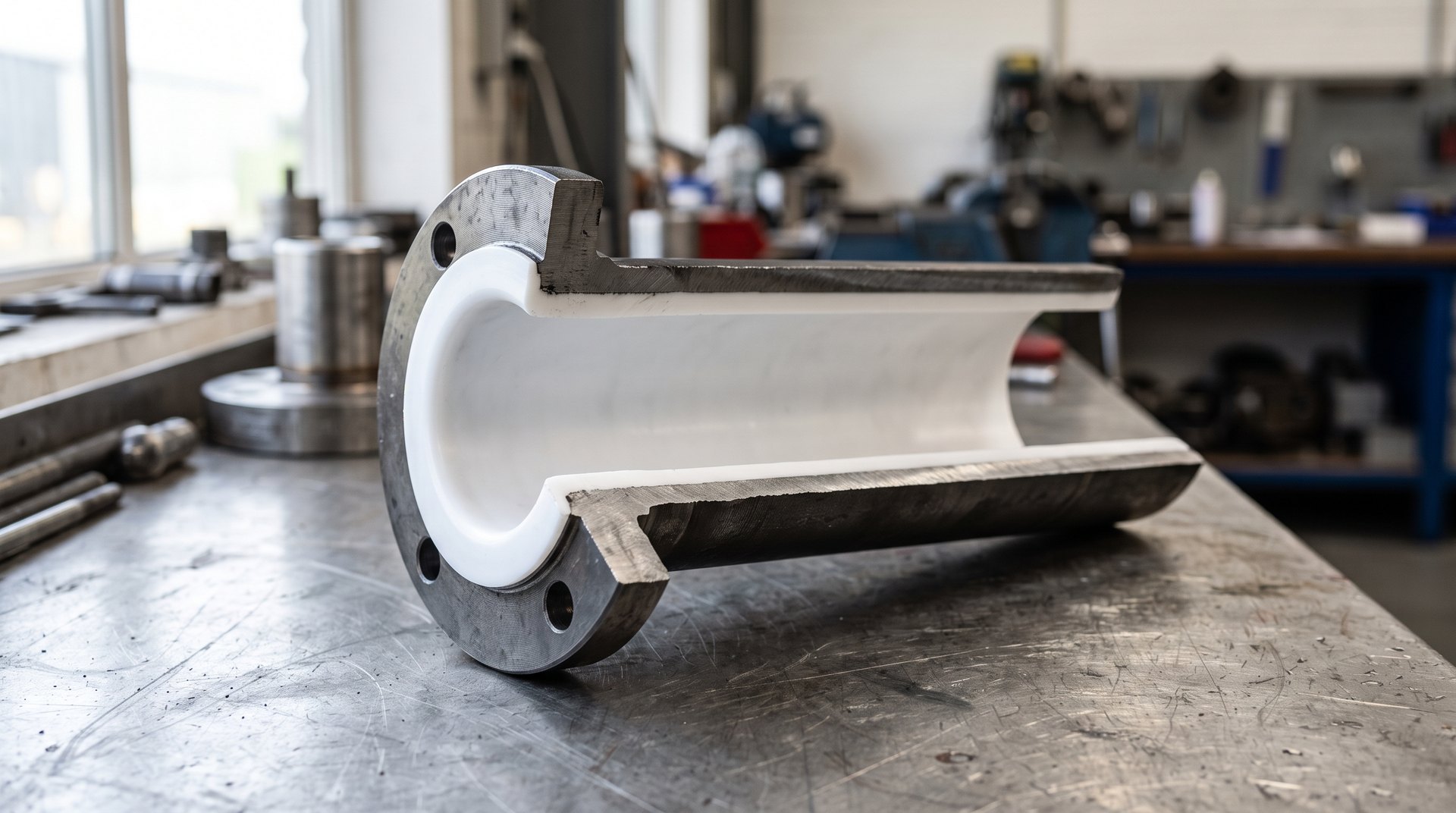
Your plant wants 49% hydrofluoric acid, low impurity, in an ISO tank; another line wants the same acid in IBCs to cut drum handling. Each bulk packaging request hides two questions to settle before the RFQ goes out. May that container carry acid of that strength? And will it keep the trace metals the certificate of analysis (CoA) promised at the fill point? The transport rules answer the first only in part. The second falls to the purity standards, which treat the container as a contamination touchpoint.
What do the rules allow for hydrofluoric acid in bulk packaging at 49%?
At 49%, hydrofluoric acid falls under the not-more-than-60-percent entries of 49 CFR and RID. The US entry allows plastic and metal drums with no glass or aluminum touching the acid, metal, rigid plastic and composite IBCs, and UN or IM portable tanks (ISO tanks). Its bulk lining provision, B15, names no lining material.
The 49 CFR 172.101 Hazardous Materials Table (eCFR, current to 2026-10-05) splits hydrofluoric acid at 60 percent strength. The weaker entry sends exceptions to 173.154, non-bulk packaging to 173.202 and bulk packaging to 173.243. It caps a package at 1 L on passenger aircraft or passenger rail cars and 30 L on cargo aircraft only, so drum quantities move by road, freight rail or sea. The special provisions that shape each format are defined in 49 CFR 172.102.
| Format | 49 CFR, entry for not more than 60% | RID 2025, entry for not more than 60% | Material or lining rule | Retest interval or use limit |
|---|---|---|---|---|
| Drums and jerricans (non-bulk) | 173.202: plastic drums 1H1/1H2, plastic jerricans 3H1/3H2, plastic receptacles in steel, aluminum, fiber or plastic drums (6HA1, 6HB1, 6HG1, 6HH1), metal drums | P001; composite drums up to 250 litres whichever packing group column applies | 49 CFR N5 and N34: no glass or aluminum in any part normally in contact with the acid | RID use limit: polyethylene packagings verified by assimilation stay in use no more than two years |
| IBCs | IB2: metal 31A, 31B, 31N; rigid plastic 31H1, 31H2; composite 31HZ1; vapor pressure no more than 110 kPa at 50 °C or 130 kPa at 55 °C | IBC02: the same IBC types | 49 CFR: B15 does not reach IBCs unless otherwise provided; where an IBC needs an inner liner, the liner is replaced before each reuse | 49 CFR: leakproofness test and external visual inspection every 2.5 years |
| UN or IM portable tanks (ISO tanks) | T8: minimum test pressure 4 bar, no bottom openings | T8 | 49 CFR: B15 does not reach them unless otherwise provided | 49 CFR: periodic inspection and test at least every 5 years, intermediate every 2.5 years |
| Road cargo tanks (US), rail tanks (RID) | 173.243(b): MC 304, MC 307, MC 330, MC 331; MC 310, MC 311, MC 312, DOT 407 and DOT 412 if designed to at least 172.4 kPa (25 psig) | Tank code L4DH: top filling and discharge, hermetically closed; closure caps locked during carriage (TU14); closures protected with lockable caps (TE21) | 49 CFR B15: a non-metallic lining impervious to the lading, or a suitable corrosion allowance | 49 CFR: a required lining is inspected every year |
Under 173.243, UN and IM 101/IM 102 portable tanks need a T code from the table, and IBCs need an IBC code that authorizes the type. Both hydrofluoric acid entries carry T codes; only the weaker one carries an IBC code. Acid over 60 percent (T10, no IBC route) is a different purchase; see the comparison of 49% and 70% hydrofluoric acid grades.
Why does B15 leave the lining choice to the shipper?
Special provision B15 sits in column 7 of both hydrofluoric acid entries. It requires bulk packagings to be protected with non-metallic linings impervious to the lading, or to have a suitable corrosion allowance. It names no lining material and no thickness. Under 172.102(b)(3), B provisions apply only to bulk packaging and, unless otherwise provided, not to UN or IM portable tanks or IBCs. For an IBC or an ISO tank of 49% acid, B15 does not answer the lining question at all.
Compare the over-60-percent entry, where B23 requires rubber-lined or unlined steel bulk tanks, with passivation before service, repassivation after any water wash-out and inhibited lading for the unlined ones. The 49% buyer gets no such recipe. The regulation lists the format and leaves the wetted material to whoever offers the acid for transport.
That person carries a named duty. Under 49 CFR 173.24(e), the offeror is responsible for packaging compatible with its contents, with corrosivity, permeability, softening, premature aging and embrittlement named, and no significant chemical or galvanic reaction allowed between packaging materials and contents. A listed metal drum or metal IBC is a permitted design type. It is not a finding that bare steel suits 49% acid.
The evidence points the other way. EPA’s Hydrogen Fluoride Study told Congress in 1993 that bulk rail and truck shipments were limited mainly to anhydrous HF and 70 percent aqueous acid, because aqueous HF below approximately 60 percent is too corrosive to be compatible with steel. The same report says chlorobutyl rubber-lined equipment can be used for aqueous solutions up to 70%, and that aqueous HF corrodes iron, stainless steel, brass, glass and natural rubber, among other materials.
Reference practice fills in what B15 leaves out. A 2018 industry reference handbook describes aqueous HF road cargo tanks as carbon steel lined with chlorobutyl rubber or, for acid at or below 49%, a fluoropolymer such as PTFE. A 2017 handbook says high density polyethylene resists solutions up to 70% at temperatures up to 60 °C, and does not recommend polypropylene for HF storage because it ages quickly in sunlight. The storage, handling and materials-of-construction post carries the same choices onto the plant side.
For a 49% buyer, B15’s silence matters more than any listed code. It moves the lining choice from the regulator to the shipper, and the lining is the part of the container that touches the acid.
How do 49 CFR and RID compare for 49% acid?
The RID 2025 text (English text of 20 August 2025) governs international carriage of dangerous goods by rail (Appendix C to COTIF); read it here as a second published rule set for the same packagings. It cuts hydrofluoric acid into three entries: more than 85 percent (P802), more than 60 but not more than 85 percent (P001 with PP81), and not more than 60 percent (P001 plus IBC02, which authorizes the same IBC types as the US code IB2).
RID also sets a calendar for plastics. It limits plastic drums, jerricans, rigid plastic IBCs and composite IBCs with plastic inner receptacles to five years from manufacture, unless the competent authority approves otherwise or a shorter period is prescribed for the substance.
For hydrofluoric acid of not more than 60 percent, polyethylene can face a shorter one. Where compatibility of polyethylene packagings and IBCs is shown by assimilation, the assimilation list sets the acid to the standard liquid water, with a permissible period of use of no more than 2 years.
Read together (a reading, not a sentence RID prints), the assimilation clauses let a polyethylene drum design type tested with water carry 49% acid without the usual six-month storage test, in exchange for the two-year limit. That reading has limits: under 4.1.1.21.2 the acid’s relative density and vapour pressure must stay within the values used in the design-type tests, and use stays subject to Table A and the P001 packing instruction.
Under 49 CFR 173.24(e)(3), each plastic packaging for liquid hazardous materials must withstand the Appendix B chemical-compatibility and permeation procedure, with test conditions of no lower than 18 °C for 180 days, 50 °C for 28 days or 60 °C for 14 days.
On tanks the two rule sets land close together. The US instruction T8 requires a minimum test pressure of 4 bar and prohibits bottom openings. RID gives the same band portable tank instruction T8 and tank code L4DH: a tank for liquids, a minimum calculation pressure of 4 bar, top filling and discharge with no openings below the liquid surface, hermetically closed.
Where does the container touch electronic-grade purity?
Grade changes none of the above, because the 49 CFR and RID entries split by strength. Low-impurity, high-purity or industrial-grade 49% acid in an ISO tank sits in the same entry, whether it was bought for glass etching and frosting or for wafer etch. What grade changes is what the container must not add to the acid.
Your container is the IRDS point of supply: the roadmap defines it as the chemical drum, tote or bulk supply, and the point of delivery as the outlet of final filtration of the chemical distribution unit. Metal-ion control starts at the supplier, the IRDS says, but contact with shipping containers and delivery equipment may warrant additional purification at the distribution system, the connection point, tool entry or inside the tool, depending on how critical the process step is.
All four purification points sit downstream of the point of supply, in the fab’s distribution chain, so whatever the container adds arrives first. The IRDS notes that extractables limits are typically easier to meet in ultrapure water than in certain chemicals, because the aggressive chemical environment extracts more metals, and NIST lists transport and delivery among the touchpoints where contaminants can be generated or added.
The scale is what makes the container matter. The technical data sheet for the semiconductor grade discussed below sets each listed trace metal, including iron, sodium, aluminum, copper and nickel, at no more than 1 (grade 1), 0.1 (grade 2) and 0.01 (grade 3) parts per billion (ppb). No transport clause above measures anything at that scale. A drum or lining that passes every inspection in the table can still decide whether a lot meets a limit set in hundredths of a part per billion.
SEMI’s distribution standards set metal limits and tests, but their public scope pages place them on distribution components and systems: F57 covers polymer materials and components, C90 metal extraction from tubing, fittings and valves, and F41 the qualification of bulk chemical distribution systems, from main unloading tank facilities to fab-wide dispense. They describe distribution components and systems, not shipping containers, so the container’s contribution is yours to specify in the RFQ.
Variation is the second purity question. The IRDS says variation in process-fluid purity can matter to wafer yield as much as absolute purity, and reports that most semiconductor manufacturers run statistical process control, such as 3-sigma limits, on critical process fluids. Treat a change of container type between lots as a change to qualify, because the CoA alone will not show it.
EPA’s 1993 report shows where the container meets the fab. Electronic-grade HF was typically bought at 49 percent and used at 1 to 10 percent, and a typical etching set-up pumped it from 55-gallon drums or one-gallon containers under nitrogen pressure through a surge tank and a manifold. That is 1993 practice.
What should your RFQ ask about the container?
-
State the strength and the entry. At 49% the acid sits in the not-more-than-60-percent entries, where IBC and portable tank routes exist.
-
For any bulk, IBC or tank format, ask for the wetted material by name: lining type, number of layers and thickness. B15 will not supply it.
-
Ask how the shipper meets 173.24(e) for that material, and whether steel touches the acid anywhere in the package.
-
For plastic drums and IBCs, ask the date of manufacture; under RID, polyethylene packaging verified by assimilation carries a two-year use limit.
-
For IBCs and portable tanks, ask the dates of the last leakproofness test and periodic inspection. For a reused IBC, ask for the 173.35(b)(1) pre-fill external inspection and confirmation that any inner liner was replaced.
-
For bulk shipments, ask how transfer hoses are tested and how often they are replaced; EPA’s 1993 report records that most industry sources placed the greatest release risk for bulk HF, chiefly anhydrous, at loading and unloading, because of temporary connections and multiple handling.
-
Ask whether the container is new or reused, and where the CoA sample was drawn relative to the package you receive.
Which format does the semiconductor grade come in?
The semiconductor-grade 49% HF ships in 235 kg net new poly drums only; it is not packed in IBCs, ISO tanks or cylinders. The IBC and tank rules above describe formats, not a RawSource offer. Its technical data sheet (PDF) says the drums must carry proper hazardous markings, UN number and placards, gives a shelf life of 1 year, and refers storage and disposal to the Safety Data Sheet (SDS).
The sheet holds HF at 48.8 to 49.2 wt % in all three grades and prints specification limits only, with no typical values and no test methods. It names its grades 1, 2 and 3 on its own scale and names no SEMI C28 grade, so none should be read into it. Binding specifications are those on the lot-specific CoA and in the sales contract.
When any 49% acid is offered as meeting a SEMI grade, check three things. SEMI C28 is the specification and guide for hydrofluoric acid used in the semiconductor industry, and its current revision, C28-0618, is listed as inactive but valid for use.
SEMI C1 numbers liquid-chemical grades 1 to 5 and says a grade validated with the appropriate procedures can be described as meeting SEMI specifications, so a grade number on a sheet is not a SEMI grade unless the sheet says so. SEMI C10 asks each trace contaminant’s method detection limit to be at or below its specification. Ask for the C28 grade, the revision and the methods. Hazards and handling follow the current SDS.
Methodology: regulatory text from 49 CFR 172.101, 172.102, Part 173 and Part 180 (eCFR, current to 2026-10-05) and RID 2025 (OTIF, English text of 20 August 2025); EPA’s Hydrogen Fluoride Study (EPA 550-R-93-001, 1993); the IRDS; NIST CHIPS 1000 (2022); SEMI public scope pages; dated industry reference handbooks and manufacturer bulletins; and the grade’s technical data sheet (V1.0, revision 2026-09-30). Readings of the regulations are labeled as readings; confirm any shipment against the current text.
Frequently asked questions
Can glass-etching hydrofluoric acid be shipped in an IBC drum?
Is 49% hydrofluoric acid shipped in high-pressure cylinders?
Does industrial-grade or high-purity 49% HF change the packaging rules?
What should an ISO tank of 49% hydrofluoric acid be lined with?
Is 49% hydrofluoric acid a fuming liquid?
Sources & methodology
Figures are RawSource sourcing data unless attributed to a named source. Regulatory citations are current as of publication. Chemical identities verified by CAS number against the RawSource catalog.
Search 1,300+ industrial chemicals by name or CAS, or send us your spec — we quote by the drum, tote, or container.
Browse the Chemical Index → Request a Quote