
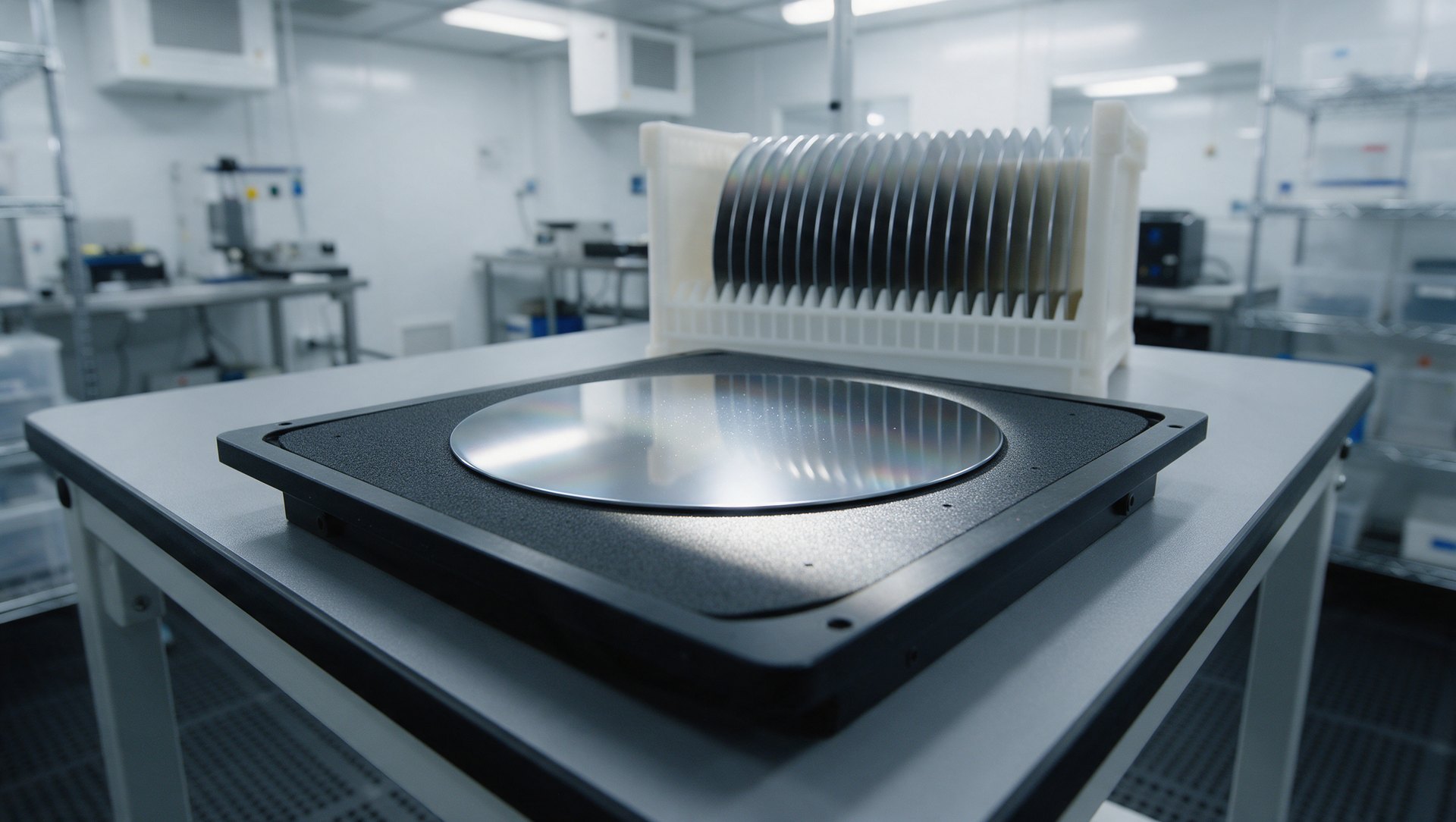
A process engineer hands purchasing a limit from a patent: less than 10 parts per trillion (ppt) of any one metal. The quote for 49% electronic-grade hydrofluoric acid lists each trace metal at 0.01 parts per billion (ppb), the same number in another unit. The match is weaker than it looks. The patent’s figure describes the liquid that touches the wafer. The quote describes acid in a drum, before it is diluted to working strength and pumped through containers, piping and a tool, each of which can add metal.
What does metal in electronic-grade HF acid do on a silicon wafer?
Copper in hydrofluoric acid deposits on bare silicon, and the amount follows the bath. A 1994 Materials Research Society study found copper deposition from spiked HF linear with concentration up to 500 ppb, with metal mixtures deviating from single-metal behavior; a 1998 Journal of the Electrochemical Society study found illumination raised copper deposition by nearly an order of magnitude. Deposited metal can raise junction leakage and weaken gate oxide.
The linear result comes from a mechanistic study in the Materials Research Society proceedings (1994). On bare wafers in metal-spiked solutions, copper and silver deposition from buffered oxide etch, and copper deposition from HF, was uniform and independent of substrate doping and rinse time. It rose linearly with time up to 25 minutes, did not occur on silicon dioxide and roughened the surface; the authors read it as mass-transport limited.
The practical reading: the step that strips the oxide is the step that exposes silicon to whatever metal the bath carries. The same study found single metals depositing, for the most part, as redox electrochemistry predicts, while mixtures deviated. Tin inhibited silver deposition. Molybdenum did not deposit in proportion to its level in solution, yet it did deposit when copper or silver was present. A per-metal specification treats each metal on its own; this result says the metals on the wafer do not always behave that way.
Light matters too. The impedance study in the Journal of the Electrochemical Society (1998) was sensitive to ppb levels of copper ions, and its TXRF data showed illumination raising copper deposition by nearly an order of magnitude. A 1997 mechanism paper explains why: copper ions are reduced by capturing conduction-band electrons, and illumination raises both the nucleation rate of copper precipitates and the growth rate of the nuclei.
The lighting over a wet bench is therefore a process variable, and one acid lot can leave different amounts of copper under different lighting.
| Study | Liquid | Copper added | What it found |
|---|---|---|---|
| Materials Research Society, 1994 | HF (copper); buffered oxide etch (copper and silver) | metal-spiked | Deposition linear with concentration up to 500 ppb and with time up to 25 minutes; none on oxide; mixtures deviate |
| J. Electrochem. Soc., 1996 | 50:1 HF | 0 to 100 ppb | More copper in the acid, more copper deposited and a higher silicon corrosion current |
| J. Electrochem. Soc., 1998 | Dilute HF | ppb levels | Illumination raised deposition by nearly an order of magnitude |
| Gate-oxide reliability paper, 1999 | 10:1 HF:H2O spiked with copper before oxidation (one of three contamination routes) | 1 to 100 ppb | Enhanced stress-induced leakage current in 7 nm oxides, attributed to the metallic contamination as a whole: iron spin-doped before oxidation, copper from the spiked HF and copper driven in after oxidation. The abstract does not separate the metals or the routes |
| Materials Research Society, 2002 | 2% HF | 1000 ppb | The copper on the surface was metallic |
These experiments spiked baths at ppb levels so deposition could be measured. They establish mechanism and direction for copper: more copper in the bath puts more copper on bare silicon, linearly up to 500 ppb in the 1994 study (copper from HF; copper and silver from buffered oxide etch). Molybdenum did not track its solution level, and light and other metals change the result. Reading the line below the lowest level a study tested is an extrapolation.
The 1994 authors also list the stakes: deposited metal can increase reverse-bias junction leakage, degrade oxide breakdown strength and increase MOS capacitor leakage.
Which metals in hydrofluoric acid matter for your process?
The International Roadmap for Devices and Systems (IRDS, 2024) gives aluminum, calcium, copper, iron, magnesium, nickel, potassium, silicon and sodium as examples of critical metals, and says the list varies from process to process. A metal earns its place by its effect on electrical parameters such as gate oxide integrity or minority carrier lifetime, and by its mobility in the substrate.
Copper deposits easily on silicon from HF-based etching solutions, a 2001 paper notes, and a dilute-HF clean does not take it back off: patent US5759971A (1998) states that dilute HF removes metals held in the oxide film but not copper and other metals adsorbed directly on silicon. Iron runs the other way. A 1993 study found that removing iron from silicon surfaces takes at least three cleaning steps plus rinses, one of which must be a hydrofluoric acid solution.
So the same acid deposits one metal and is a required step for removing another, and where the HF step sits in the clean helps decide which metals in the acid matter. The semiconductor-grade sheet discussed below sets one limit for every listed metal within a grade. It does not rank them, and it should not: the ranking belongs to your process. Name the critical metals for the step on the purchase specification, and check those limits on each certificate of analysis (CoA).
Is the ppb limit on 49% acid the ppt level at the wafer?
No, for two reasons that pull in opposite directions. EPA’s 1993 report to Congress on hydrogen fluoride states that the ultra-high purity aqueous HF used in chip manufacture is typically purchased at 49 percent, its most concentrated form, and used in much more dilute solutions of 1 to 10 percent. Dilution divides the metal the acid brings by the dilution factor. One patent, US5712198A (1998), runs its metals-removal step on 49 wt% HF diluted from about 1:1 to 1:10,000 parts by volume with water.
The second reason works against the buyer: water and hardware add metal. Patent US6620743B2 (2003) makes up its dilute HF from ultrapure water above about 15 megaohm-cm at 25 °C because the dilution water carries metals into the bath.
The IRDS places the point of supply at the chemical drum, tote or bulk supply and the point of delivery at the outlet of final filtration. Contact with shipping containers and delivery equipment, it says, may warrant more purification between the drum and the wafer, at the distribution system, a connection point, the tool entry or inside the tool, depending on how critical the step is.
The IRDS adds that aggressive chemicals extract more metals from wetted materials than ultrapure water does. The 1994 study’s authors put it plainly: process chemicals that are pure according to grade can easily be contaminated with metal ions through improper handling or storage. NIST (2022) makes the same point for semiconductor materials in general, counting touchpoints in production, storage, transport and delivery where contaminants can be generated or added.
Now the yardstick. Patent US5785820A (1998), on on-site manufacture of ultra-high-purity HF, states that all liquid solutions used on a semiconductor wafer should preferably carry less than 300 ppt of all metals combined and less than 10 ppt of any one metal. That is one patent’s preference for the liquid at the wafer, not a standard; patent figures are published data, not a recommendation to practice them. Taking each grade at its ceiling and counting only the metal the acid brings, the arithmetic of dilution runs like this:
-
Grade 3 starts at the patent’s per-metal figure, so any dilution puts the acid’s own share below it.
-
Grade 2 clears the patent’s per-metal figure at the dilute end of EPA’s 1 to 10 percent range, and not at the strong end.
-
Grade 1’s ceiling, 1 ppb, is 100 times the patent’s per-metal figure, and diluting 49% acid to the 1 percent end of EPA’s range divides it by only about 49. The acid’s own share therefore stays above 10 ppt even at the dilute end; by this arithmetic it is about 20 ppt, a derived figure, not a measured one.
Two cautions. A ceiling is not a lot value: the sheet prints limits only, so the lot’s CoA is where actual numbers live. And the patent also caps the sum of all metals, while the trace-metal rows on the sheet are per metal, so a process that works to a total needs its own total-metals line. What reached the wafer is measured on the wafer: a 1999 ICP-MS method reached 1E8 atoms/cm2 for aluminum, calcium, copper, iron, nickel, sodium and zinc on silicon surfaces.
How to read the grade 1, 2 and 3 limits
The table restates rows from the technical data sheet (PDF) for Hydrofluoric Acid 49% Semiconductor Grade, version 1.0, revised 2026-09-30. Every value is a specification limit for the 49% acid itself.
| Limit on the sheet | Grade 1 | Grade 2 | Grade 3 |
|---|---|---|---|
| Each listed trace metal, ppb | ≤ 1 | ≤ 0.1 | ≤ 0.01 |
| Chloride, nitrate and phosphate, each, ppb | ≤ 20 | ≤ 10 | ≤ 10 |
| Sulfate, ppb | ≤ 50 | ≤ 10 | ≤ 10 |
| Fluosilicic acid (H2SiF6), ppm | ≤ 5 | ≤ 1 | ≤ 1 |
| Color, APHA | ≤ 10 | ≤ 5 | ≤ 5 |
| HF, wt% | 48.8 to 49.2 | 48.8 to 49.2 | 48.8 to 49.2 |
The sheet calls these semiconductor grade 1, 2 and 3 and names no SEMI C28 grade, SEMI’s standard for hydrofluoric acid. Do not read its grade 2 as a SEMI grade 2. SEMI C1 describes liquid-chemical grades 1 to 5 and says a grade validated with the appropriate procedures can be described as “meeting SEMI Specifications”. When any seller makes that claim, ask which standard, which grade and which validated procedure stands behind it.
The sheet prints no typical values and no test methods, and its binding specifications are those on the lot-specific CoA and in the sales contract. SEMI C10 asks that every relevant trace contaminant in a SEMI process-chemical standard have a method detection limit at or below its specification. Applied to grade 3, that principle calls for a detection limit at or below the per-metal ceiling for each metal you name, so ask for the method and its detection limit before the first lot.
Does industrial-grade HF acid for metal cleaning need ppb metal limits?
No. In stainless steel pickling the bath is full of metal by design. The EU’s reference document on ferrous metals processing (2022) puts hydrofluoric acid at 10 to 40 g/l in conventional nitric-hydrofluoric pickling, with nitric acid doing most of the metal dissolution and the fluoride complexing the dissolved iron. Once dissolved iron reaches 5 % (40 g/l), iron fluoride starts to precipitate as hard crystalline sludge.
A bath that runs at grams per liter of iron gains nothing from a ppb limit on the acid that tops it up, and a colorless appearance or a high-purity label does not change that. What matters for pickling and metal cleaning is assay and strength. EPA’s 1993 study says aqueous HF is produced commercially mainly as a 70 percent solution, while electronic and reagent grades span 5 to 52 percent.
The EU document states its mixed-acid consumption figures on a 70 wt% HF basis. If your line buys 49% industrial-grade acid, re-base any 70% dosing figure on HF content, not on volume of acid. The comparison of 49% and 70% hydrofluoric acid grades covers how the two strengths differ, and pickling sits alongside etching and frosting among the industrial uses of hydrofluoric acid.
What to put on the purchase specification
-
Where the limit applies. State whether each metal limit is for the acid as delivered or for the bath at the tool.
-
Critical metals by name. List the metals the step is sensitive to, each with its limit, and add a total-metals line if your process works to one.
-
Detection limits. Require the method and its detection limit for each listed metal, at or below the limit, with results on the lot-specific CoA.
-
Bath strength. Write down the HF concentration the acid will be diluted to; the grade decision rests on it.
-
Dilution water and wetted parts. Specify the water’s resistivity and qualify the distribution components. SEMI C90 sets extraction limits for metals from tubing, fittings and valves in liquid chemical service.
-
Lot-to-lot variation. The IRDS says variation in process-fluid purity can matter as much to yield as absolute purity; ask for control limits by lot, of the kind SEMI C64 describes for ship-to-control.
-
Shelf life. The data sheet gives a shelf life of 1 year and refers storage and disposal to the Safety Data Sheet (SDS); ask for each lot’s manufacture date on the CoA and plan use within that year.
Methodology: deposition findings come from abstracts in the Materials Research Society proceedings (1993, 1994, 1999, 2002), the Journal of the Electrochemical Society (1996, 1997, 1998, 2001) and a 1999 gate-oxide paper; use strengths from EPA’s Hydrogen Fluoride Study (1993); metal-control guidance from the IRDS (2024), SEMI abstracts and NIST (2022); pickling figures from the EU reference document (2022); five granted US patents; an instrument application report (2016); grade limits from the RawSource technical data sheet, version 1.0.
Frequently asked questions
Is electronic-grade HF bought as anhydrous HF?
Can low-impurity hydrofluoric acid ship in an ISO tank without picking up metal?
Can a lab measure ppt-level metals in concentrated HF?
Does ammonium fluoride deposit more copper than dilute HF, and can buffered HF hide it?
Sources & methodology
Figures are RawSource sourcing data unless attributed to a named source. Regulatory citations are current as of publication. Chemical identities verified by CAS number against the RawSource catalog.
Search 1,300+ industrial chemicals by name or CAS, or send us your spec — we quote by the drum, tote, or container.
Browse the Chemical Index → Request a Quote