
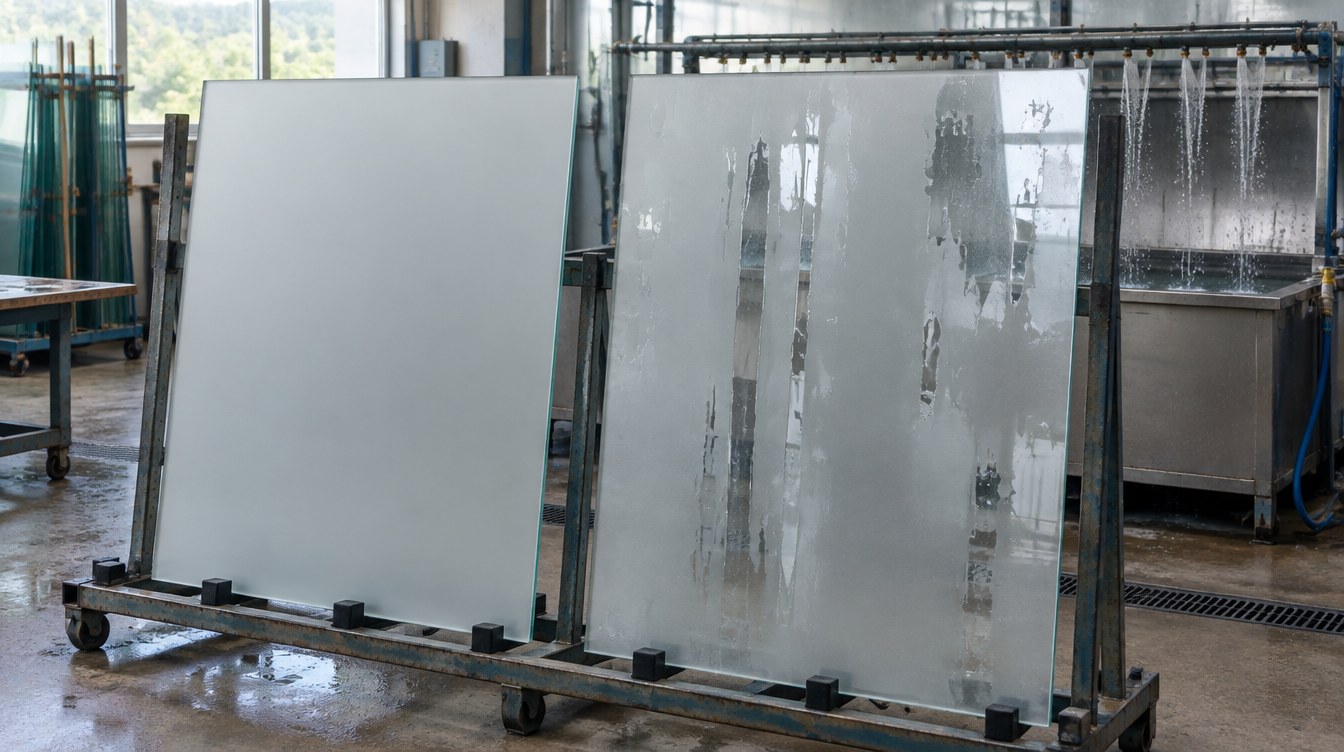
A decorative-glass line changes its float-glass supplier, and the frosted shower panels start leaving the bath with glossy streaks inside the matte field. The first purchase request asks for stronger hydrofluoric acid. That order assumes a frost is a gentler etch, and it is not. A frost is relief cut into the glass around salt crystals that the glass itself helps to grow, so the bath chemistry and the glass composition decide the finish. The percentage on the drum label is one input among several.
Why does the same acid polish crystal and frost a shower panel?
The HSDB use list that PubChem carries for hydrofluoric acid names frosting and etching glass alongside polishing crystal glass. PubChem also carries an entry sourced to the Agency for Toxic Substances and Disease Registry (ATSDR) and dated 2003, which named glass etching as the acid’s main use at that time, with oil refining and the making of other fluoride compounds also listed. Matte and mirror-bright come from one acid. The difference lies in the second half of the reaction, not the first.
The first half is the same on every glass. Fluoride breaks the silicon-oxygen bond, and the silicon leaves as silicon tetrafluoride or, in water with excess acid, as fluorosilicic acid (H2SiF6). HSDB records that the acid dissolves silica, silicic acid and glass, and the ICSC cards state that it attacks glass. CAMEO’s profile for the anhydrous form extends the point to any silica-containing material.
The second half depends on what else the glass contains. Soda-lime glass, the material of windows, shower panels and bottles, carries sodium and calcium alongside the silica. Released into the acid film, they meet fluoride and fluorosilicate and form salts that dissolve poorly. Once the film at the surface saturates, those salts crystallize on the glass. Each crystal shields the patch beneath it while the acid keeps cutting around its edges.
Rinse the crystals away and the surface is a field of tiny hills and pits that scatters light. That is the frost: relief in the glass, not a deposit on it. Keep the salts dissolved instead, with a strong mineral acid in the bath and the glass moving between short dips and rinses, and the surface dissolves evenly. That is the clear etch, and at its gentlest it is acid polishing.
Four levers that set clear or frosted
Four levers move a bath between the two finishes. The table reads across: the middle column pushes the bath toward an even, clear cut, the right column toward a crystal-masked frost.
| Lever | Pushes toward a clear etch | Pushes toward a matte frost |
|---|---|---|
| Free mineral acid | Sulfuric acid or another strong acid alongside the hydrofluoric acid keeps the reaction salts dissolved | No strong acid beyond the fluoride source itself |
| Fluoride source | Liquid hydrofluoric acid diluted to the recipe | Ammonium bifluoride or other fluoride salts, in a bath or a paste |
| Motion and contact | Agitation, short dips, rinses between dips | A still bath or a paste left in place |
| Glass composition | Quartz and fused silica in liquid acid: no sodium or calcium of their own to crystallize | Soda-lime, rich in both; borosilicate sits between and frosts less evenly |
Acid strength and bath temperature are left out of the table on purpose. Both set how fast the glass dissolves, which matters for deep etching on signage and art glass. On a frost line both also shift the salt balance, so treat a change to either as a new recipe and qualify it on trial panels.
When a frost turns patchy after a change of glass, check the glass before the acid. Soda-lime sheets from different float lines can differ in sodium and calcium content, and the two faces of a single float sheet differ as well. Surface condition is the third suspect. A film of oil or handling residue keeps the acid off the glass and leaves a glossy island of untouched surface inside the matte. Clean and dry the glass the same way before every run.
Is ammonium bifluoride a safer hydrofluoric acid?
Ammonium bifluoride (NH4HF2) is a white crystalline fluoride salt used in frosting creams and baths, and the case made for it on frosting lines is safety. Part of that case holds for logistics. A solid is weighed instead of poured, and it ships and stores without a liquid to contain.
The bath is another matter. Dissolved, ammonium bifluoride gives the bifluoride ion, which sits in equilibrium with fluoride and molecular hydrogen fluoride, and that equilibrium is what etches the glass. The tank holds hydrogen fluoride whichever feed you bought. The exposure controls for the bath therefore come from the current Safety Data Sheet (SDS) for each product, not from the word solid on the bag.
Where ammonium bifluoride earns its place is the finish. A bifluoride bath carries no strong mineral acid, the condition the table links to crystal growth. Its ammonium is also a crystal former in its own right: in a concentrated bath it comes out on the glass as ammonium hexafluorosilicate, alongside any sodium and calcium salts the glass releases. The bath builds part of the crust itself, so a frost is easier to reach and to repeat.
Semiconductor fabs make the same point from the other side: buffered oxide etch adds ammonium fluoride to hydrofluoric acid for rate control and uniformity. A fluoride salt is a control knob, not a hazard downgrade.
What should a glass line specify when it buys?
Specify the finish and the glass first, then the feed. A clear etch or an acid polish on soda-lime runs on liquid hydrofluoric acid with a strong mineral acid in the bath. A matte frost is easier to get from a concentrated bifluoride bath or paste.
In liquid hydrofluoric acid with no crystal-forming cation, polished quartz and fused silica come out clear, because they bring no sodium or calcium to build a crust. A matte finish on them needs a bath that brings its own crystal-forming cation, such as an ammonium bifluoride bath, or abrasive blasting.
Decorative work does not need electronic grade. Electronic grade is defined by impurity limits, not concentration: Haz-Map gives 49% as the standard concentration for the semiconductor wet etchant, and technical grade is commonly sold near the same strength. A frosting bath dissolves glass that already brings sodium, calcium and trace metals into solution, so technical grade diluted to your recipe is the sensible buy.
Plan the extraction before the first drum arrives, because the concentrate is where vapor comes from. ICSC 1777 records the 70% solution boiling at 66.4 °C. CAMEO, citing the ICSC data, lists a hydrogen fluoride partial pressure of 150 mmHg at 77 °F over that solution.
A molecular weight of 20.0064 g/mol suggests that vapor should rise, but hydrogen fluoride molecules associate in the vapor. ICSC 0283 gives the anhydrous vapor a relative density from 0.7 to 2.6 (air = 1), highest at low temperature. For the vapor over the 70% solution, ICSC 1777 gives 1.86 at 25 °C. Capture fume at bench and floor level in the make-up area, not only from a canopy overhead.
Then run the trial on your own glass: panels from each float supplier, etched on the same face, logged against the area of glass the bath has dissolved since make-up.
What leaves the shop: spent bath, rinse water and fume
Everything a frosting line sends out carries fluoride with it, and three of the federal listings for hydrofluoric acid bear on what leaves the building.
- Spent bath and sludge. A waste containing hydrofluoric acid is a D002 hazardous waste under the Resource Conservation and Recovery Act (RCRA) if it exhibits the corrosivity characteristic defined at 40 CFR 261.22 (PubChem regulatory summary, 2026). The determination is made on the waste as generated.
- Spills and rinse water. Hydrofluoric acid is designated a hazardous substance under Clean Water Act Section 311(b)(2)(A), a designation that extends to solutions and mixtures containing it (PubChem regulatory summary, 2026). Section 311 covers spills. Under the Superfund reporting rules, a release at or above the 100 lb (45.4 kg) reportable quantity in 40 CFR 302.4 requires immediate notice to the National Response Center under 40 CFR 302.6(a), federally permitted releases excepted (PubChem regulatory summary, 2026). Routine rinse water sent to the sewer falls under your sewer-use or pretreatment permit, and only within that permit’s limits.
- Fume. Hydrogen fluoride is on EPA’s list of hazardous air pollutants under Clean Air Act Section 112(b), with no delisting shown in EPA’s modifications table as of 2026.
Before you standardize on a feed, have spent bath from each recipe tested against the corrosivity characteristic at 40 CFR 261.22 (PubChem regulatory summary, 2026). A strong-acid clear-etch bath and a bifluoride frost bath need not give the same D002 answer, and that result feeds the hazardous waste determination for each.
Methodology: reactivity, use and physical data come from PubChem (CID 14917) and the HSDB, ICSC, CAMEO, ATSDR and Haz-Map entries it aggregates, plus EPA’s Health Effects Notebook and hazardous air pollutant list; regulatory listings come from PubChem’s regulatory summary (2026). Statements without a figure are standard glass and fluoride chemistry.
Frequently asked questions
Can hydrofluoric acid frost quartz or fused silica?
Why does a frost look different on the two faces of one float-glass sheet?
How do I tell a real frost from a salt film after rinsing?
Can dilute hydrofluoric acid sit in a glass beaker for a quick test?
Sources & methodology
Figures are RawSource sourcing data unless attributed to a named source. Regulatory citations are current as of publication. Chemical identities verified by CAS number against the RawSource catalog.
Search 1,300+ industrial chemicals by name or CAS, or send us your spec — we quote by the drum, tote, or container.
Browse the Chemical Index → Request a Quote