
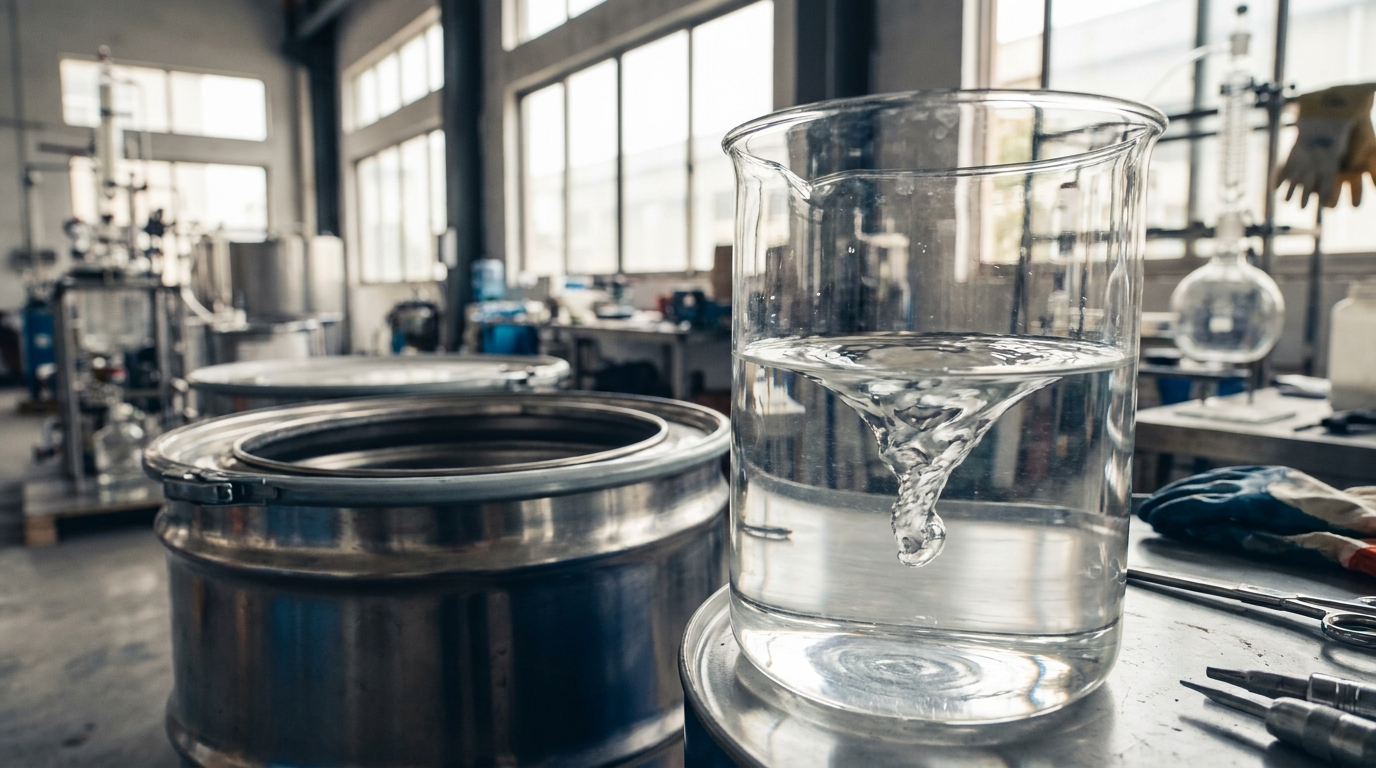
Propylene carbonate (PC, CAS 108-32-7) is a high-boiling, polar aprotic solvent — a cyclic carbonate — valued for its high dielectric constant, favorable toxicity profile, and low volatility. It is used in lithium battery electrolytes, paint and coating strippers, cosmetics, acid-gas treating, and as a general-purpose polar solvent. Those traits explain why a single solvent shows up in a battery plant, a paint shop, and a cosmetics lab. This guide walks through what PC is, the numbers that matter on a spec sheet, and where it earns its place by sector — written for buyers and formulators specifying it at volume, not for a chemistry class.
What Is Propylene Carbonate?
Propylene carbonate is the cyclic ester of propylene glycol and carbonic acid, with the formula C4H6O3. Chemically it sits in the “polar aprotic” camp: it dissolves a wide range of ionic and polar species the way water does, but without an acidic O–H proton to interfere with reactions or strip metals. That combination — strong polarity, no proton — is exactly what battery and synthesis chemists want. Two more properties carry most of its commercial weight. Its dielectric constant near 64 is unusually high for an organic solvent, which lets it dissolve and dissociate salts. Its boiling point above 240°C means it barely evaporates at room temperature, so a formulation made with it stays put.
The catch worth naming up front: that same high boiling point makes PC hard to strip back out by simple evaporation. Where you need a solvent to flash off quickly — a fast-dry coating, for instance — PC is the wrong tool, and you reach for something more volatile. It rewards applications where low evaporation is a feature, not a bug.
Propylene Carbonate Properties at a Glance
| Property | Typical value |
|---|---|
| CAS number | 108-32-7 |
| Molecular formula | C4H6O3 |
| Molar mass | 102.09 g/mol |
| Appearance | Clear, colorless liquid |
| Odor | Faint, mild (low odor) |
| Boiling point | ~242°C |
| Flash point | ~132°C (closed cup); combustible, not flammable |
| Dielectric constant (25°C) | ~64 |
| Solvent class | Polar aprotic (cyclic carbonate) |
| Water solubility | Miscible / highly water-soluble |
| Volatility / vapor pressure | Low |
Recommendation for buyers: the high flash point matters on more than a safety form. Because PC is combustible rather than flammable, it usually ships and stores with fewer restrictions than the acetone- or NMP-class solvents it often replaces, which can quietly lower freight and warehousing cost over a year of drum traffic.
Propylene Carbonate Uses by Sector
| Sector | Role of propylene carbonate |
|---|---|
| Lithium-ion batteries | Electrolyte co-solvent; dissolves and dissociates lithium salts |
| Paint & coating strippers | Active solvent; lower-toxicity, low-VOC alternative to harsher strippers |
| Gas treating | Physical solvent for CO2 and acid-gas (H2S) absorption |
| Cosmetics & personal care | Carrier solvent and viscosity/texture modifier |
| Plastics & polymers | Plasticizer and processing aid |
| Industrial cleaning | Solvent for greases, resins, and coating residues |
| Chemical synthesis | Polar aprotic reaction medium |
Lithium-Ion Battery Electrolytes
Battery electrolytes are the application where PC’s numbers pay off most directly. A lithium-ion cell needs a solvent that can dissolve a lithium salt and let the ions move; the dielectric constant near 64 does the dissolving, and the wide liquid range (from a low melting point up past 240°C) keeps the electrolyte usable across temperatures that would freeze or boil off lesser solvents. PC is rarely the whole electrolyte. It is typically blended with linear carbonates (such as dimethyl or ethyl methyl carbonate) that cut viscosity and raise conductivity, with PC contributing the high-permittivity backbone.
The honest trade-off: with ordinary graphite anodes, neat PC tends to co-intercalate and exfoliate the graphite, so it is not a drop-in replacement for ethylene carbonate in every cell. Formulators manage this with additives or chemistries (and PC remains attractive for low-temperature and certain next-generation designs because it stays liquid in the cold). If you are sourcing for cell work, specify battery grade and ask for moisture and metals on the CoA — trace water is the silent killer in these systems.
Paint and Coating Strippers
Paint stripping is where reformulation pressure has pushed PC into the spotlight. As methylene chloride and NMP have come under tighter restriction, formulators have turned to PC as an active solvent that swells and lifts many cured coatings while carrying a more favorable toxicity and VOC profile than the solvents it displaces. Its low volatility is a practical asset here: the stripper stays wet on a vertical surface long enough to work, instead of flashing off before it penetrates.
A precise word on positioning. PC is reasonably described as a lower-toxicity, low-VOC alternative in suitable applications — not as “non-toxic,” “green,” or “eco-friendly” in the absolute. It still requires PPE, ventilation, and SDS-driven handling like any industrial solvent, and its slower evaporation means a stripper may need more dwell time than a fast, aggressive blend. Test it on your specific coating system before committing a line.
CO2 and Acid-Gas Absorption (Gas Treating)
In gas processing, PC is used as a physical solvent to absorb carbon dioxide and other acid gases from natural gas, synthesis gas, and similar streams — the chemistry behind Fluor-type and related physical-solvent treating processes. Acid gases dissolve into the cold solvent under pressure and are released when the pressure drops, so the solvent is regenerated by simple flashing rather than by boiling off a chemical bond. That makes it energy-efficient for bulk CO2 removal at elevated partial pressures.
The limitation to size for: physical solvents only shine when the acid-gas partial pressure is high. At low partial pressures, chemical solvents (amines) reach lower residual CO2, so the choice is a genuine engineering call, not a default. For high-pressure bulk removal, though, PC’s regeneration economics are hard to beat.
Cosmetics and Personal Care
In personal care, PC works as a carrier solvent and texture modifier. It dissolves and evenly disperses actives and pigments, then leaves a smooth, low-tack feel because it does not flash off and does not carry a strong odor. Formulators use it to adjust viscosity and improve the spread of color cosmetics, lotions, and styling products. Used at typical low inclusion levels, it contributes to consistent sensory performance batch to batch.
As with any cosmetic ingredient, suitability and compliance are formulation- and jurisdiction-specific — confirm against your own safety assessment and the applicable regulations rather than treating “used in cosmetics” as blanket clearance for a new product.
Plasticizer, Polymers, and Cleaning
PC’s high boiling point makes it a useful plasticizer and processing aid: it stays in the polymer matrix during processing instead of evaporating, improving flexibility and flow. In industrial cleaning, the same solvency that lifts coatings makes it effective on greases, resins, and stubborn residues, with the low odor and low volatility that an indoor cleaning operation appreciates. The trade-off across both uses is the one that runs through this whole material. It is slow to remove, so any residual PC has to be acceptable in the finished part or fully rinsed away.
Chemical Synthesis and Reaction Medium
Synthetic chemists reach for propylene carbonate when they need a polar, high-permittivity medium that will not donate a proton into the reaction. It dissolves salts and polar organics, tolerates a wide working-temperature range, and stays in the flask rather than boiling off mid-reaction. That makes it a practical alternative to harsher dipolar aprotic solvents in some processes, particularly where a milder solvent profile is wanted for downstream handling. PC itself is also a building block: it is a reactive intermediate in carbonate and carbamate chemistry and a route for incorporating captured CO2 into useful molecules.
The same low volatility that helps during the reaction works against you at workup. Recovering product from a high-boiling solvent usually means extraction or distillation under reduced pressure rather than a simple rotary-evaporation step, which adds process cost. Weigh that against the handling and safety upside before you swap PC into an established route, and pilot the workup before scaling.
Sourcing Propylene Carbonate for B2B Use
Propylene carbonate is sold in grades that differ in purity and, critically, water content — the gap between a technical-grade stripper solvent and a battery-grade electrolyte component is largely about trace moisture and metals. Specifying the wrong grade is the most common and most expensive sourcing error buyers make with this material. See the Propylene Carbonate Reagent product page.
To get an accurate quote fast, a request for quote should state three things: the grade you need (battery vs. technical), the volume and packaging (drums, IBCs, or bulk), and whether you require a Certificate of Analysis (CoA) with specific moisture or purity limits called out. With those three in hand we can match the right grade to your application instead of guessing.
Methodology and sources
Identity and property context for Propylene Carbonate (PC) (CAS 108-32-7) in this guide is anchored to the compound's PubChem record. Hazard-communication framing follows OSHA's Hazard Communication Standard, 29 CFR 1910.1200. Always defer to the supplier's current SDS and CoA for the specific grade and lot you handle.
Frequently Asked Questions
What is propylene carbonate used for?
Propylene carbonate is used as a polar aprotic solvent across several industries. Its main applications are lithium-ion battery electrolytes, paint and coating strippers, CO2 and acid-gas absorption in gas treating, cosmetics as a carrier and texture modifier, plasticizers, and industrial cleaning. Its high dielectric constant and low volatility make it suitable wherever strong solvency with minimal evaporation is needed.
Is propylene carbonate safe?
Propylene carbonate carries a more favorable toxicity and VOC profile than many traditional solvents, which is why it is used as a lower-toxicity, low-VOC alternative in suitable applications. It is not “non-toxic” in the absolute sense and still requires PPE, ventilation, and handling per its Safety Data Sheet. Always consult the current SDS and confirm suitability for your specific use and jurisdiction.
Is propylene carbonate a polar aprotic solvent?
Yes. Propylene carbonate is a polar aprotic solvent — specifically a cyclic carbonate. It has strong polarity and a high dielectric constant (around 64), so it dissolves ionic and polar compounds well, but it lacks an acidic O–H proton. That makes it useful as a reaction medium and as an electrolyte solvent where a proton-free, high-permittivity environment is required.
Why is propylene carbonate used in batteries?
Its high dielectric constant lets it dissolve and dissociate lithium salts, and its wide liquid range keeps the electrolyte usable across a broad temperature window, including the cold. In lithium-ion cells it is typically blended with lower-viscosity linear carbonates that raise conductivity. Battery-grade material with tightly controlled moisture and metals is essential, since trace water degrades cell performance.
Is propylene carbonate a good paint stripper?
It is an effective active solvent in many stripper formulations and has gained ground as methylene chloride and NMP face tighter restrictions, thanks to its more favorable toxicity and VOC profile. Its low volatility keeps it working on the surface longer. The trade-off is dwell time — its slower evaporation can mean longer contact than aggressive fast solvents — so test it on your specific coating first.
What is the chemical formula of propylene carbonate?
The molecular formula of propylene carbonate is C4H6O3, with a molar mass of about 102.09 g/mol and CAS number 108-32-7. It is the cyclic ester (carbonate) derived from propylene glycol. At room temperature it is a clear, colorless, low-odor liquid with a boiling point around 242°C and a high dielectric constant near 64.
What is the difference between propylene carbonate and propylene glycol?
They are different chemicals. Propylene carbonate (C4H6O3, CAS 108-32-7) is a cyclic carbonate ester used mainly as a polar aprotic solvent. Propylene glycol (C3H8O2, CAS 57-55-6) is a diol used as a humectant, antifreeze, and carrier. Propylene carbonate is in fact made from propylene glycol and carbon dioxide/carbonic acid, but the two are not interchangeable.
How is propylene carbonate used in gas treating?
It serves as a physical solvent that absorbs carbon dioxide and acid gases such as hydrogen sulfide from natural gas and syngas streams under pressure. The dissolved gas is released when pressure drops, so the solvent regenerates by flashing rather than by heating, which saves energy. Physical solvents like propylene carbonate are most efficient when the acid-gas partial pressure is high.
Disclaimer: This article is for general industrial and educational reference and is compiled from public technical sources. It is not medical, health, efficacy, or safety advice, and does not guarantee any specification. Propylene carbonate is sold for industrial and professional use only. Always consult the current Safety Data Sheet (SDS) and confirm grade, regulatory status, and suitability for your application and jurisdiction before purchase or handling.
Search 1,300+ industrial chemicals by name or CAS, or send us your spec — we quote by the drum, tote, or container.
Browse the Chemical Index → Request a Quote