
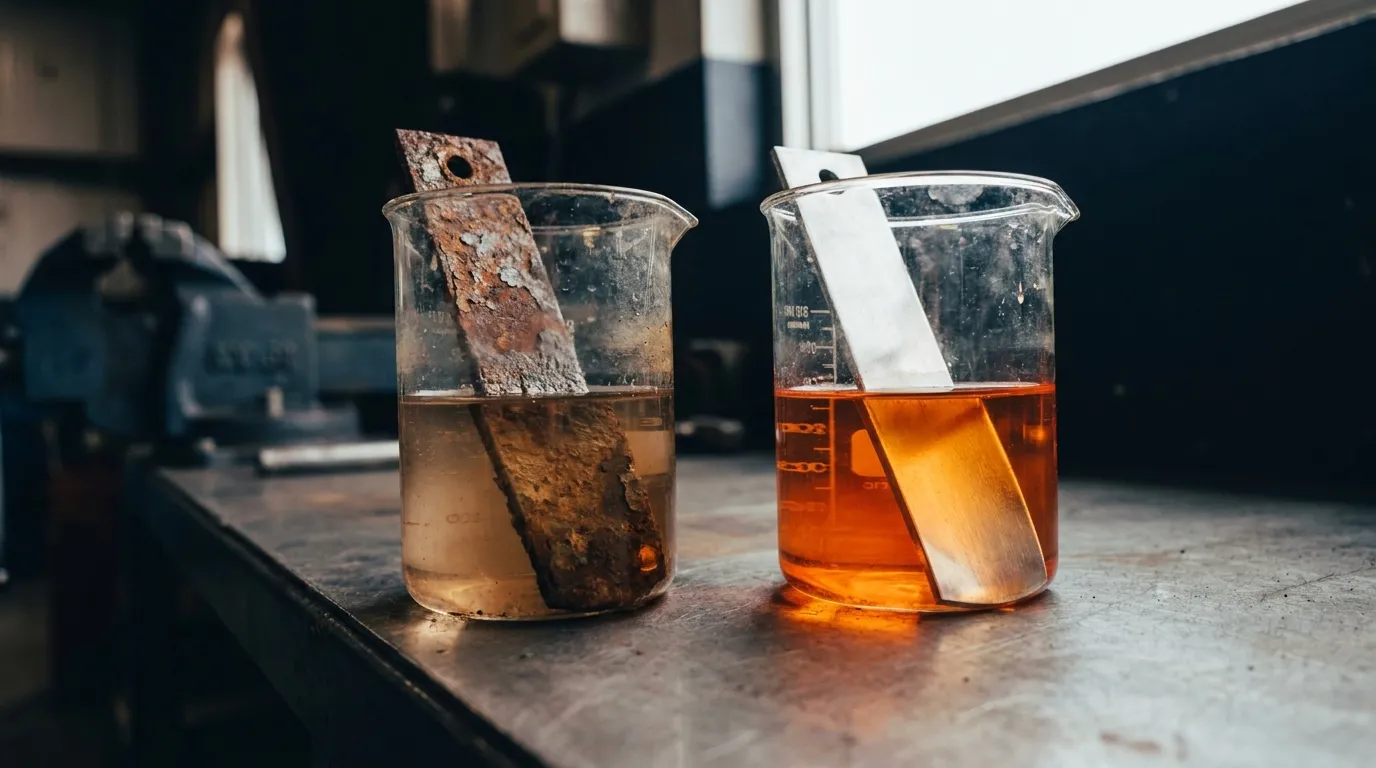
A corrosion inhibitor is a chemical or additive package that slows the corrosion of metal surfaces; a coolant is a working fluid that moves heat, and most coolants contain corrosion inhibitors as one of their additives. They are not opposites. One is an ingredient; the other is the system that carries it. So “corrosion inhibitor vs coolant” is less a head-to-head and more a part-to-whole relationship. The inhibitor protects the metal, the coolant manages temperature, and the inhibitor rides inside the coolant to keep the radiator, water pump, and engine block from rusting while the fluid does its thermal job.
Reviewed and updated July 2026 by the RawSource technical team.
This guide breaks down what each one is, how corrosion inhibitors actually work, why coolants need them, and how the IAT, OAT, and HOAT inhibitor packages differ. It is written for engineers, formulators, and purchasing teams sourcing these materials in bulk.
Part of our Corrosion Inhibitors guide — compare anodic, cathodic, VCI and organic film-forming chemistries and find the right grade for your system.
Corrosion Inhibitor vs Coolant: The Core Comparison
The fastest way to see the relationship is side by side. Notice the last row: the relationship is not “either/or,” it is “the inhibitor lives inside the coolant.”
| Attribute | Corrosion Inhibitor | Coolant |
|---|---|---|
| Primary function | Slows or stops corrosion of metal surfaces | Transfers and dissipates heat; provides freeze/boil protection |
| What it is | A single chemical or a blended additive package | A working fluid (usually water plus glycol) that is itself a formulated system |
| Where used | Cooling water, closed loops, fuels, oils, pipelines, packaging (VCI) | Engine cooling systems, HVAC chillers, industrial process loops, heat-transfer skids |
| Forms / types | Liquid concentrates, powders, tablets; anodic, cathodic, mixed, film-forming, volatile (VCI) | Pre-mixed or concentrate; IAT, OAT, HOAT chemistries; glycol- or water-based |
| Relationship | An additive: one component of the larger fluid | The system that carries the inhibitor; a complete coolant already includes one |
Read that as a hierarchy. A coolant without a corrosion-inhibitor package is just glycol and water. It will manage heat for a while, but bare iron, aluminum, copper, brass, and solder inside the loop start corroding almost immediately. The inhibitor is what turns a heat-transfer fluid into a fluid that also protects the metallurgy it touches.
How Corrosion Inhibitors Work
Corrosion is an electrochemical reaction. On a wetted metal surface, anodic sites give up electrons (the metal dissolves) and cathodic sites consume them (often reducing dissolved oxygen). An inhibitor interrupts that circuit. There are three broad mechanisms, and most real-world packages combine them.
- Passivation / anodic suppression. Oxidizing inhibitors such as nitrite and molybdate drive the metal into a passive state, building a thin, tightly bound oxide film at anodic sites. Effective at low dose, but underdose an anodic inhibitor and you can get aggressive localized pitting, which is the classic trade-off with this class.
- Film formation / cathodic and mixed action. Film-forming inhibitors like benzotriazole (for copper and its alloys) and phosphonates lay down an adsorbed molecular layer that physically blocks the corrosive species from reaching the metal. Cathodic inhibitors slow the reduction reaction instead, and are inherently safer because underdosing reduces protection rather than causing pitting.
- Oxygen scavenging. Some programs remove the corrodent itself. Oxygen scavengers consume dissolved O₂ in closed loops and boilers so the cathodic reaction has nothing to feed on.
For a deeper treatment of the chemistry and selection logic, see our reference on what corrosion inhibitors are, their types, and how they work. The table below maps the common classes to the actives most often specified.
| Inhibitor type | Example actives | Mechanism |
|---|---|---|
| Anodic | Sodium molybdate, sodium nitrite, orthophosphate | Forms a passive oxide film at anodic sites; protects best at adequate dose |
| Cathodic | Zinc salts, polyphosphates, phosphonates | Suppresses the cathodic reduction reaction; safer at low residual |
| Mixed / film-forming | Benzotriazole, tolyltriazole, phosphonates, amines | Adsorbs a protective molecular film over both anodic and cathodic sites |
| Volatile (VCI) | Volatile amine / nitrite salts | Vaporizes and condenses onto metal in enclosed spaces; used in protective packaging, not coolants |
Two notes for formulators. First, metallurgy dictates chemistry: azoles like benzotriazole and tolyltriazole are specifically for copper, brass, and bronze, while molybdate and nitrite target ferrous metals and aluminum, so a mixed-metal loop needs a blend. Second, “green corrosion inhibitor” is a legitimate technical category referring to lower-toxicity actives such as certain amino acids, plant-derived extracts, and phosphonate alternatives; it describes the chemistry and ecotoxicity profile of the active, not a blanket environmental endorsement, and any such claim should be substantiated against the relevant data for your application.
What a Coolant Is, and Why It Needs Inhibitors
A coolant is a heat-transfer fluid. In an engine it is typically a 50/50 blend of water and a glycol (ethylene glycol or propylene glycol), though industrial and electronics-cooling loops use water, glycol blends, or dielectric fluids depending on the duty. The fluid does four jobs: it absorbs and carries away heat, lowers the freezing point so the loop survives cold, raises the boiling point so it stays liquid under load, and, through its additive package, protects the metal it circulates through.
That last job is where corrosion inhibitors come in. Glycol-water mixtures are mildly corrosive on their own, and over time glycol oxidizes into acids that attack metal further. A cooling system is also a galvanic minefield: cast iron, aluminum, copper, brass, and lead-tin solder all share one electrolyte, so dissimilar-metal corrosion is a constant threat. Without inhibitors, you get rust scale that clogs the radiator and reduces heat transfer, pitting in the water pump, and eventual leaks. The inhibitor package is what makes a coolant viable for years rather than months.
IAT, OAT, and HOAT Inhibitor Packages
Modern engine coolants are classified by their corrosion-inhibitor chemistry, and the three families are not interchangeable.
- IAT (Inorganic Additive Technology). Traditional “green” coolant using inorganic inhibitors such as silicates, phosphates, and historically nitrites and borates. These deposit protective films quickly but deplete fast, which is why IAT coolants typically need replacement every 2–3 years.
- OAT (Organic Acid Technology). Uses organic acid salts (carboxylates) as inhibitors. They protect by adsorbing only at corrosion sites, so they deplete slowly. Extended-life OAT coolants are often rated for roughly 5 years or 150,000 miles. The trade-off is slower film formation and reduced silicate protection for some aluminum surfaces.
- HOAT (Hybrid Organic Acid Technology). Combines organic acids with a small inorganic component (commonly silicate) to get fast initial protection plus long service life. It is the common compromise in many OEM specifications.
The practical takeaway: never top up one technology with another without checking compatibility. Mixing OAT and silicate-heavy IAT can drop inhibitors out of solution as gel or precipitate, defeating the protection entirely. Always match the coolant chemistry to the OEM specification.
Applications: Where Each One Shows Up
Corrosion inhibitors appear far beyond the radiator. They protect pipelines, drilling equipment, and storage tanks in oil and gas; boilers, cooling towers, and distribution piping in water treatment; metalworking fluids and machinery in manufacturing; and, as VCIs, the inside of shipping containers and packaging for finished metal parts.
Coolants, by contrast, are defined by the heat-transfer job and span a wide range of industries:
- Automotive and heavy equipment: engine temperature regulation, freeze and boil protection, and corrosion control across mixed-metal cooling circuits.
- HVAC and chillers: glycol loops for heat exchange and frost protection in building systems and process cooling.
- Industrial machinery and metalworking: process cooling plus cutting/grinding fluids that cool and lubricate the tool and workpiece simultaneously.
- Data centers and electronics: liquid-cooling loops that remove heat from high-density servers and power electronics far more efficiently than air.
- Marine, renewables, and aviation: engine and gearbox cooling, heat-exchanger duty in solar-thermal and wind systems, and thermal management aboard ships and aircraft.
In every one of these, the corrosion inhibitor is the quiet component doing the protective work inside the heat-transfer fluid.
Key Differences at a Glance
- Functionality: an inhibitor prevents corrosion; a coolant manages heat and carries an inhibitor to do it cleanly.
- Composition: an inhibitor is a chemical or additive blend; a coolant is a water/glycol fluid plus that additive package.
- Application method: inhibitors are dosed into a fluid or applied to a surface; coolants are circulated through a closed loop.
- Maintenance: inhibitor residual must be monitored and replenished as it depletes; coolant must be tested and changed on a schedule because the inhibitor package, not the glycol, is what wears out first.
Sourcing Corrosion Inhibitor Raw Materials in Bulk
If you formulate coolants, treat boiler and cooling-tower water, or blend metalworking fluids, you are buying the inhibitor actives, not finished coolant. See the Sodium Molybdate product page.
We work on an RFQ basis: send the active, CAS number, grade, and quantity you need, and we return availability and pricing. New to bulk procurement of specialty chemicals? Our comprehensive guide to chemical procurement walks through specification, qualification, and supply-continuity planning so your inhibitor sourcing does not become the bottleneck in your formulation.
Frequently Asked Questions
Do rust inhibitors actually work?
Yes, when the chemistry matches the metal and the dose is maintained. AMPP projects that employing corrosion control practices would cut the global cost of corrosion by 15 to 35 percent, worth $375 to $875 billion per year. Qualification is the catch. ASTM D1384 glassware screening separates clearly harmful coolant chemistry from candidates worth further testing, and ASTM cautions that its results cannot stand alone as evidence of satisfactory corrosion inhibition. Specify against the test standard your system references, then verify inhibitor residual in service.
How long does a rust inhibitor last?
That depends on where the inhibitor is working. In heavy-duty engine coolant, ASTM D6210 requires that a fully formulated coolant, maintained with supplemental coolant additive (SCA) doses, remain suitable for at least two years of normal service. Rust preventives and VCI packaging for stored or shipped parts are rated product by product on their technical data sheets, because film thickness, enclosure, and humidity set the clock. Test inhibitor residual on a schedule rather than trusting calendar life.
What is the best coolant for corrosion protection?
The coolant qualified to the specification your equipment lists, run at the correct dilution. For automobiles and light-duty service that means ASTM D3306; for heavy-duty engines, ASTM D6210, which adds requirements for protection against cavitation corrosion (liner pitting) and hot-surface scaling. Both specifications qualify concentrates at 40 to 60 percent glycol by volume in water of suitable quality. Hold the dilution inside that window and match the OEM specification before weighing any other purchasing factor.
What is the best corrosion inhibitor?
There is no single best, only a best match for the metallurgy, pH, and temperature in the loop. Azoles protect copper and brass, nitrite and molybdate cover ferrous metals, and silicate guards aluminum, so mixed-metal systems run blends. Drinking water systems work to a different benchmark: EPA technical recommendations cite an orthophosphate residual target of 1.0 to 3.0 mg/L as PO4 at the tap, at pH 7.2 to 7.8, for lead and copper corrosion control. Inventory the metals in the system first, then set dose against a measurable residual.
Is coolant a corrosion inhibitor?
No. Coolant is not a corrosion inhibitor, but most coolants contain one. A coolant is a heat-transfer fluid, typically water and glycol, whose job is to move heat and provide freeze/boil protection. The corrosion inhibitor is one of several additives blended into that fluid to protect the metal it circulates through. The inhibitor is an ingredient; the coolant is the system.
What is the difference between a corrosion inhibitor and a coolant?
A corrosion inhibitor is a chemical or additive package that slows corrosion of metal surfaces by forming protective films or suppressing the electrochemical reaction. A coolant is a working fluid that transfers heat. They are not opposites: the inhibitor is one component, the coolant is the larger system, and a complete coolant already contains an inhibitor package to protect the cooling circuit.
What are the types of corrosion inhibitors?
The main classes are anodic (e.g. sodium molybdate, nitrite), which build a passive film; cathodic (e.g. zinc salts, polyphosphates), which slow the cathodic reaction; mixed or film-forming (e.g. benzotriazole, phosphonates), which adsorb a protective layer over both sites; and volatile inhibitors (VCIs) used in protective packaging. Metallurgy determines which active applies: azoles for copper, molybdate and nitrite for ferrous metals.
Does antifreeze prevent corrosion?
Modern antifreeze prevents corrosion because of the inhibitor package blended into it, not because of the glycol itself. Glycol and water are mildly corrosive on their own, and glycol oxidizes into acids over time. The added inhibitors (inorganic salts, organic acids, or a hybrid) protect the radiator, water pump, and engine block. When that inhibitor package depletes, the antifreeze stops protecting and must be changed.
What corrosion inhibitors are in coolant?
It depends on the coolant technology. IAT coolants use inorganic inhibitors such as silicates and phosphates. OAT coolants use organic acid salts (carboxylates) for extended life. HOAT coolants combine both. Across these, common actives include nitrite, molybdate, silicate, phosphate, carboxylic acid salts, and azoles like benzotriazole or tolyltriazole for copper and brass components.
Can I use a coolant without a corrosion inhibitor?
It is technically possible but strongly inadvisable. A coolant without inhibitors will still transfer heat, but the mixed metals in a cooling system (iron, aluminum, copper, brass, and solder) will begin corroding quickly, producing rust scale that clogs the radiator, pitting in the water pump, and eventual leaks. Always use a coolant whose inhibitor chemistry matches the equipment’s specification.
What is the difference between IAT, OAT, and HOAT coolant?
The difference is the corrosion-inhibitor chemistry. IAT uses inorganic inhibitors (silicates, phosphates) that protect fast but deplete in 2–3 years. OAT uses organic acid salts that deplete slowly, supporting extended-life intervals around 5 years. HOAT is a hybrid that adds a small inorganic component for fast initial protection plus long service life. Mixing the technologies can cause inhibitors to drop out of solution, so match the OEM spec.
How often should coolant be replaced?
Replacement interval depends on the inhibitor chemistry and the manufacturer’s schedule, because the inhibitor package depletes before the glycol does. Traditional IAT coolants are generally replaced every 2–3 years, while extended-life OAT and HOAT coolants can run roughly 5 years or about 150,000 miles. Test the fluid for inhibitor residual, pH, and contamination, and follow the equipment’s maintenance schedule.
Search 1,300+ industrial chemicals by name or CAS, or send us your spec — we quote by the drum, tote, or container.
Browse the Chemical Index → Request a Quote