
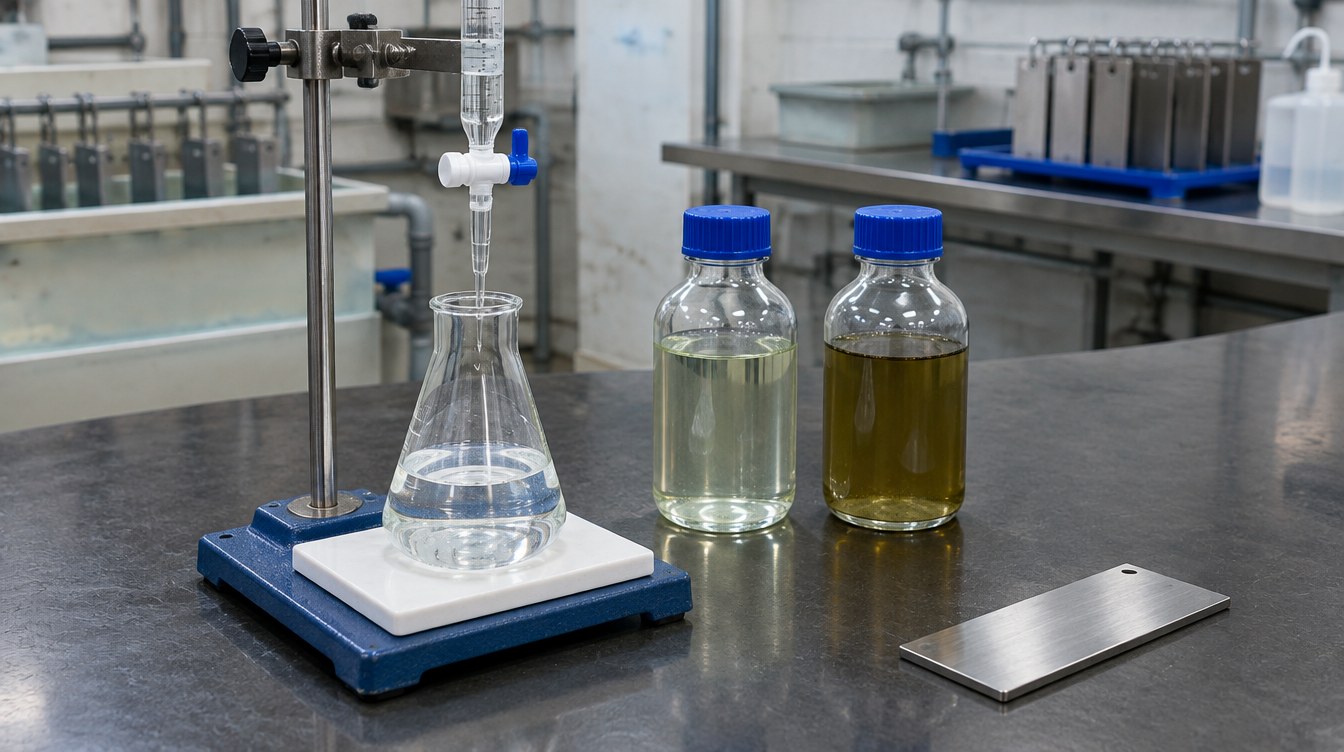
The first loads through a fresh ammonium bifluoride pickle come out clean, and a few thin parts come out dull and etched. By the third week, heat tint at the weld seams survives the dip, so the operator adds another bag. Your bath sheet says pounds of salt per tank and explains neither failure. Both trace to a number the sheet lacks: free fluoride, which moves with the lot’s assay, the water the salt took up in storage and the metal already dissolved in the tank.
What does fluoride do to stainless scale that nitric acid cannot?
Weld heat tint and annealing scale on stainless steel are oxides rich in chromium. Beneath them sits a thin layer of steel that gave up chromium to the oxide and no longer protects itself the way the bulk alloy does. Pickling has to remove both, because each lowers corrosion resistance: a tinted weld is a corrosion defect, not a cosmetic one.
Nitric acid alone passivates stainless steel; it does not dissolve chromium-rich scale at a useful rate. Fluoride does. Ammonium bifluoride (NH4HF2, CAS 1341-49-7, PubChem CID 14935) dissolves in water to form a weak solution of hydrofluoric acid (NOAA CAMEO Chemicals). That fluoride binds chromium and iron, dissolves the oxide and undercuts the scale, and the nitric acid then rebuilds the passive film on the clean metal.
The fluoride does not stop when the scale is gone. Patent US 3,419,440 (1968), written for a solid ammonium bifluoride pickling composition, described the conventional nitric plus hydrofluoric bath as aggressive enough to etch and pit the base metal along with the scale, leaving parts unfit for further treatment. That is the window a fluoride pickle runs in: enough free fluoride to clear scale and the depleted layer within the dwell time, and no more.
Does carbon-steel rust need ammonium bifluoride at all?
On plain carbon steel the case for buying it is weak, and this is the claim here most worth testing on your own line. Rust and mill scale on carbon steel are iron oxides, and hydrochloric or sulfuric acid pickling dissolves them without fluoride. Adding the salt there buys a second acid chemistry, an extra effluent parameter and a fresh attack on the base metal, for scale the mineral acid already removes.
| Substrate or deposit | Does fluoride earn its place? | Basis |
|---|---|---|
| Rust and mill scale on plain carbon steel | Weak case; hydrochloric or sulfuric acid dissolves iron oxide without it | General pickling chemistry |
| Weld heat tint and annealing scale on stainless steel | Yes; nitric acid alone does not lift chromium-rich oxide | US 3,419,440 is written for stainless steels and alloys high in chromium |
| Silica or silicate in the deposit, such as sand residue on castings | Yes; fluoride dissolves silica, which the mineral acids barely touch | HSDB records that the salt etches glass |
| Oxide on aluminum (brightening, before electroplating) | Listed use with no published dose | PubChem’s use lists name aluminum brightening and electroplating |
If a quote proposes ammonium bifluoride for a carbon-steel rust job, ask what the fluoride removes that the line’s hydrochloric or sulfuric acid leaves behind. A good answer names a silicate or an alloy. A vague one is a reason to stay with the mineral acid. For aluminum brightening or ahead of electroplating, PubChem’s use lists give no working strength, so take dose and dwell from the formulated product’s technical data sheet (TDS) and qualify them on test panels.
Write the bath in fluorine ion, then convert to salt
The 1968 patent states its bath as fluorine ion, 0.5 to 8% by weight in water or dilute nitric acid at 20 to 70 °C, not as pounds of salt per gallon. Those are published patent ranges, not a recommendation to run them. The useful part for a plant engineer is the unit: fluoride does the work, and the salt is a carrier whose fluoride content moves.
Ammonium bifluoride carries two fluorine atoms in a formula weight of 57.044 g/mol, so about two-thirds of its weight is fluorine. The patent’s Example 3 shows the conversion: 15 wt% nitric acid plus 4.59 wt% of a solid that was 98% ammonium bifluoride and 2% disodium acid phosphate gave 3 wt% fluorine ion.
Example 3 states no bath temperature; the comparative Example 1 bath ran at 50 °C. Divide your fluorine target by the salt’s fluorine fraction and by the lot’s assay, and you have the addition. Three things change the fluoride a pound of salt delivers, and none of them shows on a bath sheet written in pounds:
- Assay. A lot below full purity delivers less fluoride per pound than pure salt. The assay on each lot’s certificate of analysis (CoA) is the multiplier, so record it beside every make-up addition.
- Blends. A phosphate or other co-additive lowers the fluoride per pound, so normalize quotes per pound of fluorine, then ask what the co-additive earns: the 1968 patent credits its acid phosphate with a protective film that completes nitric-acid passivation, and with less fuming during dipping.
- Moisture. The salt is hygroscopic above 50% relative humidity and deliquescent (HSDB). A bag left open beside a heated pickle tank takes up water, so a weighed addition carries less salt than the scale reads. Reseal partial bags and buy lot sizes the line uses before they cake.
How does a fluoride pickle drift between make-ups?
A fresh bath has all of its fluoride free and no dissolved metal to bind it, so its first loads see the full strength. Put a coupon or a scrap part of the same alloy through before production parts, and watch thin sections and parts that arrived with little scale.
As the bath works, dissolved iron and chromium bind fluoride as metal-fluoride complexes; nickel binds it far more weakly. The fluoride is still in the tank, but less of it can attack scale, and heat tint starts to survive the dip. Adding salt on appearance alone works until the bath is dumped and remade at the higher addition, and then the fresh tank overetches.
So measure. A fluoride pickle runs on free fluoride, dissolved metal and, where the bath carries it, nitric acid strength. Agree with your lab whether a reported fluoride figure is free or total, because metal-bound fluoride counts in one and not in the other.
Two tools mislead. In a nitric bath the nitric acid sets the pH, so a pH reading cannot tell you fluoride strength. In a water-only bath pH says little either: a 5% solution of the salt measures pH 3.5 (HSDB), but dissolving oxide spends acid and fluoride together, so the reading does not track the fluoride left to do the work. And HSDB records that the salt etches glass, so a glass-bodied electrode or sight glass left in the tank is a consumable.
Rinse water, effluent and the listings that come with the salt
PubChem’s HSDB analytical methods list two methods for fluoride in water. The ion-selective electrode method covers 0.1 to more than 10 milligrams per liter and was checked across 111 laboratories. The SPADNS colorimetric method covers 0.05 to 1.4 milligrams per liter, was checked across 53 laboratories, and lost precision after distillation.
Both report total fluoride, which counts metal-bound fluoride along with the free. They suit rinse water and treated effluent checks; bath control needs a free-fluoride method and a heavily diluted sample, so agree both with the lab.
The salt also brings ammonium into the bath and the rinse. If your discharge permit limits ammonia, a nitric acid plus ammonium bifluoride pickle loads three parameters at once: fluoride, nitrate and ammonia.
Two of the federal listings that attach to the salt bear directly on discharge and spills. The eCFR text of 40 CFR 116.4, Table 116.4A, as published in 2026, designates ammonium bifluoride a hazardous substance under section 311(b)(2)(A) of the Clean Water Act, and states that the designation includes its solutions and mixtures. Reading that to cover a spent bath is an interpretation, not legal advice; confirm it with environmental counsel.
PubChem’s regulatory section, citing HSDB (2006), gives a CERCLA reportable quantity of 100 lb under 40 CFR 302.4: a release of 100 lb or more must be reported to the National Response Center immediately. Check the current eCFR table before writing it into a spill plan.
With moisture present the salt attacks glass, cement and most metals (HSDB). Bunds, sumps and floors around the line need a fluoride-resistant lining in place of bare concrete, and every wetted material in tanks, racks and pumps needs a compatibility check before the first fill. Take hazard statements, protective equipment and first aid from the current Safety Data Sheet (SDS).
What goes on the order and the bath sheet
-
The order: assay on each lot’s CoA, tied to the lot number; straight salt or a blend, and a blend’s fluoride content and what its co-additive does.
-
The bath sheet: the target as fluorine ion, the conversion for the current lot, and measured free fluoride and dissolved metal at each make-up.
-
The lab method: a free-fluoride method for bath samples, the total-fluoride test for rinse water, and the dilution.
-
The spill plan: the current SDS, the CERCLA reportable quantity and lined secondary containment.
Methodology: properties, reactivity, use lists, analytical methods and the CERCLA entry come from PubChem’s ammonium bifluoride record (CID 14935, with its HSDB entries) and NOAA CAMEO Chemicals; the EC number 215-676-4 from the ECHA substance record. Bath compositions and the co-additive’s role come from US 3,419,440 (1968); the Clean Water Act listing is the eCFR text of 40 CFR 116.4 as of 2026.
Frequently asked questions
How much ammonium bifluoride goes into a stainless pickling bath?
Can ammonium bifluoride replace hydrofluoric acid in a nitric acid pickle?
Why does a freshly made bath etch parts that last week’s bath cleaned?
Can carbon-steel parts share a stainless fluoride pickle?
Sources & methodology
Figures are RawSource sourcing data unless attributed to a named source. Regulatory citations are current as of publication. Chemical identities verified by CAS number against the RawSource catalog.
Search 1,300+ industrial chemicals by name or CAS, or send us your spec — we quote by the drum, tote, or container.
Browse the Chemical Index → Request a Quote