
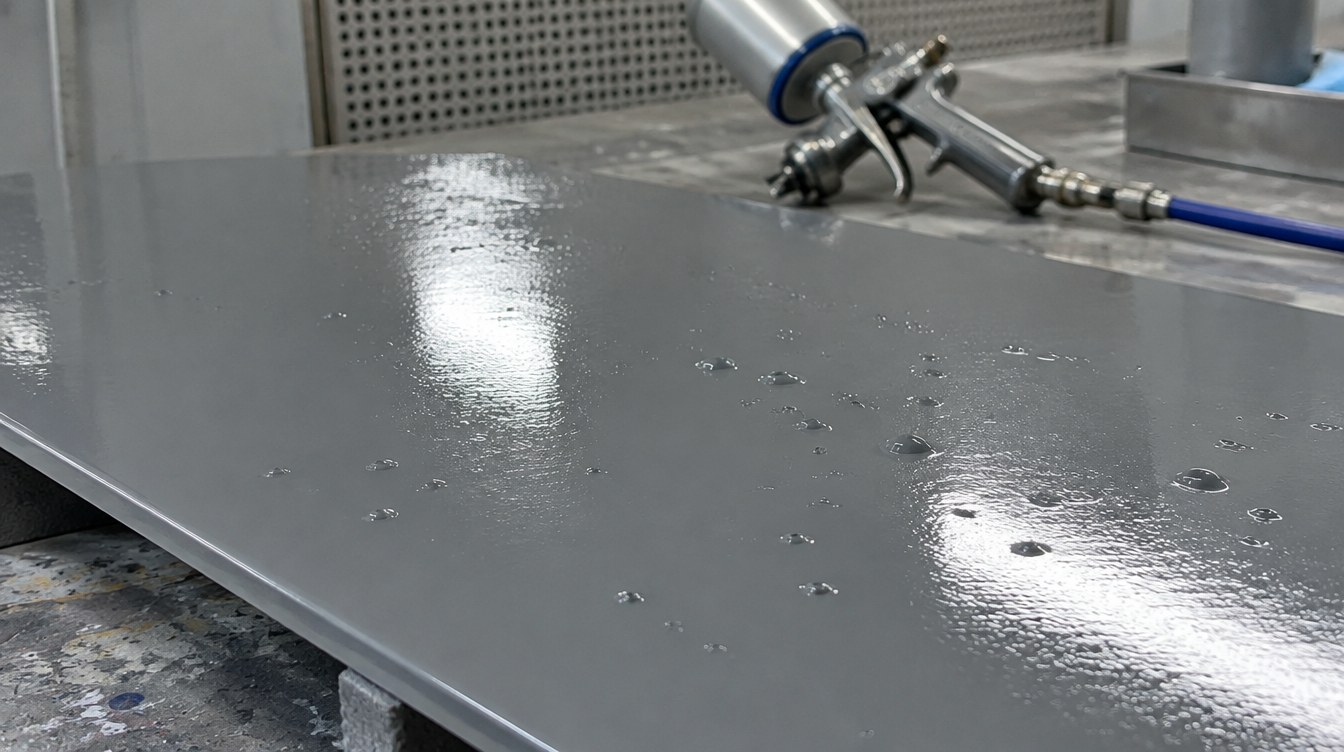
Your coatings plant asks purchasing for an organic defoamer, because the last silicone one left craters in the paint. Two quotes come back. One is sold as an organic silicon defoamer; the other is a mineral-oil type at a lower drum price. The first is a silicone under another name. The second may still carry silica that was made water-repellent with a silicone, so silicone-free is not settled either. Neither label answers the question the plant asked, and that question decides the choice before price does.
Silicone-based defoamers and organic defoamers break foam by similar physics, and in many water-based foams silicone does it at a lower dose. The deciding question is where the defoamer is allowed to end up: a paint film, a plated part, a crop, a food line or a discharge. Settle that in the specification first, then compare price on equal active.
Is an organic silicone defoamer a silicone or an organic defoamer?
It is a silicone. The active in a silicone defoamer is polydimethylsiloxane (PDMS), with the repeat unit (C2H6OSi)n: a backbone of alternating silicon and oxygen atoms, with two methyl groups on each silicon. Those methyl groups are carbon, so chemists class silicones as organosilicon compounds, and in that strict sense a silicone is organic. Trade usage draws the line elsewhere. On defoamer data sheets and price lists, “organic” means non-silicone.
The usual Chinese term for silicones translates literally as “organic silicon”, so supplier literature written in or translated from Chinese often calls a silicone defoamer an organic silicon defoamer or an organic silicone defoamer. Read either phrase as silicone. “Silicon-based” and “silicone-based” mean the same thing on a quote as well: silicon is the element, silicone the polymer. The catalog synonyms for silicone antifoam emulsion show the plain naming: PDMS antifoam, silicone defoamer and polydimethylsiloxane antifoam, all under CAS 63148-62-9.
The non-silicone side covers four chemistries that behave differently: mineral oil, fatty alcohol, polyether, and ester or vegetable oil. Calling all four “organic” hides differences in heat tolerance, biodegradability and silicone content that can matter as much as the silicone question itself.
How do silicone-based defoamers compare with organic defoamers?
Both families work the same broad way. An oil that does not dissolve in the foaming liquid, often carrying water-repellent particles, enters a bubble wall, spreads or bridges across it, and the wall breaks. The stages of that process, and why hydrophobic silica speeds it up, are set out in how silicone antifoam works. The differences between the families sit in the oil.
Three properties of silicone antifoams decide the comparison. PDMS has a lower surface tension than the hydrocarbon and fatty oils in organic defoamers, so it spreads over a wider range of foaming liquids and, in many water-based systems, works at a lower dose. The polymer holds its properties over a wider temperature range than many organic oils. And it stays silicone wherever it goes, so silicone that leaves the foaming zone can turn up on a paint film, a metal part or a membrane.
Polyether defoamers bring a property plain PDMS lacks: inverse solubility. A polyglycol or ethylene oxide/propylene oxide block copolymer grade that dissolves in cold water comes out of solution above its cloud point, which is where it acts as a defoamer. A grade with its cloud point below your process temperature defoams in the hot zone and dissolves again as the liquid cools, instead of leaving oil droplets behind. Ask for the cloud point and check it against your process temperature.
Silicone polyether copolymers share it, so a silicone grade built on a silicone polyether has a cloud point too.
| Family | What the active is | What it brings | What to put on the RFQ |
|---|---|---|---|
| Silicone (PDMS) | Polydimethylsiloxane, (C2H6OSi)n, often with hydrophobic silica; the emulsion is cataloged from 10% to 50% active | Low dose and persistence in many water-based foams; a wide temperature range | Percent active with its basis; the surfaces downstream that must stay silicone-free |
| Mineral oil | Petroleum hydrocarbon oil, often carrying hydrophobic particles | A non-silicone base oil | A silicone-free statement that covers the particles, not only the oil |
| Fatty alcohol | Long-chain alcohols, often supplied as a water emulsion | A non-silicone active | Emulsion stability limits against your process temperature |
| Polyether | Polyglycols and ethylene oxide/propylene oxide block copolymers | Defoams above its cloud point and redissolves below it | The cloud point, checked against your process temperature |
| Ester or vegetable oil | Fatty acid esters and plant oils | A non-silicone active, often from renewable fats and oils | The biodegradation test result on the product itself |
Organic does not mean biodegradable. The organic family runs from petroleum-derived mineral oil to plant oils, and biodegradability varies across it, polyethers included. PDMS is not readily biodegradable. Where a discharge permit or a customer specification asks for biodegradable additives, ask for the biodegradation test result on the product you are buying, not the family name.
Silicone foam control for crops: which defoamer belongs in the spray tank?
Foam control in a crop spray starts with where the foam forms. Crop protection formulations and spray adjuvants carry surfactants, and the fill pump, tank agitation and return flow whip them into foam. Foam hides the liquid level, so the tank gets filled by guesswork, foam spills from the fill hatch, and the pump draws air.
In agriculture, a silicone antifoam goes in at one of two points. A formulator can build foam control into the concentrate, to handle foam during manufacture and when the product is diluted. The applicator adds a tank-mix antifoam when a mix still foams. An emulsion is the form built to disperse in tank water, and antifoam already in the water before the foaming products go in stops foam from forming, which is easier than collapsing a head of foam at the hatch.
The crop sector has its own naming trap. Organosilicone surfactants, such as trisiloxane ethoxylates, are sold as spreader and penetrant adjuvants. They are silicones, they lower the surface tension of the spray so droplets spread across the leaf, and they can add to the foam in the tank. A silicone antifoam is also a silicone, with the opposite job. An order for an organic silicone for a spray program can bring either one, so name the function, antifoam or spreader adjuvant, on the order.
In agriculture, “organic” has a third meaning: certified organic production. A non-silicone defoamer is not approved for organic farming because of its family name. Check the certifier’s list of permitted inputs for the specific product. Dose depends on the tank mix, so set it by test: jar-test the full mix in its order of addition, with the antifoam at the rate you plan to use, and follow the crop protection product’s label on what may be mixed with it.
Where does the price comparison go wrong?
A drum price compares nothing until active content and dose sit on the same basis. Silicone antifoam emulsion (10-50% active) is cataloged at 10%, 20%, 30%, 40% and 50% active silicone, as a Technical Grade, so kilogram for kilogram a 50% active grade carries five times the silicone of a 10% active one. Divide each quote by its active content to get a price per kilogram of active, and ask which basis the percent active uses: silicone alone, silicone plus silica, or nonvolatile solids.
Organic defoamers sold as emulsions or blends need the same arithmetic. Then compare candidates at equal foam control in your own liquor, because the family that works at a lower dose can win on cost even at a higher price per kilogram.
Finally, price what happens downstream. A silicone that leaves craters on a paint line, or a defoamer that pushes a discharge out of its permit, costs more than the drum it came in. That cost belongs in the comparison before the cheaper quote wins.
What should the RFQ say?
-
The function: foam control, and for a spray program, that you want an antifoam and not a spreader adjuvant.
-
The silicone decision: “silicone permitted”, or “silicone-free, including any treated particles, carriers and emulsifiers”.
-
Percent active with its basis and test method, so you can price per kilogram of active.
-
Your process temperature, and for a polyether grade, its cloud point.
-
For food lines, the grade’s food-use documentation and a CoA tied to the lot; for organic farming, the certifier’s listing.
-
The biodegradation test result on the product, if it reaches a discharge or soil.
-
A trial in your own liquor at equal active, recording how fast the foam falls and how long it stays down.
Methodology: identity data (CAS Registry Number 63148-62-9, the (C2H6OSi)n repeat unit, the catalog synonyms, the 10% to 50% active range, the listed uses and the Technical Grade designation) come from the product catalog record. The comparison of defoamer families is general surface and polymer chemistry, stated without figures because no test data on specific products were used.
Frequently asked questions
What materials go into a silicone antifoam?
Are silicone antifoams heat stable?
Can silicone antifoams be used in food applications?
Do silicone antifoams suit wastewater treatment?
Which defoamer suits foam control in cleaning products?
Sources & methodology
Figures are RawSource sourcing data unless attributed to a named source. Regulatory citations are current as of publication. Chemical identities verified by CAS number against the RawSource catalog.
Search 1,300+ industrial chemicals by name or CAS, or send us your spec — we quote by the drum, tote, or container.
Browse the Chemical Index → Request a Quote